We are refreshing our website to serve you better. Some sections may be under construction.
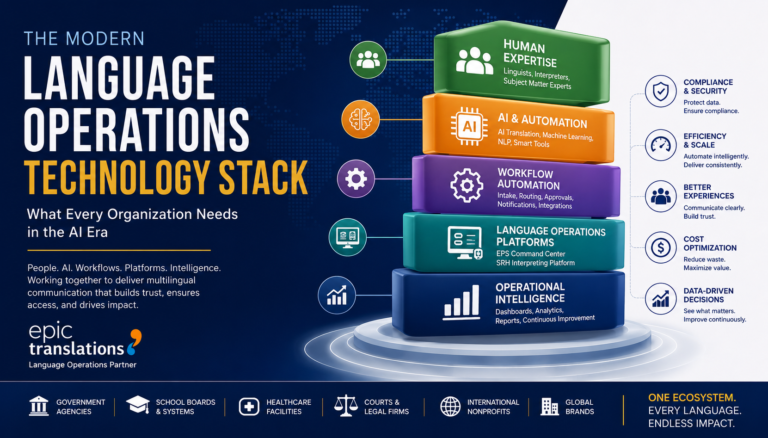
The Modern Language Operations Technology Stack showing human expertise, AI, workflow automation, EPS, SRH, and operational intelligence working together.

The Modern Language Operations Technology Stack: What Every Organization Needs in the AI Era

Executive Summary Language services are entering a new era. For decades, organizations purchased translation, interpreting, localization, and accessibility services as separate transactions. Professional translators A department emailed a document for translation. A school requested an interpreter. A hospital called an over-the-phone interpreting provider. A court engaged a separate American Sign Language vendor. Reporting, approvals, terminology, […]

The Modern Language Operations Technology Stack: What Every Organization Needs in the AI Era Read More »

Business leaders collaborating with a language operations partner to improve multilingual communication, language access, and translation services.

Why Organizations Are Replacing Traditional Translation Vendors With Language Operations Partners

Organizations today face a multilingual communication environment that is significantly more complex than it was even five years ago. Government agencies serve increasingly diverse populations while navigating federal and state language access requirements. Healthcare systems must provide equitable communication access across the patient journey. Universities support international students, multilingual communities, accessibility programs, research initiatives, and

Why Organizations Are Replacing Traditional Translation Vendors With Language Operations Partners Read More »

ASL interpreter using American Sign Language hand gestures during professional interpreting session

Building Stronger ASL Access for Government Agencies Starts with Stronger Interpreter Partnerships

Government ASL interpreting services are not simply a scheduling task. They are a critical part of public access, ADA compliance, community trust, and the ability of Deaf and hard-of-hearing individuals to participate meaningfully in public services. The ADA’s effective communication guidance explains that communication methods should be appropriate to the nature, length, complexity, and context

Building Stronger ASL Access for Government Agencies Starts with Stronger Interpreter Partnerships Read More »

Technical translation services for multilingual product documentation and compliance materials

Translation Errors That Lead to Product Liability Lawsuits | Global Compliance Guide for Manufacturers

Introduction Technical translation services for manufacturers play a critical role in reducing product liability, compliance, and safety risks across multilingual product documentation. For companies operating across international markets, multilingual communication is no longer simply a customer service consideration. It directly impacts product safety, regulatory compliance, operational continuity, and liability exposure. Incorrectly translated warnings, inconsistent technical

Translation Errors That Lead to Product Liability Lawsuits | Global Compliance Guide for Manufacturers Read More »

government language access compliance assessment for public agencies

Government Language Access Compliance Assessment: Essential Checklist for Audit-Ready Agencies (2026–2028)

Government language access compliance is no longer optional for public agencies—it is a regulatory requirement tied directly to Title VI, ADA, and Section 504. This government language access compliance assessment is designed to help agencies identify gaps, reduce risk, and build a scalable, audit-ready strategy. EPIC Translations supports government agencies nationwide with 25,000+ linguists across

Government Language Access Compliance Assessment: Essential Checklist for Audit-Ready Agencies (2026–2028) Read More »

2026 government translation services trends visualization with global map, data charts, and multilingual communication analytics

Top 2026 Translation & Interpretation Trends for Government Agencies | Government Translation Services Guide

Government agencies in 2026 are facing a convergence of pressures that make language access no longer a support function—but a core operational and compliance priority. Across federal, state, and local levels, agencies are serving increasingly diverse communities with growing Limited English Proficient (LEP) populations, while expectations around accessibility, equity, and responsiveness continue to rise. At

Top 2026 Translation & Interpretation Trends for Government Agencies | Government Translation Services Guide Read More »

U.S. Capitol building symbolizing government translation services and language access compliance in the United States

Government Translation Services for Title VI Compliance: A 2026 Guide for Agencies

Introduction Government agencies rely on government translation services to ensure compliance with Title VI and provide meaningful access to individuals with limited English proficiency (LEP). From critical public safety information to essential documents and community outreach, accurate translation and interpretation are not optional—they are fundamental to equitable service delivery. As linguistic diversity continues to grow

Government Translation Services for Title VI Compliance: A 2026 Guide for Agencies Read More »

export translation services

Global Export Opportunities in 2026: How U.S. Companies Can Adapt to a Changing Geopolitical Landscape

Global trade is being reshaped by geopolitical tensions, shifting supply chains, and new regulatory frameworks. For U.S. companies exporting products internationally, success increasingly depends on one critical factor: accurate export translation services for regulatory documentation, product manuals, and global market entry. From product manuals to regulatory documentation, exporters must ensure that technical information is translated

Global Export Opportunities in 2026: How U.S. Companies Can Adapt to a Changing Geopolitical Landscape Read More »

Business professional reviewing international trade documents and growth reports related to certificate of origin requirements for export compliance.

Certificate of Origin Requirements: Avoid Costly Export Delays in 2026

A missing or incorrectly translated certificate of origin can delay shipments, trigger tariff reassessments, or result in costly customs holds.For U.S. companies exporting goods internationally, the certificate of origin is more than a standard shipping document — it is a legally recognized declaration that determines tariffs, trade eligibility, and customs clearance. Understanding the certificate of

Certificate of Origin Requirements: Avoid Costly Export Delays in 2026 Read More »

Regulatory document translation services supporting compliance review, regulatory approval, and audit-ready documentation

Global Regulatory Translation in 2026 and Beyond: Why the EU and Middle East Demand Precision

For U.S. companies expanding internationally, regulatory compliance is no longer just a legal checkbox — it’s a geopolitical reality. As global trade patterns shift and regulatory enforcement intensifies, regulatory translation services are becoming a critical compliance function for U.S. companies expanding into the European Union and the Middle East. Each market offers strong growth potential.

Global Regulatory Translation in 2026 and Beyond: Why the EU and Middle East Demand Precision Read More »

Business professionals reviewing regulatory documents to identify translation errors that can delay global market entry

Regulatory Translation Errors That Delay Global Market Entry (And How to Avoid Them)

More often, it’s delayed—or stopped entirely—by regulatory translation errors. For companies operating in regulated industries, translation is not a branding exercise. It is a compliance function. A single mistranslated term, formatting inconsistency, or missing language requirement can trigger rejected submissions, relabeling mandates, legal exposure, or months of lost revenue. Understanding where regulatory translation fails—and how

Regulatory Translation Errors That Delay Global Market Entry (And How to Avoid Them) Read More »

Checklist used to review export-ready content and localization requirements for international markets

Export-Ready Content: The Localization Checklist U.S. Companies Miss

When U.S. companies prepare to enter new international markets, the focus is often on sales strategy, logistics, and regulatory approvals. What’s frequently overlooked is whether their content is truly export-ready. This checklist is designed to help U.S. companies understand how export document translation services support compliance, accuracy, and global market readiness. Websites, product documentation, contracts,

Export-Ready Content: The Localization Checklist U.S. Companies Miss Read More »

Why Global Manufacturers Need Technical Translation Services to Prevent Costly Errors and Compliance Failures

If your company exports any technical product, a mistranslated manual is now one of the fastest ways to lose millions — or get blocked from markets entirely. U.S. manufacturers, engineering firms, medical device companies, software developers, and automotive suppliers are facing an increasingly strict global regulatory environment. As governments tighten product liability laws and courts

Why Global Manufacturers Need Technical Translation Services to Prevent Costly Errors and Compliance Failures Read More »

Certified documents prepared for global use, representing professional translation and compliance requirements

Strategic Role of Certified Translation Services in Your Export Strategy

Developing an export strategy requires precision, not just in logistics and pricing, but in communication. At EPIC Translations, our certified translation services don’t just translate – they empower global brands to expand confidently, protect their reputation, and accelerate export growth. For companies crafting their document translation for export strategy, translation isn’t an afterthought, it’s a

Strategic Role of Certified Translation Services in Your Export Strategy Read More »

Artificial intelligence interpreting technology visualizing real-time language processing and data-driven communication

Why AI Interpreting Tools Can’t Replace Qualified Interpreters

Introduction In recent years, AI-powered interpretation tools have made headlines — including the release of features like Apple’s Live Translation in its AirPods. But when it comes to government contracts requiring a qualified interpreter, especially under strict language access compliance obligations (federal, state, or county), the human element remains essential. This blog explores what research

Why AI Interpreting Tools Can’t Replace Qualified Interpreters Read More »