Language Access Is Responsible Government: Serving Communities When Budgets Are Tight
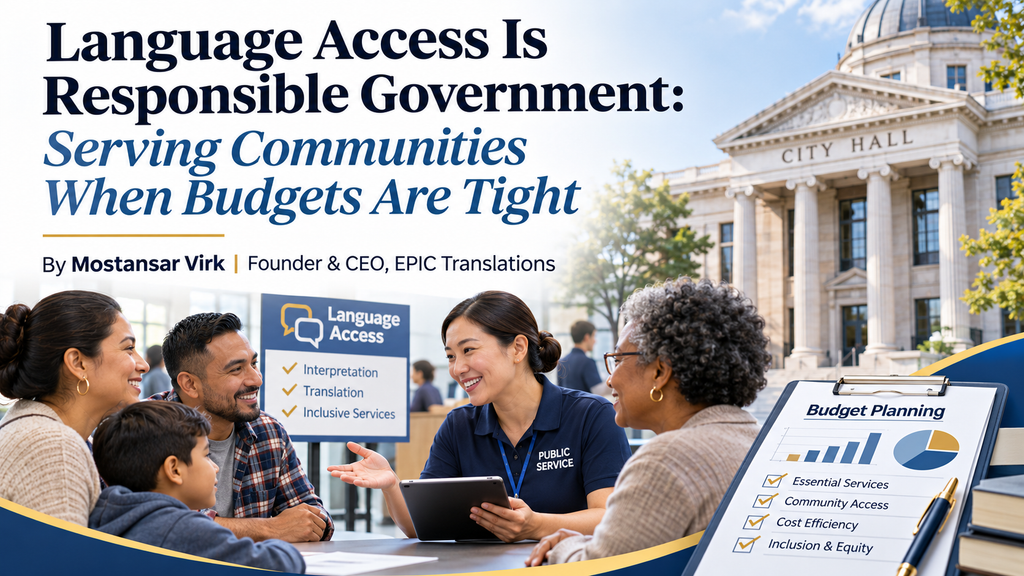
Language Access Is Responsible Government: Serving Communities When Budgets Are Tight
By Mostansar Virk | Founder & CEO, EPIC Translations
An immigrant entrepreneur’s perspective on language access, public accountability, and five practical strategies for state and local government budget planning in 2027.
My Journey: From Language Assistance to Leadership
I arrived in the United States in 1985, when I was 11 years old.
My family settled in Southwest Detroit, where I began attending Burton International School. Like many children arriving in a new country, I faced an unfamiliar educational environment, a new culture, and a language I was still learning.
During my first year, I spent approximately three hours each school day receiving bilingual instruction. My older brother sometimes helped translate for me. My teachers were respectful of my cultural background and made a sincere effort to ensure I received the assistance I needed.
Those experiences have stayed with me for more than four decades.
Within two to three years, I was speaking English fluently, reading newspapers and magazines, participating in school activities, and developing ambitions for my future.
I went on to attend Southwestern High School in Detroit and later earned my undergraduate degree from Wayne State University, also in Detroit. After completing my education, I pursued a career in information technology before becoming involved in the language-services industry. In 2005, I began managing EPIC Translations, eventually transitioning to full-time leadership in 2008.
Today, I lead a company that provides professional translation and interpreting services to government agencies, educational institutions, healthcare organizations, and businesses.
Looking back, I have often thought about those three hours of bilingual instruction.
To the school system, they represented an allocation of educational resources.
To me, they represented an opportunity.
I cannot measure precisely how much that early assistance contributed to my later accomplishments. My family, teachers, personal determination, and the opportunities available to me all played important roles.
But I know that language support helped me participate in my education while I learned English.
That experience shaped a conviction I still hold:
Language assistance is not merely an expense. When provided appropriately, it can be an investment in people’s ability to participate, contribute, and succeed.

Mostansar Virk, Founder & CEO of EPIC Translations, immigrated to the United States at age 11 and grew up in Southwest Detroit. He has worked in professional language services since 2005.
Why 2027 Requires Thoughtful Language Access Budget Planning
Across the United States, state and local government administrators face difficult decisions about how to allocate public resources.
Public health departments must serve patients and families. Courts must administer justice. Schools must communicate with parents. Housing agencies must explain eligibility and services. Local governments must provide information about emergencies, public meetings, permits, and community programs.
These responsibilities do not disappear when a resident has limited English proficiency.
At the same time, public agencies operate within real financial constraints.
Staffing costs change. Demand fluctuates. Procurement requirements can be complex. Departments compete for available funding. Administrators must demonstrate that taxpayer resources are being managed responsibly.
Federal language policy has also evolved.
Executive Order 14224, issued in March 2025, designated English as the official language of the United States and revoked an earlier executive order addressing language access. Subsequent federal guidance has addressed how federal agencies should implement that policy while recognizing circumstances in which other language services may be legally required or necessary to accomplish an agency’s mission.
These federal developments do not create a single, uniform rule for every state, municipality, or publicly funded program. Agencies must examine applicable federal statutes and regulations, state and local requirements, funding conditions, and the services they administer.
For public administrators, effective language access budget planning begins with understanding community needs, legal responsibilities, and available financial resources.
It is this:
How can government agencies maintain appropriate language access while planning expenditures carefully, evaluating service demand, and remaining accountable to the public?
That is the challenge I believe government leaders should approach with both compassion and financial discipline.
Language Access and Fiscal Responsibility Are Not Opposing Goals
My father taught me an important lesson about managing limited resources long before I became a business owner.
When he came to the United States in 1981, he left behind a family tradition of custom jewelry making in Pakistan.
In America, he worked a variety of jobs, including parking lot attendant and hotel dishwasher. He saved consistently, spending substantially less than he earned.
After several years, when he visited his bank to withdraw money for a return trip to Pakistan to bring the rest of our family to America, the bank manager was surprised by the amount he had accumulated.
By 1988, my father and older brothers had saved enough for our family to purchase a home in Southwest Detroit and begin establishing a more financially secure life.
I think about his discipline when I consider public budgeting.
Responsible spending does not mean refusing every expenditure.
It means understanding priorities, avoiding waste, and recognizing that some investments create benefits extending far beyond their initial cost.
Public language services deserve that kind of evaluation.
An interpreter helping a resident understand an essential appointment is not interchangeable with an unnecessary administrative expense.
But neither should a government agency automatically approve inefficient scheduling, unnecessary emergency premiums, duplicated purchases, or poorly monitored vendor charges.
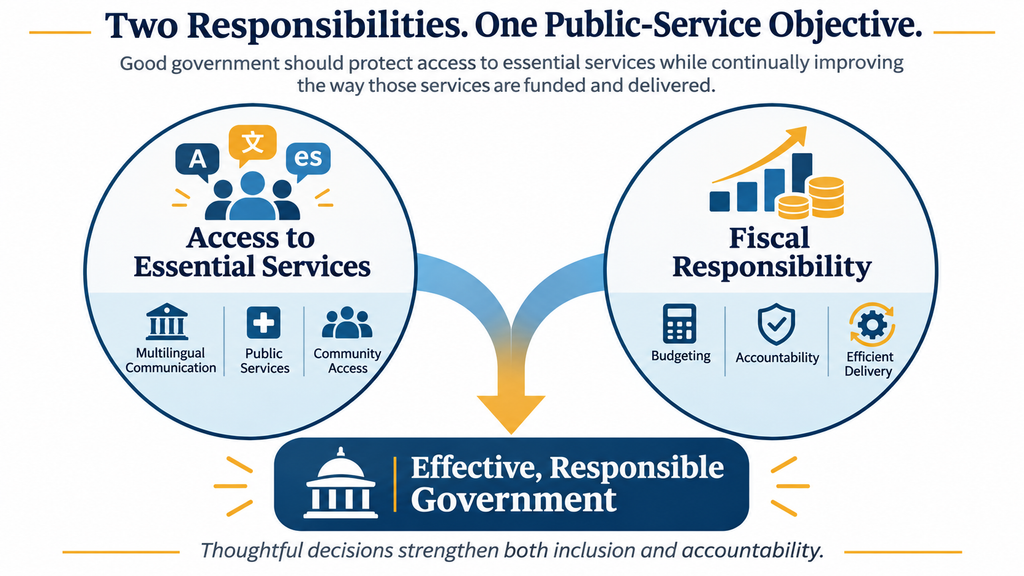
Good government should protect access to essential services while continually improving the way those services are funded and delivered.
That requires thoughtful decisions rather than choosing between inclusion and fiscal responsibility.
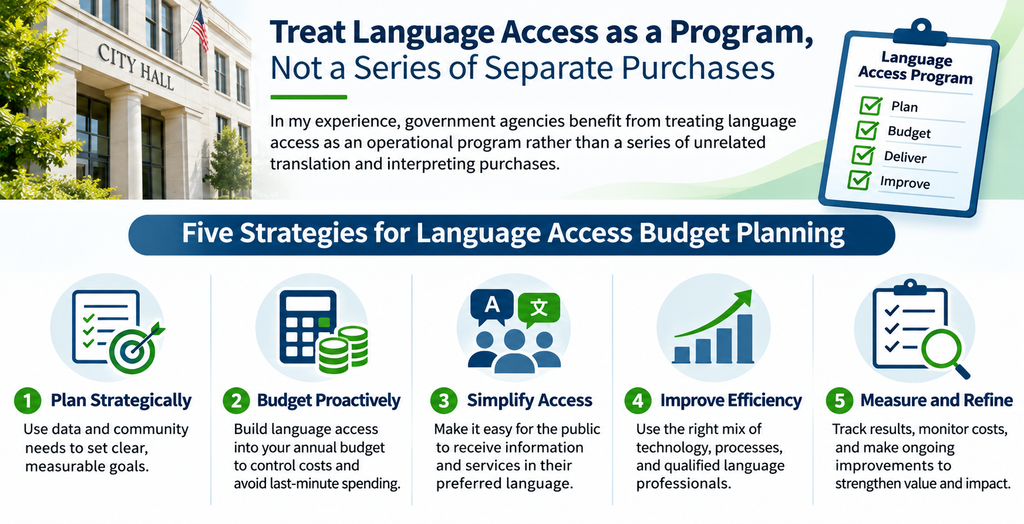
Five Practical Strategies for Government Language Access Budget Planning in 2027
In my experience, government agencies benefit from treating language access as an operational program rather than a series of unrelated translation and interpreting purchases.
The following five strategies provide a practical framework for language access budget planning, helping government agencies balance service delivery, financial accountability, and operational efficiency.
A Five-Step Framework for 2027 Language Access Planning.
Assess Demand → Match Service Methods → Coordinate Procurement → Forecast Costs → Measure Results.
1. Build Your Budget Around Actual Language-Service Demand
A budget is only as useful as the information supporting it.
Government agencies should begin by reviewing available historical utilization data.
Consider the number of interpreting appointments, language pairs requested, telephone interpreting minutes, video interpreting sessions, on-site assignments, and translated-document volumes.
Where possible, separate the information by department and program.
A public health department, for example, may experience recurring language needs very different from those of a municipal planning department.
A court system may require particular interpreter qualifications and scheduling procedures that are inappropriate for general administrative encounters.
Agencies should also consider future factors that could affect demand, including new programs, community demographics, changes in service delivery, and historical seasonal patterns.
The U.S. Census Bureau’s American Community Survey provides language-spoken-at-home and English-proficiency data that can help inform community assessments. Those figures should be supplemented with actual agency utilization rather than treated as exact forecasts of service demand.
A practical budget should answer:
- Which departments use language services most frequently?
- Which languages account for the greatest demand?
- What portion of requests is scheduled versus urgent?
- How much of the cost is driven by service volume, minimum charges, travel, or specialized requirements?
- Where are actual expenditures exceeding assumptions?
A reliable baseline gives administrators a more defensible starting point for 2027.
2. Choose the Right Language-Service Method for Each Situation
Not every interpreting encounter requires the same delivery model.
Government agencies may use over-the-phone interpreting (OPI), video remote interpreting (VRI), on-site interpreting, or specialized services such as American Sign Language interpreting.
The appropriate method depends on the circumstances.
Telephone interpreting can be useful for certain routine interactions and short conversations.
Video interpreting may be appropriate when visual communication adds value and the available technology supports effective participation.
On-site interpreting may be preferable—or necessary—for certain complex, sensitive, lengthy, or legally significant encounters.
ASL interpreting also requires attention to communication needs, interpreter qualifications, accessibility requirements, and whether the particular setting is suitable for remote delivery.
The lowest-cost method is not necessarily the correct method.
For example, replacing an appropriate on-site interpreter with telephone interpreting solely to reduce cost could create operational difficulties or interfere with effective communication.
Conversely, routinely arranging on-site appointments for encounters that can be handled effectively by other approved methods may create avoidable expenses.
The objective is to match service delivery to actual communication requirements, not to select one modality for every situation.
This is an area where clear agency procedures and qualified language-services partners can help administrators make consistent decisions.
3. Reduce Administrative Fragmentation Across Departments
One of the challenges I have observed in language-service operations is that different departments may arrange services independently.
A housing department may maintain its own process for requesting translations. A public health program may use another system for scheduling interpreters. A municipal office may rely on email exchanges to identify available linguists.
These arrangements may be appropriate individually, but fragmented operations can make overall spending and service utilization more difficult to understand.
Where procurement rules permit, agencies can evaluate opportunities for coordinated contract administration, shared vendor information, standardized requests, and consolidated reporting.
A coordinated system does not mean every department must use identical procedures.
Rather, it means establishing common administrative practices where they improve oversight without compromising department-specific requirements.
Useful questions include:
- Can authorized users submit requests through a consistent process?
- Can agencies identify recurring appointments and preferred interpreters?
- Are minimum charges, cancellations, and travel expenses clearly documented?
- Can finance personnel obtain reports by department, language, and service type?
- Are contract rates and purchasing authorizations applied consistently?
Better coordination can reduce administrative confusion and improve the information available for budget planning.
4. Forecast Multiple Scenarios Instead of Relying on One Number
Government budgets must accommodate uncertainty.
A department may expect relatively stable interpreting demand but experience a sudden increase in requests associated with an emergency, new program, or changing population needs.
That is why I recommend preparing at least three budget scenarios.
Baseline scenario: Expected demand based on historical service utilization and known program requirements.
Higher-demand scenario: Additional service volumes associated with increased demand, urgent requests, or changes in program delivery.
Constrained-budget scenario: A planning exercise that identifies scheduling efficiencies, procurement improvements, and administrative cost controls while preserving required and appropriate language assistance.
Consider a hypothetical agency expecting 2,000 telephone interpreting minutes per month.
At an illustrative planning rate of $1.25 per minute, that would represent $2,500 monthly, or $30,000 annually, before any other applicable charges.
A 20% increase in minutes would raise the illustrative annual cost to $36,000, assuming the same rate.
Actual vendor pricing, minimums, contract terms, and service requirements will vary.
The value of the example is not the particular rate. It is the discipline of understanding how service demand and contractual pricing assumptions affect the annual budget.
Administrators should also identify which expenses are predictable, which fluctuate, and which require a contingency allowance.
A transparent forecast can make budget discussions more constructive because decision-makers can see the assumptions behind each recommendation.
5. Measure Spending, Service Delivery, and Accountability
Effective language access budget planning does not end when a budget is approved. Agencies must also measure actual spending, service utilization, and performance throughout the year.
Agencies also need to understand what happened after funding was approved.
I encourage administrators to establish a practical reporting process that compares expected utilization with actual service delivery.
Useful measures include:
- Interpreting minutes and hours delivered
- Translation volume and project expenditure
- Spending by department and language
- Scheduled versus urgent assignments
- Cancellation and minimum-charge costs
- Assignment fulfillment and service continuity
- Budget-to-actual variance
- Exceptions requiring follow-up
Measurement should support operational decisions rather than simply generate paperwork.
For example, repeated emergency interpreting requests may indicate that certain appointments could be planned earlier.
Higher-than-expected document formatting costs may suggest that agencies should improve the source files they provide to translators.
Recurring gaps in interpreter availability may justify reviewing recruitment, service scheduling, or contract requirements.
A well-managed language-access program should allow administrators to explain not only how much money was spent but also what services were delivered and where improvements may be possible.
Technology Can Support Accountability—But It Cannot Replace Human Judgment
My background in information technology has strongly influenced how I approach language access budget planning, operational efficiency, and accountability in the language-services industry.
Before working full-time in language services, I managed technology projects, including work supporting General Motors through Hewlett-Packard.
When I became involved with EPIC Translations, I saw opportunities to improve how projects, interpreters, assignments, and administrative information were coordinated.
That experience contributed to our investment in technology-enabled operational systems.
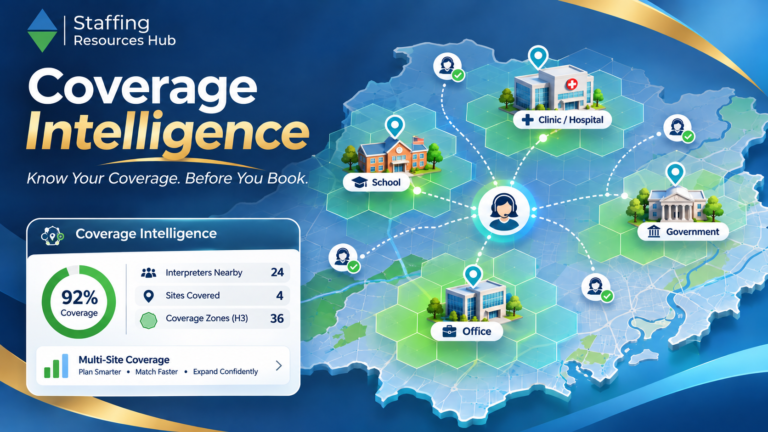
Today, EPIC uses its Enterprise Project System (EPS) for translation project management and Staffing Resources Hub (SRH) for interpreting scheduling, coordination, and reporting.
These systems support the work of professional language-service providers and the organizations they serve.
But technology should not become an end in itself.
An agency should evaluate a platform according to practical questions:
Does it make service requests easier to coordinate? Does it provide useful administrative visibility? Can authorized personnel obtain accurate records? Does it support appropriate human oversight and service continuity?
Technology cannot substitute for interpreter qualifications, translation quality, professional judgment, or the agency’s own legal and operational responsibilities.
The best technology supports accountable people doing important work—not the other way around.
What More Than Two Decades in Language Services Have Taught Me
My involvement in this industry began unexpectedly.
While I was working in information technology in California, an HR manager asked whether I could help translate an Urdu résumé into English.
I referred her to my sister. That introduction eventually led to a much larger translation assignment requiring a team of approximately 20–25 translators.
My sister invited me to help coordinate the work.
What began as an unexpected professional opportunity eventually became my career.
In 2005, I began managing the language-services business part-time. After the financial crisis of 2008 and the loss of my technology position, I committed myself to operating EPIC full-time.
Our earliest translation work included an assignment for a federal government agency. Over the years, EPIC’s public-sector experience expanded to projects involving the Bureau of Alcohol, Tobacco, Firearms and Explosives, local municipalities, state agencies, and other public institutions.
One lesson has remained consistent:
Language services are fundamentally about relationships between people.
The translator needs to understand the assignment and be treated as a valued professional.
The interpreter needs appropriate information, qualifications, and working conditions.
The government employee needs a dependable way to request and coordinate assistance.
And the resident needs communication that is accurate, understandable, and respectful.
My leadership philosophy is based on mutual respect and the belief that people generally want the opportunity to do well in life.
If I can help language professionals succeed in their work while helping clients receive high-quality, dependable services, those objectives reinforce one another.
That is the foundation on which I have worked to build EPIC.
A Practical Resource: The 2027 Government Language Access Budget Planning Worksheet
I believe practical leadership requires more than explaining problems.
It requires helping people make better decisions.
For that reason, EPIC Translations is developing a 2027 State & Local Government Language Access Budget Planning Worksheet for agency administrators, procurement teams, language-access coordinators, and financial managers.
Designed to support practical language access budget planning, the worksheet helps agencies organize service requirements, forecast translation and interpreting expenses, and compare budget scenarios.
It will provide a structured way to examine:
- OPI usage and annual cost assumptions
- Scheduled and on-demand VRI requirements
- On-site interpreting, minimum charges, and travel
- Written translation volume, review, and formatting
- Department-level allocations
- Baseline, higher-demand, and constrained-budget scenarios
- Actual expenditures compared with planned budgets
The worksheet is intended as an adaptable planning resource, not a substitute for legal review, procurement evaluation, or an agency’s official financial model.
Agencies will be able to replace illustrative assumptions with their own rates, utilization histories, and operational requirements.
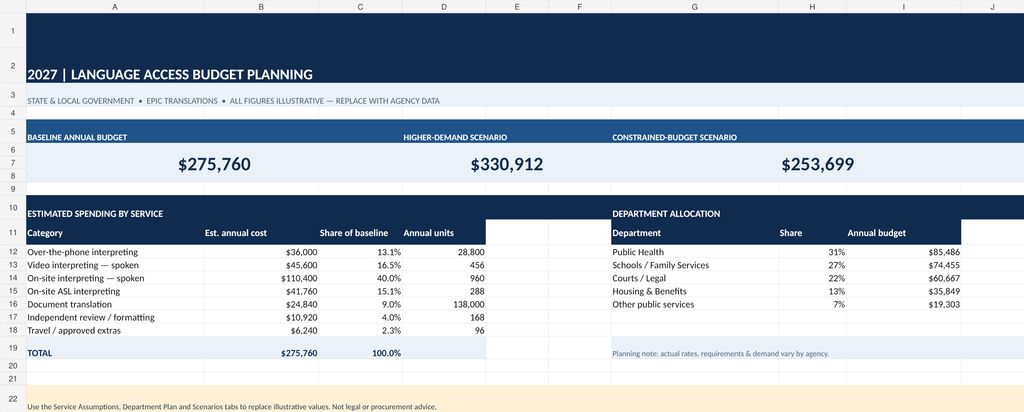
EPIC’s 2027 Government Language Access Budget Planning Worksheet helps agencies organize service demand, cost assumptions, and alternative budget scenarios.
Plan Your Agency’s 2027 Language Services Budget
Download EPIC’s complimentary Excel budgeting worksheet to forecast translation and interpreting expenses, evaluate alternative spending scenarios, and support responsible language access budget planning for 2027.
Need assistance planning your agency’s language services?
EPIC Translations can help your agency evaluate interpreting and translation requirements, coordinate service delivery, and improve utilization reporting.
Request a Government Language Services Consultation
The Public Service We Choose to Build
I grew up in Southwest Detroit surrounded by people from different cultural, linguistic, and ethnic backgrounds.
My neighbors, classmates, teachers, and teammates helped shape my understanding of what America could be.
I learned that people do not need to share the same background to respect one another, work together, or contribute meaningfully to their communities.
I also learned that opportunity matters.
My father understood that through years of hard work and financial sacrifice.
My teachers demonstrated it when they provided the support I needed to learn in a new language.
And I have seen the same principle throughout my career working with translators, interpreters, and the institutions that depend on them.
Today, as state and local governments prepare their budgets for 2027, I hope language access will be considered with the seriousness that both public service and public finances deserve.
Not every agency will face the same demands.
Not every service arrangement will be appropriate for every community.
But every agency can benefit from understanding its needs, planning carefully, evaluating costs, and ensuring that available resources are used effectively.
I do not believe that compassion and fiscal responsibility are competing values.
I believe that together they represent a more thoughtful approach to leadership.
A community’s ability to access essential public services should not depend solely on the language its residents speak. At the same time, public agencies have a responsibility to manage taxpayer resources carefully.
Those responsibilities can—and should—work together.
That is the kind of government service I believe in.
And it is the kind of leadership I hope to continue contributing to through my work at EPIC Translations.
About the Author
Mostansar Virk is the Founder and CEO of EPIC Translations, a Michigan-based language-services company supporting government agencies, educational institutions, healthcare organizations, and businesses since 2005.
An immigrant who arrived in the United States at age 11, Virk grew up in Southwest Detroit, attended Detroit Public Schools, and earned his undergraduate degree from Wayne State University.
Before leading EPIC Translations full-time in 2008, he worked in information technology and project management. His leadership philosophy emphasizes mutual respect, inclusive public service, responsible resource management, and the belief that opportunity should not be limited by language or cultural background.
Connect with Mostansar Virk on LinkedIn.
Planning Translation or Interpreting Services for Your Agency?
EPIC Translations supports state and local governments with professional translation, interpreting, and coordinated language-service workflows.