Why Organizations Are Replacing Traditional Translation Vendors With Language Operations Partners

Organizations today face a multilingual communication environment that is significantly more complex than it was even five years ago.
Government agencies serve increasingly diverse populations while navigating federal and state language access requirements. Healthcare systems must provide equitable communication access across the patient journey. Universities support international students, multilingual communities, accessibility programs, research initiatives, and global partnerships. Enterprises operate across countries, languages, regulatory frameworks, and cultural environments.
As these demands continue to grow, many organizations are discovering that the traditional approach to purchasing language services is becoming increasingly difficult to manage.
For decades, organizations typically purchased language services as individual transactions. A translation vendor handled document translation projects. An interpreting agency provided spoken language interpreting services. Another provider supplied American Sign Language (ASL) interpreting services. Telephone interpreting, video remote interpreting, multilingual publishing, transcription, and localization services were often managed independently.
That model worked when language access needs were relatively infrequent and operational complexity was lower.
Today, however, many organizations are moving toward a different model: partnering with a language operations partner capable of supporting multilingual communication, language access services, compliance requirements, and operational workflows as part of a unified strategy.
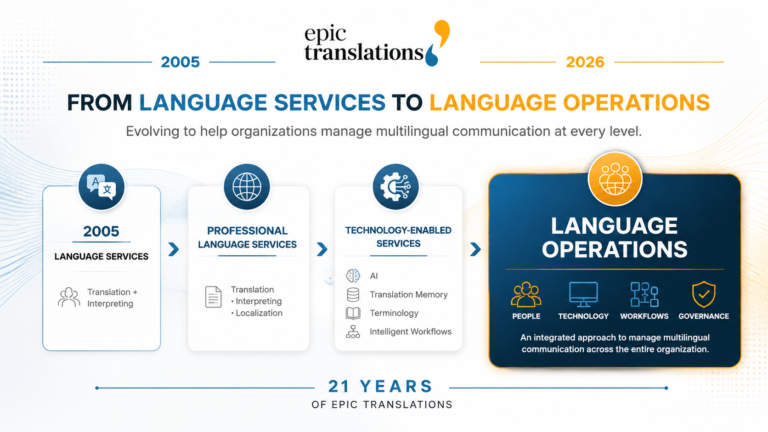
This shift represents more than a change in procurement practices. It reflects a broader evolution in how organizations manage language access, multilingual operations, interpreting services, translation services, technology platforms, and long-term communication strategy.
The Traditional Translation Vendor Model Was Built For A Different Era

Historically, organizations purchased language services as isolated services rather than integrated operational functions.
A government agency requiring translated public notices would hire a translation company. If that same agency later needed an interpreter for a public hearing, a separate interpreting services provider would be contacted. If an American Sign Language interpreter was required, another vendor relationship might be necessary. Healthcare organizations often used one provider for medical translation services, another for telephone interpreting, and a third for ASL interpreting services.
Over time, many organizations accumulated multiple vendor relationships covering:
- Translation services
- On-site interpreting services
- Over-the-phone interpreting (OPI services)
- Video remote interpreting (VRI services)
- ASL interpreting services
- Multilingual desktop publishing
- Website localization
- Transcription services
- Accessibility support
- Language access consulting
For organizations with limited multilingual communication requirements, this approach often appeared manageable.
However, as organizations expanded, regulatory requirements evolved, and expectations around accessibility increased, managing multiple language services providers became increasingly difficult.
Many organizations now struggle to answer fundamental operational questions:
- Which departments use the most language services?
- Which languages generate the highest demand?
- Which interpreting services create the greatest operational burden?
- Which providers deliver the fastest response times?
- Which services support compliance requirements most effectively?
- How can recurring language access needs be managed more efficiently?
- How can language access compliance be documented consistently?
Traditional language vendor relationships often provide limited visibility into these operational questions.
Why Organizations Are Moving Toward Language Operations

The challenge facing many organizations today is not finding a translation company or an interpreting agency.
The challenge is managing multilingual operations.
Language access now affects nearly every operational area of many organizations, including:
- Public services
- Patient care
- Education
- Human resources
- Legal compliance
- Customer service
- Community outreach
- Emergency communications
- Accessibility programs
- Digital communications
As a result, organizations increasingly require:
- Centralized coordination
- Workflow visibility
- Reporting and analytics
- Technology integration
- Language access compliance support
- Operational scalability
- Vendor management
- Workflow automation
- Strategic planning
This broader operational perspective has led many organizations to seek a language operations partner rather than a traditional translation vendor.
A language operations partner does not simply provide translation services or interpreting services when requested. Instead, a language operations partner helps organizations build repeatable, scalable, and sustainable multilingual operations.
This shift is occurring across government agencies, healthcare organizations, educational institutions, nonprofits, and global enterprises.
What Is A Language Operations Partner?

A language operations partner provides more than individual language services.
Instead, a language operations partner helps organizations manage the entire lifecycle of multilingual communication and language access.
This may include:
- Professional translation services
- On-site interpreting services
- ASL interpreting services
- OPI services
- VRI services
- Multilingual desktop publishing
- Website localization
- Transcription services
- Human-reviewed AI translation
- Workflow automation
- Reporting and analytics
- Language access compliance support
- Client technology platforms
- Vendor coordination
- Strategic language access planning
The goal is not simply to translate a document or assign an interpreter.
The goal is to create a language operations framework that supports multilingual communication consistently, efficiently, and at scale.
This distinction is becoming increasingly important as organizations seek long-term partners capable of supporting their evolving language access requirements.
Why Government Agencies Are Moving Beyond Traditional Government Language Services
Government agencies operate within some of the most complex language access environments in the United States.
Public-sector organizations routinely support:
- Public benefits programs
- Transportation systems
- Courts and legal services
- Vocational rehabilitation
- Public health programs
- Educational services
- Workforce development
- Community outreach
- Emergency management
- Public meetings
At the same time, government agencies must navigate multiple compliance frameworks, including:
- Title VI of the Civil Rights Act
- Americans with Disabilities Act (ADA)
- Section 1557 requirements
- State accessibility regulations
- Internal language access policies
- Agency-specific compliance standards
As government language services requirements continue to expand, agencies increasingly seek a language operations partner capable of providing:
- Centralized language access coordination
- Qualified interpreter management
- ASL interpreting services
- Translation workflow management
- Language access compliance support
- Reporting and analytics
- Self-service technology platforms
- Operational visibility
- Long-term partnership support
The objective is not simply to reduce costs.
The objective is to improve access, strengthen compliance, increase operational efficiency, and provide more consistent public service delivery.
Increasingly, government agencies are viewing language access as an operational function rather than a procurement category.
Why Healthcare Organizations Are Reimagining Healthcare Language Services
Healthcare organizations increasingly recognize that language access is not merely an administrative requirement.
It is a patient care issue.
Healthcare language services now extend throughout the entire patient journey, including:
- Appointment scheduling
- Registration
- Clinical encounters
- Telehealth appointments
- Emergency care
- Patient education
- Consent documentation
- Discharge instructions
- Community outreach
- Ongoing patient support
Healthcare organizations must also support:
- Limited English proficiency populations
- Deaf and hard-of-hearing patients
- Accessibility requirements
- Health equity initiatives
- Regulatory compliance standards
As healthcare systems continue to grow and consolidate, many organizations are moving toward enterprise language access models that integrate:
- Medical translation services
- OPI services
- VRI services
- ASL interpreting services
- Language access reporting
- Workflow automation
- Technology platforms
- Compliance management
- Operational analytics
Healthcare language services increasingly require coordination across multiple facilities, departments, providers, and communication channels.
For this reason, many healthcare organizations now seek a language operations partner capable of supporting language access throughout the entire patient experience.
The goal is no longer simply obtaining an interpreter.
The goal is managing patient communication effectively, safely, and consistently.
Why Universities Are Moving Toward Integrated Language Operations
Higher education institutions face some of the most diverse multilingual communication environments of any industry.
Universities routinely support:
- International students
- Admissions departments
- Accessibility services
- Academic programs
- Research initiatives
- Community engagement
- Healthcare programs
- Legal offices
- Public events
- Continuing education programs
Historically, many institutions managed these language services independently across multiple departments.
However, this decentralized approach often creates:
- Duplicate vendor relationships
- Inconsistent service quality
- Limited reporting
- Operational inefficiencies
- Compliance challenges
- Poor visibility into institutional language access needs
As universities become increasingly global and multilingual, many institutions are adopting integrated language operations strategies.
These strategies often include:
- Centralized translation services
- Interpreting services coordination
- ASL interpreting services
- Language access reporting
- Workflow management
- Accessibility support
- Technology platforms
- Operational analytics
Higher education institutions increasingly seek a language operations partner that can support multilingual operations across the entire institution rather than serving individual departments independently.
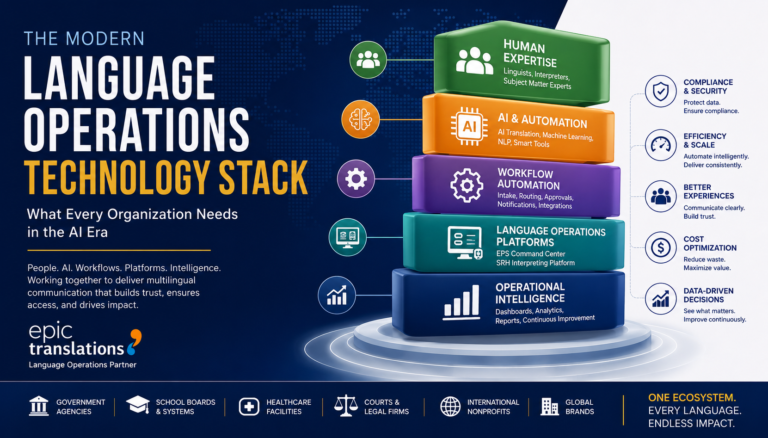
Technology Is Becoming As Important As Language Expertise

Professional linguists remain the foundation of effective multilingual communication.
Technology does not replace human expertise.
However, organizations increasingly expect their language operations partner to provide technology that supports operational efficiency.
Modern language operations platforms increasingly support:
- Self-service requests
- Online scheduling
- Interpreter availability management
- Project tracking
- Secure document exchange
- Reporting dashboards
- Workflow automation
- Operational analytics
- Compliance documentation
- Translation management
- AI-assisted workflows
- Client portals
Organizations today expect the same visibility from language services providers that they receive from other enterprise vendors.
They want to know:
- What services were used?
- Who requested them?
- How quickly were they delivered?
- Which departments generated the most activity?
- Which languages are trending?
- What compliance requirements were satisfied?
- Where can efficiencies be improved?
Technology helps answer these questions.
This is one reason why the concept of the language operations platform continues to gain importance across multiple industries.
Why AI Is Changing How Organizations Purchase Language Services
Artificial intelligence is changing the language services industry.
However, AI is not eliminating the need for human expertise.
Instead, AI is changing how organizations evaluate language services providers.
Organizations increasingly seek providers capable of combining:
- AI-assisted translation
- Human review
- Translation memory
- Terminology management
- Workflow automation
- Quality assurance
- Reporting
- Operational analytics
The future of language services is unlikely to be entirely human or entirely automated.
Instead, successful multilingual operations will combine:
- Artificial intelligence
- Human expertise
- Workflow automation
- Technology platforms
- Quality management
- Compliance support
This hybrid model allows organizations to improve efficiency while maintaining quality, consistency, and accountability.
For many organizations, selecting a language operations partner increasingly means selecting a partner capable of managing both human and technology-enabled workflows.
Why Language Access Compliance Is Becoming An Operational Function
Language access compliance is also becoming increasingly operational.
Government agencies, healthcare organizations, universities, courts, and public-facing organizations must frequently document:
- Language access requests
- Interpreter usage
- Translation services provided
- Accessibility accommodations
- Response times
- Compliance activities
- Service utilization trends
This documentation requirement creates operational challenges that traditional vendor relationships were never designed to solve.
Organizations increasingly require:
- Reporting dashboards
- Usage analytics
- Centralized records
- Compliance documentation
- Workflow visibility
- Operational oversight
As a result, language access compliance itself is becoming a major reason organizations seek a language operations partner rather than relying on multiple disconnected language vendors.
What Organizations Should Look For In A Language Operations Partner
Organizations evaluating language services providers should consider whether a prospective language operations partner can support:
✓ Professional translation services
✓ On-site interpreting services
✓ ASL interpreting services
✓ OPI services
✓ VRI services
✓ Human-reviewed AI translation
✓ Multilingual desktop publishing
✓ Language access compliance
✓ Client portals
✓ Workflow automation
✓ Reporting and analytics
✓ Operational visibility
✓ National service delivery
✓ Long-term scalability
The question organizations increasingly ask is no longer:
“Can this company translate our documents?”
Instead, the more important question has become:
“Can this organization support our multilingual operations over the long term?”
That distinction is reshaping how organizations purchase language services.
The Future Of Language Services Is Operational
The language services industry is evolving rapidly.
Organizations increasingly expect more than translation services or interpreting services alone. They seek partners capable of providing technology, operational workflows, compliance support, analytics, reporting, multilingual communication expertise, and strategic guidance.
The organizations best positioned for the future will likely combine:
- Human expertise
- Technology platforms
- Workflow automation
- Reporting and analytics
- Compliance support
- Artificial intelligence
- Operational management
- Long-term partnership models
At EPIC, we believe multilingual communication works best when language professionals, technology, workflows, and organizational objectives work together.
We believe the future belongs to organizations that treat language access not as a series of isolated transactions, but as an integrated operational function.
Because ultimately, language services are not simply about translating documents or assigning interpreters.
They are about helping organizations communicate effectively, equitably, compliantly, and at scale.
Partner With EPIC For Language Operations Support

Organizations today need more than a translation vendor. They need a trusted language operations partner that can support multilingual communication, language access, compliance, and operational efficiency across every department.
EPIC partners with government agencies, healthcare systems, universities, courts, nonprofits, and enterprises to help simplify complex language operations through integrated services, experienced linguists, and technology-enabled workflows.
Our language solutions include:
- Professional translation services
- On-site interpreting services
- Over-the-phone interpreting (OPI)
- Video remote interpreting (VRI)
- American Sign Language (ASL) interpreting
- Human-reviewed AI translation
- Multilingual desktop publishing
- Language access consulting
- Technology-enabled workflow management
- Reporting and operational analytics
Whether you’re looking to streamline multilingual operations, improve language access, or consolidate multiple language vendors into a single strategic partnership, EPIC can help.
Ready to rethink how your organization manages language services? Contact EPIC to discuss how a language operations approach can help improve efficiency, compliance, and communication across your organization.