Transform Multilingual Communication Into A Strategic Organizational Capability
Bring People, Processes, Technology, Governance, Automation, And Operational Intelligence Together—Creating A More Connected, Measurable, And Scalable Approach To Multilingual Communication.
Modern Language Operations moves beyond disconnected language services by coordinating professional expertise, workflows, technology, governance, and intelligence within a unified operational framework.
People | Processes | Technology | Governance | Automation | Operational Intelligence
Language Services Have Changed. The Operating Model Hasn’t.
Multilingual communication now touches more departments, more technologies, more service channels, and more stakeholders than ever before. Organizations may be coordinating translation, interpreting, accessibility, vendors, internal teams, compliance requirements, reporting, and increasingly, artificial intelligence—all at the same time.
Yet these activities are often still managed through disconnected emails, spreadsheets, separate vendor systems, manual approvals, and fragmented workflows. As demand grows, so does the difficulty of maintaining consistency, visibility, accountability, and control across the organization.
The challenge is no longer simply providing language services. It is managing multilingual communication as an organizational capability.
A New Operational Discipline Is Emerging: Language Operations
As multilingual communication becomes more complex, leading organizations are beginning to manage it as a coordinated operational function rather than a collection of individual translation and interpreting requests.
Language Operations brings together people, processes, technology, governance, automation, and operational intelligence to create a more connected approach to multilingual communication—one that can be managed, measured, governed, and continuously improved.
People → Processes → Technology → Governance → Automation → Operational Intelligence
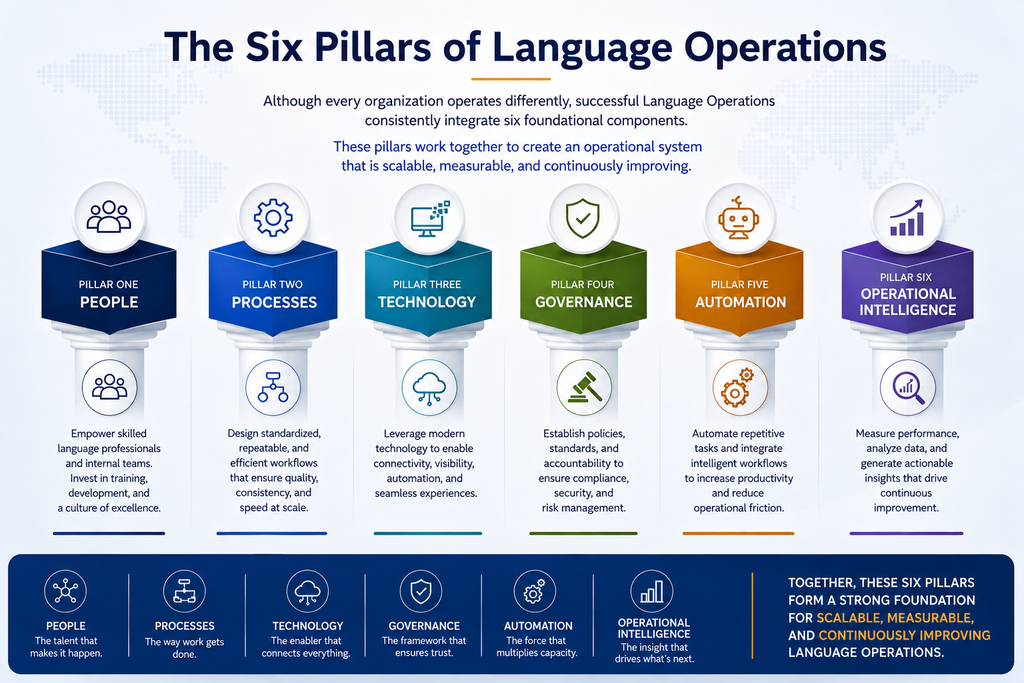
What Modern Language Operations Looks Like In Practice
Centralized Access
Give authorized teams a consistent way to access translation, interpreting, and other language services—without relying on disconnected emails, phone numbers, or processes.
Connected Workflows

Coordinate multilingual requests, approvals, assignments, and delivery across departments, locations, programs, and service types through more consistent workflows.
Human Expertise + AI

Apply professional human expertise, responsible artificial intelligence, and automation where each provides the greatest value—while maintaining appropriate human oversight.
Governance & Accountability

Establish clearer policies, responsibilities, controls, and oversight for how multilingual communication is requested, delivered, managed, and evaluated.
Operational Intelligence

Turn language-service activity into meaningful insight about demand, usage, performance, cost, and trends—giving leaders greater operational visibility.
Continuous Improvement
Use data, feedback, and operational insight to identify friction, strengthen workflows, improve performance, and continuously advance Language Operations.
Where Is Your Organization Today?
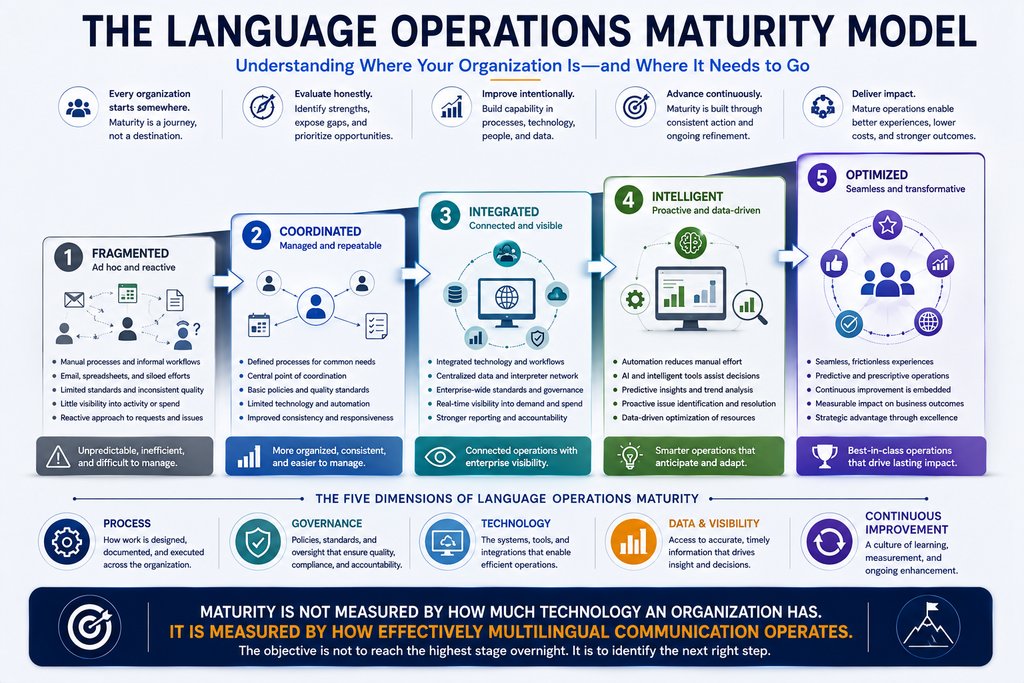
Modern Language Operations does not happen all at once. Organizations typically progress through stages as workflows become more coordinated, governance becomes stronger, technology becomes more integrated, and operational visibility improves.
The Language Operations Maturity Model provides a practical way to understand your current operating model—and identify what should come next.
Reactive Operations
Language services are primarily handled request by request through email, spreadsheets, individual departments, and manual coordination, with limited organization-wide visibility.
Coordinated Operations
Common processes and preferred resources begin to emerge, creating greater consistency across requests while basic tracking and reporting improve.
Managed Operations
Workflows become more centralized and standardized, with stronger governance, clearer accountability, and greater visibility across language-service activity.
Intelligent Operations
Automation, responsible AI, integrated technology, and advanced analytics begin reducing administrative friction and supporting more informed operational decision.
Strategic Language Operations
Multilingual communication is managed as an organizational capability, with executive visibility, integrated governance, continuous optimization, and data-informed planning.
Where Are You Today?
link to the Language Operations Maturity Assessment once we build it.
Modernization Is a Journey—Not a Software Project.
Modernizing Language Operations does not require replacing everything at once. Sustainable transformation begins by understanding the current operating model, identifying the areas creating the greatest friction, and improving them systematically.
Organizations can progress by standardizing core processes, strengthening governance, introducing intelligent automation, building operational intelligence, and establishing continuous improvement—while preserving the professional human expertise essential to effective multilingual communication.
The goal is not simply to implement more technology. It is to create an operating model in which people, processes, technology, governance, automation, and intelligence work together.
The result: multilingual communication that becomes more connected, measurable, accountable, and scalable as the organization evolves.
Understand → Standardize → Govern → Automate → Build Intelligence → Continuously Improve
Technology Should Strengthen Human Communication—Not Replace It.
Modern Language Operations brings new opportunities to use artificial intelligence, automation, and connected technology to reduce administrative effort, improve visibility, and support more efficient workflows.
But technology is only one part of the operating model. Professional translators, interpreters, and language specialists continue to provide the judgment, context, cultural understanding, and accountability that effective multilingual communication requires.
The strongest Language Operations models use technology deliberately—automating what should be automated, applying artificial intelligence where it adds value, and preserving human expertise where judgment and communication matter most.
The future is not human expertise or technology. It is an intelligent operating model that allows each to do what it does best.
Organizations Across Sectors Already Rely on EPIC.
Wisconsin






For more than two decades, EPIC Translations has supported public agencies, educational institutions, and organizations with professional language services and multilingual communication solutions.
Governance and Accountability Built Into Language Operations
As multilingual communication expands across departments, technologies, service providers, and artificial intelligence, organizations need more than access to language services. They need clear standards for how multilingual work is requested, managed, protected, measured, and governed.
Modern Language Operations establishes the structure needed to strengthen accountability, protect sensitive information, improve organizational visibility, and support responsible use of both human expertise and technology.
Governance & Standards
Establish clearer policies, responsibilities, approval processes, and operating standards for how multilingual communication is managed across the organization.
Security & Confidentiality
Protect sensitive information through controlled workflows, appropriate access, professional language resources, and security practices aligned with organizational requirements.
Responsible AI
Define where artificial intelligence can add value, where human oversight is required, and how AI-assisted language workflows should be governed and evaluated.
Quality & Human Oversight
Maintain appropriate professional review, linguistic expertise, quality controls, and human judgment based on the content, audience, risk, and purpose of the communication.
Visibility & Reporting
Create greater visibility into language-service demand, activity, usage, performance, and cost so leaders can understand what is happening across the organization.
Accountability & Auditability
Create clearer records of requests, decisions, workflows, and service activity to support organizational oversight, compliance requirements, and continuous improvement.
Modern Language Operations is not simply about delivering language services. It is about creating the governance, visibility, and accountability needed to manage multilingual communication responsibly at organizational scale.
Go Deeper With the Executive Playbook
How Leading Organizations Are Transforming Language Operations provides a practical framework for leaders responsible for multilingual communication, language access, operations, technology, procurement, compliance, and organizational performance.
The Executive Playbook explores the operating models, maturity stages, governance principles, technology strategies, and transformation roadmap shaping the next generation of Language Operations.
Where Should Your Organization Go Next?
Every organization starts from a different place. Some are still coordinating multilingual work primarily through email and individual departments. Others have standardized workflows but lack governance, automation, integrated technology, or meaningful operational intelligence.
Understanding your current state is the first step toward determining what should come next.
Your Current Environment
✓ How are language-service requests submitted and coordinated?
✓ Are workflows consistent across departments?
✓ Where are manual processes creating friction?
✓ How is AI currently being used or governed?
✓ What operational information can leadership see?
Your Future State
✓ More consistent, connected workflows
✓ Clearer governance and accountability
✓ Responsible use of AI and automation
✓ Greater visibility into activity and performance
✓ Continuous improvement based on operational intelligence
Modernization Begins With Understanding Where You Are Today.
Get Your Complimentary Executive Playbook
Modernizing Language Operations does not begin with choosing software. It begins with understanding your organization’s current operating model, priorities, challenges, and opportunities.
Complete the form below and we’ll email you a copy of How Leading Organizations Are Transforming Language Operations.
Send Me the Executive Playbook
Frequently Asked Questions
What Is Language Operations?
Language Operations is the coordinated management of multilingual communication across an organization through the integration of people, processes, technology, governance, automation, and operational intelligence. It moves language services beyond individual transactions toward a more connected and strategically managed organizational capability.
How Is Language Operations Different From Traditional Language Services?
Traditional language services often focus on individual translation or interpreting requests. Language Operations addresses the broader operating model behind those services—including how requests are submitted, workflows are managed, professionals and technology are coordinated, governance is established, activity is measured, and processes are continuously improved.
What Organizations Can Benefit From Modern Language Operations?
Organizations managing multilingual communication across multiple departments, locations, programs, or service channels can benefit. This includes government agencies, educational institutions, healthcare organizations, courts and legal organizations, nonprofits, and global enterprises.
What Role Does Artificial Intelligence Play In Language Operations?
AI can support translation, automation, administrative workflows, terminology management, and other operational activities. Modern Language Operations emphasizes responsible AI with appropriate human oversight, applying technology where it adds value while preserving professional expertise where linguistic judgment, context, cultural understanding, or accountability is required.
Does Modernizing Language Operations Require Replacing Our Existing Systems?
Not necessarily. Language Operations modernization should begin by understanding the organization’s current operating model and identifying the areas creating the greatest friction or risk. Organizations can then improve processes, governance, technology, automation, and operational visibility progressively rather than replacing everything at once.
How Can Our Organization Get Started?
A practical first step is to evaluate how multilingual communication is currently managed across people, processes, technology, governance, automation, and operational intelligence. EPIC’s Executive Playbook provides a framework for understanding the current state, evaluating organizational maturity, and developing a practical modernization roadmap.
Ready to Build a More Modern Approach to Multilingual Communication?
Whether your organization is beginning to coordinate fragmented workflows or advancing toward more intelligent, integrated operations, the next step begins with understanding where you are today—and where you want to go.