Building Stronger ASL Access for Government Agencies Starts with Stronger Interpreter Partnerships

Government ASL interpreting services are not simply a scheduling task. They are a critical part of public access, ADA compliance, community trust, and the ability of Deaf and hard-of-hearing individuals to participate meaningfully in public services. The ADA’s effective communication guidance explains that communication methods should be appropriate to the nature, length, complexity, and context of the communication.
Whether the setting is a public benefits appointment, court-related meeting, vocational rehabilitation session, school meeting, transportation program, healthcare-related public service, community event, or emergency communication, the quality of the ASL interpreting experience matters.
That quality depends on more than whether an interpreter is available.
It depends on whether the right interpreter is available, qualified for the setting, familiar with the assignment type, prepared for the subject matter, and able to support effective communication between all parties.
That is why EPIC is investing in a more connected ASL service model through EPS, our client and interpreter portal.

A Better Way to Coordinate Government ASL Requests
ASL interpreting requires more than basic availability. Government agencies need qualified ASL interpreters who fit the setting, meet applicable requirements, and can support effective communication for Deaf and hard-of-hearing individuals. EPIC’s enhanced EPS workflow helps agencies request ASL services with more visibility, structure, and scheduling continuity. Government ASL interpreting services work best when agencies have both qualified interpreter access and a structured request process that supports continuity, compliance, and timely coordination.
Government agencies often manage recurring ASL interpreting needs across multiple departments, locations, programs, and public-facing services. Over time, certain interpreters become familiar with an agency’s processes, terminology, expectations, and communication environment.
That continuity matters.
When an interpreter has successfully supported a prior assignment, agencies may prefer to work with that interpreter again. When a Deaf or hard-of-hearing participant has had a positive communication experience, maintaining consistency can improve trust and reduce friction. When assignments involve specialized terminology, agency-specific procedures, or sensitive public services, matching the right interpreter to the right setting becomes even more important.
EPS now gives participating government clients a more structured way to request ASL services and, where available, request specific ASL interpreters from the appropriate interpreter pool.
This does not replace EPIC’s coordination process. Instead, it gives agencies a better way to communicate preferences while allowing EPIC to confirm availability, qualifications, certification requirements, assignment fit, and scheduling details.
How To Request A Preferred ASL Interpreter In EPS
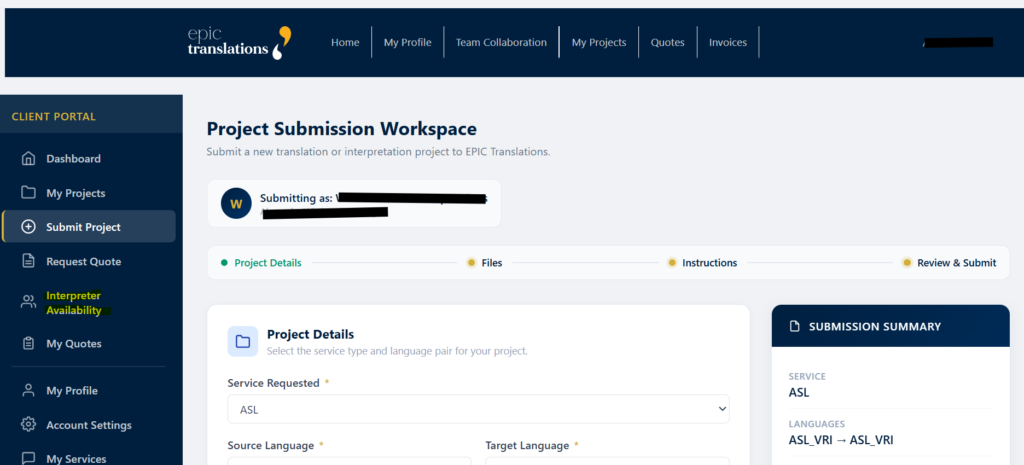
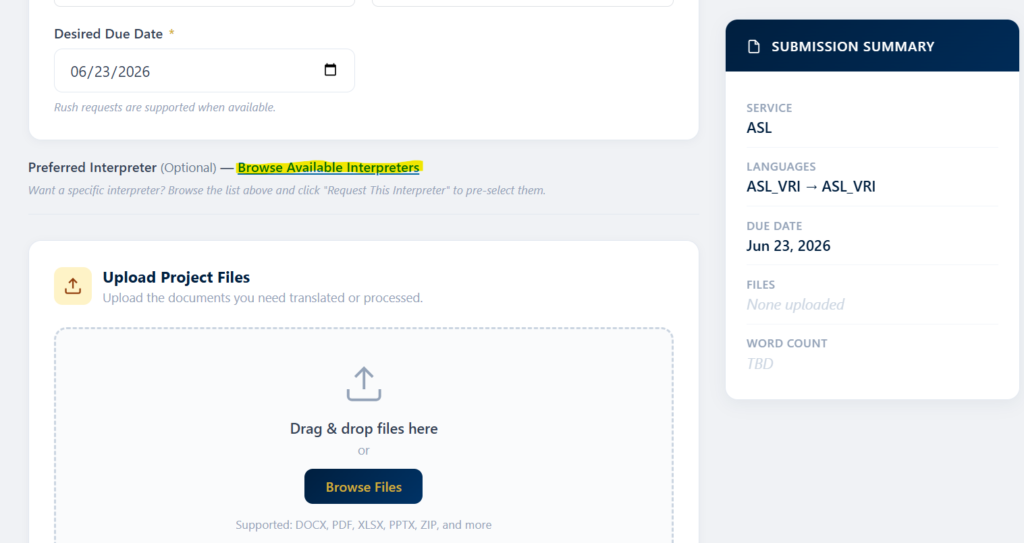
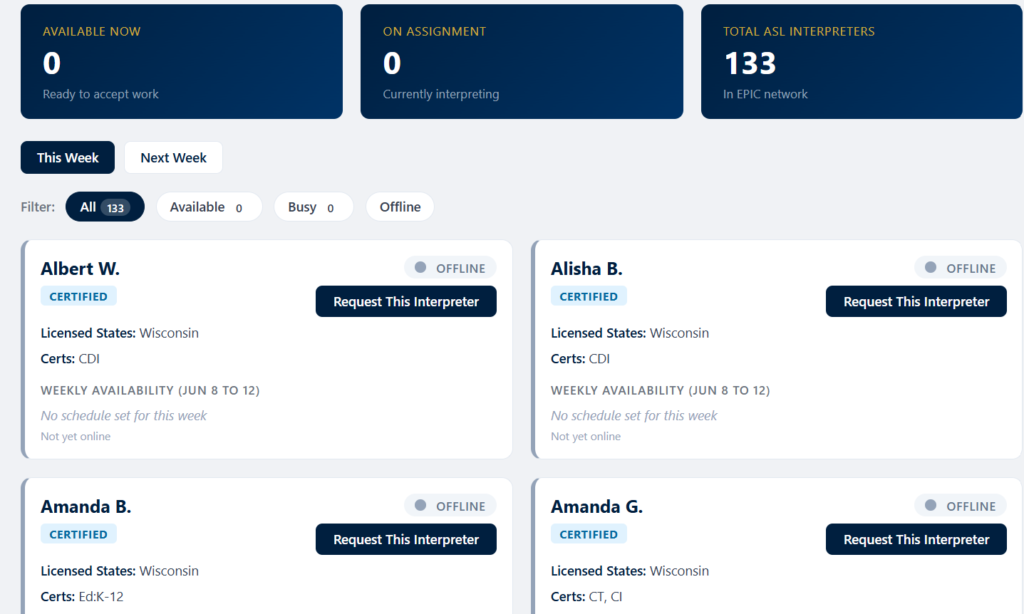
Pro Tip: Fastest Way to Request an ASL Interpreter: Log in to EPS, click Submit Project, select ASL as the service type, browse the ASL interpreters associated with your state, click Request This Interpreter, and complete the remaining brief form. EPS makes the process simple while EPIC continues managing final coordination.
Important to Know: Requesting a specific ASL interpreter in EPS does not automatically confirm that interpreter for the assignment. EPIC still reviews interpreter availability, qualifications, certification requirements, assignment details, location, timing, and scheduling fit before final confirmation.
Requesting a preferred ASL interpreter through EPS is simple. Clients log in to EPS, click Submit Project, select ASL as the service type, and EPS will display the link to browse all of the ASL interpreters associated with the client’s state and applicable certification requirements.
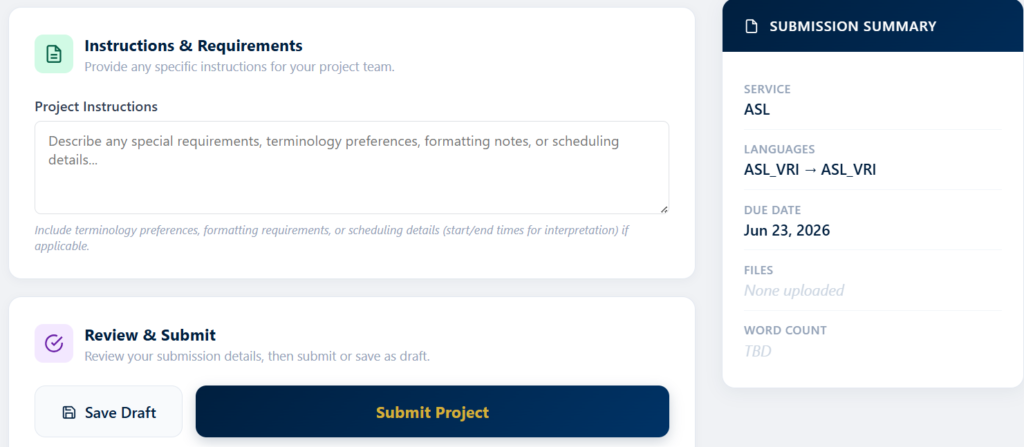
From there, the client can browse the interpreter list, click Request This Interpreter for the preferred ASL interpreter, and complete the remaining brief request form. That is it. The new workflow gives agencies a fast, guided way to request preferred ASL interpreters while still allowing EPIC to confirm availability, assignment fit, and final scheduling details.
Why Interpreter Matching Matters
Pro Tip: For recurring ASL assignments, request interpreters who are already familiar with your agency, setting, terminology, and communication environment. Interpreter continuity can help reduce preparation time, improve consistency, and create a smoother experience for staff and participants.
ASL interpreting is highly contextual.
A public meeting is different from a legal appointment. A vocational rehabilitation session is different from a medical benefits meeting. A classroom setting is different from a government training session. A short front-desk interaction is different from a complex multi-hour meeting involving multiple speakers.
Government agencies need more than a name on a schedule. They need a reliable process that considers:
- Interpreter qualifications and certification requirements
- Assignment setting and subject matter
- Location or remote service needs
- Interpreter availability
- Prior agency experience
- Client and participant preferences
- Continuity for recurring services
- The need for team interpreting on longer or more complex assignments
By improving how interpreters are connected to assignments, EPIC can help agencies create a more consistent and professional ASL access experience.
Supporting ASL Interpreters as Professional Partners
For ASL interpreters, strong coordination matters too.
Interpreters do their best work when assignments are properly matched, clearly communicated, and scheduled with respect for their time and expertise. A better portal should not create unnecessary administrative burden. It should help interpreters receive better-fit opportunities, manage visibility, and maintain more control over how they are contacted.
EPIC’s goal is to build stronger partnerships with ASL interpreters by making EPS more useful and more flexible.
That means giving interpreters practical options, including the ability to:
- Keep recurring weekly availability on file
- Confirm that availability is the same as the prior week
- Limit availability to select assignments
- Pause their profile when they are unavailable
- Choose whether they are visible for client-requested assignments
- Remain in EPIC’s interpreter pool without being shown directly to clients
- Update availability through EPS, email, text, or phone when needed
This approach recognizes a simple reality: ASL interpreters are busy professionals. If a system is too rigid or time-consuming, it becomes one more task. If it is flexible and connected to real assignment opportunities, it becomes a useful professional tool.
Visibility Should Benefit the Interpreter, Not Burden the Interpreter
For ASL Interpreters: EPS is designed to support better assignment matching, not remove interpreter control. Interpreters can keep availability current, limit participation, pause visibility, or ask EPIC to contact them outside EPS when needed.
One of the most important parts of EPIC’s ASL service model is interpreter visibility.
When a qualified ASL interpreter keeps availability current in EPS, government clients may be able to request that interpreter for eligible assignments. This can support stronger continuity between interpreters and agencies that have worked well together in the past.
However, visibility should not mean loss of control.
Interpreters should not feel that being part of a portal means they are always available, automatically assigned, or publicly listed without preference. EPIC’s role remains important: reviewing each request, confirming availability, validating assignment fit, and coordinating the final schedule.
For interpreters, this creates a better balance.
They can remain connected to government ASL opportunities while still having control over their schedule, visibility, and level of participation.
For agencies, this creates a more informed request process without removing EPIC’s oversight.
A Stronger Model for Government ASL Services
Watch Out: Last-minute ASL requests can limit interpreter availability, especially for public meetings, legal settings, specialized appointments, multi-hour assignments, or requests requiring state-specific certification. Submit recurring or high-priority ASL requests as early as possible so EPIC has more time to coordinate the right interpreter.
Government agencies are under increasing pressure to provide timely, reliable, and compliant language access services. For ASL interpreting, that means agencies need a dependable system for requesting qualified interpreters, tracking service needs, managing recurring assignments, and supporting effective communication.
EPIC’s enhanced ASL request process is designed to help agencies move from reactive scheduling to more strategic ASL access management.
The goal is to help agencies answer important questions more effectively:
- Which qualified interpreters are available for this type of assignment?
- Has this interpreter worked with our agency before?
- Is this interpreter familiar with the setting?
- Can we request a preferred interpreter for recurring services?
- What happens if the preferred interpreter is unavailable?
- How does EPIC ensure the final assignment is properly coordinated?
By combining client preference, interpreter availability, certification awareness, and EPIC’s scheduling oversight, EPS helps create a stronger service model for public-sector ASL interpreting.
Why This Matters Nationally
Although this enhancement is especially valuable for state-specific ASL programs, the same model can support government agencies across the country.
Many public agencies face similar challenges:
- Limited interpreter availability
- High demand for qualified ASL services
- Recurring assignments across multiple departments
- Need for compliant, documented coordination
- Preference for interpreters familiar with specific programs
- Difficulty managing last-minute requests
- Need for both on-site and video remote ASL interpreting
A national ASL service model must be flexible enough to respect state-specific certification requirements while still giving agencies access to a broader, well-managed interpreter network.
That is the direction EPIC is building toward: a more connected ASL interpreting ecosystem where government agencies, interpreters, and EPIC’s coordination team work from the same operational foundation.
For Government Agencies: More Control, Better Continuity
For government clients, the enhanced EPS ASL request process provides a more practical way to manage interpreter preferences.
Agencies can continue submitting ASL requests without selecting a specific interpreter, or they can request a preferred interpreter when appropriate.
This is especially useful for:
- Recurring appointments
- Public meetings
- Ongoing programs
- Specialized departments
- Assignments involving sensitive subject matter
- Situations where continuity improves communication
- Agencies that have had positive prior experiences with specific interpreters
The requested interpreter is not automatically guaranteed. Final confirmation remains subject to availability, qualifications, service requirements, and EPIC’s coordination process.
But the ability to request a preferred interpreter gives agencies a stronger voice in the scheduling process.
For ASL Interpreters: Better-Fit Opportunities
Pro Tip for ASL Interpreters: Keeping your availability current helps EPIC identify better-fit opportunities faster. Interpreters who maintain accurate availability can be considered more efficiently for recurring assignments, preferred client requests, and assignments that match their schedule, qualifications, and preferences.
For ASL interpreters, the enhanced model creates a clearer connection between availability and opportunity.
When interpreters keep availability current, EPIC can identify better-fit assignments faster. Agencies that have worked with them before may be able to request them again. Recurring relationships can be supported more easily. Last-minute assignment coordination can become more efficient.
Most importantly, interpreters can decide how they want to participate.
Some interpreters may want to be highly visible for government requests. Others may prefer limited availability. Some may only want to be contacted for certain assignment types. Others may want to pause their profile temporarily.
EPIC’s goal is not to force every interpreter into the same workflow. The goal is to create a system that respects interpreter preferences while improving service reliability for government clients.
Technology Should Strengthen Human Coordination
ASL interpreting will always depend on human expertise, professional judgment, and communication skill.
Technology should not replace that.
The role of EPS is to improve the coordination around the interpreting service: availability, request details, interpreter preferences, client preferences, scheduling visibility, and assignment management.
Better technology allows EPIC’s team to spend less time chasing basic information and more time making thoughtful assignment decisions.
That benefits everyone:
- Agencies receive more responsive scheduling support.
- Interpreters receive better-matched opportunities.
- Deaf and hard-of-hearing individuals receive stronger communication access.
- EPIC can provide more consistent service across public-sector programs.
The Future of ASL Access Is Partnership-Based
The strongest ASL programs are not built only on software, contracts, or scheduling volume. They are built on trusted partnerships.
Government agencies need dependable access to qualified ASL interpreters. Interpreters need to be treated as skilled professionals whose time, preferences, and qualifications matter. Deaf and hard-of-hearing individuals need communication access that is effective, respectful, and appropriate to the setting.
EPIC’s enhanced EPS ASL workflow is part of that larger commitment.
By giving agencies better request options and giving interpreters more flexible participation choices, EPIC is building a more sustainable ASL interpreting model for public-sector language access.
For government agencies, this means stronger continuity and more informed scheduling.
For ASL interpreters, it means better visibility, better-fit opportunities, and more control over how they partner with EPIC.
And for the communities served, it means a better path toward effective communication.
Partner with EPIC for Government ASL Interpreting Services
Government ASL interpreting services require more than availability; they require qualified interpreters, clear coordination, ADA-aware workflows, and reliable scheduling support.
EPIC provides ASL interpreting support for government agencies, public-sector programs, educational institutions, healthcare-related public services, transportation programs, courts, and community-facing agencies.
Our ASL services include:
- On-site ASL interpreting
- Video remote ASL interpreting
- Recurring ASL assignment coordination
- Government ASL interpreter scheduling
- Preferred interpreter request workflows
- State-specific interpreter pool management
- Support for public meetings, appointments, trainings, and agency programs
If your agency needs a more reliable way to manage ASL interpreting requests, EPIC can help build a workflow that supports compliance, continuity, and effective communication.
If you are an ASL interpreter interested in partnering with EPIC, we welcome qualified interpreters who want to support public-sector ASL access through a more organized and respectful scheduling model.
EPIC is building stronger ASL access by building stronger partnerships.