eLearning Localization Services
Training and Learning Content Built for Multilingual Audiences
EPIC helps organizations localize eLearning courses, training programs and digital learning content for audiences across languages.
From on-screen text and assessments to narration, subtitles, graphics and supporting materials, our eLearning localization workflows bring linguistic, multimedia and production requirements together—helping organizations deliver a more consistent learning experience across languages.
Whether you’re localizing a single course or an expanding library of training content, EPIC can support multilingual learning programs across 200+ languages.
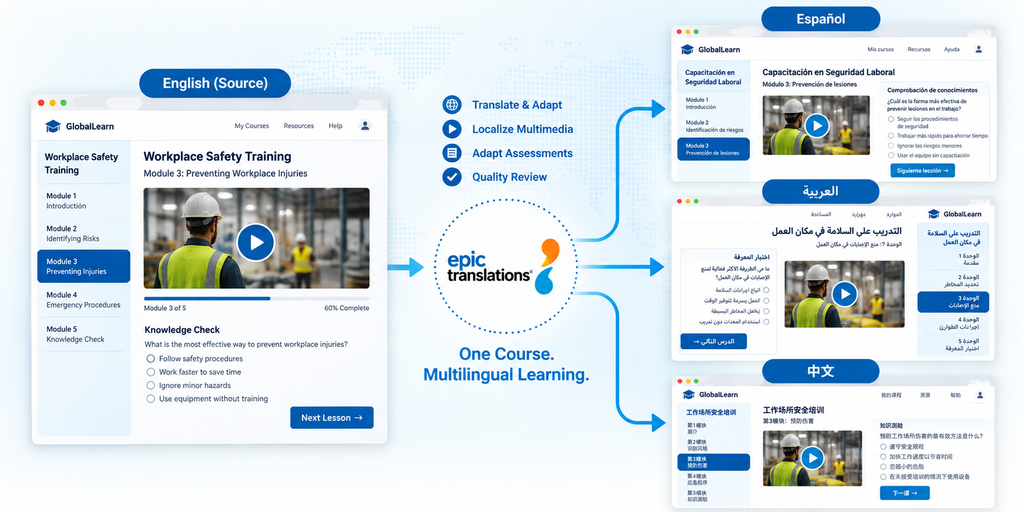
What eLearning Localization Means at EPIC
eLearning localization goes beyond translating course text. Digital learning experiences can combine instructional content, navigation, assessments, audio, video, graphics, downloadable materials and other elements that must work together in the target language.
EPIC coordinates the linguistic and production requirements involved in adapting eLearning content for multilingual audiences while maintaining instructional meaning, terminology, consistency and the structure of the original learning experience.
Depending on the project, localization can include course content, quizzes, narration, subtitles, graphics, presentations, training documents and other learner-facing materials.

Since 2005
20+ years of continuous operation

200+ Languages
Language support for global audiences

25,000+
Qualified linguists

Nationwide
Coverage across the United States
More Than Course Translation
Linguistic Localization
Qualified linguists adapt instructional content for meaning, terminology, tone, audience and learning context.
Multimedia Localization
Audio, video, subtitles, on-screen text and graphics can be coordinated as part of the broader multilingual learning experience.
Structured Quality Review
Localized content is reviewed for linguistic quality, consistency, completeness and project-specific requirements before delivery.
Built for Organizations That Train and Educate at Scale
Corporate Learning & Development
Employee training, onboarding, professional development, compliance programs and internal learning content.
Schools & Higher Education
Digital courses, instructional resources, student learning materials and multilingual educational content.
Government & Public Agencies
Workforce training, public education programs, procedural instruction and agency learning materials.
Healthcare & Regulated Organizations
Staff training, compliance education, procedural content and other learning materials requiring clear, consistent terminology.
From Source Course to Multilingual Learning Experience
1. Review Course Content
EPIC reviews the source content, target languages, course components, multimedia assets and delivery requirements.
2. Translate & Localize
Qualified linguists adapt instructional content, terminology and learner-facing elements for the target language and audience.
3. Coordinate Multimedia & Production
Applicable narration, subtitles, graphics, documents and other course components are prepared for the localized learning experience.
4. Review & Deliver
Localized content is reviewed for linguistic quality, consistency and completeness before delivery in the agreed project format.
What Can Be Localized?
eLearning localization can extend across the entire learning experience—not just the words displayed on screen.
Course Content
Lessons, modules, instructions, explanations and other learner-facing course content.
Assessments & Quizzes
Questions, answer choices, instructions, feedback and related assessment content.
Audio & Narration
Multilingual voice-over and narration requirements for training and instructional content.
Video & Subtitles
Subtitles, captions and translated audiovisual content for multilingual learners.
Graphics & On-Screen Text
Text within diagrams, screenshots, illustrations, animations and other visual course elements.
Supporting Materials
Workbooks, presentations, PDFs, job aids, guides and downloadable learning resources.
One Course Can Contain Many Localization Requirements
An eLearning course may combine written content, narration, video, graphics, assessments and downloadable resources. Localizing these components independently can create inconsistent terminology, duplicated coordination and an uneven learner experience.
EPIC can coordinate multiple localization requirements within the broader project so language, terminology and supporting assets remain aligned across the course.
Course Content · Assessments · Audio · Video · Graphics · Supporting Materials
Localization for Ongoing Learning Programs
Initial Course Localization
Localize an existing course, training program or defined content library into one or multiple target languages.
New Courses & Updates
Support localization as new modules are developed or existing training content is revised.
Terminology Continuity
Maintain approved terminology and language conventions across courses, updates and recurring training programs.
Training libraries evolve. New courses are introduced, policies change and existing content is updated. EPIC can support both initial localization and ongoing multilingual learning content as your program grows.
When to Choose eLearning Localization
eLearning localization is appropriate when:
- Learners need to complete the same training across multiple languages.
- Courses contain more than text alone.
- Instructional terminology needs to remain consistent across modules.
- Audio, video, graphics or assessments require localization.
- Your organization maintains a growing library of training content.
- Learning materials need to support employees, students or other audiences across languages.
- You want professional linguistic review rather than publishing raw machine-translated course content.
If you only need a standalone document translated, EPIC’s document translation services may be more appropriate. When multiple learning components must work together across languages, eLearning localization provides a more comprehensive approach.
Managed Within EPIC’s Translation & Production Workflow
EPS — Translation Project Management
EPIC Project System (EPS) provides centralized management for translation projects, files, status and deliverables.
Translation Production
Course content can follow 100% Human Translation or Human-Reviewed AI Translation workflows according to project requirements and the selected production approach.
Multimedia & Multilingual Production
Audio, video, subtitles, graphics and formatted supporting materials can be coordinated with the broader localization project when required.
Why Organizations Choose EPIC for eLearning Localization
Qualified Linguists
Linguists are selected according to language, subject matter, audience and project requirements.
Multimodal Capability
Coordinate text, multimedia and supporting learning materials through a broader localization workflow.
Terminology Consistency
Maintain approved terminology across modules, courses, updates and related training materials.
Structured Quality Review
Localized content is reviewed for linguistic quality, completeness, consistency and applicable project requirements.
Ongoing Program Support
Support individual courses or recurring localization as multilingual training libraries evolve.
Frequently Asked Questions About eLearning Localization Services
ind answers to common questions about eLearning localization, multilingual content, course formats, multimedia requirements and ongoing learning content updates.
What is eLearning localization?
eLearning localization adapts digital learning content for another language or audience. Depending on the course, this can include instructional text, navigation, assessments, narration, subtitles, graphics, videos and supporting materials.
How is eLearning localization different from translation?
Translation primarily addresses written language. eLearning localization considers how translated content functions within the complete learning experience, including multimedia, assessments, graphics and other learner-facing elements.
What types of eLearning content can EPIC localize?
EPIC can support course content, training modules, quizzes, assessments, presentations, narration, subtitles, graphics, videos, PDFs, workbooks, job aids and other agreed learning materials.
Can EPIC localize audio and video?
Yes. Projects can include multilingual narration, voice-over, subtitles and other audiovisual localization requirements according to project scope.
Can EPIC localize assessments and quizzes?
Yes. Questions, answer choices, instructions, learner feedback and other assessment content can be included within an eLearning localization project.
Can EPIC support ongoing course updates?
Yes. EPIC can support new courses, revised modules and recurring content updates while helping maintain terminology and linguistic consistency across the learning program.
Can EPIC work with our LMS or authoring platform?
The appropriate workflow depends on the platform, available source files and project requirements. EPIC can review your learning environment and content formats to determine an appropriate localization and delivery workflow.
How many languages does EPIC support?
EPIC supports translation and localization across 200+ languages.
Does EPIC use AI for eLearning localization?
EPIC offers different translation production approaches depending on project requirements, including 100% Human Translation and Human-Reviewed AI Translation. The appropriate workflow can be selected according to the content, organizational requirements and client preferences.
How do we get started?
Send EPIC information about your course or training program, target languages, content formats and multimedia requirements. Our team can review the materials and determine an appropriate scope and localization workflow.