The Modern Language Operations Technology Stack: What Every Organization Needs in the AI Era
Executive Summary
Language services are entering a new era.
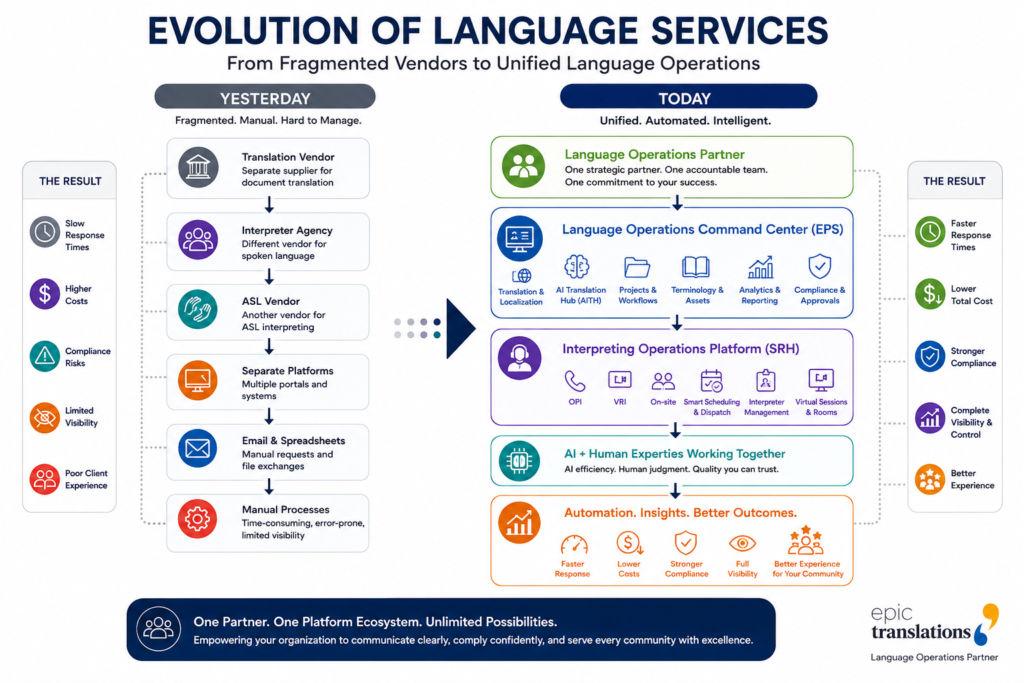
For decades, organizations purchased translation, interpreting, localization, and accessibility services as separate transactions. A department emailed a document for translation. A school requested an interpreter. A hospital called an over-the-phone interpreting provider. A court engaged a separate American Sign Language vendor. Reporting, approvals, terminology, budgets, compliance records, and service history were often distributed across multiple vendors, inboxes, spreadsheets, and systems.
That model is becoming increasingly difficult to sustain.
Government agencies, school systems, healthcare organizations, courts, legal firms, international nonprofits, and global enterprises now operate in environments where multilingual communication is continuous, cross-functional, regulated, and increasingly technology-dependent. They need more than access to linguists. They need a coordinated operating model that connects professional language expertise, artificial intelligence, workflow automation, secure platforms, reporting, and organizational oversight.
This is the purpose of a Modern Language Operations Technology Stack.
A modern stack does not replace professional translators or interpreters. It gives them—and the organizations they serve—a stronger operational foundation. It brings people, technology, data, workflows, and governance together so language access can be delivered more consistently, securely, efficiently, and at scale.
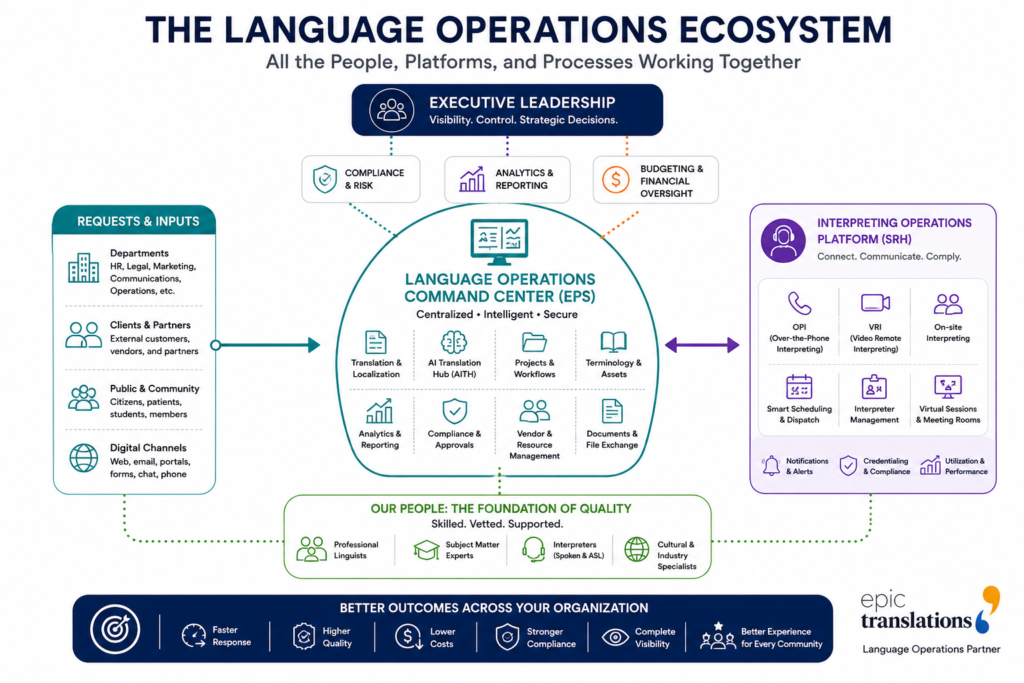
At EPIC Translations, this model is supported through an integrated ecosystem that includes:
- EPS, the Language Operations Command Center for translation, localization, multilingual content, projects, AI-assisted workflows, terminology, reporting, and operational oversight.
- SRH, the Interpreting Operations Platform for over-the-phone interpreting, video remote interpreting, on-site interpreting, scheduling, dispatch, interpreter management, virtual sessions, credentialing, and performance visibility.
- AITH, the AI Translation Hub that supports governed, human-reviewed AI translation workflows within a broader quality and operational framework.
- A nationwide network of professional linguists, interpreters, subject-matter experts, project managers, and quality professionals.
The central lesson for organizational leaders is clear:
The future of language services is not a choice between people and technology. It is the disciplined integration of human expertise, AI, automation, operational platforms, and intelligence.
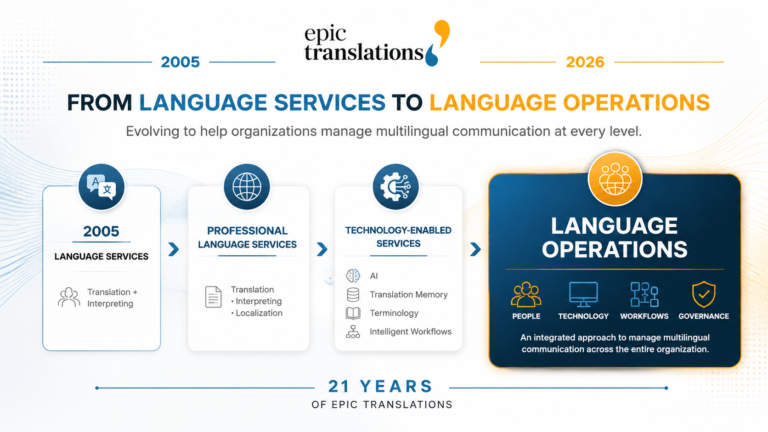
Language Services Were Built for Transactions. Organizations Now Need Operations.
The traditional language services model was designed around individual requests.
A document needed translation, so it was sent to a translation vendor.
A meeting required an interpreter, so an interpreting agency was contacted.
An American Sign Language accommodation was needed, so an ASL provider was engaged.
A multilingual brochure required formatting, so a desktop publishing specialist was added.
Each service could be delivered successfully on its own. The problem emerged as the number of requests, departments, languages, stakeholders, vendors, and compliance obligations increased.
Many organizations now find themselves managing:
- Multiple language vendors
- Separate portals and logins
- Email-based requests
- Spreadsheets used for tracking
- Inconsistent approval processes
- Decentralized departmental spending
- Limited visibility into service utilization
- Repeated document uploads
- Separate interpreter databases
- Disconnected translation and interpreting records
- Inconsistent terminology
- Limited reporting for leadership
- Unclear AI usage
- Fragmented compliance documentation
The challenge is no longer simply obtaining a translation or finding an interpreter.
The challenge is coordinating multilingual communication across an entire organization.
That is the difference between purchasing language services and managing Language Operations.
What Are Language Operations?
Language Operations is the coordinated management of the people, processes, technology, data, governance, and services required to support multilingual communication across an organization.
It can include:
- Translation and localization
- Over-the-phone interpreting
- Video remote interpreting
- On-site interpreting
- American Sign Language interpreting
- Transcription and captioning
- Multilingual desktop publishing
- AI-assisted translation
- Human linguistic review
- Terminology management
- Interpreter scheduling and dispatch
- Document and project workflows
- Departmental approvals
- Budget and utilization reporting
- Language access documentation
- Security and privacy controls
- Performance measurement
- Continuous improvement
Language Operations treats these functions as parts of one connected system rather than as unrelated purchases.
This matters because language access now affects almost every major organizational function.
For a government agency, it can affect public benefits, emergency communications, transportation, hearings, community engagement, and public notices.
For a school system, it can affect parent communication, individualized education meetings, enrollment, student services, disciplinary matters, board meetings, and community outreach.
For a healthcare organization, it can affect scheduling, registration, informed consent, clinical communication, patient education, discharge instructions, telehealth, and health equity.
For courts and legal organizations, it can affect due process, testimony, evidence, attorney-client communication, hearings, filings, and accessibility.
For an international nonprofit or global enterprise, it can affect program delivery, workforce communication, compliance, customer experience, brand consistency, and global growth.
Once multilingual communication reaches this level of complexity, it can no longer be managed effectively through isolated vendor transactions.
What Is a Modern Language Operations Technology Stack?
A Language Operations Technology Stack is the connected set of human, technological, and operational capabilities an organization uses to manage multilingual communication and language access.
It is not one software application.
It is not simply a translation management system.
It is not an interpreter scheduling calendar.
It is not an AI translation tool.
It is the broader architecture that brings these capabilities together.
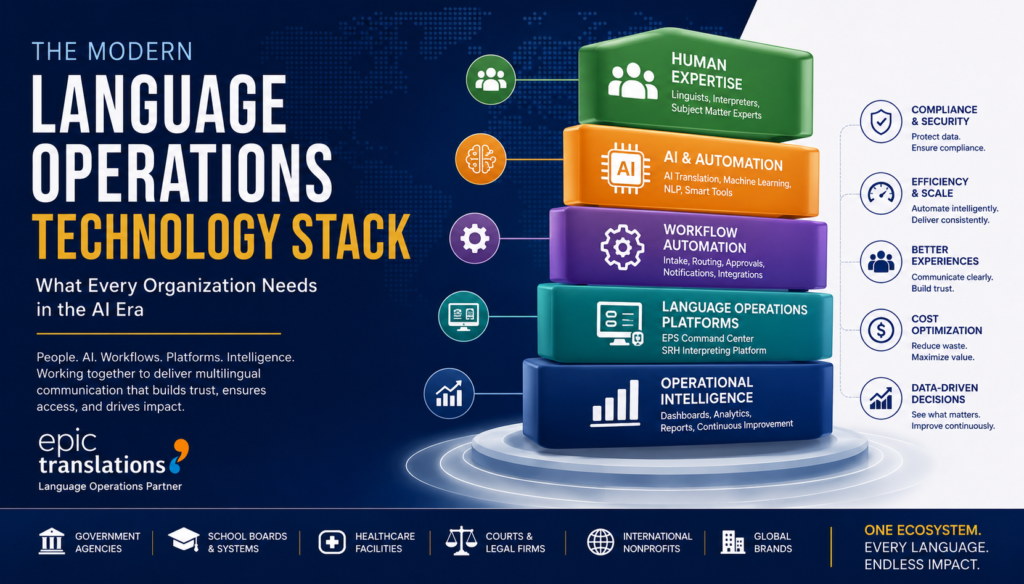
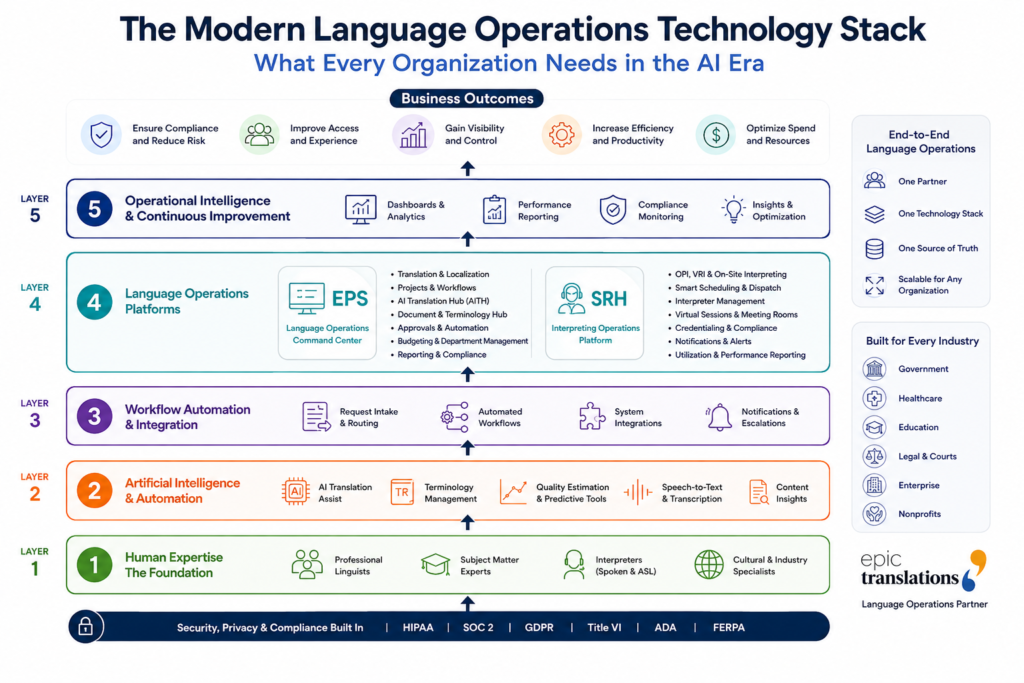
A complete Language Operations Technology Stack should contain five layers:
- Human Expertise
- Artificial Intelligence and Automation
- Workflow Automation and Integration
- Language Operations Platforms
- Operational Intelligence and Continuous Improvement
These layers work together rather than independently.
Human expertise provides judgment, cultural understanding, subject-matter knowledge, accountability, and quality.
AI accelerates appropriate tasks, identifies patterns, supports translation workflows, assists terminology use, and reduces repetitive work.
Workflow automation routes requests, manages approvals, sends notifications, captures records, and connects systems.
Operational platforms provide the centralized environment in which translation, interpreting, projects, linguists, documents, and services are managed.
Operational intelligence turns activity into visibility through reporting, analytics, performance measurement, and continuous improvement.
Security, privacy, compliance, and governance must support every layer.
This is the core difference between purchasing isolated technologies and building a true operational stack.
Layer 1: Human Expertise Remains the Foundation
Artificial intelligence has changed language services, but it has not eliminated the need for professional language expertise.
Language is not merely a substitution exercise in which one word is exchanged for another. Meaning depends on context, audience, culture, purpose, tone, risk, subject matter, and intended outcome.
Professional translators remain essential for high-risk content where accuracy, accountability, subject-matter expertise, and human judgment cannot be compromised.
A modern language operation therefore still depends on:
- Professional translators
- Spoken-language interpreters
- American Sign Language interpreters
- Subject-matter experts
- Editors and reviewers
- Localization professionals
- Multilingual desktop publishing specialists
- Project managers
- Quality assurance professionals
- Cultural and industry specialists
Their roles may evolve as technology improves, but their judgment becomes more important—not less—in high-impact environments.
A professional linguist must often determine whether language is technically accurate, culturally appropriate, legally defensible, clinically safe, educationally understandable, or consistent with an organization’s established terminology.
An interpreter must do more than convert speech. The interpreter must manage accuracy, register, neutrality, turn-taking, context, confidentiality, and communication dynamics in real time.
AI can support these professionals. It cannot assume full accountability for every outcome.
This is especially important in public-sector, healthcare, education, legal, and regulated enterprise environments, where language errors may affect rights, safety, access, trust, or compliance.
The most effective language operations model is therefore not human versus AI.
It is human expertise strengthened by appropriately governed technology.
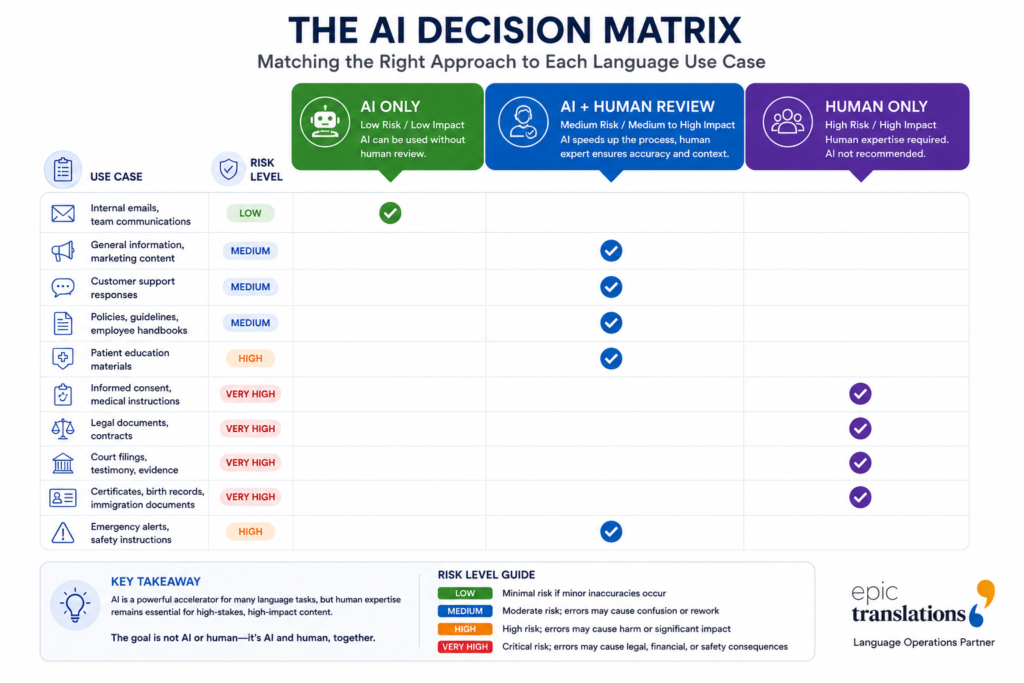
Layer 2: Artificial Intelligence Must Be Applied According to Risk
AI can improve speed, scalability, terminology consistency, content analysis, transcription, workflow routing, and first-pass translation.
However, not every use case should be treated the same way.
An internal message used by a small team may tolerate a different level of risk than:
- A patient consent form
- A court filing
- An emergency alert
- A special education document
- A benefits eligibility notice
- A legal contract
- A public safety instruction
- A document submitted to a regulatory authority
The correct question is not:
“Should our organization use AI for language services?”
The better question is:
“Where can AI add value, what risks are present, and what level of human oversight is required?”
A mature organization should classify language work according to factors such as:
- Consequences of an error
- Legal or regulatory significance
- Audience vulnerability
- Confidentiality
- Subject-matter complexity
- Need for cultural adaptation
- Public visibility
- Brand impact
- Required certification
- Need for traceability
- Reversibility of harm
NIST’s AI Risk Management Framework similarly emphasizes governance, context, measurement, and active risk management rather than treating AI as a one-size-fits-all capability. Its core functions—Govern, Map, Measure, and Manage—provide a useful general model for responsible organizational adoption.
For language operations, that principle should translate into clear service pathways.
AI-only workflows
These may be appropriate for limited, low-impact uses where the audience understands the limitations and minor imperfections are unlikely to cause meaningful harm.
Examples may include:
- Internal working notes
- Preliminary content understanding
- Noncritical internal communication
- Early-stage content classification
- Search and summarization support
AI-assisted, human-reviewed workflows
These are often appropriate when speed and efficiency matter, but accuracy, context, quality, or brand integrity still require professional review.
Examples may include:
- General public information
- Marketing content
- Employee communications
- Policies and handbooks
- Patient education materials
- Multilingual web content
- Public outreach materials
- High-volume document programs
Human-led workflows
These should remain the standard where errors could affect rights, safety, legal outcomes, clinical decisions, or formal acceptance.
Examples may include:
- Certified translations
- Court filings and evidence
- Immigration documents
- Contracts
- Informed consent materials
- Critical medical instructions
- Sworn testimony
- High-risk emergency communications
The purpose of AI governance is not to prevent innovation.
It is to ensure that efficiency is never confused with fitness for purpose.
Layer 3: Workflow Automation Turns Services Into an Operating System
Many language programs do not fail because an organization cannot find qualified linguists.
They fail because the surrounding workflow is fragmented.
Requests arrive through email.
Important information is missing.
Files are attached without context.
Departments do not know which service to select.
Approvals happen inconsistently.
Project status is difficult to see.
Interpreter scheduling requires multiple phone calls.
Urgent requests are mixed with routine work.
Records are spread across inboxes and spreadsheets.
Invoices cannot easily be connected to departments, locations, languages, or programs.
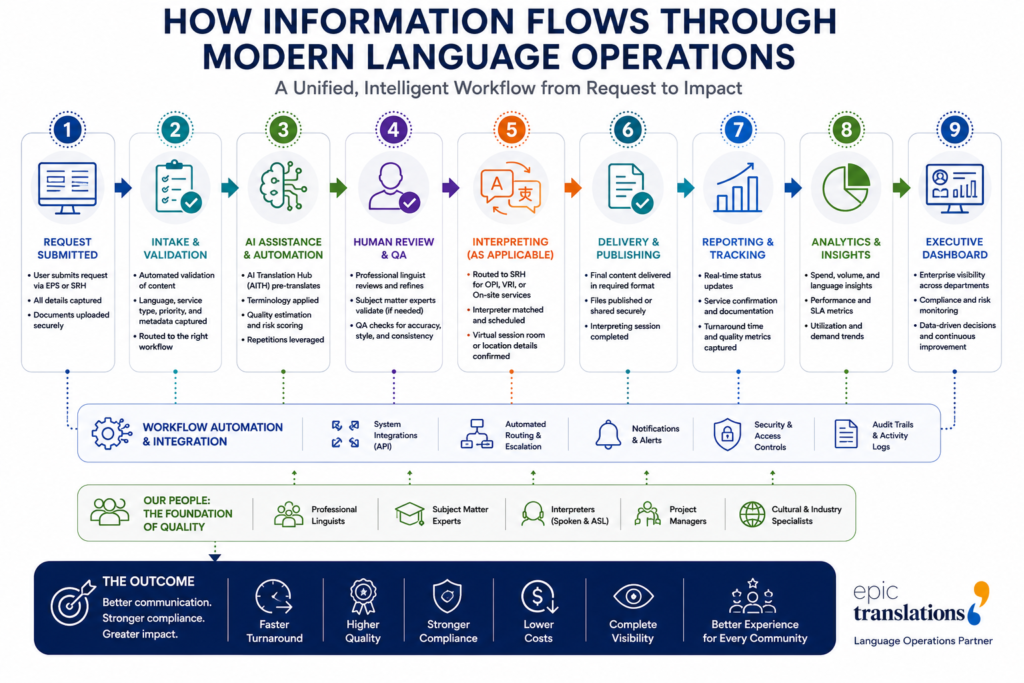
Workflow automation addresses these problems by creating a repeatable path from request to outcome.
A modern workflow can:
- Capture service requirements through structured intake
- Validate required fields
- Identify language and service type
- Route work according to urgency or subject matter
- Apply terminology and client preferences
- Trigger approvals
- Match interpreters according to qualifications and availability
- Send status notifications
- Record activity and turnaround time
- Store documents securely
- Document service completion
- Generate reports
- Escalate exceptions
- Maintain audit trails
Automation does not mean removing people from the process.
It means allowing people to focus on decisions that require judgment while the platform handles predictable, repetitive, and administrative work.
For executives, the value is control.
For procurement teams, it is accountability.
For operational teams, it is consistency.
For requesters, it is simplicity.
For linguists and interpreters, it is clearer information and fewer administrative barriers.
For the communities being served, it is faster and more reliable access.
Layer 4: Language Operations Require Purpose-Built Platforms
The fourth layer is where the operating model becomes tangible.
Organizations need platforms that can manage both written and spoken language services without forcing every department to invent its own process.
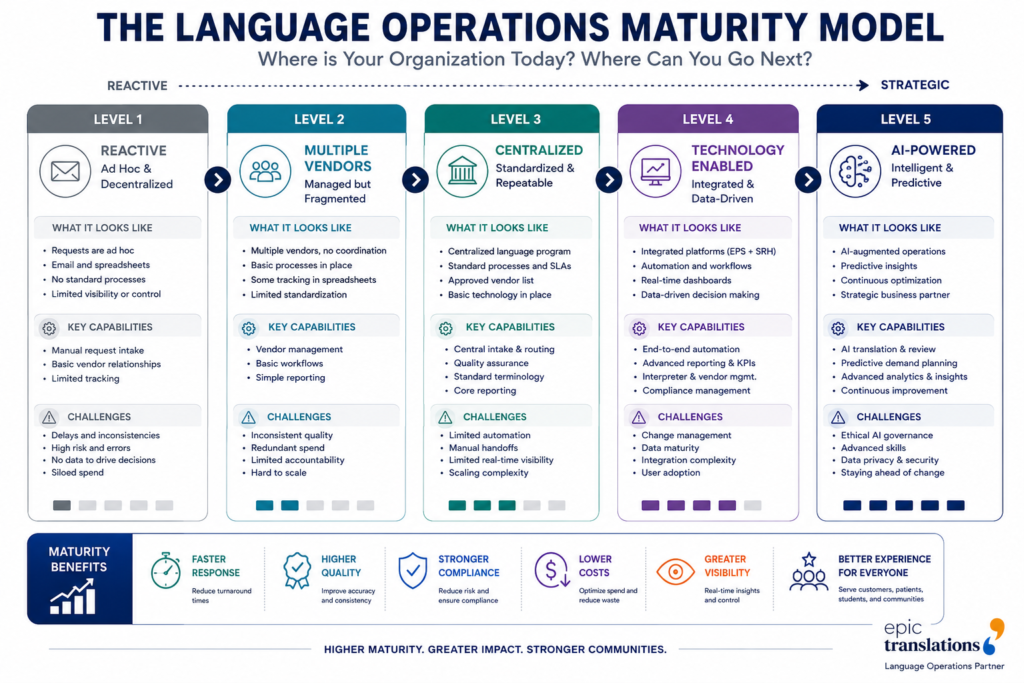
At EPIC, these capabilities are organized through two connected operational platforms:
EPS: The Language Operations Command Center
EPS serves as the central operational environment for written language services, multilingual content, projects, and organizational oversight.
It is designed to support functions such as:
- Translation and localization requests
- Secure document intake and exchange
- Project and workflow management
- Human-reviewed AI translation
- AITH-supported workflows
- Terminology management
- Translation memory and multilingual assets
- Approvals
- Department and organizational structures
- Vendor and linguist coordination
- Quote and project tracking
- Reporting and analytics
- Compliance documentation
- Budget and utilization visibility
The phrase Language Operations Command Center is intentional.
A conventional client portal allows a user to submit a request.
A command center provides a broader level of operational awareness.
It helps an organization answer questions such as:
- What language work is active?
- Which departments are submitting requests?
- Which languages are increasing in demand?
- Where are approvals delayed?
- What content has already been translated?
- Which terminology should be reused?
- What work can be accelerated through AI?
- What requires human-only processing?
- How much is being spent?
- What service levels are being achieved?
- What documentation is available for oversight or compliance?
EPS is therefore not positioned merely as a place to upload files.
It is the operational hub through which multilingual content can be planned, managed, governed, and improved.
SRH: The Interpreting Operations Platform
Interpreting requires a different operational model.
Unlike document translation, interpreting depends on time, availability, modality, qualifications, scheduling, dispatch, user access, and real-time service delivery.
SRH is designed to support that environment.
Its functions include:
- Over-the-phone interpreting
- Video remote interpreting
- On-site interpreting
- Scheduled and on-demand requests
- Smart scheduling and dispatch
- Interpreter availability management
- Linguist profiles
- Credential and compliance tracking
- Virtual sessions and meeting rooms
- Assignment acceptance
- Notifications and alerts
- Client self-service
- Usage and performance reporting
- Interpreter workforce management
- Service history and operational visibility
The phrase Interpreting Operations Platform reflects this broader role.
A scheduling system may place an appointment on a calendar.
An Interpreting Operations Platform coordinates the complete service lifecycle—from request and matching through delivery, documentation, reporting, and improvement.
This distinction is especially important for organizations managing large numbers of locations, departments, schools, facilities, courtrooms, clinics, employees, or community users.
Why EPS and SRH Are Separate but Connected
Written translation and real-time interpreting share a common mission, but their operational requirements are different.
Translation is primarily content- and project-driven.
Interpreting is primarily people-, availability-, and session-driven.
Trying to force both into one generic workflow can make each less effective.
EPIC’s model gives each area a purpose-built operational environment while connecting them through a larger Language Operations ecosystem.
Together, EPS and SRH create:
- Shared organizational visibility
- Coordinated workflows
- Centralized reporting
- Better departmental accountability
- Consistent service access
- Broader language utilization data
- Unified operational oversight
- One strategic partnership
EPS manages multilingual content and written communication.
SRH manages real-time interpreted communication and interpreter resources.
Together, they allow organizations to manage what gets communicated, how it gets delivered, who supports it, and what the organization learns from the activity.
Layer 5: Operational Intelligence Turns Activity Into Better Decisions
Language services have historically been difficult for leadership to evaluate.
Invoices may show how much was spent, but not necessarily:
- Which departments generated the demand
- Which languages were requested
- Which service types were most frequently used
- Whether response times met expectations
- Where urgent requests occurred
- Whether the same content was translated repeatedly
- Which interpreters or workflows performed best
- Whether usage is increasing or declining
- Where compliance documentation is stored
- Whether AI-assisted workflows are producing meaningful savings
- Where service gaps remain
Operational intelligence changes that.
It turns language activity into information that leaders can use.
A mature Language Operations Technology Stack should support:
- Demand reporting
- Language trend analysis
- Departmental utilization
- Location-level activity
- Spend visibility
- Turnaround measurement
- Interpreter utilization
- Assignment fill rates
- Quality indicators
- SLA performance
- Requester behavior
- Compliance records
- Audit trails
- Forecasting
- Continuous improvement
This is one of the most important differences between a vendor and a Language Operations Partner.
A vendor completes the requested transaction.
A Language Operations Partner helps the organization understand the operation itself.
That insight can lead to better budgeting, faster service, more appropriate modality selection, improved staffing, stronger compliance practices, and a better experience for the people who depend on language access.
What This Technology Stack Means for Different Organizations
The architecture is consistent, but its application differs by industry.
Government Agencies
Federal, state, regional, and local agencies often manage language access across multiple programs, offices, funding sources, public-facing services, and legal obligations.
A modern stack can support:
- Centralized public-sector requests
- Translation of notices, forms, websites, and program materials
- OPI, VRI, on-site, and ASL interpreting
- Department and program tracking
- Emergency and time-sensitive communication
- Public meeting support
- Usage documentation
- Vendor consolidation
- Accessibility coordination
- Reporting for leadership and oversight
Title VI prohibits discrimination based on race, color, or national origin in federally funded programs, while longstanding federal language-access frameworks have focused on meaningful access for people with limited English proficiency. The federal policy environment has continued to evolve, which makes documented, adaptable operational practices especially important.
The operational lesson is broader than any one policy:
Agencies should be able to show how language needs are identified, how assistance is delivered, and how activity is documented.
School Boards and School Systems
School systems communicate with students, parents, guardians, educators, specialists, and community members across a wide range of sensitive contexts.
A modern stack can support:
- Parent and guardian communication
- Enrollment materials
- Individualized education meetings
- Student services
- Board and public meetings
- Disciplinary communication
- Emergency notices
- School-level access
- Interpreter scheduling
- On-demand VRI and OPI
- Centralized district reporting
The U.S. Department of Education states that schools must communicate important school-related information to limited-English-proficient parents in languages they can understand.
For school leaders, the practical challenge is making services accessible without creating administrative complexity at every school.
A platform-driven model can allow approved users to access language support while preserving district-level visibility, controls, and reporting.
Healthcare Facilities and Hospitals
Healthcare language access affects both patient experience and patient safety.
The need can arise during:
- Scheduling
- Registration
- Triage
- Clinical encounters
- Informed consent
- Telehealth
- Patient education
- Discharge
- Pharmacy communication
- Billing and financial assistance
- Community health programs
HHS guidance associated with Section 1557 states that covered entities must take reasonable steps to provide meaningful access to individuals with limited English proficiency.
A healthcare-oriented language operations stack should therefore support not only rapid interpreter access, but also:
- Appropriate interpreter modality
- Documentation
- Secure workflows
- High-risk content review
- ASL access
- Department and facility reporting
- Quality oversight
- AI governance
- Patient communication continuity
Courts and Legal Firms
Legal communication requires precision, confidentiality, neutrality, and traceability.
Courts may need interpreting and translation across:
- Hearings
- Trials
- Testimony
- Evidence
- Filings
- Public service counters
- Forms
- Notices
- Attorney communication
- Depositions
- Transcription
Legal firms may also need multilingual support for contracts, discovery, immigration matters, investigations, compliance, and international transactions.
The correct technology model must preserve human expertise in high-risk legal work while improving scheduling, file handling, workflow visibility, and reporting.
International Nonprofits
Nonprofits often operate across countries, funding sources, programs, partners, and communities.
Their challenges may include:
- Multilingual program materials
- Grant and donor communication
- Community outreach
- Interpretation
- Emergency response
- Research
- Training
- Monitoring and evaluation
- Global consistency
- Limited internal resources
A platform approach can help them standardize workflows without losing the flexibility needed for diverse field environments.
Global Brands
Global enterprises must maintain consistency across markets while adapting content to local audiences.
Their stack may need to support:
- Product and service localization
- Marketing
- Legal and compliance content
- Employee communication
- Customer support
- Technical documentation
- Training
- Multilingual websites
- Terminology
- Brand governance
- Analytics
- AI-assisted scale
For these organizations, language operations becomes part of global business infrastructure rather than a downstream content task.
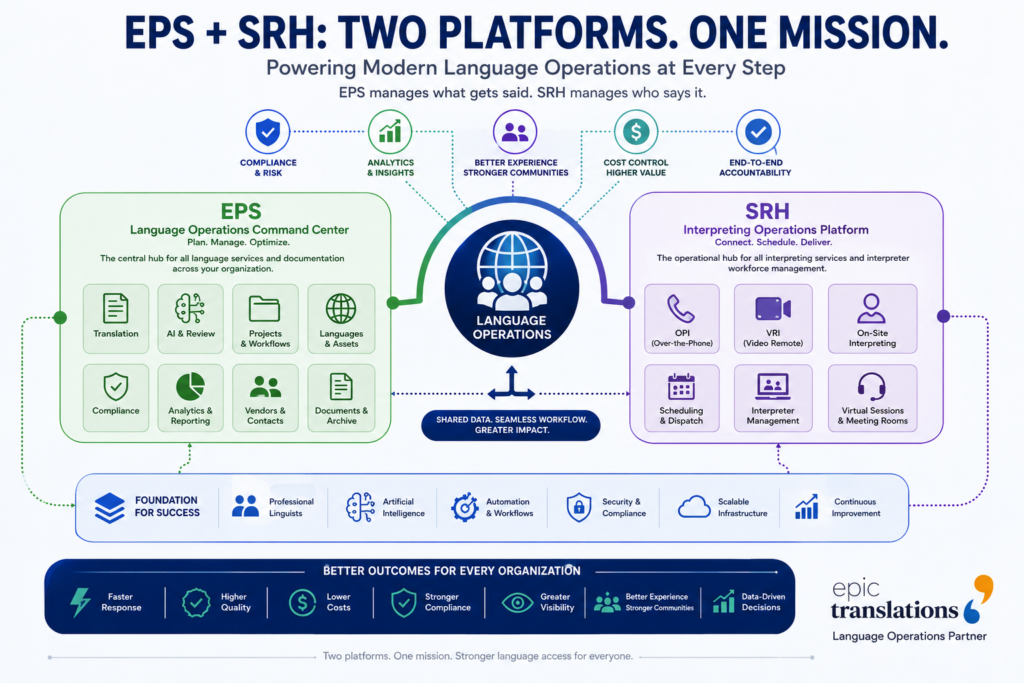
The Language Operations Maturity Model
Not every organization will implement the complete stack at once.
Most progress through recognizable stages.
Level 1: Reactive
Requests are handled individually through email, phone calls, and informal processes.
The organization has limited visibility and depends heavily on specific employees to coordinate services.
Level 2: Multiple Vendors
The organization has established provider relationships, but services remain fragmented.
Some tracking exists, although reporting and standardization are limited.
Level 3: Centralized
Requests, vendors, terminology, and service processes are increasingly standardized.
Leadership begins receiving meaningful utilization and performance information.
Level 4: Technology-Enabled
Platforms such as EPS and SRH support integrated workflows, automation, dashboards, approvals, and coordinated service delivery.
Level 5: AI-Powered and Continuously Improving
AI is applied according to governed risk models.
Data supports forecasting and optimization.
Human expertise, technology, workflows, and operational intelligence function as one system.
The objective is not to reach Level 5 merely to claim technological sophistication.
The objective is to create a language operation that is more responsive, accountable, scalable, and effective.
What Organizations Should Look for in a Language Operations Partner
Not every language services provider is prepared to support this operating model.
Organizations should evaluate potential partners based on whether they can provide the following.
Comprehensive Service Coverage
The provider should be able to support written, spoken, signed, and technology-enabled communication rather than forcing the client to coordinate unrelated vendors.
Human Expertise
The provider should maintain access to qualified linguists, interpreters, subject-matter experts, reviewers, and project managers.
AI Governance
The provider should be able to explain:
- Where AI is used
- Where it is not used
- What human review is provided
- How confidential information is handled
- How quality is evaluated
- How risk determines the workflow
- How AI activity is governed and documented
Operational Platforms
Clients should have structured ways to submit, manage, track, and report on services.
Interpreting Infrastructure
The provider should be able to manage OPI, VRI, on-site, and ASL workflows, including scheduling, matching, credentialing, delivery, and reporting.
Security and Privacy
The operational model should include appropriate controls for data access, secure file exchange, confidentiality, documentation, and retention.
Reporting and Visibility
The organization should be able to understand service activity rather than depend only on invoices and email records.
Scalability
The model should work across departments, locations, languages, programs, and changing demand.
Strategic Guidance
The provider should help the organization determine how to improve—not simply wait for the next transaction.
This is where the distinction between a traditional vendor and a Language Operations Partner becomes most visible.
EPIC’s Model for the New Era of Language Services
EPIC Translations was established as a professional language services organization, but the needs of clients have evolved.
Organizations today require more than linguistic capacity.
They require:
- Simplified access
- Centralized management
- Qualified professionals
- AI-enabled efficiency
- Secure workflows
- Flexible service delivery
- Operational reporting
- Better user experiences
- Strategic partnership
EPIC’s Language Operations ecosystem has been developed around those requirements.
EPS provides the Language Operations Command Center for written content, translation projects, AI-assisted workflows, assets, approvals, documentation, reporting, and organizational oversight.
SRH provides the Interpreting Operations Platform for OPI, VRI, on-site interpreting, scheduling, dispatch, interpreter management, virtual delivery, compliance, and performance visibility.
AITH supports governed AI translation workflows that remain connected to human review, terminology, project management, and quality processes.
EPIC’s professional linguists and interpreters remain the foundation across all three.
This creates a model in which:
- Technology makes services easier to access.
- AI accelerates appropriate work.
- Human experts protect quality and context.
- Automation improves consistency.
- Platforms create operational visibility.
- Reporting supports better decisions.
- One partner remains accountable for the complete ecosystem.
That is what consuming language services as a platform should mean.
It should not mean replacing service with software.
It should mean delivering professional language services through a more intelligent, visible, scalable, and user-centered operating environment.
The Future Is Not Fully Automated. It Is Fully Orchestrated.
The language services industry is often described through a simple debate:
Will AI replace human translators and interpreters?
That question is too narrow.
The more consequential change is not replacement.
It is orchestration.
The future belongs to organizations that can coordinate:
- Human expertise
- AI
- Translation technology
- Interpreter delivery
- Secure data
- Workflow automation
- Organizational access
- Compliance
- Analytics
- Continuous improvement
A disconnected collection of tools will not be enough.
A large linguist network alone will not be enough.
AI alone will not be enough.
The winning model is an operational ecosystem in which each component performs the role it is best suited to perform.
Humans provide judgment, accountability, empathy, cultural intelligence, and subject-matter understanding.
AI provides speed, pattern recognition, assistance, and scale.
Platforms provide structure.
Automation provides consistency.
Data provides visibility.
Leadership provides governance.
A Language Operations Partner brings them together.
Conclusion: Build the Operation, Not Just the Vendor List
Organizations should no longer evaluate language services solely by asking:
“Can this provider translate our documents?”
or:
“Can this provider supply an interpreter?”
Those questions remain important, but they are incomplete.
The more strategic questions are:
- Can this partner support multilingual communication across our entire organization?
- Can employees and departments access services efficiently?
- Can we manage translation and interpreting through connected platforms?
- Can the provider combine AI and human expertise responsibly?
- Can leadership see what is happening?
- Can we document service delivery?
- Can the model scale?
- Can it support compliance, quality, security, and continuous improvement?
- Can the partner help us prepare for what comes next?
The organizations best positioned for the AI era will not treat language access as a collection of isolated transactions.
They will manage it as an integrated operational function.
They will build a Language Operations Technology Stack.
And they will choose a partner capable of bringing the entire system together.
EPIC Translations has built that model.
Through EPS, SRH, AITH, professional linguists, interpreters, structured quality processes, and technology-enabled workflows, EPIC helps government agencies, school systems, healthcare organizations, courts, legal firms, international nonprofits, and global enterprises manage multilingual communication with greater clarity, accountability, and scale.
The future of language services is not simply faster translation.
It is better Language Operations.
Call to Action
Build a Modern Language Operation With EPIC
Your organization should not have to choose between professional expertise and modern technology.
EPIC brings them together.
Through our Language Operations ecosystem, your teams can access translation, interpreting, AI-assisted workflows, project management, secure document exchange, reporting, and operational visibility through one strategic partnership.
Whether you are modernizing an existing language access program, consolidating multiple vendors, preparing for responsible AI adoption, or looking for a more scalable way to serve multilingual communities, EPIC can help you build the right operating model.
Talk with EPIC about your Language Operations strategy.
FAQs
What is a Language Operations Technology Stack?
A Language Operations Technology Stack is the combination of human expertise, AI, workflow automation, operational platforms, security, and analytics used to manage multilingual communication across an organization.
What is a Language Operations Command Center?
A Language Operations Command Center is a centralized platform for managing translation, localization, multilingual content, projects, approvals, terminology, documents, reporting, and organizational oversight. EPS serves this role within EPIC’s ecosystem.
What is an Interpreting Operations Platform?
An Interpreting Operations Platform manages OPI, VRI, on-site interpreting, scheduling, dispatch, interpreter availability, credentialing, virtual sessions, service documentation, and performance reporting. SRH serves this role within EPIC’s ecosystem.
Does AI replace professional translators and interpreters?
No. AI can accelerate appropriate language workflows, but professional expertise remains essential for context, quality, cultural accuracy, accountability, high-risk content, and real-time interpreted communication.
How should organizations decide when to use AI translation?
Organizations should evaluate the potential consequences of an error, the sensitivity of the content, the intended audience, subject-matter complexity, confidentiality, and legal or regulatory significance. Higher-risk content generally requires stronger professional oversight.
Can one platform manage both translation and interpreting?
Translation and interpreting share common organizational needs but involve different operational workflows. A strong ecosystem can connect them while using purpose-built platforms for written language services and real-time interpreting.
Who needs a Language Operations Technology Stack?
It is particularly valuable for organizations with recurring multilingual communication needs, multiple departments or locations, compliance obligations, diverse service types, or a need for centralized reporting. This includes government agencies, schools, healthcare systems, courts, legal organizations, nonprofits, and global enterprises.
How is a Language Operations Partner different from a traditional language vendor?
A traditional vendor primarily fulfills individual requests. A Language Operations Partner supports the broader operating model, including services, technology, workflows, data, reporting, governance, scalability, and continuous improvement.