Staffing Resources Hub
SRH is the platform EPIC built to run interpreting services for organizations that have more than one location, more than one budget holder and more than one language to account for. It is not licensed software you have to implement. It comes with the service.
One platform for every interpreting modality.
An organization rarely needs only one kind of interpreting. A hearing needs someone in the room, a clinic call needs someone on the line in ninety seconds, a deaf constituent needs a qualified ASL interpreter, and a public meeting needs live captioning. Splitting those across separate vendors and separate systems is what makes language access hard to manage. SRH holds all of them in one place.
How a request moves through the platform.
An authorized user raises a request against their location and department, choosing the modality, the language and the time.
EPIC’s team assigns an appropriately qualified linguist. The assignment, and who holds it, is visible on the record rather than held in an inbox.
The session runs. Duration, modality and location are captured on the record as it happens, not reconstructed afterwards.
If an assigned interpreter becomes unavailable, the request can be reassigned through the same record instead of restarting as a new one.
Completed activity rolls up by department, location, language and service type for the people who have to account for the spend.
Because every session carries its own identifier, an individual line on an invoice can be traced back to the request that produced it.
What an administrator can see.
The difference between a language-services vendor and a language-access program is whether anyone can answer questions about it without asking the vendor. These are the questions SRH is built to answer from inside the organization.
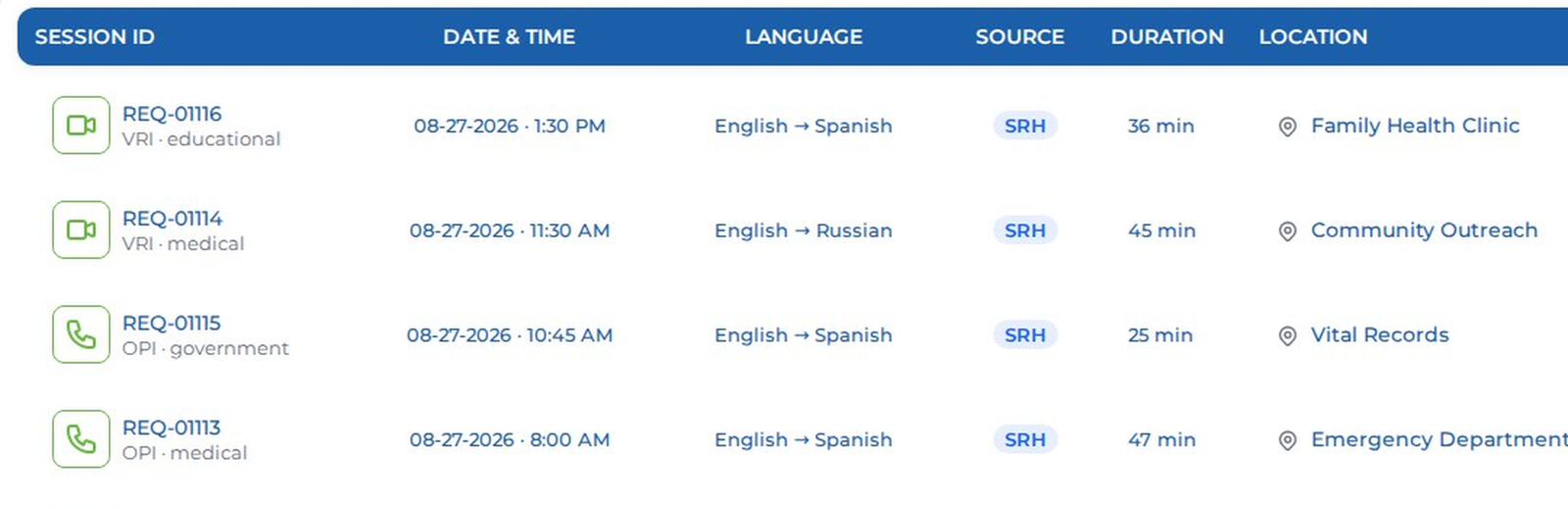
Which parts of the organization are actually requesting language support, and how often.
Which offices, clinics or campuses generate demand — the basis for planning rather than reacting.
Which languages a community is actually asking for, which is frequently not the list an organization assumed.
How much is phone, video, on-site, ASL or captioning, so the mix can be planned deliberately.
Consumption tracked against the contract, by the people responsible for the budget code.
What was requested, what was delivered, by whom and for how long — on the record, per session.
Interpreter credentials are tracked, not taken on trust.
A credential that expired last quarter is the same risk as no credential at all.
Court-certified, medical-certified and nationally certified ASL interpreter credentials are recorded in SRH with their expiry dates, and assignment decisions are made against that record. For an agency, that is the difference between a vendor asserting its interpreters are qualified and being able to show how that is maintained.
Where a contract requires interpreters to meet a specific standard for a specific setting, that requirement is applied at assignment rather than checked after the fact.
Access and security.
- Who gets an account
- Authorized users at the organization. Accounts are scoped to the location and department they belong to, so a user sees their own activity rather than the whole organization’s.
- Administrator view
- Nominated administrators see across departments and locations for reporting and oversight.
- Authentication
- Individual accounts with multi-factor authentication. Shared logins are not required for a team to use the platform.
- Data in transit
- TLS-encrypted. Role-based access limits what an account can reach.
- Implementation
- SRH is provided as part of EPIC’s service. There is no separate licence to buy and no software for the organization to host.
- Where it lives
- staffingresourceshub.com
How organizations get access to it.
With an EPIC contract
SRH comes with the service. Organizations contracting with EPIC for interpreting are set up with their own structure — departments, locations and approvers — before the first request is raised.
Request a QuoteThrough a cooperative
EPIC holds TIPS contract 211002. TIPS member agencies can purchase interpreting services, and the platform that runs them, without conducting a separate solicitation.
Cooperative purchasingThrough a solicitation
If your organization is running an RFP or an IFB, send it over. The platform, its reporting and its access model can be described directly against your requirements.
Procurement information