Software Localization Services
Is Your Software Ready for Users Outside the U.S.?
EPIC helps organizations localize software applications, digital platforms and user-facing interfaces for multilingual audiences.
From menus, buttons and system messages to help content, terminology and supporting documentation, software localization requires language to work within the structure and context of the product—not simply exist as translated strings.
Whether you’re localizing an established software product or supporting ongoing releases, EPIC provides scalable localization workflows across 200+ languages.
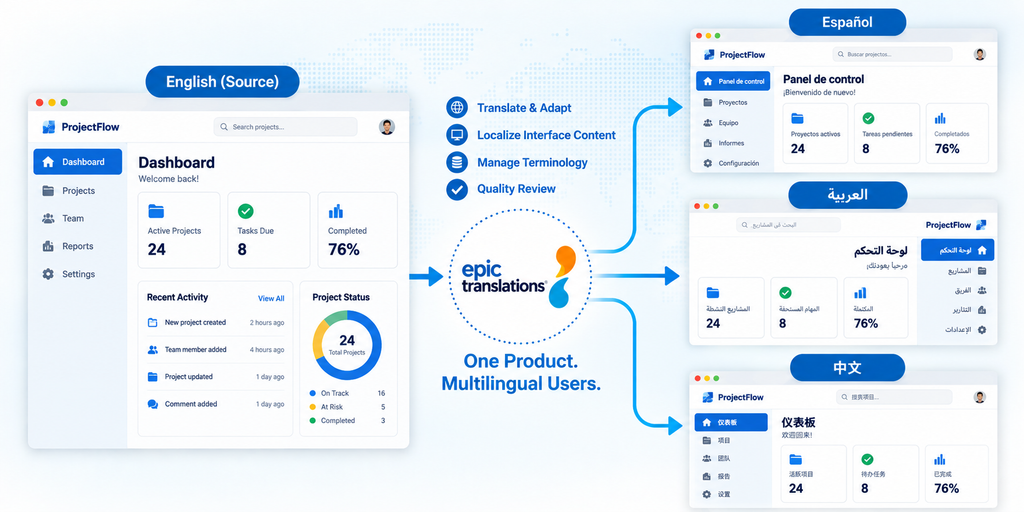
What Software Localization Means at EPIC
Software localization adapts user-facing software content for different languages and audiences while accounting for terminology, interface context, character expansion, language direction and other language-specific requirements.
EPIC coordinates the linguistic components of software localization so translated content remains clear, consistent and appropriate within the context in which users encounter it.
Depending on the project, localization may include interface strings, menus, buttons, notifications, error messages, help content, onboarding experiences and related software documentation.

Since 2005
20+ years of continuous operation

200+ Languages
Language support for global audiences

25,000+
Qualified linguists

Nationwide
Coverage across the United States
More Than Translating Software Strings
Context-Aware Localization
Qualified linguists localize software content according to meaning, interface context, terminology, audience and product requirements.
Interface & Language Adaptation
Localization accounts for language-specific considerations such as text expansion, character sets and right-to-left languages.
Structured Quality Review
Localized content is reviewed for linguistic quality, consistency, completeness and project-specific requirements before delivery.
Built for Organizations With Multilingual Software
Enterprise Software
Business applications, internal platforms, dashboards and software used across multilingual organizations.
SaaS Platforms
Cloud-based products, customer portals and subscription software serving users across languages and markets.
Government & Public Platforms
Digital systems, public-facing applications and agency software supporting multilingual communities.
Education & Healthcare Technology
Learning platforms, patient-facing systems and other software requiring clear multilingual user experiences.
From Source Software to Localized User Experience
1. Review Content & Requirements
Review source content, target languages, terminology, available context and project requirements.
2. Translate & Localize
Qualified linguists adapt software content according to meaning, interface context, terminology and audience.
3. Linguistic QA
Localized content is reviewed for accuracy, consistency, completeness and language-specific issues.
4. Prepare for Implementation
Approved localized content is delivered in the agreed format for implementation within the software environment.
What Can Be Localized?
Software localization can extend across the entire user experience—not just the primary interface.
User Interface Content
Menus, buttons, labels, fields, navigation and other user-facing interface text.
System Messages
Notifications, alerts, confirmations, warnings and error messages.
Onboarding & User Guidance
Setup instructions, walkthroughs, prompts and other content that helps users navigate the software.
Help & Support Content
Knowledge-base content, FAQs, in-product help and related support resources.
Product Terminology
Recurring product terms, feature names and approved terminology requiring consistency across the software.
Supporting Documentation
User guides, manuals, release information and other materials associated with the software.
Software Creates Unique Localization Challenges
Text Expansion & Contraction
Translated content may require more or less space than the source language, affecting interface elements with limited character space.
Right-to-Left Languages
Languages such as Arabic require consideration of text direction and the surrounding user experience.
Interface Context
Short strings can have different meanings depending on where and how they appear within the software.
Terminology Consistency
Product terminology should remain consistent across screens, features, help content and recurring software releases.
Software presents linguistic challenges that are different from ordinary document translation. Individual strings may be short, lack context or appear within interfaces with limited space, making context and terminology especially important.
Text Expansion & Contraction · Right-To-Left Languages · Interface Context · Terminology Consistency
Localization for Ongoing Software Releases
Software evolves continuously. New features are released, interfaces change and user-facing content is updated. EPIC can support both initial localization and recurring multilingual content as your software develops.
Initial Software Localization
Localize an existing application, platform or defined set of software content into one or multiple target languages.
New Features & Releases
Support localization as new features, interface content and software updates are introduced.
Terminology Continuity
Maintain approved terminology and language conventions across releases, features and recurring localization projects.
When to Choose Software Localization
Software localization is appropriate when:
- Your application or platform serves users across multiple languages.
- Interface text must work within specific software contexts.
- Product terminology needs to remain consistent across screens and features.
- New software releases require recurring localization.
- Error messages, notifications and user guidance need localization.
- Your software supports right-to-left or other language-specific requirements.
- You need professional linguistic review rather than publishing raw machine-translated interface content.
If you only need standalone documentation translated, EPIC’s document translation services may be more appropriate. When language is part of the software user experience itself, software localization provides a more comprehensive approach.
Managed Within EPIC’s Translation Workflow
EPS — Translation Project Management
Enterprise Project System (EPS) provides centralized management for translation projects, files, status and deliverables.
Translation Production
Software content can follow 100% Human Translation or Human-Reviewed AI Translation workflows according to project requirements and the selected production approach.
Related Multilingual Content
Supporting documentation, graphics and other product materials can be coordinated with the broader software localization project when required.
Why Organizations Choose EPIC for Software Localization
Qualified Linguists
Linguists are selected according to language, subject matter, audience and software project requirements.
Context-Aware Localization
Software content is localized with attention to where and how users encounter language within the product.
Terminology Consistency
Approved terminology can be maintained across interfaces, features, documentation and recurring releases.
Structured Quality Review
Localized content is reviewed for linguistic quality, completeness, consistency and applicable project requirements.
Ongoing Release Support
Support initial software localization as well as recurring content associated with product updates and new releases.
See How Ready Your Software Is for Localization
Complimentary Software Localization Readiness Review
Planning to take your English-language software into additional markets? Send us a representative sample, resource file, or screenshots. EPIC’s localization team will review it for potential localization issues and provide practical recommendations—at no cost.
Frequently Asked Questions About Software Localization Services
Find answers to common questions about software localization, interface content, multilingual releases, terminology and localization workflows.
What is Software localization?
Software localization adapts user-facing software content for another language or audience while accounting for terminology, interface context and language-specific requirements.
How is software localization different from software translation?
Translation addresses the language itself. Software localization also considers how translated language functions within the software experience, including interface context, text length, terminology and language-specific requirements.
How do you test localized software before release?
When included in the project scope, EPIC can support in-context linguistic review of localized software in a test or staging environment to identify issues such as incorrect terminology, truncated text, missing content and translations that do not work appropriately within the interface. Where the client’s development workflow supports it, pseudo-localization can also be used earlier in the process to help identify internationalization issues before translation and release.
Can EPIC localize SaaS platforms?
Yes. EPIC can support localization requirements for SaaS platforms and other software products according to the available content, target languages and project workflow.
Can EPIC support right-to-left languages?
Yes. EPIC supports languages written from right to left, including Arabic, and can account for applicable linguistic and content-direction requirements within the localization workflow.
What file formats does EPIC work with?
EPIC can work with common software localization formats, including PO/POT, RESX, Apple .strings and .stringsdict, Android strings.xml, JSON/ICU, XLIFF, .properties, ARB and YAML files. We can review your source files, development workflow and delivery requirements to determine the appropriate localization process and output format.
How does software localization work for ongoing releases?
EPIC can establish a recurring localization workflow around your release cycle. Depending on your development process, new or updated localization files can be provided to EPIC with each sprint or release through an agreed file-transfer or managed handoff process. EPIC localizes the changed content, maintains approved terminology and returns the localized files in the agreed format for implementation in the next build.
How many languages does EPIC support?
EPIC supports translation and localization across 200+ languages.
Does EPIC use AI for software localization?
EPIC offers different translation production approaches depending on project requirements, including 100% Human Translation and Human-Reviewed AI Translation. The appropriate workflow can be selected according to the content, organizational requirements and client preferences.
How does EPIC handle pluralization and language-specific message rules?
Pluralization rules vary significantly across languages and must be handled appropriately within localized software strings. Where applicable, EPIC can work with structured message formats such as ICU MessageFormat and language-specific plural categories defined by Unicode CLDR. This helps preserve variables, plural logic and other non-translatable syntax while linguists localize the language presented to users.
How do we get started?
Send EPIC information about your software, target languages, available content formats and localization requirements. Our team can review the project and determine an appropriate scope and workflow.