TRANSLATION TECHNOLOGY
Translation Technology Built for Modern Language Operations
Connect translation memory, AI-assisted translation, terminology, human review, quality assurance and project management in a structured workflow built for scale.
EPIC Translations combines professional linguists with purpose-built technology to help organizations manage multilingual content more efficiently—without sacrificing the human expertise required for quality, context and accuracy.
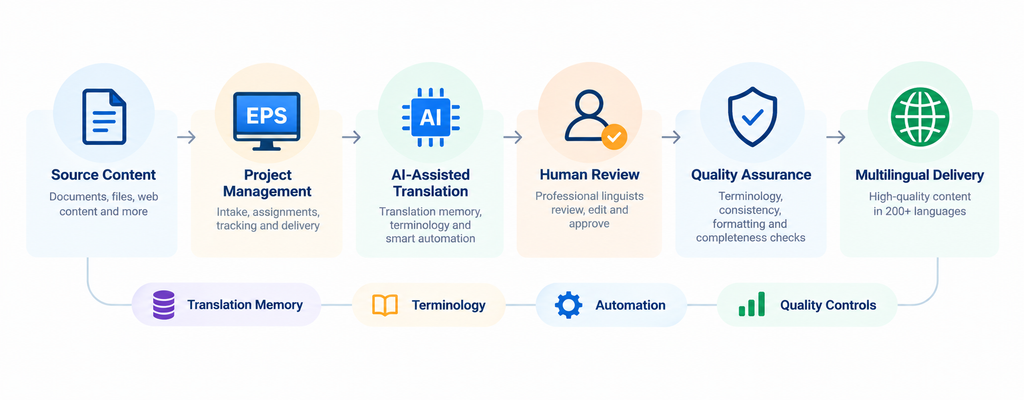
Translation Memory • Terminology • Automation • Quality Controls

Since 2005
Supporting organizations since 2005

200+ Languages
Translation, localization and multilingual production
25,000+ Linguists
Global professional language network

Human + Technology
Technology-enabled workflows with professional oversight
Translation Gets More Complex as Content Grows
BEYOND ONE-OFF TRANSLATION
Translating a single document is straightforward. Managing thousands of pages, recurring updates, multiple languages, approved terminology, previous translations and formatting requirements is not.
Organizations with ongoing multilingual content need a workflow that can answer questions such as:
What Have We Already Translated?
Identify previously approved translations and reusable content instead of starting over.
Which Terminology Should Be Used?
Maintain approved terminology, product names and organization-specific language across projects.
What Actually Changed?
Separate new and modified content from material that has already been translated.
Where Is the Project?
Manage intake, assignments, review, quality control and delivery through a structured production workflow.
Where Can AI Help?
Apply AI-assisted translation where appropriate without removing human oversight from professional translation.
Is the Final Content Ready?
Apply linguistic, terminology, formatting and completeness checks before multilingual content is delivered.
EPIC’s translation technology brings these functions together so multilingual production becomes a managed operational process rather than a collection of disconnected translation tasks.
Technology That Supports Every Stage of Translation
THE TECHNOLOGY BEHIND THE WORKFLOW
EPIC applies different technologies at different stages of the translation lifecycle. The objective isn’t automation for its own sake. It’s greater consistency, visibility, efficiency and control.
Translation Memory
Previously translated and approved content can be identified and reused when appropriate, helping maintain consistency while reducing unnecessary retranslation.
Fuzzy Matching
Similar—not just identical—source content can be identified against translation memory so linguists can review existing translations and adapt them to new content.
Terminology Management
Approved terminology, organization-specific language, product names and reference materials help keep multilingual communication consistent across projects.
AI-Assisted Translation
AI can accelerate initial translation processing for appropriate content while structured workflows determine when professional human review is required.
Human Review & Approval
Qualified linguists can review, edit and approve translated segments, applying contextual judgment, subject-matter knowledge and linguistic expertise.
Automated QA & Validation
Workflow controls help identify potential omissions, inconsistencies, formatting issues and other exceptions before final delivery.
EPS + AITH: From Project Intake to Multilingual Delivery
CONNECTED TRANSLATION OPERATIONS

EPS – Enterprise Project System
EPS serves as the operational layer for professional translation projects.
It supports:
- Project intake and requests
- Project management
- Linguist coordination
- Workflow tracking
- Client communication
- Quality-control processes
- Project delivery
AITH – AI Translation Hub
AITH supports technology-assisted multilingual production.
It enables:
- AI-assisted translation
- Translation memory
- Fuzzy matching
- Terminology management
- Segment-level editing
- Human post-editing
- Formatted document processing
EPS manages the translation operation. AITH helps power the translation workflow. Professional linguists and project managers provide the human expertise connecting the two.
Your Previous Translations Should Keep Creating Value
TRANSLATION MEMORY
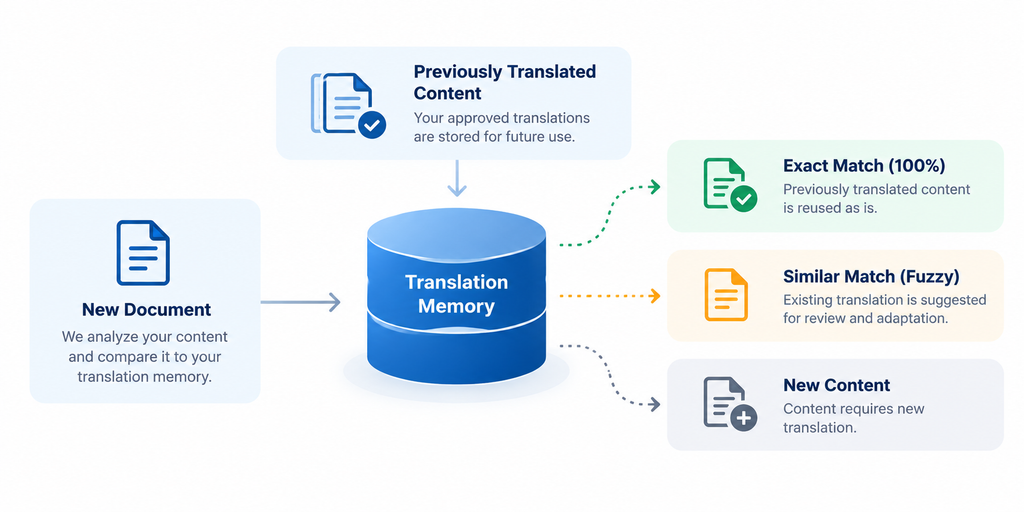
Organizations frequently translate versions of the same forms, manuals, policies, communications, training materials and product documentation.
Translation memory allows previously translated content to become a reusable linguistic asset.
EPIC’s workflow can distinguish between:
Exact Matches — Content that matches previously translated material.
Fuzzy Matches — Similar content that can be reviewed and adapted.
New Content — Content requiring new translation.
The result is a more controlled approach to recurring multilingual content—supporting terminology consistency, reducing unnecessary duplication and helping linguists focus attention where it is actually needed.
Technology Accelerates the Workflow. Human Expertise Protects the Message.
AI WHERE IT HELPS. PEOPLE WHERE THEY MATTER.
AI can be valuable for processing multilingual content at scale. But speed alone does not determine translation quality.
EPIC uses AI-assisted translation within controlled workflows based on the content, use case, quality requirements and level of risk.
Professional linguists can provide the contextual judgment technology cannot reliably supply on its own, including:
Context — Understanding meaning beyond individual words.
Terminology — Applying appropriate industry and organization-specific language.
Tone — Preserving the intended voice and audience relationship.
Cultural Relevance — Adapting content appropriately for the target audience.
Subject-Matter Judgment — Recognizing when literal translation isn’t sufficient.
Final Approval — Reviewing multilingual content before delivery when human review is required.
A More Structured Translation Workflow
FROM INTAKE TO DELIVERY
01 — Intake & File Analysis
Files, languages, content requirements, formatting and project specifications are reviewed.
02 — Content & Linguistic Assets
Translation memory, approved terminology, reference material and existing multilingual content are identified.
03 — Translation
Content moves through the appropriate human or technology-assisted translation workflow.
04 — Human Review
Qualified linguists review and edit content according to the project’s quality requirements.
05 — QA & Formatting
Terminology, consistency, completeness, formatting and other project requirements are checked.
06 — Delivery & Reuse
Final multilingual content is delivered while approved linguistic assets can support future projects.
Preserve More Than the Words
LANGUAGE IS ONLY PART OF THE DELIVERABLE
Documents frequently contain tables, charts, headings, styles, numbering, images and carefully designed layouts.
EPIC’s technology-enabled workflows support structured file processing designed to preserve document organization and formatting wherever possible.
For projects requiring more extensive visual adaptation, our multilingual desktop publishing specialists can address text expansion, right-to-left languages, typography, graphics and page-layout requirements.
Where Translation Technology Creates the Most Value
BUILT FOR RECURRING MULTILINGUAL CONTENT
Government & Public Sector
Forms, public communications, policies, notices and recurring multilingual programs.
Healthcare
Patient communications, educational materials, forms and organizational content.
Higher Education
Student communications, research materials, institutional content and recurring publications.
Manufacturing
Technical manuals, product documentation, training materials and safety content.
Enterprise & Corporate
Employee communications, policies, training, marketing and operational documentation.
Software & Digital Content
Interfaces, websites, applications, support content and frequently updated digital experiences.
Technology Becomes More Valuable as Your Content Grows
FROM PROJECTS TO PROGRAMS
The greatest benefit of translation technology often appears over time.
As multilingual content accumulates, organizations can build reusable translation memory, approved terminology and structured workflows that support future projects.
Instead of treating every translation as an isolated transaction, EPIC can help organizations develop a multilingual content operation designed to support:
- Recurring content
- Multiple departments
- Multiple languages
- Large document collections
- Frequent updates
- Long-term terminology consistency
Translation Technology Backed by Language Expertise
How it works
Technology + People
Technology improves workflow efficiency while professional linguists provide judgment, context and quality control.
Connected Operations
EPS and AITH support project management and multilingual production through a structured technology environment.
Built for Scale
Translation memory, terminology and workflow automation become increasingly valuable as multilingual content grows.
One Language Partner
Translation, localization, multilingual production and interpreting capabilities can operate within the broader EPIC language-services ecosystem.
Translation Technology & Workflow Automation FAQs
Find answers to common questions about translation technology, workflow automation, translation memory, AI-assisted translation, human review and multilingual content management.
How does translation technology improve translation quality?
Translation technology helps linguists and project managers maintain consistency, reuse approved content, manage terminology, identify potential issues and apply structured quality-control processes. Technology supports the process; professional expertise remains responsible for linguistic judgment.
What is translation memory?
Translation memory stores previously translated source and target-language segments so matching or similar content can be identified in future projects. This can improve consistency and reduce unnecessary retranslation.
What is fuzzy matching?
Fuzzy matching identifies content that is similar, but not identical, to previously translated material. Linguists can review the existing translation and adapt it for the new source content.
Does EPIC use AI for translation?
Yes. EPIC can use AI-assisted translation for appropriate projects within controlled workflows. The appropriate workflow depends on content type, quality expectations, risk and client requirements.
Does AI replace EPIC’s professional translators?
No. AI is one technology available within EPIC’s translation environment. Professional linguists remain essential when projects require contextual judgment, specialized terminology, cultural adaptation or human-reviewed quality.
Can EPIC preserve the formatting of our documents?
EPIC supports structured file processing and formatted multilingual output. Projects requiring more extensive layout adaptation can also be supported through multilingual desktop publishing.
Can our previous translations be reused?
Yes, when appropriate. Previously approved content can be incorporated into translation memory and used to identify exact or similar content in future projects.
Can this support ongoing translation programs?
Yes. Translation technology is particularly valuable for organizations with recurring content, frequent updates, multiple departments, multiple languages or large multilingual content libraries.