Language Access Under Budget Pressure: How Governments, Schools and Universities Can Do More With Less

Language Access Under Budget Pressure: How Governments, Schools and Universities Can Do More With Less
If you are responsible for language access at a government agency, school district, college, or university, you may be feeling a tension that is becoming harder to ignore.
The people who need your help have not disappeared.
Parents still need to understand what is happening at their child’s school. Residents still need to communicate with public agencies. Patients, students, families, defendants, witnesses, employees, and community members still need to understand information that may affect their education, health, rights, benefits, or future.
But the money available to provide those services may be getting tighter.
And somewhere between those two realities sits the language access professional.
You may be hearing questions such as:
- Can this be done for less?
- Do we really need an onsite interpreter?
- Can we reduce translation costs?
- Why did this department spend so much on interpreting last month?
- Can technology help?
- Can AI translate this?
- Can we consolidate vendors?
- Can we maintain the same level of service with the same—or a smaller—budget?
Those are not easy questions when the answer affects real people.
For language access teams, this is not simply an exercise in cost control. It is about finding responsible ways to stretch limited resources without allowing meaningful access to become the casualty.
And increasingly, that may be one of the most important challenges facing public-sector language access programs.
Budget Pressure Is Becoming Harder to Ignore
Government budgets are always subject to competing priorities, but the current environment is creating additional pressure.
States entered fiscal year 2026 more cautiously, with the National Conference of State Legislatures reporting slowing revenues, changes in federal policy, and mounting spending demands as major concerns for state budgets.
Inflation has also remained above earlier projections. The Congressional Budget Office reported that recent changes in U.S. trade policy and tariffs contributed to higher prices and projected that inflation would remain elevated during 2026 before gradually declining.
School districts are feeling that pressure particularly strongly. In 2026, budget shortfalls and declining enrollment moved to the top of many superintendents’ concerns, while persistent inflation continued to strain district finances.
Higher education faces its own version of the same problem. Although state and local appropriations for public higher education reached a record $130.7 billion in fiscal year 2025, enrollment grew faster than funding. After adjusting for inflation, funding per student declined 1%, marking the first decrease since 2012.
Different institution. Same underlying challenge.
More demands.
Higher costs.
Limited resources.
And difficult decisions about where the money goes.
Language Access Does Not Stop When Budgets Get Tight
This is where the issue becomes very personal for anyone working in language access.
A budget spreadsheet may show interpreting as an expense.
But you know what is behind that number.
It may be a mother trying to understand her child’s Individualized Education Program.
It may be a resident trying to explain an urgent issue to a city department.
It may be a student participating in a university investigation.
It may be a family trying to understand an important public notice.
It may be a Deaf individual who needs an ASL interpreter to participate fully in a meeting.
It may be someone trying to navigate a government system that is already difficult to understand—even before language becomes a barrier.
That is why simply cutting language services is rarely a meaningful strategy.
In K–12 education, for example, federal civil-rights requirements continue to require schools to take affirmative steps to address language barriers and to communicate important school information to parents with limited English proficiency in languages they can understand.
The responsibility remains even when budgets become uncomfortable.
And demand can move in the opposite direction from available funding. Federal funding dedicated to English learners remained flat for fiscal year 2026 even as educators reported growing student populations and increasing costs associated with serving them.
That creates a difficult position for the people managing these programs.
You may not control the budget.
You may not control inflation.
You may not control federal funding.
You may not control staffing shortages.
You may not control the policies that affect the cost of doing business.
But you are still expected to make language access work.
You Should Not Have to Choose Between Access and Fiscal Responsibility
There is a dangerous assumption that sometimes appears when budgets tighten:
If an organization wants to spend less on language services, it must provide less language access.
That does not have to be the answer.
The better question is:
How can we deliver language access more intelligently?
That starts by looking beyond the price of an individual interpreting hour or translated word and examining the entire way services are being requested, scheduled, delivered, and managed.
Because sometimes the biggest opportunity for savings is not lowering the interpreter’s rate.
It is eliminating inefficiency around the interpreter.
Use the Right Interpreting Modality for the Right Situation
Not every interaction requires the same type of interpreting.
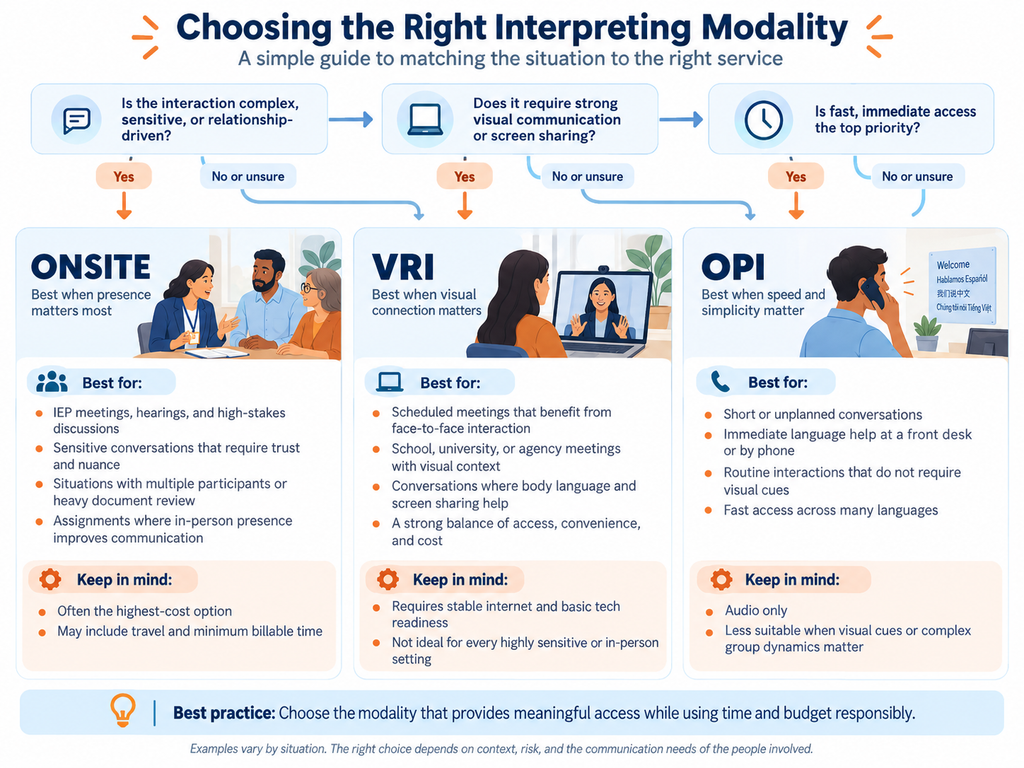
There are situations where onsite interpreting is clearly the best choice.
There are also many interactions that may be handled effectively through Video Remote Interpreting (VRI) or Over-the-Phone Interpreting (OPI).
The important question is not:
Which method is cheapest?
It is:
Which method is appropriate for this interaction while providing meaningful access?
Consider a short, unexpected conversation with a resident who speaks limited English.
Waiting hours—or days—for an onsite interpreter may not improve the experience. Immediate access to an OPI interpreter may be faster, more practical, and more cost-effective.
A scheduled meeting involving visual communication, documents, or multiple participants may be better suited for VRI.
A complex legal proceeding, sensitive educational meeting, or situation requiring significant interpersonal interaction may justify an experienced onsite interpreter.
The goal should not be to force every encounter into the least expensive modality.
It should be to stop treating every encounter as if it requires the most expensive one.
That distinction can have a meaningful impact on a language access budget.
Look at Minimum Charges, Not Just Hourly Rates
A low hourly rate does not always mean a low cost.
Imagine that one provider charges less per hour but requires a two-hour minimum for every onsite assignment.
Another provider may have a somewhat higher hourly rate but offer VRI or OPI for situations where an onsite interpreter is unnecessary.
For a ten-minute conversation, the difference can be substantial.
That is why procurement teams and language access coordinators should evaluate total cost of service, not simply compare rate sheets.
Questions worth asking include:
- What are the minimum billable times?
- Are there cancellation charges?
- Is travel billed separately?
- Can shorter interactions move to VRI or OPI?
- Are departments using onsite interpreters when another modality would work?
- Are recurring assignments being scheduled efficiently?
- Are multiple departments purchasing the same services independently?
Small operational decisions repeated hundreds or thousands of times can become major budget items.
Visibility Matters More When Money Is Tight
Many organizations still manage language services through combinations of email, spreadsheets, phone calls, invoices, and disconnected vendor portals.
That may work when utilization is low.
As demand grows, it becomes much harder to answer basic questions:
Which department is using the most interpreting?
Which languages are requested most often?
How much are we spending on onsite interpreting versus VRI?
Are certain appointments generating repeated cancellation costs?
Are interpreters being scheduled efficiently?
Are departments staying within their budgets?
Are requests increasing?
Without that visibility, language access can become difficult to manage—and difficult to defend when budget discussions begin.
Good data changes that conversation.
Instead of saying:
“We think demand is increasing.”
you can show it.
Instead of saying:
“We need this budget.”
you can explain exactly how it is being used.
Instead of discovering overspending after invoices arrive, teams can identify patterns earlier.
That is not merely financial management.
It is stronger language access management.
Technology Should Reduce Administrative Burden, Not Add to It
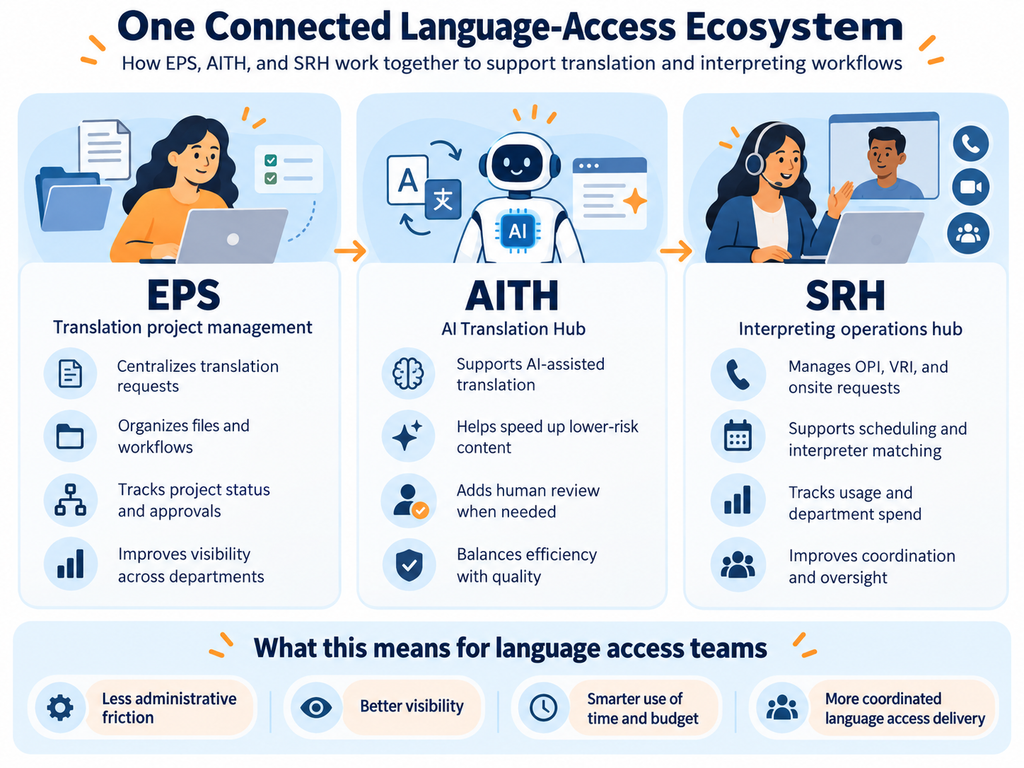
This is also where technology can make a meaningful difference.
A language access coordinator should not have to manage translation projects through one system, onsite interpreters through another, VRI through a third, invoices through email, and departmental spending through spreadsheets.
The technology should support the people doing the work.
At EPIC Translations, that philosophy has shaped the development of our technology ecosystem.
EPS, our translation management environment, helps centralize translation projects, files, workflows, and project visibility.
AITH, the AI Translation Hub, supports the responsible use of AI-assisted translation where it makes sense, while allowing human linguistic expertise and review to remain part of the workflow when quality, risk, or subject matter requires it.
SRH, the Staffing Resources Hub, brings OPI, VRI, and onsite interpreting into a more centralized environment where organizations can manage requests, scheduling, interpreter resources, departmental activity, budgets, and service utilization.
The purpose of these platforms is not technology for technology’s sake.
It is to give language access teams better control over something that has historically been fragmented.
Because when budgets tighten, visibility matters.
Speed matters.
Utilization matters.
And administrative efficiency matters.
AI Can Help—But “Use AI for Everything” Is Not a Strategy
Many language access professionals are also being asked another increasingly common question:
Can’t we just use AI?
Sometimes, AI can absolutely help.
For high-volume, lower-risk material, AI-assisted translation can reduce turnaround time and cost significantly.
But the right question is not whether AI can produce words in another language.
The question is whether the output is appropriate for the purpose.
A public information page is different from a legal notice.
A draft internal communication is different from a special education document.
A general informational flyer is different from a medical consent form.
Organizations should be thinking in terms of risk-based translation workflows.
Where can AI safely create efficiencies?
Where should a professional linguist review the output?
Where should translation remain primarily human from the beginning?
Used intelligently, AI can help preserve language access during periods of budget pressure.
Used indiscriminately, it can create entirely different problems.
State and Local Leaders Are Not Powerless
Many of the economic pressures affecting public organizations originate far beyond the language access office.
Federal fiscal decisions, trade policy, immigration policy, funding priorities, and other national actions can ultimately affect state revenues, municipal budgets, school systems, colleges, and public-service delivery.
State and local governments do not control U.S. foreign or trade policy.
But they are not without a voice.
Governors, legislatures, local governments, school systems, higher education organizations, professional associations, and public-sector coalitions can communicate the real-world consequences of federal decisions to congressional delegations, federal agencies, and national policymakers.
That advocacy matters.
But so does the reality of today.
A language access coordinator cannot wait for Washington to resolve every policy dispute before deciding how to staff tomorrow’s meeting.
The services still have to be delivered.
Do Not Lose Sight of the Person on the Other Side
During difficult budget discussions, language access can easily become numbers.
Cost per minute.
Cost per hour.
Cost per word.
Monthly spend.
Utilization.
Vendor rate.
Minimum charge.
Those numbers matter.
But there is another number that rarely appears on the spreadsheet:
the person who could not participate because they could not understand.
That is ultimately why