Multilingual SEO Services
Get Found in Every Language You Do Business In
Expanding your website into another language doesn’t automatically make it visible in that market.
EPIC’s multilingual SEO services combine target-language keyword research, SEO localization and professional linguistic expertise to help your localized content align with how people actually search.
From keywords and metadata to page content and international SEO elements, we help turn translated websites into discoverable multilingual experiences.
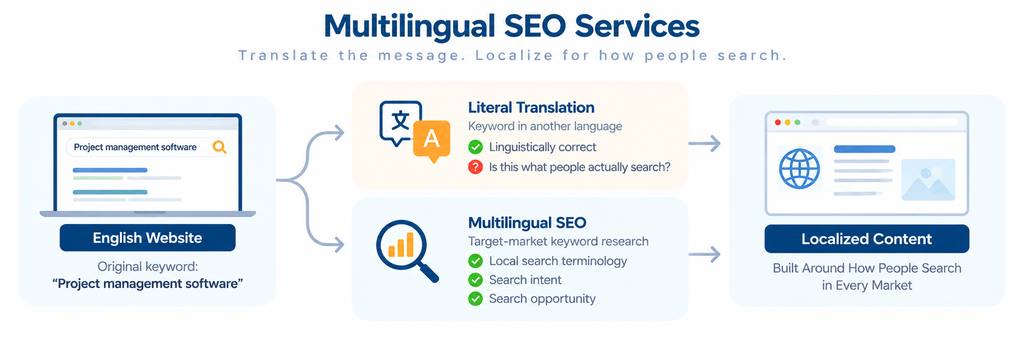
Your English Keywords Don’t Always Translate Into Search Demand
Your English keyword may translate perfectly into Spanish, German or Japanese.
But that doesn’t mean people actually type that translation into Google.
Different markets can use different terminology, phrases and search patterns for the same product or service. Multilingual keyword research identifies how people actually search in each target market before your localized content is optimized around those terms.

Since 2005
20+ years of continuous operation

200+ Languages
Multilingual support for global markets

25,000+ Linguists
Language expertise across global markets

SEO + Language Expertise
Search insights combined with professional linguists
Multilingual SEO Services for International Growth
Multilingual Keyword Research
Research how customers actually search for your products, services and topics within each target language and market.
SEO Content Localization
Localize website content around researched keywords and search intent rather than simply translating English SEO copy.
Metadata Localization
Optimize localized page titles, meta descriptions, headings, image alt text and other on-page elements.
International SEO & Hreflang Guidance
Help align language versions, hreflang implementation and international website structure so search engines can identify the appropriate pages.
Multilingual Content Optimization
Review existing localized pages for terminology, search intent, keyword targeting and opportunities to improve organic visibility.
Ongoing SEO Localization
Support new landing pages, articles, product content and other website updates as your multilingual content grows.
Already Have a Translated Website—But Not the Traffic?
You don’t necessarily need to start over.
EPIC can review existing localized content to determine whether target-language keywords, metadata, headings, terminology and other SEO elements align with how your audience searches.
We can then identify opportunities to optimize existing pages rather than retranslating content unnecessarily.
SEO Expertise Meets Language Expertise
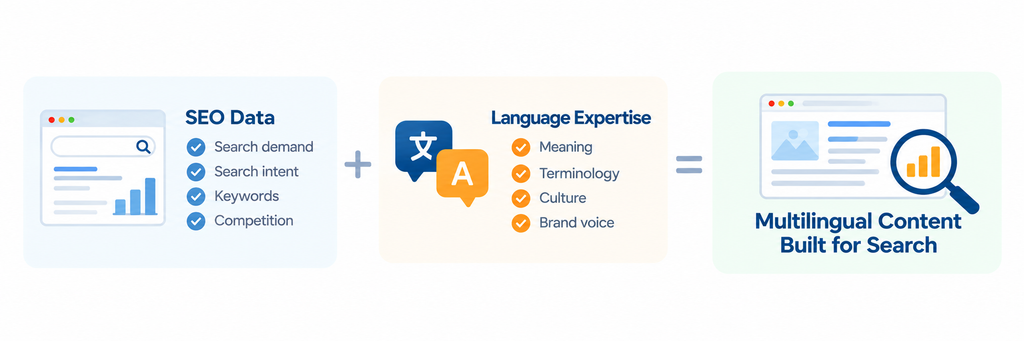
International search isn’t only an SEO problem. It’s also a language problem.
Search data can identify which terms people use, but professional linguistic expertise helps determine whether those terms communicate the right meaning, terminology, tone and intent.
EPIC brings multilingual SEO and professional language expertise together so your content can be optimized for search without sacrificing the message behind your brand.
1. SEO Data
Understand how people search.
Identify target-market search demand, keyword opportunities, search intent and competitive patterns before optimizing localized content.
Search demand · Keywords · Search intent · Competition
2. Language Expertise
Make the language right for the market.
Professional linguists help ensure selected terminology communicates the intended meaning while respecting local usage, culture and brand voice.
Meaning · Terminology · Culture · Brand voice
3. Content Built for Search
Bring search and language together.
Use market-specific SEO insights and linguistic expertise to create localized content aligned with how your target audience actually searches.
Discoverable · Relevant · Natural · On-brand
Building a Multilingual Website?
Multilingual SEO works best when search strategy is considered before localization begins. EPIC can incorporate target-language keyword research and SEO requirements into your broader website localization workflow.
Our Multilingual SEO Process
Effective multilingual SEO starts with understanding how your target audience searches—not simply translating an existing English SEO strategy.
EPIC combines target-market research, keyword mapping, SEO localization and professional linguistic review to help align multilingual content with search behavior in each market.
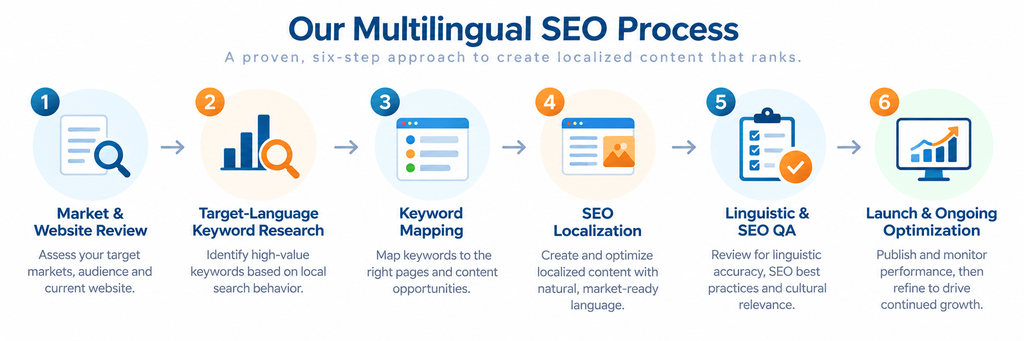
1. Market & Website Review
Understand target countries, languages, audiences, website and business objectives.
2. Target-Language Keyword Research
Identify relevant search terminology and intent within each market.
3. Keyword Mapping
Match appropriate target-language keywords and topics to specific pages.
4. SEO Localization
Localize content, headings, metadata and other relevant elements around the approved search strategy.
5. Linguistic & SEO QA
Review language, terminology and SEO implementation together.
6. Launch & Ongoing Optimization
Support new pages, markets and multilingual content as the website evolves.
Built for Organizations Expanding Into Global Markets
B2B & Professional Services
Generate international visibility for services, expertise and thought leadership.
Software & SaaS
Localize product, solution and resource pages around how buyers search in each market.
Manufacturing & Industrial
Connect technical terminology with the phrases international buyers actually use.
eCommerce
Optimize multilingual categories, products and informational content around local search behavior.
Education & Training
Make multilingual programs, resources and educational content easier to discover.
Enterprise Websites
Coordinate multilingual SEO across large websites, multiple languages and ongoing content.
Frequently Asked Questions About Multilingual SEO Services
Find answers to common questions about multilingual SEO, SEO localization, target-language keyword research, international search optimization, localized content and ongoing multilingual SEO support.
What is multilingual SEO?
Multilingual SEO is the process of optimizing website content for search engines across different languages and markets. It combines target-language keyword research, search intent, content localization and international SEO considerations so your multilingual pages align with how people actually search in each target market.
What is SEO localization?
SEO localization adapts website content for both the language of the target audience and their search behavior. Rather than simply translating English keywords and copy, SEO localization considers locally relevant keywords, terminology, search intent, metadata and other on-page SEO elements.
What is the difference between multilingual SEO and international SEO?
Multilingual SEO focuses primarily on optimizing content across different languages, while international SEO is broader and can also address different countries or regions that share the same language. In practice, the two often overlap when organizations operate multilingual websites across multiple international markets.
Why shouldn’t I just translate my English keywords?
A direct translation can be linguistically correct without being the phrase people commonly search for in the target market. Search terminology, phrasing and intent can vary by language and region. Target-language keyword research helps identify the terms your audience actually uses before localized content is optimized around them.
Do translated websites automatically rank in other countries?
No. Translation makes your website understandable to another language audience, but it does not automatically create organic search visibility. Search performance can also depend on keyword targeting, search intent, content quality, technical implementation, competition, website authority and other SEO factors.
What is multilingual keyword research?
Multilingual keyword research identifies relevant search terms and search behavior within a specific language and target market. Instead of simply translating an English keyword list, EPIC can research target-language terminology and search intent to help determine which keywords should guide the localization and optimization of your content.
Can EPIC optimize a website that has already been translated?
Yes. EPIC can review existing multilingual content and identify opportunities to better align target-language keywords, terminology, headings, metadata and page content with local search behavior. This can be especially useful when a translated website is not generating the organic visibility or engagement you expected.
Do you localize title tags and meta descriptions?
Yes. Multilingual SEO projects can include localization and optimization of title tags, meta descriptions, headings, image alt text and other relevant on-page elements. These elements should reflect both the meaning of the original content and the target-language search strategy.
What is hreflang and why does it matter?
Hreflang is an HTML attribute that helps search engines understand which language or regional version of a webpage should be presented to different users. Proper hreflang implementation can be an important part of international SEO for websites with multiple language or country versions.
Do I need a different SEO strategy for every language?
Usually, each target language or market should be evaluated individually. Keywords, terminology, competition and search intent can differ substantially between markets, even when the underlying product or service is the same. The appropriate strategy depends on your target audiences, markets and website structure.
Can EPIC provide website localization and multilingual SEO together?
Yes. Combining the two can be particularly effective because target-language keyword research can inform localization before pages are translated. EPIC can coordinate website localization and multilingual SEO so language, terminology, keywords, metadata and other content elements are considered within the same workflow.
How much do multilingual SEO services cost?
Pricing depends on the number of languages and markets, website size, number of pages, keyword-research requirements, whether content is already translated, and the level of SEO localization and ongoing support required. EPIC can review your website and objectives and recommend an appropriate scope.
Target-language research · Professional linguists · SEO localization · 200+ languages