Human-Reviewed AI Translation Services
AI Speed. Human Review. EPIC-Managed Quality Control.
Scale multilingual content faster without making raw AI output your final translation.
EPIC combines AI-assisted translation with mandatory review by qualified linguists, terminology control and structured quality assurance. The result is a scalable translation workflow designed for organizations that require efficiency, professional accountability and controlled use of AI.
What Human-Reviewed AI Translation Means at EPIC
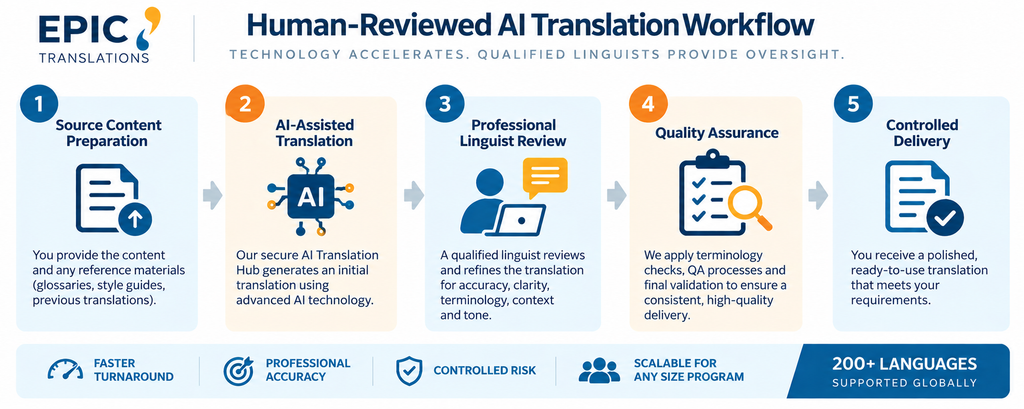
AI Translation Hub creates an initial translation within EPIC’s managed production workflow. A qualified linguist reviews and refines the content for meaning, terminology, context, tone and intended use before final delivery.
AI accelerates production. Qualified linguists remain responsible for the reviewed translation.
Why Raw AI Translation Alone Is Not Enough
AI translation services and tools can generate fluent text — but fluency alone does not equal accuracy or suitability for real-world use.
Professional linguistic review helps organizations:
- Detect contextual or cultural misinterpretation
- Maintain terminology consistency across programs
- Identify regulatory, legal, or safety-sensitive language
- Apply judgment to ambiguous or high-risk content
When unmanaged AI output is used as final translation, organizations may face confusion, rework, reputational damage, compliance concerns, or loss of trust with the communities they serve.
Human-Reviewed AI Translation closes this gap by combining AI-assisted speed with professional linguist review and EPIC-managed quality control.
Human-Reviewed AI Translation Workflows Built for Oversight and Risk Control
Human-Reviewed AI Translation applies AI within a controlled production workflow designed to improve speed and scalability while maintaining professional review, terminology consistency, and quality control.
AI-Assisted Translation
AI Translation Hub generates the first draft translation inside EPIC’s managed workflow. AI helps accelerate production, but it does not serve as the final authority for client-ready content.
Professional Linguist Review

Qualified linguists review and edit AI-generated translations for accuracy, clarity, terminology, tone, readability, and appropriateness for the intended audience.
Terminology and Translation Memory Control

Approved terminology, prior translations, reference materials, client preferences, and translation memory are used to support consistent language across documents, departments, languages, and recurring projects.
Structured Quality Control
EPIC applies defined quality control steps to identify errors, omissions, inconsistencies, terminology issues, formatting concerns, or contextual problems before final delivery. These checks provide accountability and reduce the risk associated with uncontrolled AI output.
Security and Confidential Workflow
Client materials are handled through controlled workflows, confidentiality protocols, and secure file-management practices. AI-assisted processing is applied only when appropriate for the content type, risk level, and client requirements.
Risk-Based Workflow Selection
Not all content is suitable for AI-assisted translation. EPIC Translations defines clear boundaries for when Human-Reviewed AI Translation is appropriate—and when fully human or certified translation workflows are required—protecting clients from misapplication and compliance risk.
When to Choose Human-Reviewed AI Translation
Use Human-Reviewed AI Translation when the project benefits from:
- high-volume or recurring multilingual production;
- faster turnaround;
- terminology and translation-memory reuse;
- professional review of AI-assisted output;
- scalable content across departments, markets or locations.
Built for Organizations That Require Oversight
Government agencies, universities, healthcare organizations and global institutions need more than faster translation. They need visibility into how AI is used, where professional linguistic review occurs, how terminology is controlled, and how sensitive content is handled.
EPIC’s Human-Reviewed AI Translation workflow builds these controls into the translation process through mandatory linguist review, governed terminology, structured quality assurance and secure content handling.
- Human-Reviewed AI Translation Expertise — Our Human-Reviewed AI Translation workflows are purpose-built to combine AI-assisted production with professional human review, ensuring speed without sacrificing accuracy, clarity, or accountability.
- Governed, Repeatable Translation Processes — We apply structured, repeatable workflows that support human review, terminology consistency, controlled revisions, and documented quality checks across the entire content lifecycle.
- Terminology & Reference Control — Approved terminology, organizational language, and key references are centrally managed to prevent AI drift and ensure consistent application across documents, languages, and versions.
- Mandatory Linguist Review & Quality Assurance — Every Human-Reviewed AI Translation project includes defined review and QA steps performed by qualified linguists to identify errors, ambiguities, or contextual issues before delivery.
- Secure Handling of Client Content — Translation projects are managed using controlled file access, confidentiality protocols, and secure handling practices appropriate for proprietary, confidential, or sensitive materials.
This governed approach gives organizations greater control over AI-assisted translation while supporting consistency, accountability and responsible scaling across multilingual content programs.
Languages Supported for Human-Reviewed AI Translation
Human-Reviewed AI Translation services require more than broad language availability. Organizations must ensure that AI-assisted translations are professionally reviewed by qualified linguists, supported by terminology control, and governed by documented quality checks—regardless of language pair.
EPIC Translations supports Human-Reviewed AI Translation projects across 200+ languages, enabling enterprises and public institutions to scale multilingual content while maintaining accuracy, consistency, and human oversight across markets and regions.
Our language coverage supports organizations that require reliable, reviewable translations for enterprise communications, operational content, marketing materials, and high-volume multilingual workflows used across internal teams and external audiences.
Common Language Pairs Used in Human-Reviewed AI Translation Projects Include:
- English to Spanish — Widely used for enterprise communications, internal documentation, marketing content, and customer-facing materials across North America and Latin America
- English to Chinese (Simplified and Traditional Chinese) — Supporting high-volume content, operational documentation, and multilingual communications for global and Asia-Pacific markets
- English to Arabic — Frequently required for multilingual business content, marketing materials, and enterprise communications distributed across Middle Eastern regions
- English to Vietnamese — Supporting internal documentation, operational content, and multilingual communications for global supply chains and distributed teams
- English to French, German, Portuguese, Russian, and additional languages — Commonly required for international operations, enterprise communications, and multilingual content programs
Language assignments are made based on verified linguistic qualifications, subject-matter experience, and review availability, ensuring AI-assisted translations are consistently validated by professional reviewers regardless of target language.
By applying disciplined Human-Reviewed AI Translation workflows across all supported languages—including AI-assisted production, mandatory linguist review, and terminology control—EPIC Translations helps organizations scale multilingual content responsibly while preserving accuracy, consistency, and trust worldwide.
FAQs — Human-Reviewed AI Translation Services
Below are common questions organizations ask when evaluating AI-assisted translation services with human review, particularly for enterprise, regulated, and high-volume multilingual content where accuracy, oversight, and accountability are required.
What Makes Human-Reviewed AI Translation Different from Raw AI Translation?
Human-Reviewed AI Translation uses AI for efficiency, but professional linguists are fully responsible for the final translation. Nothing is delivered without human validation.
Are All AI-Generated Translations Reviewed by Linguists?
Yes. Every AI-generated translation processed under the Human-Reviewed AI Translation workflow is reviewed and edited by a qualified professional linguist. Human review is mandatory and is applied to identify errors, resolve ambiguity, correct contextual issues, and ensure the content is suitable for real-world use.
Is Human-Reviewed AI Translation Suitable for All Content Types?
Human-Reviewed AI Translation can be appropriate for certain regulated or sensitive content when certification is not required and when human review is applied. Content eligibility is assessed in advance, and clear boundaries are established to determine when fully human or certified translation workflows are required instead.
When Should Organizations Choose 100% Human Translation Instead?
100% Human Translation may be more appropriate when contractual requirements, organizational policies, content sensitivity, risk considerations or client preferences call for a fully human production workflow. Certified or legally sensitive documents may also require specialized translation processes depending on their intended use.
How Do You Ensure Consistency Across Languages and Projects?
Consistency is maintained through centralized terminology management, reference alignment, and documented review processes. Approved terminology and organizational language are applied consistently across documents, languages, and versions to support scalable multilingual content programs.
Can Human-Reviewed AI Translation Support Ongoing or High-Volume Projects?
Yes. Human-Reviewed AI Translation workflows are designed to support both single projects and ongoing, high-volume multilingual content programs. The combination of AI-assisted production and human review allows organizations to scale efficiently while maintaining consistent quality and oversight.