Multilingual Desktop Publishing Services
Why Translation Alone Is Not Enough
A translation can be linguistically accurate and still fail as a finished document. Translation changes text length, line breaks, fonts, reading direction and page flow—sometimes significantly.
Without multilingual DTP, translated documents may contain:
- Text overflow or cut-off sentences
- Broken tables, charts, forms, or columns
- Incorrect line breaks or awkward spacing
- Fonts that do not support the target language
- Misaligned headings, bullets, captions, or callouts
- Untranslated text inside graphics
- Right-to-left formatting errors
- Inconsistent branding across language versions
- PDF output issues or print-readiness problems
EPIC combines multilingual formatting, language-aware layout decisions and structured quality review to prepare translated documents for print, digital publication and organizational use.
Multilingual DTP addresses these issues before delivery by combining language-aware formatting, professional layout work and final quality review.
What Multilingual Desktop Publishing Means at EPIC
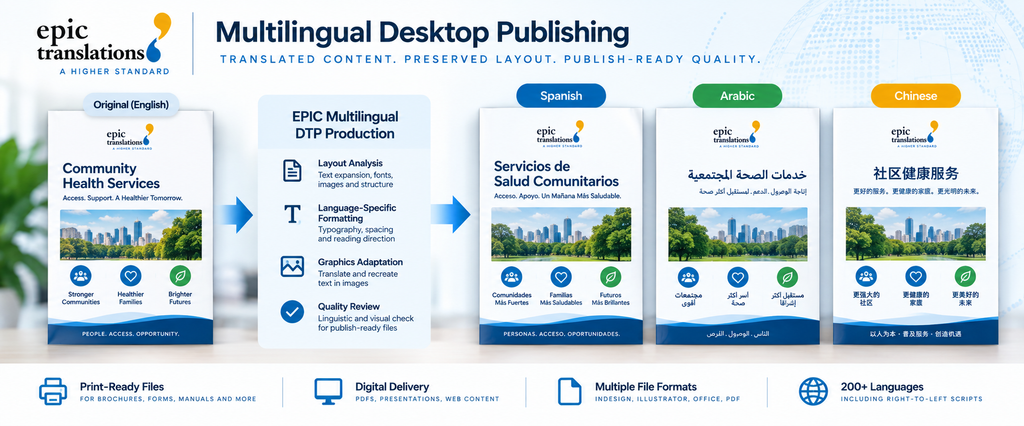
Multilingual Desktop Publishing (DTP) is the process of adapting translated content so the finished document preserves the structure, readability, branding and visual quality of the source while accommodating the requirements of the target language.
That can require far more than replacing English text with translated text. Languages expand and contract differently, scripts require different fonts and reading directions, tables and forms change dimensions, and graphics may contain text that must be recreated.
From Translated Content to Publish-Ready Files
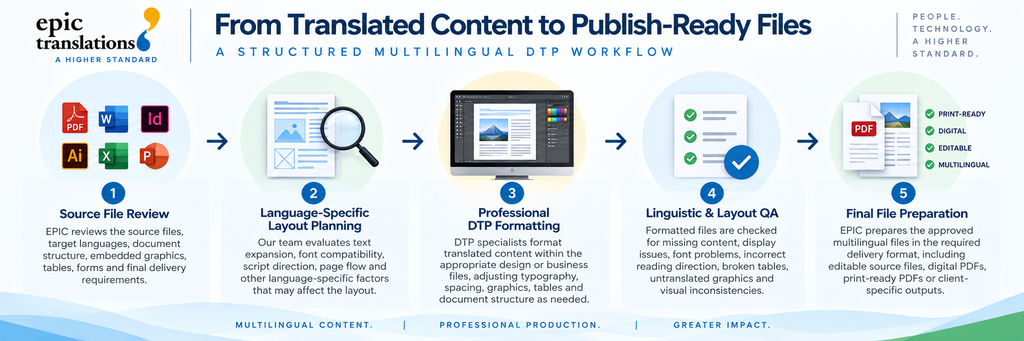
EPIC applies multilingual desktop publishing through a structured production workflow designed to preserve visual integrity while adapting each document to the requirements of the target language and final delivery format.
Multilingual Content Ready for Real-World Use
Government & Public Communications
Notices, forms, public information, reports, program materials and constituent communications.
Healthcare & Benefits
Patient materials, benefit documents, instructions, forms and healthcare communications.
Education
School district communications, university materials, student resources, forms and institutional publications.
Technical & Regulatory Content
Technical manuals, product guides, safety documentation, compliance materials and regulated content.
Corporate & Training Materials
HR documents, policies, training materials, presentations and internal communications.
Marketing & Product Content
Brochures, flyers, sales materials, packaging, labels, inserts and multilingual product documentation.
Multilingual Formatting Challenges EPIC Solves
Text Expansion and Contraction
Layouts are adjusted for languages that require more or less space than the source, including changes to line breaks, text boxes, columns, spacing and page flow.
Right-to-Left Language Formatting
Arabic, Hebrew, Farsi, Urdu and other RTL languages require specialized handling of reading direction, alignment, punctuation, tables and document structure.
Font and Character Support
Not all fonts support every language. EPIC identifies font issues and applies appropriate multilingual font solutions so accents, special characters, non-Latin scripts, and double-byte characters display correctly.
Tables, Charts, and Forms
Translated tables and forms often require careful resizing and alignment. EPIC adjusts columns, labels, fields, checkboxes, captions, and table structures so the final document remains clear and usable.
Graphics With Embedded Text
When graphics contain text, EPIC can recreate or adapt the visual element in the target language while preserving the style and purpose of the original design.
PDF Recreation
When editable source files are unavailable, EPIC can review the PDF and determine the best recreation or formatting approach to produce a clean multilingual version.
File Formats & Production Environments
EPIC supports multilingual DTP across common design, publishing and business-document environments.
InDesign
Illustrator
Photoshop
MS Word
MS PowerPoint
MS Excel
Fillable Forms
Other Formats
Editable source files are recommended whenever available. When only a PDF is available, EPIC can review the document and recommend the most practical formatting or recreation approach.
Why Organizations Choose EPIC for Multilingual DTP
Professional multilingual publishing requires linguistic awareness, design expertise and controlled quality review. EPIC coordinates these disciplines within the broader translation workflow rather than treating formatting as an afterthought. Explore Export Document Translation Services →
EPIC’s Document Translation Services combine professional linguistic expertise with managed translation workflows, with multilingual desktop publishing available when documents require specialized formatting or layout adaptation.
Multilingual DTP Expertise
DTP specialists understand how language changes affect typography, spacing, page flow, graphics, forms and publication quality.
Translation & Layout Coordination
Translation, formatting and review are coordinated so linguistic and visual requirements remain aligned throughout production.
Terminology & Brand Consistency
Approved terminology, organizational language and brand requirements can be maintained across files, languages and versions.
Structured Quality Review
Final files are reviewed for layout problems, missing content, font issues, untranslated graphics, table errors and output concerns before delivery.
Secure File Handling
Client materials are handled through controlled workflows and confidentiality practices appropriate to sensitive and proprietary content.
Multilingual DTP Across 200+ Languages
EPIC supports multilingual desktop publishing across 200+ languages, including languages requiring specialized handling for right-to-left direction, non-Latin scripts, accented characters, font compatibility and complex character sets.
Spanish & European Languages
Text expansion, typography and layout adaptation.
Arabic & Other RTL Languages
Reading direction, alignment, punctuation and mirrored layout considerations.
Chinese, Japanese & Korean
Character support, font compatibility, spacing and language-specific layout requirements.
Additional Global Languages
Language-specific formatting is evaluated according to script, file type and publication requirements.
Frequently Asked Questions About Multilingual Desktop Publishing
Below are common questions organizations ask when preparing translated documents for print, digital publication, public distribution, or internal use.