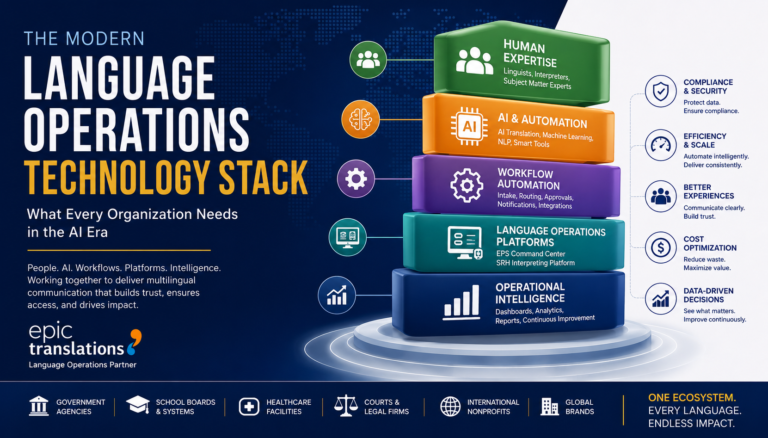
More Than a New Website: EPIC’s Evolution to Language Operations
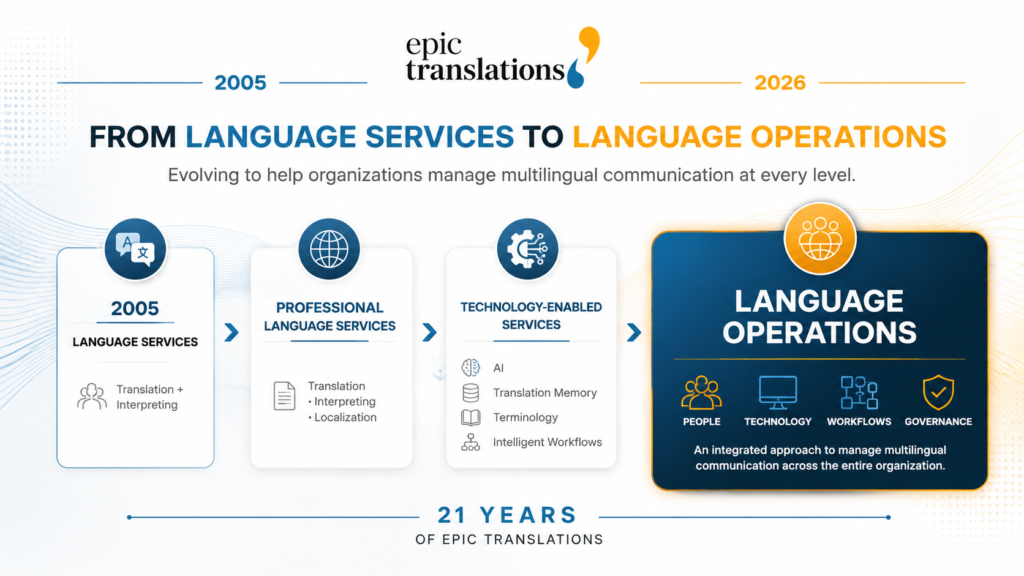
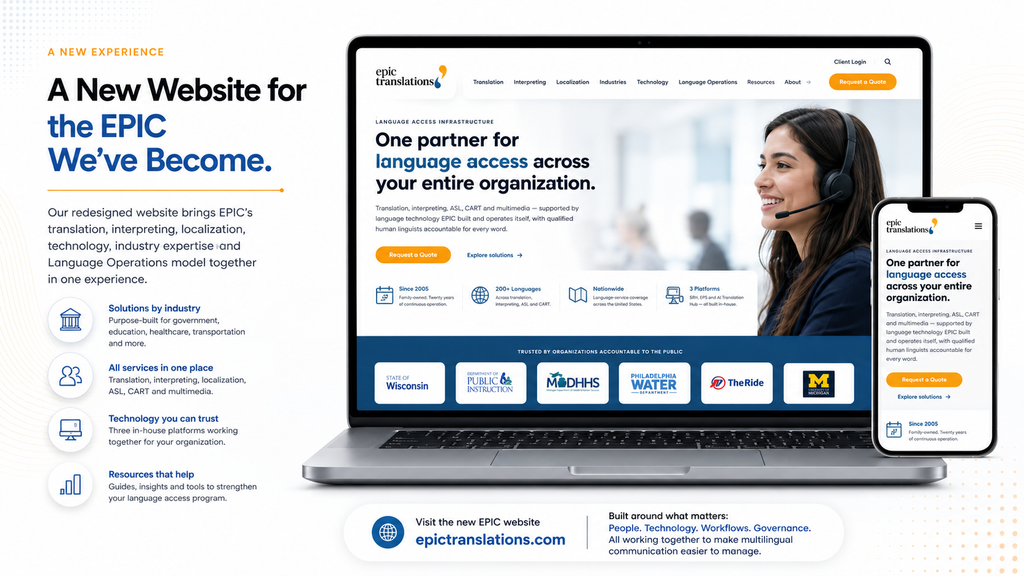
After more than 20 years in language services, EPIC Translations is launching a new website that reflects something much bigger than a new design: the evolution of how we help organizations manage language operations.
When EPIC Translations was founded in 2005, the language-services industry looked very different.
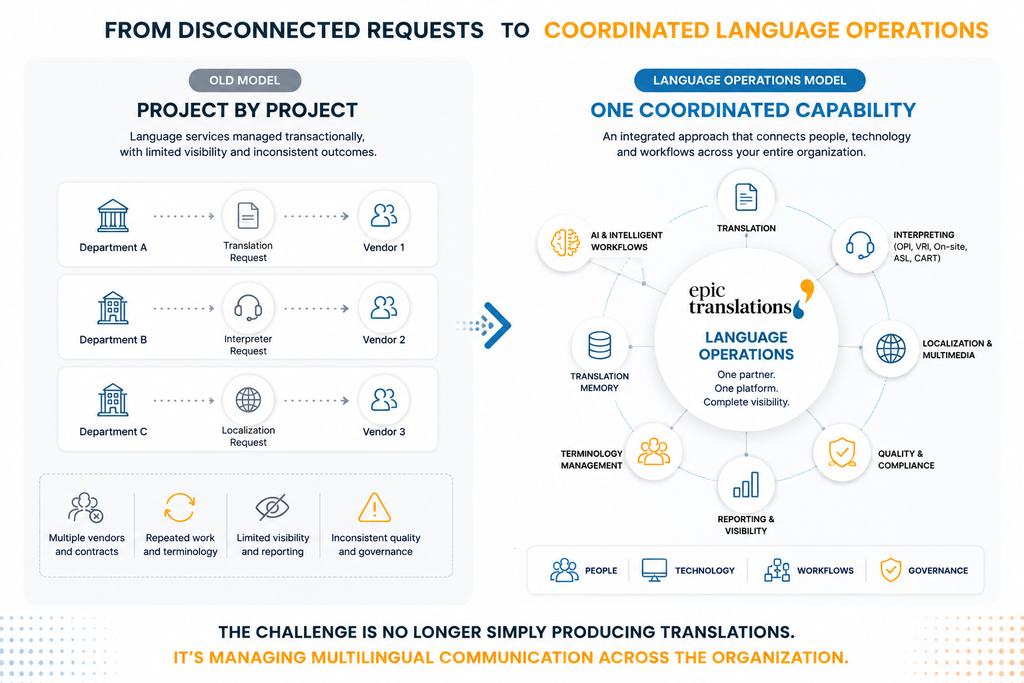
Organizations typically approached language services one project at a time. A document needed to be translated. A meeting required an interpreter. A website needed localization. The primary challenge was finding qualified language professionals who could complete that work accurately and reliably.
That work still matters enormously.
But the challenge facing organizations today has become much bigger.
A state agency may need to translate hundreds of documents while simultaneously providing interpreters across departments. A healthcare organization may need multilingual patient information, real-time interpreting and carefully controlled terminology. A school system may need to communicate with families across dozens of languages. A global company may need to localize websites, software, training, marketing and technical documentation while keeping terminology consistent across markets.
And artificial intelligence has introduced an entirely new set of possibilities—and questions.
Multilingual communication is no longer simply a collection of translation projects.
It has become an operational challenge.
That evolution is why we rebuilt epictranslations.com.
Our New Website Reflects the EPIC of Today
A new website can mean a different design, new photography and updated navigation.
We wanted ours to do something more important.
We wanted it to accurately represent the company EPIC has become.
Since 2005, we have expanded beyond traditional document translation into interpreting, localization, multilingual accessibility, language technology and increasingly sophisticated language workflows.
Along the way, we also began building technology of our own.
Not because technology should replace professional translators and interpreters, but because we saw how much complexity existed around the actual linguistic work.
Requests arrived through different channels. Projects involved multiple departments. Interpreters needed to be scheduled and matched. Translation memories and terminology needed to be maintained. Organizations wanted greater visibility into their language spending and activity. AI created opportunities for efficiency while introducing new questions about quality, oversight and appropriate use.
We increasingly found ourselves solving not just a language problem, but an operations problem.
Our new website is built around that reality.
The Language-Services Industry Is Changing
The last several years have brought extraordinary advances in machine translation, large language models and generative AI.
Translation can now be produced faster than at any point in history.
But greater translation capacity does not eliminate the need for professional language services. In many organizations, it actually creates a different challenge:
How Should All Of This Capability Be Managed?
Which content is appropriate for AI?
Which content requires professional human translation?
When should AI-generated translation receive human post-editing?
What happens when the material involves safety, healthcare, legal rights or regulatory requirements?
How should approved terminology be maintained?
How can previously translated content be reused?
How are interpreters requested, qualified, scheduled and tracked?
How does an organization maintain consistency when different departments are requesting language services independently?
And how does leadership gain visibility into all of it?
These are not simply translation questions.
They are questions about people, technology, workflows, linguistic assets, governance and accountability.
That’s where we believe the future of professional language services is heading. AI is changing how organizations produce and manage multilingual content.
From Language Services to Language Operations
At EPIC, we call this broader approach Language Operations.
Language Operations is the coordinated management of the people, processes, technology and linguistic resources an organization uses to communicate across languages.
Instead of treating every translation or interpreting request as an isolated transaction, Language Operations asks a larger question:
How can multilingual communication become a managed organizational capability?
That shift matters.
A translation memory created for one project can become an institutional resource for future projects.
Approved terminology can be maintained across departments and communication channels.
Interpreting requests can move through a centralized process rather than disconnected emails and phone calls.
Technology can provide greater visibility into project activity and service usage.
AI can be incorporated where it creates meaningful value while professional linguistic judgment remains part of workflows where the consequences demand it.
The appropriate workflow can be determined by what the content is for, who will use it and what happens if it is wrong.
That is a very different model from simply sending a document to a translation vendor and waiting for it to come back.
And it is the model around which EPIC is increasingly building its services and technology.
Technology Built Around Language Operations
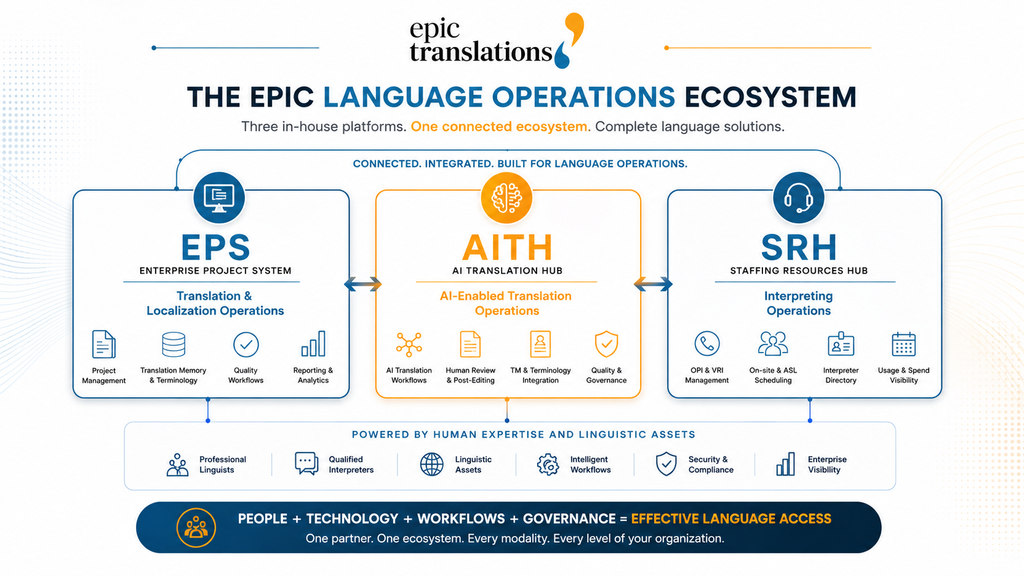
One of the biggest changes visitors will see on the new EPIC website is a much clearer view of the translation technology and language operations technology behind our services.
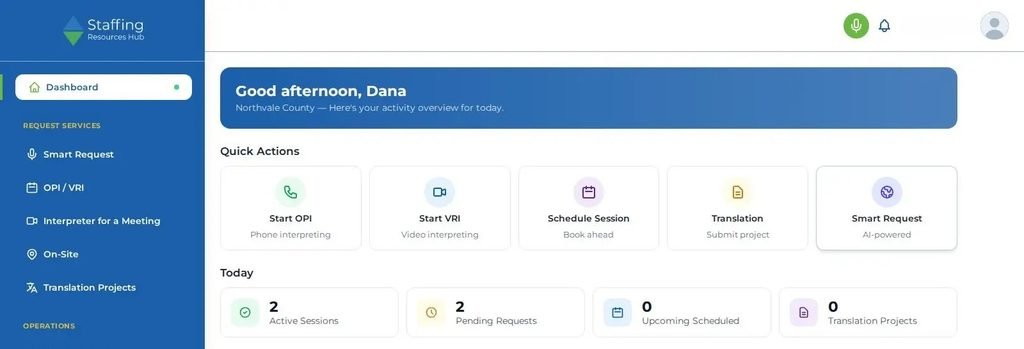
EPIC has developed three technology environments addressing different components of Language Operations.
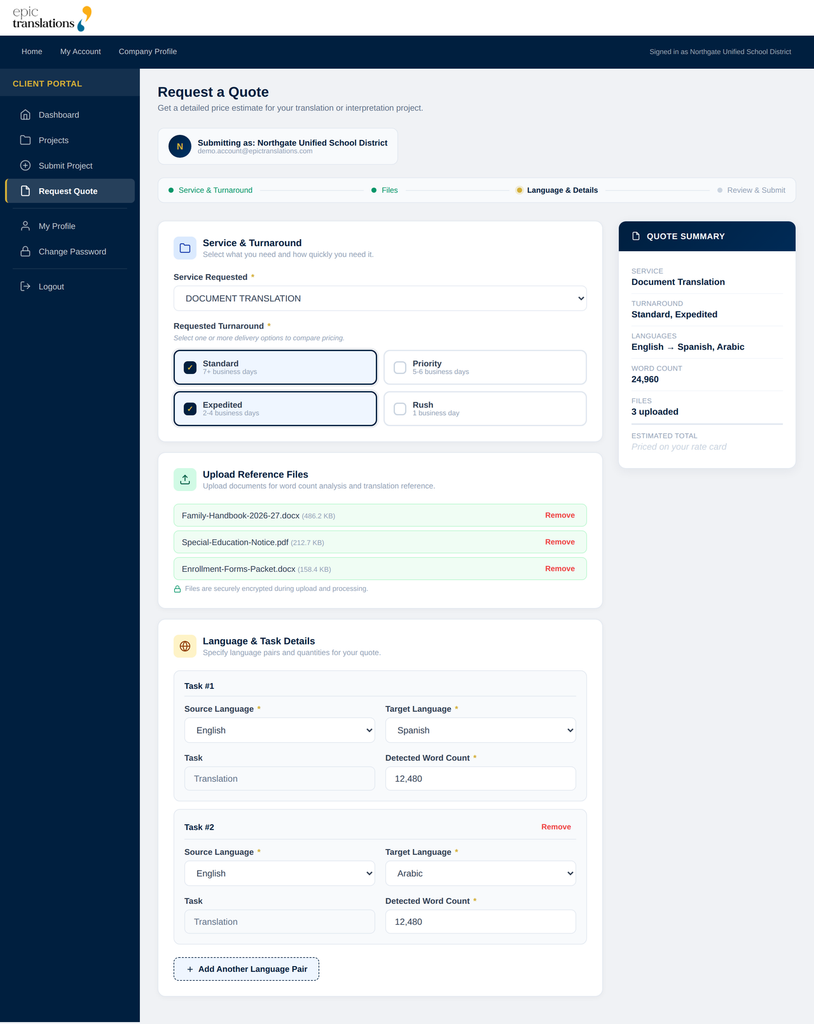
EPS — Enterprise Project System
Our Enterprise Project System (EPS) supports the translation and localization project lifecycle.
It provides an environment for managing multilingual projects, files, requirements, linguistic resources, project activity and delivery of document translation projects.
Translation Memory and terminology resources can become part of an ongoing language program rather than assets that disappear after an individual project is completed.
For organizations managing recurring translation and localization needs, the objective is greater structure, continuity and visibility.
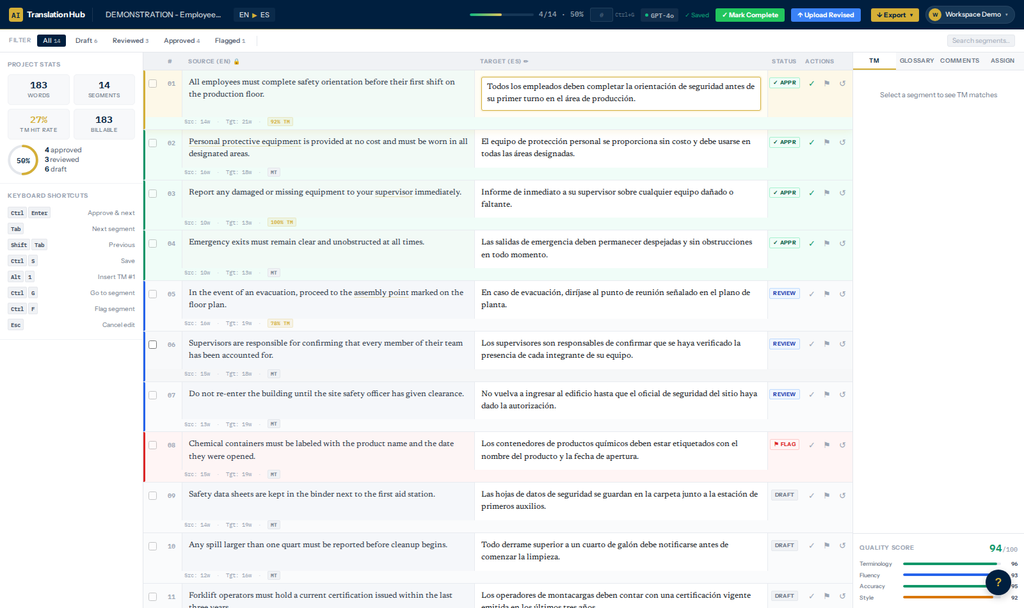
AITH — AI Translation Hub
Artificial intelligence can dramatically increase translation capacity—but the most important question isn’t simply whether AI can translate something.
It is:
What level of linguistic control does this content require?
Our AI Translation Hub (AITH) supports AI-enabled translation workflows that can combine automation with Translation Memory, terminology and professional human review according to project requirements.
Some content may benefit from greater automation.
Other content may require professional post-editing.
High-consequence material may call for a more controlled human-led workflow.
We believe AI should be applied according to the purpose and risk of the communication—not simply because the technology exists.
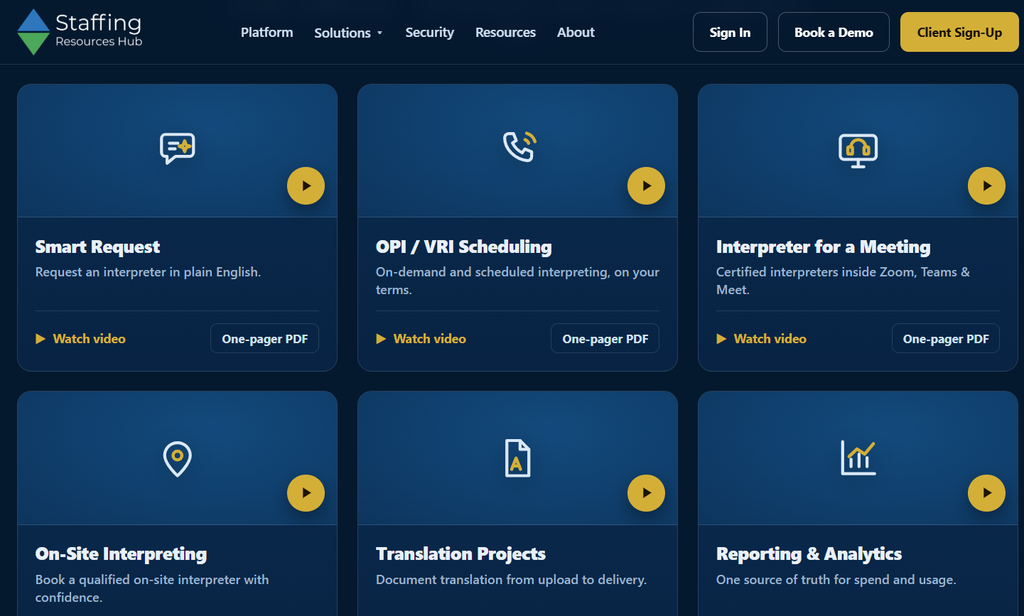
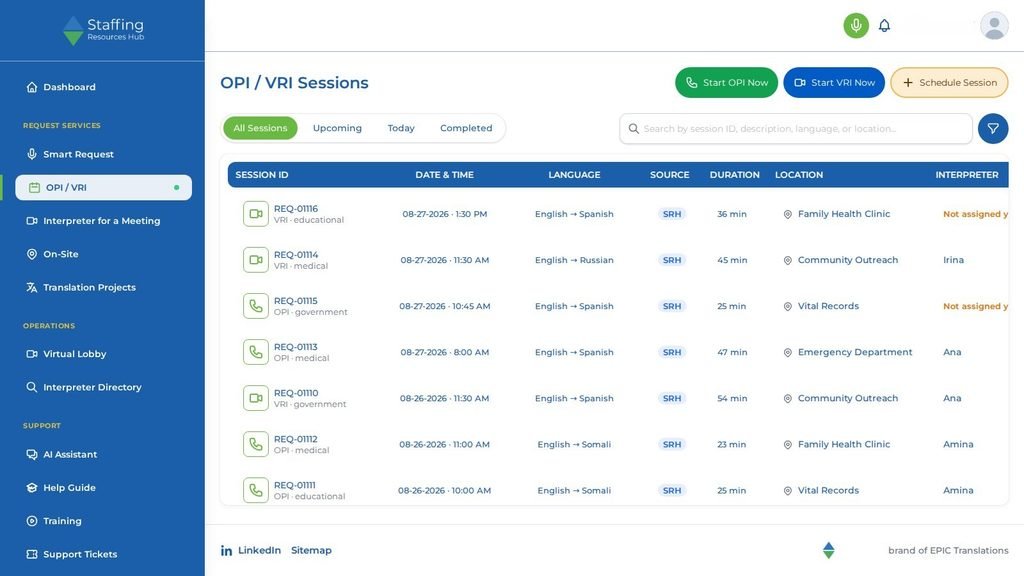
SRH — Staffing Resources Hub
Interpreting presents a different operational challenge.
Organizations may need Over-the-Phone Interpreting, Video Remote Interpreting, American Sign Language or on-site interpreters across different locations, departments and situations.
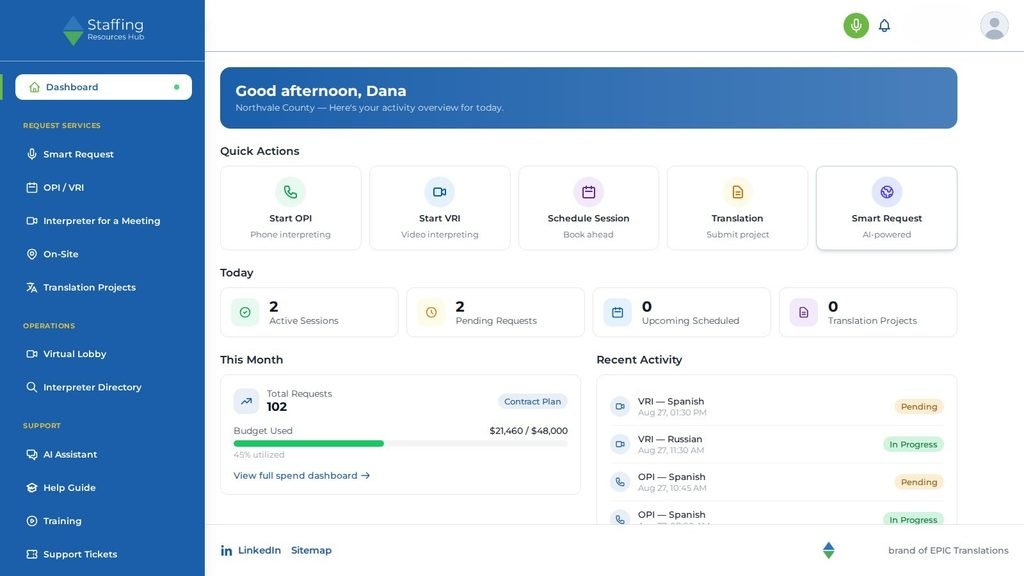
Our Staffing Resources Hub (SRH) supports the interpreting operation—from requests and scheduling to interpreter matching, service delivery and operational visibility.
Together, EPS, AITH and SRH allow EPIC to connect enterprise language services with the technology and workflows needed to manage multilingual communication through a more coordinated Language Operations model.
We don’t view technology as the replacement for professional language expertise.
We view it as infrastructure that can help professional language services operate better.
Human Expertise Still Matters
With so much attention focused on artificial intelligence, it is easy to assume that the future of translation is simply a race toward greater automation.
We see it differently.
There are situations where automation can create enormous value.
And there are situations where professional human judgment remains essential.
A routine internal communication does not necessarily require the same workflow as an informed-consent document.
A general informational webpage does not carry the same consequences as an emergency safety instruction.
A first-pass understanding of a document is different from a publication carrying an organization’s name and reputation.
The question isn’t:
Human or AI?
The better question is:
What combination of people and technology is appropriate for this communication?
Our approach is to use automation where it creates value and professional expertise where professional expertise creates value.
That principle is becoming increasingly important as organizations determine how AI should fit into their multilingual communication strategies.
Built for the Organizations We Serve
Our new website also reflects another lesson we’ve learned over the past two decades:
Language requirements change dramatically by industry.
A healthcare organization does not have the same communication environment as a manufacturer.
A public transit agency does not operate like a technology company.
A university’s language-access responsibilities differ from those of a financial institution.
Government agencies, school systems, courts, healthcare organizations, transportation authorities, manufacturers, nonprofits and global enterprises may all need translation and interpreting—but the consequences, terminology, audiences and workflows can be very different.
That is why our new website goes much deeper into the industries we serve.
Visitors can explore how multilingual communication applies within their own operating environment rather than reading the same generic description of translation services regardless of industry.
Because the workflow should reflect what the content is for, who will use it and what happens if it is wrong.
More Ways to Explore What EPIC Does
The new epictranslations.com has also been reorganized around how organizations actually use language services.
Visitors can explore our capabilities across:
Translation — from document translation and desktop publishing to terminology management and Translation Memory.
Interpreting — including Over-the-Phone, Video Remote, on-site and American Sign Language interpreting.
Localization — for websites, software, mobile applications, eLearning, multimedia, marketing and multilingual SEO.
Technology — including EPS, AITH and SRH.
Industries — with resources focused on the specific multilingual requirements of government, education, healthcare, transportation, manufacturing, financial services, technology and other sectors.
Language Operations — for organizations ready to think beyond individual projects and build a more coordinated approach to multilingual communication.
The objective is simple:
If you come to EPIC with a language challenge, we want you to understand not only what service can solve it, but how that service can fit into a larger multilingual operation.
Some Things Haven’t Changed
Technology has changed.
The language-services industry has changed.
EPIC has changed.
But some principles have remained remarkably consistent since 2005.
Professional expertise matters.
Quality matters.
Responsiveness matters.
Accountability matters.
And the relationship between a language-services provider and its client matters.
Behind every translation is someone who needs to understand something.
Behind every interpreting session are people trying to communicate.
Behind every language-access program is an organization trying to serve employees, customers, patients, students, riders, constituents or communities more effectively.
Technology can improve how that happens.
It should never make us forget why it happens.
The Next Chapter of EPIC
More than 20 years ago, EPIC Translations began with a straightforward mission: help organizations communicate accurately across languages.
That mission hasn’t disappeared.
It has expanded.
Today, multilingual communication can span documents, conversations, websites, applications, video, training, public information and AI-generated content—often across multiple departments and hundreds of individual interactions.
Organizations need professional language expertise.
Increasingly, they also need the infrastructure to manage it.
That’s the EPIC our new website was built to represent.
Professional linguists. Professional interpreters. Translation and localization expertise. Proprietary technology. Intelligent workflows. Human judgment.
All working toward one objective:
Making multilingual communication easier to manage across the organization.
Our new website isn’t the destination of EPIC’s evolution.
It’s a clearer view of where we’re going.
Welcome to the next chapter of EPIC Translations.