AI Translation vs. Human Translation: When to Use Each
AI translation vs human translation isn’t simply a choice between technology and people. The right approach depends on what you’re translating, who will use it, how quickly it is needed, and the level of quality and oversight required.
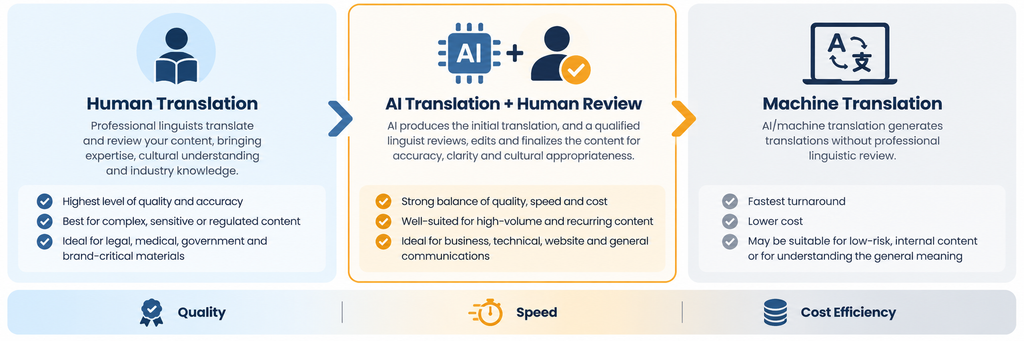
The Right Translation Approach Depends on the Content
There is no single translation method that is right for every project. The best approach depends on what you are translating, who will use it, how quickly it is needed, the level of accuracy and nuance required, and the consequences of an error.
For most organizations, the decision comes down to three practical options: human translation, AI translation with human review, or machine translation without professional review.
Human Translation
Best when accuracy, nuance, subject-matter expertise, and accountability are critical.
AI Translation + Human Review
Best when organizations need a balance of quality, speed, scalability, and cost efficiency.
Machine Translation
Best suited to lower-risk situations where the primary goal is understanding the general meaning rather than producing publication-ready content.
When Human Translation Is the Better Choice
Human translation remains the strongest choice when accuracy, nuance, subject-matter expertise, and accountability matter more than simply achieving the fastest possible turnaround.
When comparing AI translation vs human translation, organizations should start with the purpose, audience, and risk of the content.
Human translation is often appropriate for:
Legal and regulatory documents
contracts, court documents, regulatory submissions, policies, and other content where wording can have significant consequences.
Healthcare and medical content
patient-facing materials, informed consent documents, medical information, and other communications where accuracy and clarity are critical.
Government and public-sector communications
notices, forms, public information, and materials where organizations have language-access or compliance responsibilities.
Highly specialized content
technical, scientific, financial, or industry-specific material requiring subject-matter knowledge and precise terminology.
Brand-critical content
marketing campaigns, corporate communications, websites, and other content where tone, messaging, and cultural relevance directly affect how an organization is perceived.
Content requiring significant cultural adaptation
material where the translator must consider audience expectations, idiomatic language, cultural context, and intended impact.
When AI Translation + Human Review Makes Sense
AI-assisted translation can be a practical choice when organizations need to translate large volumes of content quickly and efficiently without giving up professional human oversight.
In this approach, AI produces the initial translation, and a qualified linguist then reviews, edits, and finalizes the content. The human review step adds linguistic judgment, context, terminology control, and quality assurance that raw machine translation does not provide.
AI translation with human review can be a strong fit for:
- High-volume content — Large document collections, recurring translation projects, and content libraries where traditional translation workflows may take longer or cost more.
- Recurring business content — Internal communications, operational materials, policies, procedures, and other content that organizations need to translate regularly.
- Websites and digital content — Website pages, knowledge bases, portals, and other digital content that may require frequent updates across multiple languages.
- Technical and product content — Product information, manuals, software content, and other materials where terminology consistency is important and a defined review process can be applied.
- Multilingual content programs — Organizations managing content across many languages, departments, locations, or markets can use AI-assisted workflows to improve scalability.
- Projects with demanding turnaround times — AI can accelerate the initial translation while human review helps ensure the final content meets the required quality standard.
- U.S. Department of Health & Human Services — Language Access Plan — discusses using technology such as AI to expedite translation while retaining qualified human translators and editors for review.
The key advantage
AI provides speed and scalability. Human review provides judgment and quality control.
For many organizations, this combination offers a practical balance between quality, turnaround time, and cost—particularly when the content is substantial, recurring, or operational in nature.
However, AI-assisted translation is not automatically appropriate for every project. The content’s purpose, sensitivity, complexity, audience, and required quality level should determine whether human translation or an AI-assisted workflow is the better choice.
EPIC’s approach
EPIC’s Human-Reviewed AI Translation service is built around this model: use AI to accelerate the initial translation, then apply qualified human linguistic review to produce a more polished and reliable final result.
The objective isn’t to replace human expertise. It’s to use technology where it adds efficiency while keeping human expertise where it matters.
When Machine Translation May Be Enough
We need this section because we’ve established the three approaches, and we’ve covered Human Translation and AI Translation + Human Review. We should now address the third option honestly.
I would make this section shorter than the previous two—roughly 150–200 words.
The key is not to disparage machine translation. We want EPIC to appear knowledgeable and objective. The section should explain that machine-only translation can be appropriate when the primary objective is understanding rather than producing polished, publication-ready content.
Comparing Human, AI-Assisted, and Machine Translation
The right translation approach depends on the content, audience, risk level, quality expectations, timeline, and budget. The three approaches can each serve a purpose, but they are not interchangeable.
| Factor | Human Translation | AI Translation + Human Review | Machine Translation |
|---|---|---|---|
| Quality control | High | High | Variable |
| Speed | Moderate | Fast | Very fast |
| Cost | Higher | Moderate | Lower |
| Nuance & context | Excellent | Strong | Variable |
| Terminology control | Strong | Strong with appropriate review | Variable |
| Human oversight | Yes | Yes | No |
| Large-volume content | Suitable, but may require more time | Strong fit | Strong fit |
| Recurring content | Suitable | Strong fit | Strong fit |
| High-risk content | Best suited | May be appropriate depending on review requirements | Generally not recommended |
| Brand-critical content | Strong fit | Strong fit with appropriate review | Generally not recommended |
| Speed-sensitive projects | May require additional time | Strong fit | Strong fit |
The important distinction
The choice isn’t simply between AI and human translators. For many organizations, the most useful option is a hybrid workflow that combines AI’s speed and scalability with professional human review.
The appropriate approach should be determined by the purpose and risk of the content, rather than by technology alone.
For example, a low-risk internal document may not require the same level of linguistic oversight as a regulatory submission, patient communication, legal document, or public-facing government information.
There is no universally “best” translation method. There is a best-fit approach for each type of content.
How to Choose the Right Translation Approach
The right translation workflow starts with the purpose, audience, and risk of the content. Instead of choosing a technology first, organizations should consider what the translation needs to accomplish and what level of quality and oversight is appropriate.
Consider these questions before choosing a translation approach:
1. Who will use the translated content?
Content intended for patients, customers, employees, government agencies, or the general public may require a higher level of linguistic quality than material used only for internal understanding.
2. What are the consequences of an error?
If an inaccurate translation could create legal, regulatory, medical, financial, safety, or reputational consequences, professional human oversight becomes particularly important.
3. How complex is the content?
Specialized terminology, nuanced language, cultural references, and highly technical subject matter can increase the need for experienced translators and reviewers.
4. How much content needs to be translated?
Large or continuously updated content libraries may benefit from an AI-assisted workflow that improves speed and scalability while retaining human review.
5. How quickly is the translation needed?
When turnaround time is critical, AI-assisted translation can accelerate the initial translation while professional review helps maintain the required quality.
6. What level of investment is appropriate?
Human translation may require a greater investment, while AI-assisted workflows can provide efficiencies for appropriate content. The goal should be to match the workflow to the value and risk of the content—not simply choose the lowest-cost option.
A practical rule of thumb
Higher risk and greater linguistic complexity → more human expertise.
Higher volume and greater speed requirements → greater potential value from AI-assisted workflows.
Lower-risk content intended primarily for general understanding → machine translation may be sufficient.
For many organizations, the answer won’t be the same across every document or content type. A single multilingual program may appropriately use human translation for high-risk materials, AI-assisted translation with human review for high-volume content, and machine translation for limited low-risk purposes.
That is why evaluating the content and its intended use is more useful than asking whether AI or human translation is universally better.
How EPIC Combines AI Efficiency With Human Expertise
AI can accelerate the translation process, but technology alone does not replace linguistic judgment. EPIC’s Human-Reviewed AI Translation approach combines AI-assisted production with professional human review to create a workflow designed around quality, efficiency, and scalability.
AI helps accelerate the work
AI can process large volumes of content quickly, helping reduce turnaround times and making high-volume translation projects more manageable.
Human linguists provide the critical review
Professional linguists review the AI-generated translation for meaning, terminology, context, grammar, tone, and overall linguistic quality. They can revise the output where AI-generated language does not adequately reflect the source content or intended audience.
The workflow can be adapted to the content
Not every project requires the same level of review. EPIC can help determine the appropriate workflow based on the content type, intended audience, language, volume, timeline, and quality requirements.
The goal is not AI instead of humans
It is AI where AI creates efficiency—and human expertise where human judgment matters.
For organizations managing substantial or recurring multilingual content, this approach can provide a practical alternative to choosing between the higher cost and potentially longer turnaround of fully human translation and the quality risks of unreviewed machine translation.
Learn more about Human-Reviewed AI Translation →
I would make this section relatively prominent because this is where the page transitions from “here are your options” to “here is how EPIC can help you implement the right one.”
AI Translation vs Human Translation: What About Accuracy?
Translation quality is about more than whether the words have been converted correctly. A high-quality translation should preserve the meaning, context, terminology, tone, and intent of the original content while remaining natural and appropriate for its intended audience.
AI translation can produce strong results, particularly for well-structured and high-volume content, but it can also miss context, interpret terminology incorrectly, or produce language that is technically understandable but unnatural. The risk varies significantly by language pair, content type, and subject matter.
Human translators bring linguistic judgment to these situations. They can evaluate meaning in context, resolve ambiguities, apply specialized terminology, and recognize when a literal translation does not communicate the intended message.
This is why human review can be particularly valuable when the translated content will be published, distributed externally, or used in situations where accuracy and clarity matter.
Accuracy should be evaluated in context
There is no single accuracy threshold that applies to every translation project. A translation intended simply to help an employee understand an internal email does not necessarily require the same level of review as a legal agreement, regulatory document, patient communication, or public-facing government information.
The more important the content—and the greater the consequences of an error—the more important the appropriate level of human oversight becomes.
Which Translation Approach Is Right for You?
Use the following framework as a starting point for determining the most appropriate translation workflow. The right choice depends on the content, audience, risk, volume, timeline, and required level of quality control.
Choose Human Translation When:
- The content is legal, regulatory, medical, financial, or safety-related
- Accuracy and nuance are critical
- The content is highly specialized or complex
- The translation will have significant legal, regulatory, or reputational consequences
- Brand voice and cultural adaptation are particularly important
Priority: Accuracy, nuance, expertise, and accountability
Choose AI Translation + Human Review When:
- You have large volumes of content to translate
- Content is recurring or frequently updated
- You need faster turnaround
- Cost and scalability are important considerations
- The content still requires professional linguistic quality and oversight
- You want to balance efficiency with human expertise
Priority: Quality + speed + scalability
Consider Machine Translation When:
- The content is low risk
- The primary objective is understanding the general meaning
- The content is for internal or preliminary use
- Publication-quality language is not required
- Human review is not necessary for the intended purpose
Priority: Speed and accessibility
The Bottom Line
Don’t choose a translation technology first. Choose the workflow that fits the content.
For some projects, that means fully human translation. For others, an AI-assisted workflow with professional human review can provide the right balance of quality, speed, and scalability. For lower-risk content, machine translation may be sufficient.
The best translation strategy may also use more than one approach across different types of content within the same organization.
How to Evaluate a Translation Provider
Choosing a translation provider is about more than comparing a per-word rate. The provider you select should be able to match the right people, technology, quality controls, and workflow to the requirements of your content.
Look for these capabilities:
Linguistic expertise
Qualified translators and reviewers should have the appropriate language skills and, when necessary, subject-matter expertise for your content.
Quality assurance
Ask how translations are reviewed, edited, proofread, and checked for terminology, consistency, formatting, and overall quality.
Appropriate use of technology
A capable provider should know when AI and translation technology can improve efficiency—and when human expertise and additional review are necessary.
Security & confidentiality
For sensitive, proprietary, personal, legal, medical, or regulated information, understand how the provider protects files and translation data throughout the workflow.
Scalability & Project Management
If your organization needs multiple languages, recurring translation, or large volumes of content, make sure the provider can support those requirements consistently.
Relevant Experience
Look for demonstrated experience with your industry, content types, languages, and intended audiences.
Price is only one part of the decision
The lowest translation rate does not necessarily represent the lowest overall cost. Rework, inconsistent terminology, missed deadlines, formatting problems, or inadequate quality control can create additional costs after the initial translation is delivered.
The right provider should give you confidence that the translation workflow—not just the translation itself—is designed for your requirements.
For organizations evaluating AI-assisted translation, this becomes especially important. Ask not only whether a provider uses AI, but how AI is used, when human review is applied, who performs that review, and how quality is ultimately controlled.
Frequently Asked Questions About AI and Human Translation
Choosing between human translation, AI-assisted translation, and machine translation depends on the content, audience, risk, volume, timeline, and required level of quality control. These questions address some of the most common considerations when evaluating the right translation approach.
Is AI translation as accurate as human translation?
AI translation can produce strong results, particularly for certain language pairs and well-structured content, but it does not consistently provide the same level of contextual judgment and linguistic nuance as an experienced human translator. Human translators can interpret ambiguity, understand context, apply specialized terminology, and adapt language to the intended audience. For higher-risk or highly nuanced content, professional human translation or AI translation with qualified human review may be more appropriate.
What is AI translation with human review?
AI translation with human review is a hybrid workflow in which AI produces an initial translation and a qualified linguist then reviews, edits, and finalizes the content. The linguist evaluates meaning, terminology, grammar, context, tone, and overall quality. This approach can provide greater speed and scalability than fully human translation while retaining professional human oversight.
When should I use human translation instead of AI translation?
Human translation is generally the stronger choice when the content is legally, medically, financially, or technically sensitive; requires significant cultural or linguistic nuance; or carries substantial regulatory, safety, or reputational consequences. It can also be appropriate for brand-critical content where tone and messaging are particularly important.
Is AI translation appropriate for legal or regulatory documents?
It can be used as part of a controlled workflow, but legal and regulatory content generally requires a high level of accuracy, terminology control, and human oversight. For many such documents, fully human translation or AI translation followed by qualified human review is more appropriate than relying on unreviewed machine translation.
Is AI translation cheaper than human translation?
AI-assisted translation can reduce translation costs for appropriate projects, particularly when large volumes or recurring content are involved. However, the total cost depends on the workflow, language pair, complexity of the content, and level of human review required. The lowest initial translation rate does not necessarily result in the lowest overall cost if errors require correction or rework.
What types of content work well with AI-assisted translation?
AI-assisted translation can be particularly useful for high-volume, recurring, technical, operational, website, and digital content when an appropriate human review process is included. It can help organizations manage substantial multilingual content more efficiently while maintaining professional linguistic oversight.
Can AI translation maintain terminology and formatting?
AI can assist with terminology and translation consistency, but results depend on the technology, workflow, source material, and controls used. Professional review and appropriate terminology resources can help identify and correct inconsistencies. Formatting also requires consideration of the source file, target language, document structure, and whether desktop publishing or additional formatting work is needed.
How do I choose the right translation approach for my project?
Start with the purpose of the content, who will use it, the consequences of an error, the complexity and volume of the material, the required turnaround time, and your quality expectations. Higher-risk or highly nuanced content generally warrants greater human involvement, while high-volume or recurring content may benefit from an AI-assisted workflow with human review. A qualified language service provider can help determine the appropriate workflow for each content type.
Not Sure Which Translation Approach Is Right for You?
Every translation project has different requirements. EPIC can help you evaluate your content, audience, timeline, quality expectations, and risk level to determine the most appropriate translation workflow—from professional human translation to AI-assisted translation with human review.