How to Manage On-Site Interpreter Coverage Across Multiple Locations
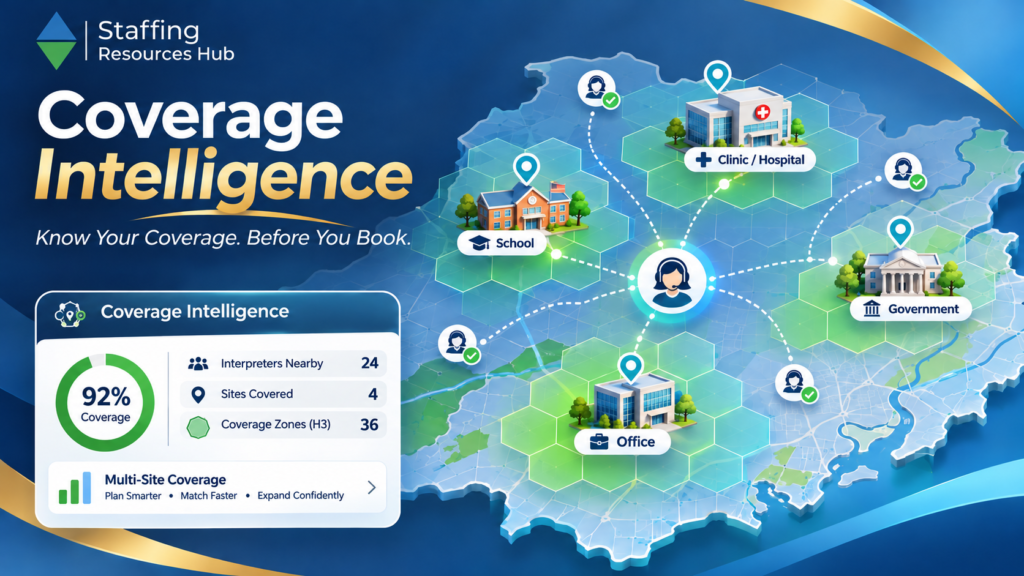
What if you could evaluate on-site interpreter coverage across all your facilities—before submitting your next interpreting request?
For school districts managing parent-teacher conferences and IEP meetings, healthcare systems coordinating patient appointments, and government agencies serving diverse communities, securing qualified on-site interpreters across multiple locations can be a persistent operational challenge.
Traditional interpreter scheduling often begins with a request, followed by phone calls, emails, and outreach to determine whether a qualified interpreter can serve the location. When appointments are urgent, geographically dispersed, or require specialized qualifications, that uncertainty can lead to delays, additional coordination, and unfilled assignments.
But what if organizations could identify potential interpreter coverage before scheduling an appointment?
Advances in geographic mapping and location-based interpreter matching are changing how language-access services can be planned and coordinated. Instead of relying solely on reactive scheduling, organizations can gain visibility into interpreter coverage by location and language, identify potential service gaps, and make more informed decisions.
Staffing Resources Hub (SRH), developed by EPIC Translations, brings this approach to life through Coverage Intelligence—a geographic coverage and interpreter-matching capability designed to make on-site language-access planning more transparent, efficient, and proactive.
Rather than waiting until an interpreting request is submitted to discover potential coverage limitations, organizations can begin understanding their geographic interpreter resources ahead of time.
Why On-Site Interpreter Coverage Is Difficult to Manage
For organizations operating across multiple locations, securing qualified interpreters involves more than finding someone who speaks the required language. Each assignment introduces geographic, scheduling, and qualification requirements that can make reliable coverage difficult to coordinate.
Consider a school district with 30 campuses, a healthcare network serving patients at 15 clinics, or a state agency operating offices across several counties. Each location may have different language needs, appointment schedules, and access to qualified interpreters.
An organization might have strong Spanish interpreting coverage in one city but limited access to American Sign Language (ASL), Arabic, or Bengali interpreters at another location just 40 miles away.
Without geographic visibility into the interpreter network, those differences may remain unknown until an appointment needs to be staffed.
The Limitations of Traditional Interpreter Scheduling
Conventional on-site interpreting workflows often involve several recurring challenges:
- Limited visibility into local coverage: Organizations may not know how many qualified interpreters potentially serve a particular facility.
- Geographically dispersed locations: A provider with strong interpreter resources in one metropolitan area may have limited coverage in surrounding communities.
- Short-notice appointments: Urgent requests leave less time to identify, contact, and confirm an appropriately qualified interpreter.
- Travel considerations: Interpreter distance, travel preferences, and applicable reimbursement requirements can affect staffing feasibility and cost.
- Specialized qualifications: Healthcare, legal, educational, and government assignments may require additional training, credentials, or contract-specific approvals.
These challenges become more pronounced as organizations expand across cities, counties, or entire states.
Why Reactive Scheduling Creates Uncertainty
When interpreter coverage is evaluated only after a request is submitted, organizations have limited opportunity to plan around potential service gaps.
A healthcare clinic may discover that an interpreter with the required qualifications is based far from the appointment location. A school district may learn that its rural campuses have fewer potential interpreting resources than its urban schools.
For government agencies responsible for language access across multiple facilities, these geographic differences can complicate staffing coordination and resource planning.
The fundamental challenge is not simply scheduling an interpreter. It is understanding where qualified interpreting resources may be available before the need becomes urgent.
That distinction is driving growing interest in geographic visibility and more proactive interpreter coverage planning.
What Is Geographic On-Site Interpreter Coverage?
Geographic interpreter coverage refers to the availability of interpreting resources across defined service areas. It helps organizations understand where qualified interpreters may be located, which facilities they can reasonably serve, and where additional resources may be needed.
Unlike traditional scheduling, which typically begins with an appointment request, geographic coverage analysis allows organizations to evaluate their potential interpreting resources in advance.
For example, a school district might discover that several Spanish interpreters serve its central campuses, while its more remote schools have fewer nearby resources. A healthcare network may identify strong American Sign Language (ASL) coverage around one hospital but limited coverage near an outpatient clinic.
This information supports more informed scheduling, earlier planning, and targeted coordination with interpreting providers.
Understanding Interpreter Coverage by Location
An effective geographic coverage system considers several factors:
- Interpreter location: The approximate geographic area where an interpreter is based.
- Language qualifications: The languages and interpreting services the professional is qualified to provide.
- Travel preferences: How far an interpreter is willing to travel for an on-site assignment.
- Assignment requirements: Additional credentials, training, or eligibility requirements associated with specific interpreting services.
- Service location: The geographic location where interpreting is requested.
By bringing these factors together, organizations can better understand their potential access to qualified interpreting resources across different facilities.
Coverage Is Not the Same as Confirmed Availability
An important distinction is that geographic interpreter coverage does not guarantee that an interpreter is available for a particular appointment.
An interpreter may be located near a facility but already committed to another assignment, unavailable at the requested time, or unable to meet specific assignment requirements.
Geographic coverage provides an informed starting point. Actual availability and assignment confirmation remain part of the scheduling process.
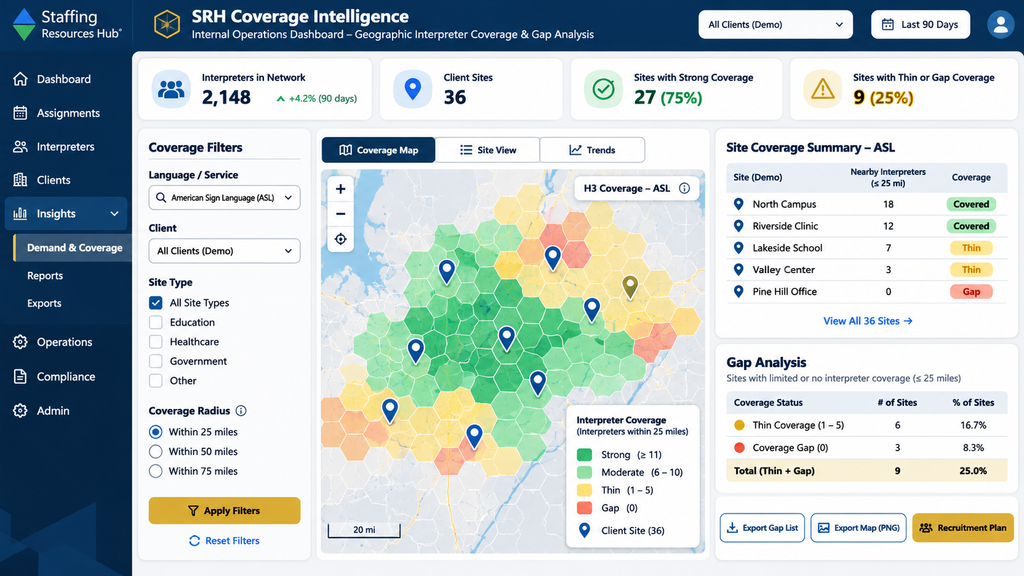
Geographic coverage visualization helps organizations identify potential interpreter resources across multiple service locations. Illustrative SRH interface; counts shown are demonstration data.
How Location-Based Interpreter Matching Works
Location-based interpreter matching makes on-site interpreter coverage easier to evaluate by introducing geographic information into the assignment process.
Rather than identifying interpreters solely by language or general service region, geographic matching considers how close interpreters are to the requested appointment and whether the assignment falls within their preferred travel area.
This is particularly valuable for organizations managing on-site interpreting across large geographic territories.
Geographic Mapping and Interpreter Service Areas
Modern geospatial technology can divide geographic regions into smaller, standardized areas, making it easier to analyze the distribution of interpreting resources.
One example is H3, an open-source geospatial indexing system originally developed by Uber. H3 organizes geographic coordinates into a grid of predominantly hexagonal cells. When combined with interpreter location information, it can help an interpreting platform identify potential resources serving a particular geographic area.
For privacy-conscious platforms, an interpreter’s ZIP code can provide approximate coordinates without requiring their exact residential location to appear on a coverage map.
However, H3 itself does not track interpreters, confirm their availability, or calculate driving times. Those functions depend on additional scheduling, location, and operational systems.
Why Interpreter Travel Preferences Matter
Distance alone does not determine whether an interpreter is a suitable match.
Some interpreters prefer working near home, while others are comfortable traveling longer distances for specialized assignments.
A location-aware interpreting platform should account for those preferences rather than sending every available professional the same assignment notification.
This can reduce irrelevant offers, improve the relevance of assignment opportunities, and help scheduling teams identify interpreters who are more likely to consider a particular location.
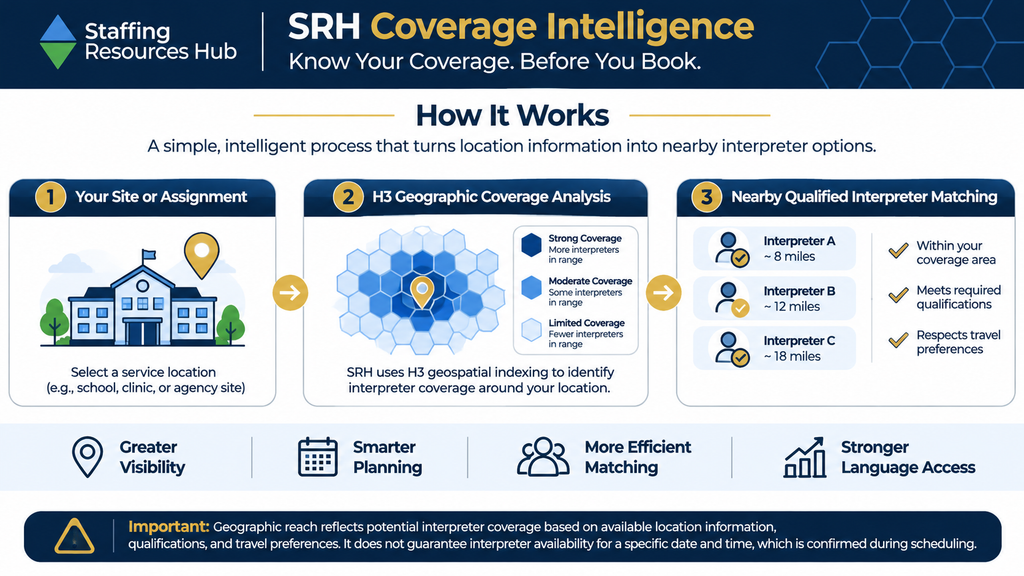
SRH combines geographic coverage analysis with interpreter qualifications, travel preferences, and assignment requirements to support on-site interpreter matching.
Introducing Coverage Intelligence
Recognizing the challenges organizations face when planning on-site interpreting services, EPIC Translations has introduced Coverage Intelligence, a geographic coverage and interpreter-matching capability within its Staffing Resources Hub (SRH) platform.
Designed for organizations managing language access across multiple facilities, Coverage Intelligence provides a more transparent way to evaluate on-site interpreter coverage, identify potential geographic gaps, and plan future interpreting needs.
Instead of waiting until an appointment is submitted to begin evaluating geographic resources, clients can explore coverage across their service locations through their SRH portal.
Watch Coverage Intelligence in Action
See how Staffing Resources Hub helps government agencies, school districts, and healthcare organizations visualize potential interpreter coverage, identify geographic gaps, and make more informed scheduling decisions.
Watch the 2-minute, 40-second product overview below.
Visualize Interpreter Coverage Across Multiple Locations
Coverage Intelligence allows eligible clients to view their service locations on a geographic map and explore potential interpreter coverage by language.
Organizations can:
- View multiple service locations within their SRH account.
- Examine geographic interpreter coverage for selected languages.
- Identify locations categorized as Covered, Thin, or Gap.
- Review counts of interpreters potentially serving individual locations.
- Add locations to support planning for future interpreting needs.
- Download a visual snapshot of their coverage information.
This capability is particularly useful for organizations operating across cities, counties, or entire states.
A state agency, for example, can review geographic coverage around multiple offices without having to evaluate each location through a separate scheduling inquiry.
Identify Potential Coverage Gaps Before Scheduling
Not every facility has the same access to interpreting resources.
By highlighting locations with limited nearby interpreter coverage, SRH helps organizations recognize potential challenges earlier.
For facilities with thin geographic coverage, clients may consider submitting requests with additional notice, coordinating recurring appointments, or discussing other interpreting arrangements with EPIC Translations.
Where appropriate for the assignment, Video Remote Interpreting (VRI) may also provide an alternative to on-site services.
The objective is not to eliminate every coverage challenge, but to make those challenges more visible and manageable.
Know Your Coverage. Before You Book.
Wondering how well your locations are covered by qualified on-site interpreters?
Discover how Coverage Intelligence helps school districts, healthcare networks, and government agencies visualize potential interpreter coverage, identify geographic gaps, and plan interpreting services with greater confidence.
See Geographic Coverage During the Booking Process
Coverage Intelligence also connects geographic information with the on-site booking workflow.
When a client submits an on-site interpreting request, SRH can display the number of potentially eligible interpreters within the applicable geographic search distance.
For example, an organization may be able to review interpreter coverage within a 75-mile radius of an appointment location, subject to the applicable service settings and interpreters’ travel preferences.
This provides additional context before the request enters the assignment process.
The benefit is straightforward: organizations can make scheduling decisions with greater awareness of the interpreting resources potentially serving their locations.
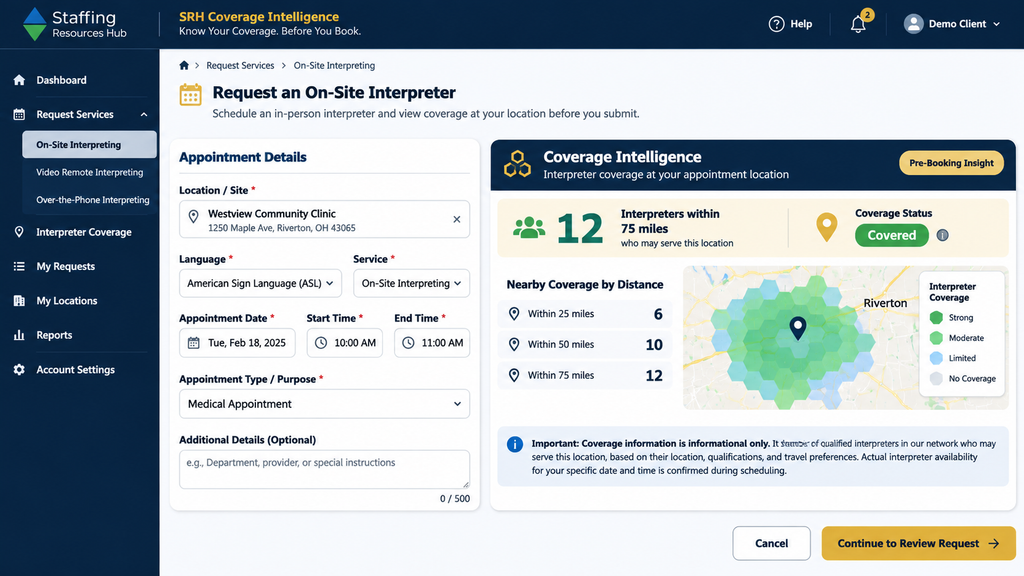
SRH provides geographic interpreter coverage information within the on-site booking workflow, helping clients understand potential local resources before submitting a request.
Benefits for Government, Education, and Healthcare Organizations
Although geographic interpreter coverage is valuable across many industries, it is especially relevant to organizations with multiple facilities and recurring language-access needs.
Government Agencies: Greater Visibility Across Service Locations
State and local government agencies may provide services through numerous departments, regional offices, and community facilities.
For organizations developing broader language-access strategies, the U.S. Department of Justice’s Language Access Plan resources provide an example of how government agencies organize language assistance services and address communication barriers for individuals with limited English proficiency.
Interpreting needs can vary considerably between urban and rural service locations.
With geographic coverage intelligence, agencies can gain a clearer picture of potential interpreting resources around their facilities.
For agencies responsible for multiple regional offices, understanding on-site interpreter coverage by location can support earlier planning and help identify communities where additional qualified interpreting resources may be needed.
This can help language-access coordinators identify areas where additional planning or interpreter recruitment may be needed.
For agencies coordinating ASL and spoken-language interpreting across multiple counties, geographic visibility can support more informed service planning and conversations with interpreting providers.
K–12 School Districts: Supporting Language Access Across Campuses
School districts frequently require interpreters for parent-teacher conferences, Individualized Education Program (IEP) meetings, enrollment activities, disciplinary proceedings, and other educational communications.
These needs may arise at different schools simultaneously, often involving different languages.
Geographic coverage information helps districts better understand which campuses have stronger potential access to qualified interpreters and which locations may require additional coordination.
For a district operating dozens of campuses, this visibility can be valuable when preparing for recurring meetings or periods of increased interpreting demand.
Healthcare Systems: Planning Across Hospitals and Clinics
Healthcare networks often coordinate interpreting services across hospitals, outpatient clinics, rehabilitation centers, and specialty practices.
The availability of qualified interpreters may vary across these locations, particularly for less commonly requested languages or specialized healthcare assignments.
Geographic coverage analysis can help healthcare administrators identify potential local resources and anticipate staffing challenges.
For appointments requiring specialized qualifications, interpreter eligibility and availability must still be verified before an assignment is confirmed.
Across all three sectors, the common advantage is the ability to evaluate geographic interpreter coverage before an appointment becomes an urgent staffing challenge.
How Geographic Matching Benefits Professional Interpreters
Effective interpreting technology should benefit the professionals delivering language services—not just the organizations requesting them.
For freelance interpreters, assignment location plays an important role in deciding which opportunities to accept.
Long travel distances, unpredictable commuting requirements, and offers outside preferred service areas can make assignments less practical.
SRH’s nearby-interpreter matching capabilities address this challenge by incorporating geographic location and interpreter travel preferences into the assignment process.
More Relevant Nearby Assignment Opportunities
Interpreters registered for on-site assignments can maintain their location information and specify their preferred travel distance within SRH.
The platform uses this information to prioritize geographically relevant assignment offers alongside language qualifications and other applicable requirements.
Interpreters may select travel preferences such as 25, 50, or 75 miles, or another supported distance.
This gives interpreting professionals greater control over the geographic areas they are willing to serve.
Supporting Interpreter Privacy
Interpreter location data also requires appropriate privacy safeguards.
SRH’s client-facing coverage experience displays geographic coverage information rather than individual interpreters’ residential addresses.
Clients can evaluate potential coverage without receiving access to interpreters’ private home locations.
This approach helps balance useful geographic information with the privacy interests of independent professionals.
Connecting Interpreter Preferences With Client Needs
When client service locations and interpreter travel preferences are considered together, geographic matching can support more relevant opportunities and better-informed staffing decisions.
For clients, the benefit is improved visibility into potential local resources.
For interpreters, the benefit is greater control over travel expectations and the geographic relevance of assignment offers.
For EPIC Translations, the benefit is the ability to coordinate interpreter outreach while identifying regions where additional qualified professionals may be needed.
Moving From Reactive Scheduling to Proactive Language-Access Planning
Traditional interpreter scheduling primarily focuses on finding someone to fill an appointment.
Geographic coverage intelligence adds another important dimension: understanding where potential interpreting resources exist before the appointment is requested.
This shift is especially valuable for organizations managing numerous facilities, recurring assignments, and geographically dispersed language-access needs.
Rather than treating every interpreting request as an isolated event, organizations can begin viewing geographic coverage as part of their broader operational planning.
They can identify facilities with stronger potential coverage, recognize areas requiring additional preparation, and collaborate with their interpreting provider on suitable staffing approaches.
For organizations developing broader language-access strategies, the U.S. Department of Justice’s language access planning resources provide additional background on organizing language assistance programs and evaluating service needs.
Geographic information does not replace qualified interpreters, experienced scheduling teams, or professional judgment.
Instead, it provides another layer of information to support those critical functions.
The future of on-site interpreter coordination is not simply about finding an interpreter faster. It is also about understanding geographic coverage earlier and making better-informed decisions.
Frequently Asked Questions About On-Site Interpreter Coverage
How can an organization determine whether on-site interpreters serve its locations?
Organizations can work with interpreting providers that maintain geographically organized interpreter networks and offer coverage information by language and service location.
Coverage Intelligence allows eligible clients to explore potential interpreter coverage across their locations through the Staffing Resources Hub portal.
Can interpreter coverage be evaluated across multiple facilities?
Yes. Geographic coverage tools can help organizations evaluate potential interpreting resources across multiple schools, clinics, government offices, or other facilities.
SRH allows clients to maintain multiple service locations and review geographic coverage information for selected languages.
Does geographic interpreter coverage guarantee that an interpreter will be available?
No. Geographic coverage indicates potential interpreter reach based on the information available to the platform. It does not guarantee that a specific interpreter is available or will accept an appointment.
Interpreter qualifications, schedule availability, and assignment requirements must still be confirmed during the booking process.
How does geographic interpreter matching work?
Geographic matching uses location information to identify interpreters who may reasonably serve an appointment location.
SRH combines geographic proximity with interpreter travel preferences, language qualifications, and applicable assignment rules to support targeted on-site interpreter offers.
Does SRH share interpreter home addresses with clients?
No. SRH’s client-facing geographic coverage features are designed to provide coverage information without displaying interpreters’ residential addresses.
Is Coverage Intelligence available for all interpreting services?
Coverage Intelligence is designed primarily for geographic on-site interpreting coverage and assignment planning.
Remote interpreting services, including Over-the-Phone Interpreting (OPI) and Video Remote Interpreting (VRI), have different geographic and operational considerations.
Discover a Smarter Way to Manage On-Site Interpreter Coverage
Managing on-site interpreter coverage across multiple locations should not depend entirely on last-minute scheduling and uncertainty. With greater visibility into geographic resources, organizations can identify potential coverage gaps and plan interpreting services with more confidence.
By connecting geographic visibility, site-level coverage analysis, and location-aware interpreter matching, Coverage Intelligence offers a more informed approach to on-site language-access planning.
Whether you manage a school district, statewide government agency, healthcare network, or another multi-location organization, understanding geographic interpreter coverage can help you prepare for future service needs.
Know Your Coverage. Before You Book.
Discover how Staffing Resources Hub can help your organization explore potential interpreter coverage across its locations.