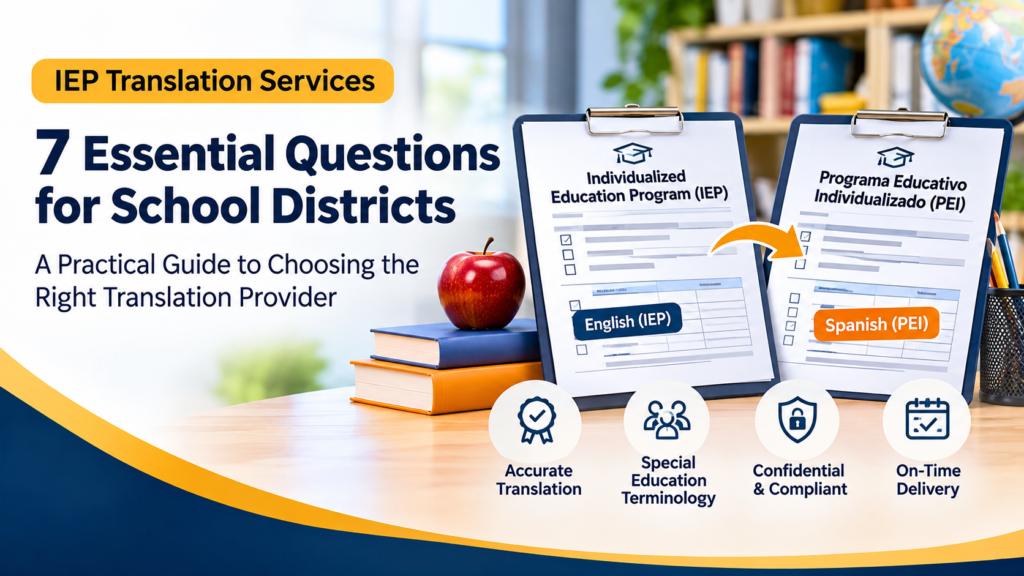
IEP Translation Services: 7 Essential Questions for School Districts
When a school district “needs an Individualized Education Program (IEP) translated for a family whose preferred language is not English, the challenge goes beyond translating words.
IEPs contain specialized educational terminology, student-specific goals, services, accommodations, progress information, and other details that families need to understand.
For special education directors, student services administrators, and language-access coordinators, choosing a reliable provider of IEP translation services means finding a partner who understands both linguistic accuracy and the practical requirements of school operations.
But how can districts distinguish between providers when comparing translation quality, confidentiality, turnaround, and cost?
Here are seven questions worth asking before selecting a professional translation partner.
Why Professional IEP Translation Services Matter
An IEP is a critical part of the special education process. It documents a student’s individualized educational goals and the services and supports identified by the IEP team.
When families use a language other than English, clear communication is essential to meaningful participation.
Federal requirements under the Individuals with Disabilities Education Act (IDEA) address parent participation, interpretation during IEP meetings, and the provision of certain notices in a parent’s native language. Separately, federal civil-rights obligations may require timely and complete translation and interpretation to provide meaningful access for parents with limited English proficiency.
Not every IEP must automatically be translated under IDEA. Districts should evaluate their applicable federal and state obligations and the family’s communication needs.
Regardless of the specific requirement, an inaccurate translation can create confusion about important educational information.
The objective is not simply to produce a translated document. It is to communicate the original information accurately, consistently, and understandably.
7 Questions to Ask an IEP Translation Services Provider
1. Do Your Translators Understand Special Education Terminology?
IEPs contain terms that may not have straightforward equivalents in another language.
Examples include:
- Individualized goals and measurable objectives
- Related services and accommodations
- Present levels of academic achievement and functional performance
- Specialized instruction and evaluation terminology
- Behavioral support and progress monitoring
A qualified provider should be able to assign linguists with relevant educational terminology experience.
Ask how the provider handles terminology that may vary by country or region, and how it maintains consistency across related documents.
What to look for: Professional translators with appropriate subject-matter experience, supported by reference materials and terminology-management procedures.
2. Is the Translation Independently Reviewed for Accuracy?
Translation and quality assurance should be treated as distinct activities.
A document may appear fluent in the target language while still containing terminology inconsistencies, omitted details, or meaning that differs from the original.
For important special education documents, ask whether the provider offers independent bilingual review by a qualified second linguist.
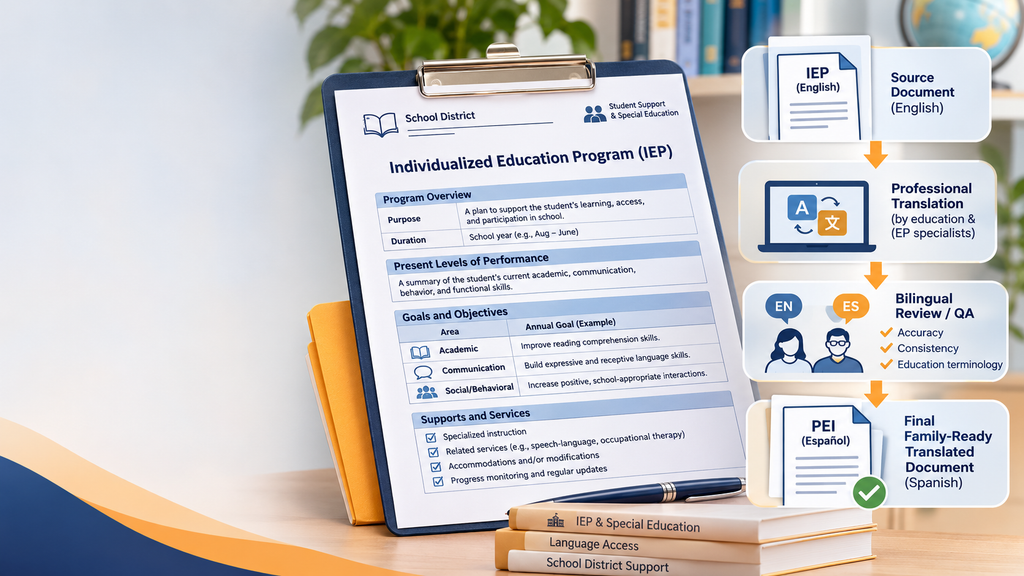
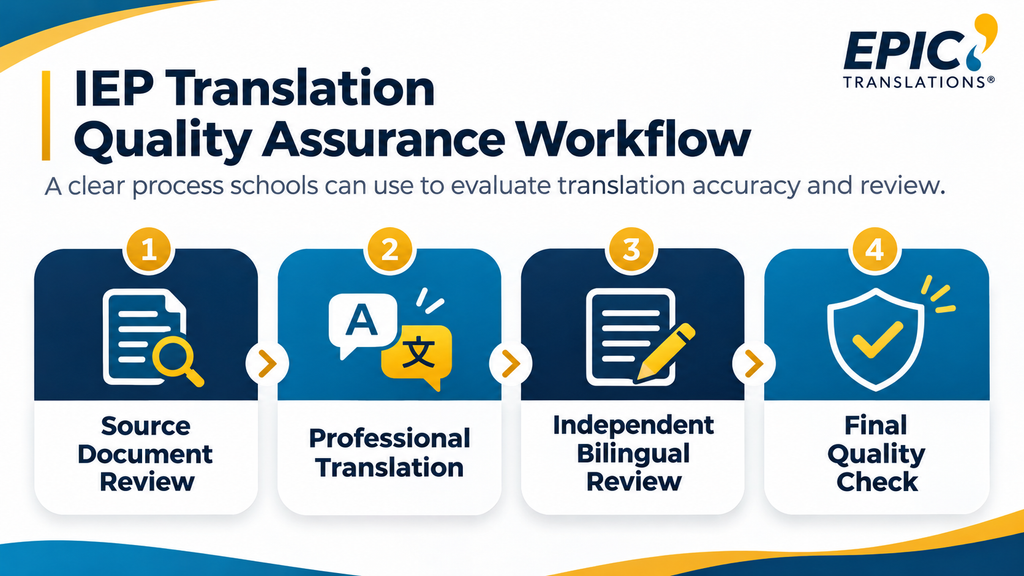
An effective quality process may include:
- Review of the original document and project requirements.
- Translation by a qualified linguist.
- Independent bilingual editing or review.
- Final checks for completeness, formatting, and requested deliverables.
At EPIC Translations, professional translation workflows can incorporate qualified translators, independent editing, terminology management, and document-level quality checks appropriate to the assignment.
3. Can the Provider Preserve the Original IEP Format?
IEPs frequently include tables, numbered sections, goal statements, checkboxes, and standardized district forms.
Poor formatting can make a translated document difficult to navigate even when the language is accurate.
A provider should evaluate whether the original structure can be retained and explain any additional formatting or desktop publishing requirements before production begins.
For example, a district may need a translated Word document that remains editable or a PDF that closely follows the original layout.
EPIC supports document translation and multilingual formatting for Word documents, PDFs, forms, and other common file types.
What to look for: A provider that discusses file formats and layout requirements during the quotation process—not after the translation is completed.
4. How Will Confidential Student Information Be Handled?
IEPs can contain sensitive student information, including educational evaluations, disability-related information, and individualized support needs.
Before sharing documents, districts should understand the translation provider’s confidentiality practices, access controls, file-handling procedures, and any applicable contractual requirements.
The Family Educational Rights and Privacy Act (FERPA) places conditions on the disclosure and handling of personally identifiable information from education records. Under applicable circumstances, schools may outsource certain functions to service providers subject to defined controls and requirements.
Districts should confirm that their vendor arrangements and document-sharing procedures comply with applicable policies and legal requirements.
Ask prospective vendors:
- Who will have access to the documents?
- Are assigned linguists subject to confidentiality requirements?
- How are files transferred and managed?
- Can the vendor accommodate district-specific security requirements?
EPIC uses managed translation workflows, confidentiality practices, and project-specific access controls. Districts with particular requirements should discuss them before submitting sensitive student records.
5. Can the Provider Meet Our Required Turnaround?
School districts may need translations for upcoming meetings, scheduled reviews, family communications, or other time-sensitive activities.
Turnaround depends on factors such as word count, language pair, file complexity, review requirements, and formatting.
A realistic provider should evaluate these requirements before confirming a delivery schedule.
Ask whether the quotation includes all necessary steps, particularly bilingual review and document formatting.
For recurring needs, districts should also determine whether their vendor can support multiple assignments and different languages without requiring a completely new administrative process each time.
What to look for: Clear turnaround commitments based on the actual project rather than an unsupported promise that every document can be completed immediately.
6. Is the Pricing Transparent, Including Minimum Charges and Formatting?
Price matters, particularly when school districts manage limited budgets and multiple language-access requirements. The cost of IEP translation services depends on the language pair, document complexity, review requirements, and turnaround.
However, comparing per-word rates alone can be misleading.
Two quotations may differ because one includes independent review, formatting, and project management while another covers translation only.
Before selecting a provider, confirm:
- The language pair and applicable per-word or project rate
- Minimum project charges
- Whether independent editing or review is included
- Any document formatting or desktop publishing costs
- Expedited turnaround charges, when applicable
- The requested final file format
For short documents, minimum charges can be particularly important.
A competitive quotation should clearly describe what the district is purchasing so administrators can evaluate the actual cost of obtaining a usable document.
7. Can the Provider Support More Than One IEP or One Language?
A single translation request may be the immediate priority, but district-wide language needs often extend beyond one student or one school.
A district may also require translations of evaluation reports, Section 504 Plans, consent forms, parent notices, enrollment materials, and other school communications.
Working with a provider that supports a broad range of languages and document types can simplify future coordination.
EPIC Translations supports professional translation and interpreting services across more than 200 languages, including services for K–12 educational organizations.
For districts with recurring needs, it may be helpful to establish a consistent request and quotation process rather than evaluate a new provider for every assignment.
Need an IEP or Special Education Document Translated?
EPIC Translations works with school districts and education organizations to support professional translation of IEPs, evaluations, Section 504 Plans, consent forms, parent communications, and related materials.
Have an IEP or Special Education Document That Needs Translation?
EPIC can help with professional translation, terminology consistency, independent review when required, and document formatting. Share your project details to receive a quote tailored to your district’s needs.
Share the language pair, document details, requested deadline, and formatting requirements. EPIC can review your project and provide a quotation based on its scope.
For sensitive student documents, please confirm the appropriate secure submission method before transmitting personally identifiable information.
What About AI Translation for IEP Documents?
EPIC provides IEP translation services alongside other professional language solutions for K–12 districts. AI-assisted translation can be useful in certain document workflows, but special education content demands careful attention to meaning, terminology, completeness, and confidentiality.
A machine-generated document should not be assumed accurate simply because it reads naturally.
Educational terms, student-specific details, tables, and specialized language may require additional human evaluation.
When a district is considering AI-assisted translation, important questions include whether the process is authorized for the information involved, how sensitive data is handled, and what professional human review is performed before delivery.
EPIC supports both professional human translation and appropriately reviewed AI-assisted translation workflows.
For sensitive or consequential IEP content, the district and provider should agree on an appropriate translation and quality-assurance process before work begins.
Proven Experience Translating IEPs for School Districts
EPIC Translations has extensive experience supporting K–12 educational organizations, including completing numerous Individualized Education Program (IEP) translation projects for Calhoun Intermediate School District in Michigan.
This hands-on experience gives EPIC a practical understanding of the specialized educational terminology, document structures, and accuracy requirements involved in translating important special education materials.
Whether your district needs a single IEP translated or ongoing support for multilingual educational documents, EPIC is equipped to help.
How to Request an IEP Translation Quote From EPIC
The request process can be straightforward.
Step 1: Identify the documents. Determine whether you need a complete IEP, selected sections, an evaluation report, or another special education document translated.
Step 2: Specify the language. Indicate the original language and required target language, including any relevant language preferences.
Step 3: Describe the deadline and format. Include the requested turnaround, original file format, and any requirements for an editable translation or preserved layout.
Step 4: Request a quotation. Submit the project details through EPIC’s online quote request process. EPIC can review the requirements and advise on the appropriate next steps for providing files.
Step 5: Review and authorize the project. Once the scope, pricing, and turnaround are confirmed, the district can proceed according to its purchasing and authorization procedures.
For recurring requests, EPIC can also discuss how to establish a practical translation workflow across departments and campuses.
Frequently Asked Questions About IEP Translation Services
Can EPIC translate IEPs into Spanish and other languages?
Yes. EPIC provides professional document translation across more than 200 languages, subject to project requirements and linguist availability. Districts can request translation into Spanish and other languages used by their school communities.
Do all IEPs have to be translated?
IDEA does not impose a blanket requirement to translate every IEP. However, schools have specific obligations involving meaningful parent participation, interpreters during IEP meetings when necessary, and notices in a parent’s native language. Additional federal and state requirements may apply. Districts should assess their obligations based on the circumstances.
How much does an IEP translation cost?
Pricing depends on the language pair, word count, complexity, review requirements, formatting, and requested turnaround. Minimum charges may apply. EPIC can prepare a project-specific quotation after reviewing the requirements.
Can you preserve tables and formatting?
EPIC supports translation of formatted documents, including Word files and PDFs. The precise formatting requirements and any additional production work are evaluated as part of the project scope.
Can EPIC also help with interpreting during an IEP meeting?
Yes. In addition to written document translation, EPIC offers over-the-phone interpreting, video remote interpreting, on-site interpreting, and American Sign Language services, subject to availability and applicable service arrangements.
Learn more about EPIC’s K–12 language services.
Choose a Translation Partner That Understands School District Needs
Choosing the right IEP translation services provider involves more than competitive pricing—it means ensuring that important educational information is communicated accurately and consistently to families.
School districts need confidence that important educational content will be handled accurately, consistently, confidentially, and according to the project’s operational requirements.
As you evaluate providers, consider their linguistic qualifications, review procedures, document-formatting capabilities, security practices, responsiveness, and experience with educational materials.
EPIC Translations has supported public education organizations and school districts with professional language services since 2005.
Whether your district has one IEP to translate or recurring multilingual document needs across several schools, EPIC can help you evaluate the appropriate translation services.
Need an IEP or Special Education Document Translated?
EPIC Translations helps school districts translate IEPs, evaluations, 504 Plans, and other important educational documents with professional accuracy, consistent terminology, and careful attention to formatting and confidentiality.