Language Access Services for 2027: A Practical Guide for Government Agencies, Schools, and Organizations
Discover seven ways to improve translation, interpreting, accessibility, and multilingual communication with professional language expertise and modern technology.
Language access services are becoming an increasingly important operational consideration for government agencies, school districts, universities, healthcare organizations, and businesses serving multilingual communities.
Whether translating an important public notice, arranging an interpreter for a parent-teacher conference, preparing multilingual technical documentation, or supporting a patient who uses American Sign Language (ASL), organizations need more than access to someone who speaks another language.
They need qualified language professionals, dependable service delivery, efficient coordination, and technology that helps employees obtain the right support when it is needed.
Yet many organizations continue to manage translation and interpreting services through disconnected vendors, email requests, spreadsheets, and department-specific processes.
As 2026 comes to a close, the opportunity is not simply to review outstanding translation projects. It is to evaluate whether existing language access services are equipped to support the organization’s communication needs in 2027.
At EPIC Translations, we combine professional language expertise with a purpose-built technology ecosystem to help organizations coordinate translation, interpreting, and multilingual communication more effectively.
This guide explores seven priorities for strengthening language access services, with practical recommendations for government agencies, school districts, and other institutional buyers.
1. Evaluate Whether Your Current Language Access Services Meet Organizational Needs
Most organizations do not have a single language access requirement.
A state agency may need document translation for public programs, over-the-phone interpreting for constituent inquiries, and on-site ASL interpreters for meetings.
A school district may need Spanish translations for parent communications, Hmong interpreting for student services, and video remote interpreting for scheduled conferences.
A healthcare organization may need translated patient materials, medical interpreting, and accessible communication options for Deaf and hard-of-hearing patients.
These needs can emerge across different departments, locations, and budgets.
The challenge is ensuring that employees can obtain appropriate services without unnecessary delays or complicated administrative procedures.
Questions to consider before 2027:
- Which languages are most frequently requested?
- Are translation and interpreting requests managed consistently across departments?
- Can employees obtain qualified interpreters when needed?
- Are outstanding documents awaiting translation or revision?
- Are language-service costs, assignments, and project records easy to review?
- Do existing vendors support the full range of services your organization requires?
A language access review should identify not only what services are available, but how effectively those services operate.
EPIC’s approach: Provide access to professional translation and interpreting services through organized workflows that support individual projects and recurring organizational needs.
2. Strengthen Government Translation Services Across Departments and Programs
Government translation services support communication between public institutions and the communities they serve.
Federal, state, county, and municipal agencies routinely communicate important information through applications, forms, correspondence, public notices, program materials, websites, and community outreach.
These communications may relate to health and human services, public transportation, workforce development, courts, public safety, education, or other government functions.
When language support is unavailable or difficult to coordinate, residents may struggle to understand information, complete applications, or participate in services.
Language Access Responsibilities Require Practical Solutions
Title VI of the Civil Rights Act of 1964 and applicable implementing regulations establish nondiscrimination requirements for recipients of federal financial assistance, including requirements relevant to meaningful access for individuals with limited English proficiency.
Specific responsibilities depend on the agency, its programs, applicable regulations, and other legal requirements.
The federal language-access policy environment has also changed in recent years. Organizations should review current federal, state, and local requirements rather than rely exclusively on outdated guidance.
For agencies, an effective operational approach can include professional document translation, qualified interpreting resources, clear staff procedures, and organized service records.
Common Government Translation and Interpreting Needs
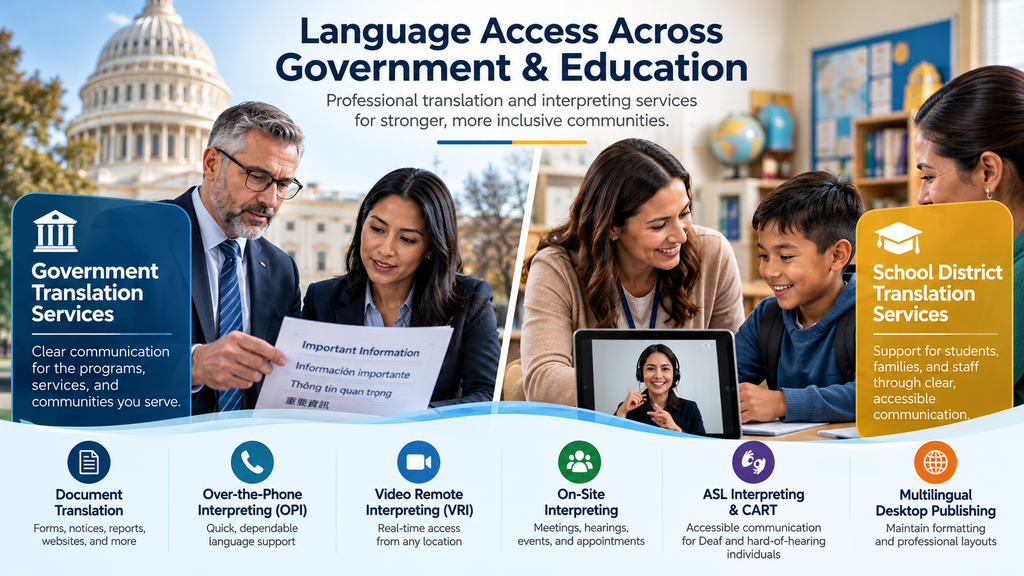
EPIC supports government language-services requirements involving:
- Public notices, forms, applications, and program documents.
- Benefits information and constituent communications.
- Administrative hearings and public meetings.
- Legal and regulatory documents.
- Transportation and public infrastructure communications.
- Training materials and multilingual outreach.
- Over-the-phone, video remote, and on-site interpreting.
- ASL interpreting and CART services where appropriate.
A particularly important consideration is preserving document formatting.
Government forms, tables, reports, and applications often contain structured information that must remain understandable after translation.
EPIC’s multilingual document-production capabilities help organizations maintain professional layouts while accommodating the text expansion and formatting differences that can occur between languages.
For agencies coordinating multiple programs, centralized translation project management and interpreting operations can also simplify service administration.
Explore EPIC’s Government Translation Services for federal, state, and local agencies.
3. Improve School District Translation Services and Family Communication
School district translation services play a significant role in communication among administrators, teachers, students, and families.
Districts serve families with different language backgrounds and must manage communication across multiple buildings, departments, educational programs, and staff roles.
A district may require language support for enrollment, special education, student services, academic progress, disciplinary matters, family engagement, or district-wide communications.
The U.S. Department of Education explains that schools and districts have obligations to address language barriers affecting English learners and communicate important school-related information to parents with limited English proficiency in languages they understand.
Where Schools Need Professional Language Services
Common school district requirements include:
Document translation: Enrollment forms, parent handbooks, academic notices, district improvement plans, student policies, permission forms, and special education materials.
Over-the-phone interpreting (OPI): Parent calls, administrative inquiries, and suitable student-service conversations.
Video remote interpreting (VRI): Parent-teacher conferences, counselor meetings, scheduled discussions, and other appropriate remote interactions.
On-site interpreting: Meetings, assessments, educational events, and situations requiring in-person language support.
ASL interpreting and CART: Accessibility services for students, families, staff, and participants who need these communication supports.
The Operational Challenge for School Districts
Consider a district with 15 schools.
If each building manages interpreting independently, administrators may have limited visibility into requests, service activity, spending, or recurring language needs.
A centralized approach allows schools to follow a more consistent requesting process while giving district leadership better information about language-service operations.
This is one reason EPIC developed Staffing Resources Hub (SRH), a specialized interpreting platform that supports school-based and district-wide language-service workflows.
Staff can request or schedule interpreting services through an organized environment, while authorized administrators can gain visibility into relevant service activity.
EPIC also supports written translation requirements through its dedicated translation management workflows.
Rather than forcing districts to manage several disconnected service arrangements, EPIC can support both spoken-language interpreting and professional document translation through one provider relationship.
Explore EPIC’s School District Translation Services and Interpreting Solutions.
Need Translation or Interpreting Services for Your Agency or School District?
EPIC helps government agencies and educational institutions coordinate professional language services, from individual document translations to recurring interpreting assignments.
4. Make Translation and Interpreting Services Easier to Request and Manage
Translation and interpreting services address different communication needs, but organizations frequently purchase both.
Translation involves written content, including documents, forms, websites, technical materials, and digital communications.
Interpreting facilitates communication between people using spoken or signed languages.
An effective language-services arrangement should make both easier to coordinate.
Choosing the Appropriate Interpreting Method
Over-the-Phone Interpreting (OPI) can be appropriate for telephone conversations, routine inquiries, and situations where visual communication is unnecessary.
Video Remote Interpreting (VRI) provides real-time video communication with an interpreter and can be useful when participants are in different locations.
On-Site Interpreting supports in-person appointments, meetings, hearings, events, and situations where physical presence is necessary.
ASL Interpreting supports communication with individuals who use American Sign Language, including through qualified in-person interpreters or appropriate video remote arrangements.
CART Services provide real-time transcription of spoken communication for individuals who benefit from text access.
These options are not interchangeable in every situation.
For example, effective communication requirements under the Americans with Disabilities Act may necessitate particular auxiliary aids or services. When VRI is used for sign-language communication, equipment quality, visual clarity, connectivity, and the circumstances of the interaction are important considerations.
Organizations should select service methods based on the communication requirements rather than cost or convenience alone.
A Better Process for Recurring Interpreting Needs
Organizations should consider whether their interpreting process supports:
- Clear service-request procedures.
- Appropriate interpreter qualifications and specialization.
- Scheduled and time-sensitive assignments.
- Multiple languages and locations.
- Assignment confirmation and communication.
- Centralized administrative visibility.
- Organized service records and billing information.
EPIC provides professional interpreting services across multiple modalities, supported by dedicated interpreting operations technology.
5. Use AI Translation Carefully Without Sacrificing Quality
Artificial intelligence is creating new possibilities for organizations managing multilingual content.
AI-assisted workflows can be useful for certain recurring, high-volume, or lower-risk materials where faster processing and scalable content production are priorities.
However, not every document should be handled in the same way.
Legal documents, medical communications, technical manuals, public safety instructions, and other high-impact materials may require specialized professional translation and rigorous linguistic review.
AI-generated translation can contain inaccurate terminology, missed context, omissions, or misleading interpretations that are not immediately apparent to someone unfamiliar with the target language.
Human Translation Versus Human-Reviewed AI Translation
Organizations should evaluate:
- The document’s purpose and intended audience.
- The consequences of an inaccurate translation.
- Confidentiality and authorized data-handling requirements.
- Industry-specific terminology.
- Required accuracy and review procedures.
- Formatting and publication requirements.
- Volume, turnaround, and budget considerations.
For projects requiring extensive human judgment or specialized expertise, professional human translation may be the appropriate choice.
For suitable materials, AI-assisted translation combined with professional human review may provide a practical alternative.
EPIC supports both approaches.
Our goal is not to promote AI as a replacement for professional linguists. It is to use technology where appropriate while maintaining human oversight and quality processes aligned with the project’s requirements.
This approach gives government agencies, educational institutions, healthcare organizations, and businesses greater flexibility when planning translation work.
6. Discover How EPIC’s Technology Stack Supports Language Access Services
One of the most significant differences between traditional language-service purchasing and a coordinated language operations model is the technology supporting delivery.
Organizations often have to manage quotations, translation files, interpreter assignments, project communications, and service records across unrelated systems.
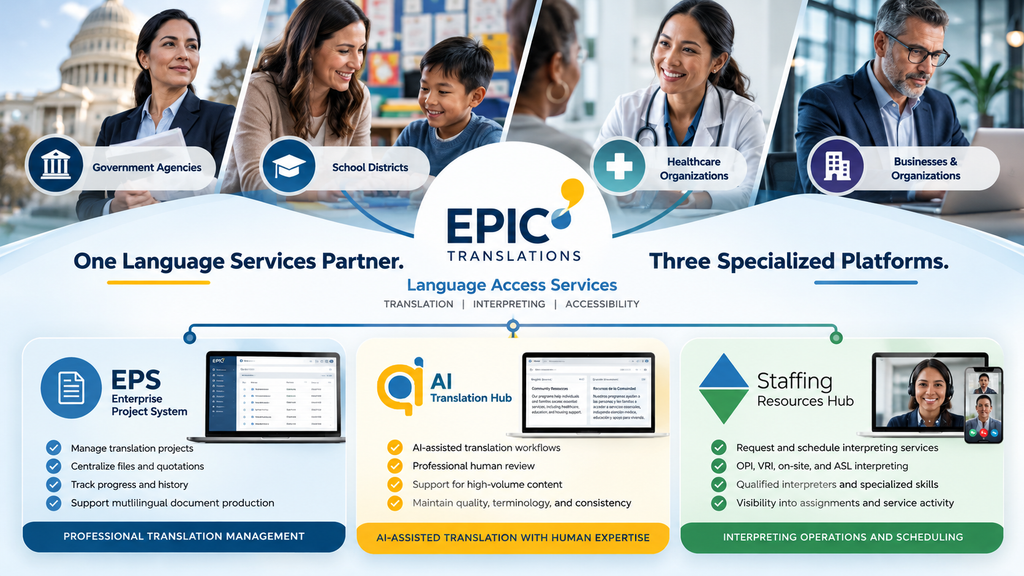
EPIC has developed three specialized platforms to address different components of language operations.
EPS: Enterprise Project System
Purpose: Professional translation project management and coordination.
EPS supports the operational lifecycle of written translation projects, including quotation workflows, project coordination, document handling, and delivery.
For organizations translating recurring documents or managing work across departments, EPS helps create a more structured project environment.
Its value is particularly relevant to government agencies handling multilingual forms, school districts translating district-wide materials, and manufacturers working with complex documentation.
Rather than managing every translation project through disconnected email exchanges, organizations can benefit from more organized project processes and records.
AITH: AI Translation Hub
Purpose: AI-assisted translation workflows with appropriate human review.
AITH supports EPIC’s approach to AI-enabled multilingual content production.
It can help organizations evaluate and process suitable content through AI-assisted translation workflows, with professional human review incorporated according to project requirements.
AITH is particularly relevant when organizations have recurring content volumes, multilingual updates, or situations where AI-assisted processing may offer operational efficiencies.
Crucially, machine-generated output is not automatically considered a finished professional translation.
Human review, content sensitivity, terminology, and quality requirements remain central to determining whether the result is suitable for its intended use.
SRH: Staffing Resources Hub
Purpose: Interpreting request management, scheduling, and coordination.
SRH is EPIC’s specialized interpreting operations platform.
It supports over-the-phone interpreting, video remote interpreting, on-site interpreting, and ASL interpreting workflows.
For authorized organizational users, SRH provides an environment for requesting services, coordinating scheduled or on-demand needs, and reviewing relevant assignment activity.
For a school district, this may mean giving multiple schools a consistent process for requesting interpreters.
For a government agency, it may mean more organized coordination of interpreting requests across programs and departments.
For a healthcare organization, it may support scheduling and managing interpreting assignments across different service locations.
Explore Staffing Resources Hub.
Three Platforms, One Coordinated Language Services Partner
Each technology platform serves a distinct purpose:
- EPS: Manages professional written translation projects.
- AITH: Supports AI-assisted translation workflows and human review.
- SRH: Coordinates interpreting requests and service operations.
Together, these platforms support EPIC’s broader language operations model.
Organizations can begin with a single translation project, an interpreting assignment, or one recurring service requirement. There is no need to adopt every technology platform to benefit from working with EPIC.
The objective is simple: combine qualified language professionals with operational systems that make multilingual communication easier to manage.
7. Build a Practical Language Access Services Plan for 2027
The transition from 2026 to 2027 provides a useful opportunity to review current service arrangements and identify improvements.
For many organizations, the best starting point is a short, practical assessment.
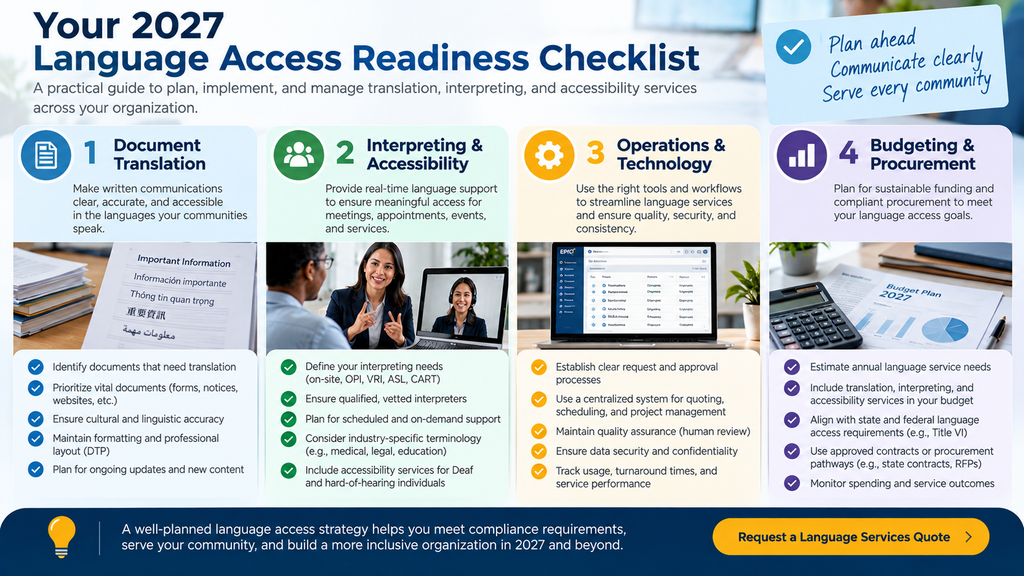
Your 2027 Language Access Services Checklist
Document Translation
- Identify outstanding documents requiring translation.
- Review existing translations for outdated information.
- Determine whether translated documents require formatting or desktop publishing.
- Identify materials requiring professional human translation or human-reviewed AI workflows.
Interpreting and Accessibility
- Review recurring interpreting languages and service locations.
- Evaluate OPI, VRI, on-site, and ASL interpreting needs.
- Identify upcoming appointments, meetings, and events requiring support.
- Review CART and other effective communication requirements where applicable.
Operations and Technology
- Evaluate how departments request and manage services.
- Identify administrative delays or fragmented vendor arrangements.
- Review project records, assignment visibility, and reporting needs.
- Consider whether specialized technology could simplify translation and interpreting operations.
Budgeting and Procurement
- Identify projects requiring completion before year-end.
- Estimate recurring language-service needs for 2027.
- Review existing purchasing arrangements and contract options.
- Request quotations for outstanding and upcoming projects.
Organizations do not need to solve every language access challenge at once.
A focused review can identify immediate projects, recurring operational needs, and areas where improved coordination may provide lasting value.
Why Organizations Partner With EPIC Translations
Since 2005, EPIC Translations has provided professional language services for organizations requiring accurate multilingual communication and dependable project coordination.
Our experience includes government agencies, school districts, universities, healthcare organizations, manufacturers, and other institutional clients.
Clients can benefit from:
Professional language expertise. Access to professional translators and interpreters, including linguists with relevant subject-matter experience.
Comprehensive translation and interpreting services. Human translation, human-reviewed AI translation, OPI, VRI, on-site interpreting, ASL, CART, localization, and multilingual document production.
Technology-supported operations. EPS, AITH, and SRH address the distinct operational requirements of written translation, AI-assisted translation, and interpreting coordination.
Support for complex documents. Translation and multilingual formatting for forms, reports, manuals, public communications, and other structured materials.
Public-sector and education experience. Familiarity with institutional language needs, recurring service requirements, and organizational purchasing processes.
Flexible project engagement. Support for individual requests, recurring departmental work, and broader language-service programs.
EPIC’s approach brings together professional linguistic services and technology designed to support the work organizations need to accomplish.
Planning Language Access Services for 2027? Start With EPIC.
Whether your organization needs government translation services, school district translation services, professional interpreting, or a more organized approach to multilingual operations, EPIC Translations can help you evaluate your requirements.
You may have outstanding documents that need translation before the end of 2026.
You may be preparing a language-services budget for 2027.
Or you may be looking for a provider capable of coordinating translation and interpreting services across multiple departments, schools, or locations.
The first step is identifying what your organization needs.
Share your documents, target languages, project deadlines, interpreting requirements, or recurring service needs with EPIC.
Our team can review the scope and recommend an appropriate service approach, supported by the professional linguists and specialized technology your projects require.
Ready to Improve Your Language Access Services?
Whether your organization needs document translation, OPI, VRI, on-site interpreting, ASL, or human-reviewed AI translation, EPIC Translations can help you find the right solution.