How to Choose a Language Service Provider
How to choose a language service provider is an important decision when your organization relies on accurate, secure, and reliable multilingual communication. The right provider should have the linguistic expertise, quality controls, technology, security, capacity, and operational experience to support your specific requirements.
Whether you need translation, interpreting, localization, or ongoing multilingual support, this guide explains what to evaluate before selecting a language service provider—and the questions worth asking along the way.
Why Choosing the Right Language Service Provider Matters
Knowing how to choose a language service provider is particularly important when multilingual communication is ongoing or involves sensitive, specialized, or high-stakes content. Organizations should also understand the language-access obligations that may apply to their programs and services. The U.S. Department of Health & Human Services provides additional information on federal language-access requirements through its Limited English Proficiency resources.
A capable language service provider should be able to understand your requirements, recommend an appropriate workflow, maintain consistent quality, protect sensitive information, and scale services as your needs change.
The consequences of choosing poorly can extend well beyond a disappointing translation. Inconsistent terminology, missed deadlines, inadequate interpreting coverage, security gaps, or insufficient quality controls can create operational problems and additional costs.
For organizations with ongoing multilingual requirements, the provider should function as a reliable language-services partner, not simply a vendor that delivers individual translations.
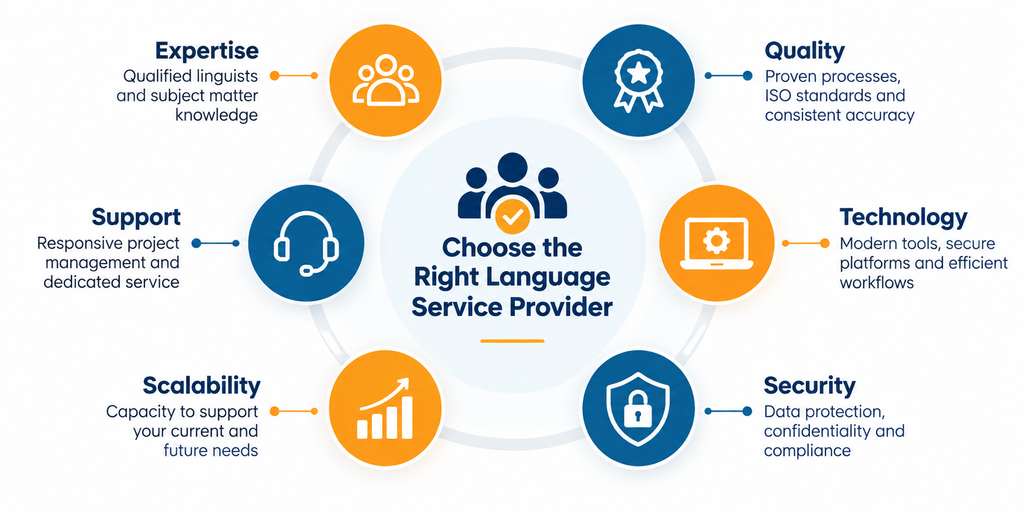
6 Key Criteria for Evaluating a Language Service Provider
1
Linguistic Expertise
Look for qualified translators and interpreters with the language skills and subject-matter expertise appropriate for your content, industry, and audience.
2
Quality Assurance
Evaluate the provider’s processes for translation, editing, proofreading, terminology management, quality control, and final review.
3
Technology & Workflow
A strong provider should use translation technology, AI, terminology tools, and workflow automation appropriately while maintaining human oversight where it matters.
4
Security & Confidentiality
Understand how the provider protects sensitive, proprietary, personal, legal, medical, and regulated information throughout the language-services workflow.
5
Scalability
Consider whether the provider can support your current and future requirements, including multiple languages, high volumes, recurring projects, and different service types.
6
Support & Project Management
Look for responsive project management, clear communication, reliable scheduling, transparent processes, and a team that takes responsibility for delivering the work.
How to Choose a Language Service Provider: Questions to Ask Before Selecting a Provider
Selecting a language service provider is an important decision, particularly when multilingual communication is ongoing or involves sensitive, specialized, or high-stakes content. Before choosing a provider, ask questions that help you understand its people, processes, technology, security practices, capacity, and pricing.
Understanding how to choose a language service provider can help organizations look beyond price and evaluate the people, processes, technology, and safeguards behind the services they receive.
What should I look for in a language service provider?
Look for a provider with qualified language professionals, defined quality-assurance processes, appropriate technology, strong security practices, sufficient capacity, and responsive project management. The provider should also have relevant experience with your industry, content types, languages, and service requirements. Rather than focusing on a single factor such as price or the number of languages offered, evaluate whether the provider can build and manage a reliable workflow that fits your organization’s specific needs.
How do I evaluate the quality of a language service provider?
Ask how the provider selects and qualifies translators and interpreters, how assignments are matched to subject-matter expertise, and what review and quality-control processes are used. You should also understand how the provider manages terminology, consistency, client feedback, and corrections. Certifications and established quality standards can provide additional insight into a provider’s processes, but they should be considered alongside the provider’s actual experience, workflows, and ability to consistently deliver quality work.
How do I know if a language service provider uses qualified translators and interpreters?
Ask how language professionals are recruited, screened, qualified, and assigned to projects. Depending on the service and subject matter, relevant qualifications may include language proficiency, interpreting credentials, certifications, education, professional experience, and subject-matter expertise. A reputable provider should be able to explain how it determines which translator or interpreter is appropriate for a particular assignment rather than treating every language professional as interchangeable.
What technology should a language service provider use?
A capable provider should use technology where it improves efficiency, consistency, and workflow management without allowing technology to replace appropriate human judgment. Depending on the project, this may include computer-assisted translation tools, translation memories, terminology management, AI-assisted translation, workflow platforms, and other language technologies. The more important question is not whether a provider uses the newest technology, but how it uses technology and when human review or expertise is required.
How should a language service provider protect confidential information?
Ask how the provider handles sensitive information from the moment files are received through translation, review, storage, and delivery. Important considerations can include confidentiality agreements, access controls, secure file handling, data protection practices, employee and linguist policies, and procedures for sensitive or regulated information. If your organization handles personal, medical, legal, financial, government, or proprietary information, make sure the provider’s security practices are appropriate for the nature of the material.
Can the language service provider scale with my organization’s needs?
Consider whether the provider can support your requirements as the volume, number of languages, locations, departments, or service types change. A scalable provider should be capable of handling both individual projects and recurring programs, including large translation volumes, interpreting requests, localization, and other multilingual requirements. It is also important to understand whether the provider has the operational systems and language-professional network needed to maintain consistent service as demand increases.
How should I compare language service provider pricing?
Don’t compare providers solely on their headline per-word or hourly rates. Look at the total cost of the required workflow, including translation, review, formatting, project management, interpreting minimums, rush services, technology, and any other applicable fees. Also consider what is included in the quoted price. A lower initial rate may not represent better value if it results in additional rework, inconsistent quality, missed deadlines, or unexpected charges.
What questions should I ask before selecting a language service provider?
Before making a decision, make sure you can clearly answer several basic questions: Who will perform the work? How is quality controlled? How is sensitive information protected? What technology is used? Can the provider handle our volume and languages? How will projects be managed? How is pricing structured? And does the provider have relevant experience with organizations like ours? A provider that can answer these questions clearly and demonstrate its capabilities is better positioned to become a reliable long-term language-services partner.
A strong language service provider should be able to answer these questions clearly and provide evidence to support its claims. If a provider cannot explain how it manages quality, security, linguist qualifications, technology, capacity, and pricing, that should be part of your evaluation.
Why Organizations Choose EPIC as Their Language Service Provider
EPIC Translations provides language services for organizations that need more than a one-time translation. The focus is on building a reliable, scalable language-services workflow that aligns people, technology, quality controls, and project requirements.
Qualified Language Professionals
EPIC works with qualified translators and interpreters across a broad range of languages, industries, and subject areas. Language professionals can be matched to the requirements of the assignment, including specialized terminology, content type, and audience.
Integrated Language Technology
EPIC combines professional language expertise with technology designed to make multilingual workflows more efficient. Its technology ecosystem includes EPS, AITH, and SRH, supporting translation projects, AI-assisted workflows, interpreting operations, resource management, and client visibility.
Human Oversight Where It Matters
EPIC does not treat every project the same way. Depending on the content and requirements, workflows can incorporate human translation, AI-assisted translation with human review, interpreting, localization, and other language services. The objective is to match the workflow to the project’s quality, timeline, volume, and risk requirements.
Built for Ongoing Programs
Organizations with recurring language needs can benefit from a centralized approach to managing translation and interpreting across departments, locations, languages, and content types. EPIC can support both individual projects and broader multilingual programs as requirements evolve.
Quality, Security & Accountability
For organizations handling sensitive or regulated information, the language provider’s quality and security practices matter. EPIC’s approach incorporates established quality processes, security controls, qualified language professionals, and defined project workflows designed to provide accountability from intake through delivery.
A Partner, Not Just a Vendor
The goal is not simply to deliver translated words or schedule an interpreter. EPIC works to understand the organization’s language-access requirements and build a workflow that can support them over time.
Whether the need is a single document, recurring multilingual content, on-demand interpreting, or a broader language-access program, the right solution should be based on the organization’s actual requirements.
That’s the standard organizations should expect when choosing a language service provider.
Choose a Language Service Provider With Confidence
The right language service provider should do more than translate words. You need a partner that can align linguistic expertise, quality, technology, security, and operational capacity with your organization’s requirements.
Whether you need translation, interpreting, localization, or an ongoing multilingual program, EPIC can help you determine the right approach and build a workflow around your needs.
Let’s discuss your language-services requirements.