State-by-State LEP & Language Access Requirements
Language access requirements can extend beyond federal requirements. States may impose additional obligations through laws, regulations, agency guidance, funding conditions, and other provisions affecting organizations that serve individuals with limited English proficiency (LEP).
This guide provides a practical starting point for understanding language access requirements across the United States, including how requirements may differ by state, organization type, program, and applicable funding or regulatory framework.
Last updated: October 2026 – View all states.
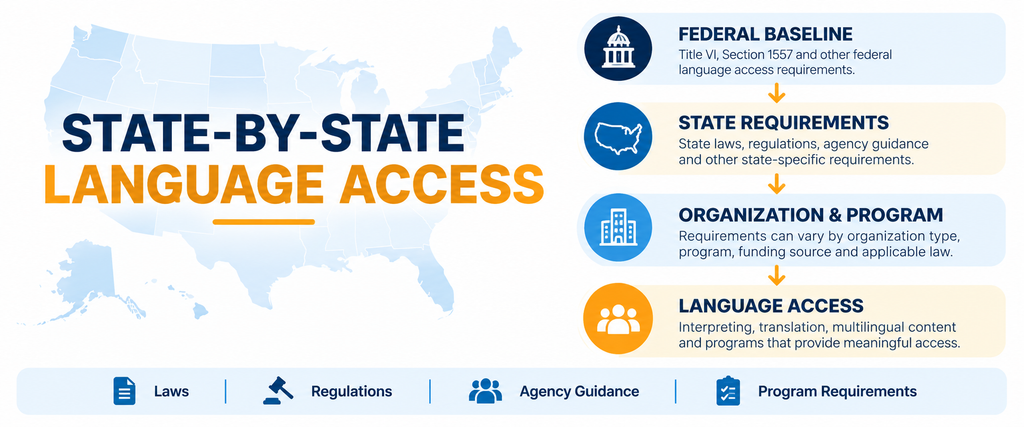
Federal Language Access Requirements: The Starting Point
State language-access requirements do not exist in isolation. Before evaluating state-specific laws and policies, organizations should understand the federal framework that may already apply to their programs, services, funding, or activities.
For many organizations, the federal starting point includes Title VI of the Civil Rights Act of 1964 and, for covered healthcare programs and activities, Section 1557 of the Affordable Care Act. The specific obligations depend on the organization and the programs or activities involved.
Title VI and Limited English Proficiency
Title VI prohibits discrimination based on race, color, or national origin in programs and activities receiving federal financial assistance. Language barriers can implicate the national-origin nondiscrimination requirements when they prevent individuals with limited English proficiency from meaningfully accessing federally assisted programs or services.
The important point for organizations is that federal language-access obligations are not necessarily identical for every recipient. The appropriate language assistance can depend on factors such as the nature and importance of the service, the size of the organization, the population served, the frequency of contact with LEP individuals, and available resources.
That is one reason a state-by-state analysis should begin with the question:
What federal requirements already apply to this organization and this particular program?
Section 1557 and Healthcare
Section 1557 provides a separate federal nondiscrimination framework for covered health programs and activities. HHS identifies language access for individuals with LEP as part of its civil-rights framework and explains that covered entities must take reasonable steps to provide meaningful access to individuals with LEP who are eligible to be served or likely to be directly affected by covered health programs and activities.
Because Section 1557 applies specifically to covered healthcare programs and activities, it should not simply be treated as a universal requirement for every organization.
Healthcare organizations should therefore evaluate Section 1557 separately from the broader Title VI framework.
Federal Requirements Are Only the Starting Point
An organization may need to consider several layers of requirements at the same time:
FEDERAL
Title VI, Section 1557, and other applicable federal requirements
↓
STATE
State statutes, regulations, agency requirements, and guidance
↓
PROGRAM / FUNDING
Requirements associated with particular programs, grants, contracts, or funding sources
↓
ORGANIZATION
The organization’s own policies, procedures, population served, and operational needs
This layered approach is important because being located in a particular state does not automatically mean that every organization in that state has the same language-access obligations.
A Note About Federal Guidance
Federal language-access guidance can change over time. Organizations should therefore distinguish between statutory and regulatory requirements, agency guidance, and recommended operational practices.
For example, DOJ’s current Federal Coordination and Compliance Section notes that its public-facing LEP guidance materials are under review following federal policy changes in 2025.
For that reason, this resource should point readers toward current official federal and state sources rather than treating an older guidance document as permanently controlling.
Start With the Applicable Federal Framework
Before moving to state-specific requirements, organizations should establish:
- Which federal laws and regulations apply
- Whether the organization receives federal financial assistance
- Which programs or activities are covered
- Whether healthcare-specific requirements apply
- Which federal agency or agencies oversee the relevant program
- What language-access obligations arise from those requirements
Once that federal baseline is established, the next question becomes:
What additional language-access requirements apply in our state?
That’s the purpose of the state-by-state portion of this resource.
Related resources:
- Title VI Language Access Compliance Guide
- Section 1557 Language Access Compliance Guide
- Official Federal Language Access Resources
Find Language Access Requirements by State
State language-access requirements can vary significantly depending on the jurisdiction, organization type, program, funding source, and applicable laws or regulations. Use the state selector below to navigate directly to the state you are researching.
Language Access Requirements by Organization Type
State language-access requirements do not apply identically to every organization. The obligations that apply can depend on the type of organization, the programs or services it provides, funding sources, applicable federal and state requirements, and the population it serves.
The categories below provide a practical starting point for understanding where language-access considerations may arise. They are not intended to suggest that every organization within a category has the same legal obligations.
Government Agencies
Government agencies may encounter language-access requirements through federal or state civil-rights laws, program-specific requirements, funding conditions, and agency policies.
Language access may affect public benefits, applications, notices, hearings, case management, community services, and other interactions with residents.
Explore Government Language Services →
Healthcare Organizations
Healthcare organizations may face multiple layers of language-access requirements depending on their programs, funding, and applicable federal and state requirements.
Language access can affect clinical encounters, registration, consent, notices, patient communications, websites, and other healthcare interactions.
Explore Healthcare Language Services →
Schools & Educational Institutions
School districts, colleges, universities, and other educational institutions may encounter language-access requirements related to students, parents, guardians, and families with limited English proficiency.
Language needs may arise during enrollment, meetings, educational services, notices, family communications, and other interactions.
Explore Education Language Services →
Courts & Legal Systems
Courts and legal organizations may have specific requirements and procedures relating to language assistance for individuals participating in legal proceedings or accessing court services.
Depending on the jurisdiction and proceeding, language access may involve interpreting, translated documents, notices, forms, and other communications.
Explore Legal Language Services →
Social-Service Organizations
Organizations providing public-facing social, community, or human services may encounter language-access requirements through federal or state programs, funding arrangements, or other applicable requirements.
Language assistance may be needed for applications, eligibility determinations, case management, program participation, notices, and ongoing communication.
Explore Nonprofit & Social Services →
Other Public-Facing Organizations
Other organizations may also have language-access responsibilities or operational reasons to establish a formal language-access program.
The applicable requirements depend on the organization’s activities, funding, jurisdiction, contractual obligations, and the populations it serves.
Explore Language Services →
State-by-State Language Access Requirements
Select a state below to expand its section and review applicable language access requirements, key considerations, and official resources.
Alabama
Last reviewed: October 2026
Alabama’s language-access requirements vary by organization, program, funding source, and applicable federal or state requirements. Rather than relying on a single statewide LEP mandate, organizations should evaluate the specific programs and populations they serve and identify the federal, state, and program-specific requirements that apply to them. Alabama state agencies have adopted language-access plans, policies, and procedures addressing LEP populations in areas including public benefits, healthcare, education, and federally assisted programs.
Who may Be covered
Organizations operating in Alabama may have language-access responsibilities when they administer federally funded programs, provide public services, or operate programs subject to specific federal or state requirements.
The applicable requirements can differ substantially by program. For example, Alabama agencies have developed language-access plans for federally assisted programs, while the Alabama Department of Public Health and Alabama Medicaid provide language assistance to their respective patients, recipients, and program participants. Alabama’s public education system also has specific requirements and procedures for communicating with families of English learners.
Organizations should therefore determine which requirements apply to their particular program or activity, rather than assuming that every Alabama organization has identical language-access obligations.
Key Language Access Requirements
A significant portion of Alabama’s language-access framework arises through federal civil-rights and program requirements applicable to federally assisted activities. Alabama’s Department of Economic and Community Affairs (ADECA), for example, maintains a statewide Language Access Plan for persons with limited English proficiency and uses a four-factor analysis to determine appropriate language-assistance measures for federally assisted programs. The factors include the number or proportion of LEP individuals served or encountered, the frequency of contact with LEP individuals, the nature and importance of the program or service, and available resources.
Alabama agencies also demonstrate that language assistance can include both oral interpretation and written translation. The Alabama Department of Human Resources, for example, states that language-assistance resources include written translation and oral interpretation and requires its county departments to offer interpreter services during contacts with LEP clients in the programs covered by its policy.
For organizations receiving federal financial assistance, the applicable federal requirements should therefore be evaluated together with any Alabama-specific agency, program, contractual, or funding requirements.
Interpreting Requirements
Alabama state agencies provide numerous examples of formal language-assistance procedures that include professional or qualified interpreting.
The Alabama Department of Public Health states that free communication assistance is available to its clients and identifies services including qualified interpreters, language lines, sign-language interpreters, and video remote interpreting (VRI).
The Alabama Department of Human Resources’ current language-assistance policy states that county departments must use or offer interpreter services during contacts with LEP clients covered by the policy, including in-home and telephone contacts. The policy also addresses language assistance involving program areas, subrecipients, and contractors.
Alabama also maintains a separate Licensure Board for Interpreters and Transliterators (ALBIT). The Board states that individuals providing interpreting for remuneration must hold the required Alabama license or permit, subject to applicable exemptions, and identifies medical, legal, and educational settings among the situations covered by its licensing framework. Organizations engaging interpreters should verify the applicable Alabama credentialing requirements for the specific interpreting modality and assignment.
Translation Requirements
Alabama’s language-access requirements can also involve the translation of written information.
For example, Alabama Medicaid provides language assistance information and translated notices for beneficiaries whose primary language is not English. Its current language-assistance resources identify free language services and provide notices in multiple languages.
Within Alabama’s education system, the Alabama State Department of Education provides translated parent resources and requires local education agencies receiving applicable federal funding to maintain processes for serving English learners and communicating with parents. State education resources also recognize the need for translated communications and interpreter assistance when communicating with families whose preferred language is not English.
Organizations should evaluate which documents are important to accessing or benefiting from their programs and determine whether translation is required or otherwise appropriate under the applicable federal, state, agency, or program-specific requirements.
Relevant State Authorities
Several Alabama agencies and authorities may be relevant depending on the organization and program involved:
- Alabama Department of Economic and Community Affairs (ADECA) — maintains language-access plans and resources for federally assisted programs.
- Alabama Department of Human Resources (DHR) — maintains language-assistance policies and provides interpreter/translation services within its programs.
- Alabama Department of Public Health (ADPH) — provides free communication and language assistance to its clients.
- Alabama Medicaid Agency — provides free language assistance and maintains multilingual recipient communications.
- Alabama State Department of Education (ALSDE) — provides English learner resources and supports language-access requirements for communications with students and families.
- Alabama Licensure Board for Interpreters and Transliterators (ALBIT) — administers Alabama’s interpreter/transliterator licensing framework.
Official Sources
Primary Alabama resources
- ADECA — Compliance Plans & Language Access Resources
- Alabama DHR — Interpreter/Translation Services
- Alabama DHR — Language Assistance Policy
- Alabama Department of Public Health — Free Communication Assistance
- Alabama Medicaid — Language Assistance
- Alabama State Department of Education — English Learner Resources
- Alabama Licensure Board for Interpreters and Transliterators — Rules & Regulations
What Organizations Should Consider
Organizations serving LEP populations in Alabama should begin by identifying which federal, state, agency, funding, and program-specific requirements apply to their activities. They should then assess the languages and communication points involved, establish procedures for accessing qualified interpreters and translators, identify important written materials, train frontline staff, and periodically review whether language assistance is actually reaching the people who need it.
For organizations operating across multiple programs or locations, a formal Language Access Plan can provide a practical framework for coordinating these responsibilities and maintaining more consistent language access.
Related EPIC Resources
Alaska
Last reviewed: October 2026
Alaska’s language-access framework is shaped by a combination of state law, federal nondiscrimination requirements, and agency- and program-specific language-access policies. Alaska law recognizes English and numerous Alaska Native languages as official languages of the state, while also establishing rules governing the use of languages in government. Separate requirements and language-access procedures may apply to specific programs, agencies, courts, and federally assisted activities.
Who may Be covered
Alaska’s state language provisions apply broadly to the state’s legislative and executive branches and to political subdivisions, including state and local government departments, agencies, divisions, instrumentalities, the University of Alaska, public authorities, and public corporations.
However, Alaska’s official-language statutes should not be interpreted as creating identical language-access obligations for every organization. Private-sector activities are expressly outside the scope of Alaska’s official-language provisions, while federally assisted programs may have additional obligations under federal civil-rights requirements.
Organizations should therefore determine which federal, state, agency, program, funding, and contractual requirements apply to their specific activities and the populations they serve.
Key Language Access Requirements
Alaska’s official-language statutes recognize English and a number of Alaska Native languages as official languages of the state. The designation of Alaska Native languages as official languages does not, by itself, require the state or a municipal government to print documents, conduct meetings, or carry out government activities in every official language.
Alaska law also establishes English as the language used in the preparation of official public documents and records, while providing exceptions that allow government to use other languages for specified purposes. These include circumstances involving health and safety information or emergencies, as well as other purposes identified in state law.
For organizations receiving federal financial assistance, federal Title VI requirements may create additional language-access responsibilities. Alaska state agencies that receive or administer federal funding have developed LEP plans and procedures that emphasize meaningful access and use factors such as the number or proportion of LEP individuals served, frequency of contact, importance of the service, and available resources.
The practical result is a layered language-access environment. Organizations should evaluate applicable state provisions together with federal requirements and any agency- or program-specific policies.
Interpreting Requirements
Alaska provides particularly clear language-access procedures in several public programs and systems.
The Alaska Court System provides language assistance at all court locations and operates a statewide interpreter-services program under Administrative Rule 6, which addresses interpreter services in court proceedings for individuals with limited English proficiency. The court system also provides procedures for requesting spoken-language and sign-language interpreters.
Alaska state agencies have also established procedures for providing interpretation. For example, the Department of Environmental Conservation’s LEP Plan provides for written and oral language assistance and directs staff to obtain professional language services when appropriate. The Department of Health’s Division of Public Assistance provides free interpreter services to individuals who need language assistance when accessing its programs.
The Alaska Department of Law’s Criminal Division also states that victims and witnesses of crimes who need an interpreter can receive interpreter services at no cost.
Organizations should distinguish between statewide legal requirements and agency-specific procedures. Where an organization is subject to a particular program’s requirements, it should follow the applicable agency rules and procedures for requesting and providing interpreting services.
Translation Requirements
Alaska does not require government entities to translate every official document into every language recognized as an official language of the state. The state’s official-language statute expressly states that recognition of additional official languages does not itself create a duty for state or municipal governments to print documents or conduct government activities in those languages.
However, translation requirements and practices can arise through specific programs and agencies. Alaska’s Department of Environmental Conservation, for example, maintains an LEP Plan addressing translation of vital documents and identifies circumstances in which important information should be translated into prominent languages other than English.
Alaska’s Department of Commerce, Community, and Economic Development has also established language-access procedures for federally funded programs that address translation of significant documents and language assistance for public participation.
Organizations should therefore identify documents that are important to accessing or benefiting from their services and determine whether translation is required or appropriate under the specific federal, state, agency, program, or funding requirements that apply.
Relevant State Authorities
Alaska State Legislature — establishes the state’s statutory framework governing official languages and government use of languages.Alaska Court System — administers statewide court interpreter services and language-access procedures for court proceedings.Alaska Department of Environmental Conservation (DEC) — maintains an LEP Plan and language-access procedures for its programs and activities.Alaska Department of Health — provides language assistance within programs including the Division of Public Assistance.Alaska Department of Law — maintains language-access procedures for victims and witnesses served by the Criminal Division.Alaska Department of Education and Early Development (DEED) — administers statewide English learner requirements and procedures for Alaska school districts.Alaska Department of Commerce, Community, and Economic Development (DCCED) — administers language-access requirements within applicable federally funded programs.
Official Sources
- Alaska State Legislature — Alaska Statutes
- Alaska Court System — Language Interpreter Services
- Alaska Department of Environmental Conservation — Nondiscrimination & LEP Plan
- Alaska Department of Health — No-Cost Interpreter Services
- Alaska Department of Law — Language Access
- Alaska Department of Education & Early Development — English Learner Education
What Organizations Should Consider
Organizations operating in Alaska should begin by determining which requirements actually apply to their programs and activities. For government entities and federally assisted programs, this may involve evaluating both Alaska’s state provisions and applicable federal language-access requirements.
Organizations should then identify the languages encountered, determine where language barriers may affect access to services, establish procedures for obtaining qualified interpreters and translators, identify important documents requiring language assistance, train staff, and monitor whether language-access procedures are working in practice.
Organizations serving Alaska Native communities should also consider the geographic and linguistic diversity of Alaska when assessing language needs. Language requirements can vary significantly across communities, and a statewide approach may not adequately address the needs of every service area.
Related EPIC Resources
Arizona
Last reviewed: October 2026
Arizona’s language-access landscape includes a constitutional framework establishing English as the state’s official language, together with federal nondiscrimination requirements and specific state agency and program requirements addressing language assistance. The applicable requirements can vary depending on the organization, program, funding source, and type of service involved. Arizona’s Constitution itself identifies several exceptions to its English-language provisions, including actions required by federal law, public health and safety, victims’ rights, and assistance for people with hearing impairments.
Who may Be covered
Arizona’s constitutional language provisions apply to state government and political subdivisions when they perform official actions. However, the Constitution also identifies circumstances in which its English-language provisions do not restrict government action, including actions required under federal law and actions involving public health and safety, victims of crime or criminal defendants, Native American languages, and assistance to people with hearing impairments.
Separate language-access requirements may apply to federally funded programs and specific state agencies. For example, the Arizona Department of Health Services states that organizations receiving federal funding should plan for language assistance for LEP populations, while Arizona DES maintains formal LEP policies and language-access plans for its programs.
Organizations should therefore determine which federal, state, agency, program, and funding requirements apply to their specific activities, rather than assuming that every organization in Arizona has the same language-access obligations.
Key Language Access Requirements
Article XXVIII of the Arizona Constitution establishes English as the official language of the state and provides that official actions are conducted in English. At the same time, the Constitution expressly excludes certain activities from the definition of “official action,” including actions required under federal law, actions necessary to protect public health and safety, actions protecting victims and criminal defendants, preservation or use of Native American languages, and assistance to hearing-impaired or illiterate persons.
This means Arizona’s English-official-language provision should not be interpreted as eliminating language-access obligations that arise under federal law or specific programs. Arizona state agencies receiving or administering federal funds have developed LEP policies and language-access plans addressing meaningful access, interpretation, translation, and other language-assistance measures.
The Arizona Department of Health Services’ language-access guidance states that federally funded organizations should provide language assistance to LEP individuals and consider factors such as the number or proportion of LEP individuals served, frequency of contact, importance of the service, and available resources.
Organizations should therefore evaluate Arizona’s state framework together with applicable federal requirements and program-specific rules.
Interpreting Requirements
Arizona has particularly well-developed requirements and procedures for language access within its court system. The Arizona courts state that individuals with limited English proficiency have the right to assistance from a competent court interpreter in all case types, including at hearings, clerk’s offices, public counters, self-help centers, and other court facilities. Services may be provided in person, by telephone, or through video remote services, and the courts provide interpreters at no cost to individuals who need them.
Arizona courts are also required to maintain current Language Access Plans under Administrative Order 2011-96. The Arizona Court Interpreter Credentialing Program establishes a credentialing framework for spoken-language court interpreters, with credential tiers based on language proficiency, ethics, court knowledge, and interpreting skills.
For federally funded programs outside the courts, interpreting requirements may arise from applicable federal civil-rights and program requirements. Arizona Department of Health Services guidance specifically addresses interpretation for federally funded organizations and advises against relying on family members, friends, or minors when qualified language assistance should be provided.
Translation Requirements
Arizona’s constitutional English-language provisions do not create a blanket requirement for government entities to translate every document into every non-English language. The Constitution establishes English for official government actions while identifying specific exceptions, including actions required under federal law and actions necessary to protect public health and safety.
Translation requirements can nevertheless arise through federal funding requirements and specific programs. Arizona Department of Health Services guidance emphasizes the importance of translating vital documents for regularly encountered LEP populations when applicable federal requirements apply.
AHCCCS, Arizona’s Medicaid agency, provides both oral interpretation and translation of written materials for customers who need language assistance. Its policies also establish specific requirements for written materials, including Spanish translations and translation of critical or vital materials into prevalent non-English languages in applicable managed-care settings.
Organizations should therefore identify documents that are important to accessing or benefiting from their programs and determine whether translation is required under the specific federal, state, agency, program, or funding requirements that apply.
Relevant State Authorities
- Arizona Legislature — establishes the state’s constitutional and statutory framework, including Article XXVIII concerning English as the official language.
- Arizona Department of Health Services (ADHS) — provides language-access guidance for federally funded organizations and health programs.Arizona Health Care Cost Containment System (AHCCCS) — maintains requirements and procedures for interpretation and translation within its programs and managed-care system.
- Arizona Department of Economic Security (DES) — maintains LEP policies and language-access plans for its programs.
- Arizona Judicial Branch — administers statewide court language-access programs, court Language Access Plans, and the Arizona Court Interpreter Credentialing Program.
- Arizona Commission for the Deaf and the Hard of Hearing (ACDHH) — oversees Arizona’s licensing framework for ASL interpreters.
- Arizona Department of Education — administers state English learner programs and related requirements for Arizona schools.
Official Sources
- Arizona Constitution — Article XXVIII: English as the Official Language
- Arizona Department of Health Services — Language Access Guidance
- AHCCCS — Language Interpretation and Translation Policy
- AHCCCS — ACOM Policy 405: Language Access Requirements
- Arizona Department of Economic Security — Limited English Proficiency Policy and Procedures
- Arizona Department of Economic Security — 2024 Language Access Plan
- Arizona Judicial Branch — Language Access
- Arizona Judicial Branch — Court Interpreter Credentialing Program
- Arizona Department of Education — English Learner Instructional Services
- Arizona Commission for the Deaf and the Hard of Hearing — Interpreter Licensing
What Organizations Should Consider
Organizations operating in Arizona should begin by determining which federal, state, agency, program, and funding requirements apply to their activities. For organizations receiving federal funding, language-access obligations may arise even where Arizona’s constitutional English-language provisions would otherwise govern official state action.
Organizations should then assess the languages and communication points they encounter, establish procedures for obtaining qualified interpreters and translators, identify important written materials, train frontline staff, and monitor whether language assistance is available when and where it is needed.
Organizations serving healthcare, public-benefit, court, education, or other publicly funded programs should pay particular attention to program-specific language-access requirements, because those requirements can be more specific than the general statewide framework.
Related EPIC Resources
Arkansas
Last reviewed: October 2026
Arkansas does not appear to have a single, comprehensive statewide language-access requirement covering every organization and program. Language-access obligations can arise from federal requirements, state laws and regulations, and agency- or program-specific requirements. Arkansas agencies have established language-access procedures for particular programs, while the Arkansas Judiciary maintains a statewide system for court interpreting and the state’s education system has specific requirements for serving English learners.
Who may Be covered
Language-access requirements in Arkansas can apply differently depending on the organization, program, funding source, and services involved.
Organizations administering federally funded programs may have obligations to provide meaningful access to individuals with limited English proficiency under applicable federal requirements. Arkansas state agencies have also adopted language-access policies and procedures for specific programs. For example, the Arkansas Department of Agriculture provides free language assistance to individuals with limited English proficiency, while Arkansas agencies administering federally funded programs may maintain formal language-access plans.
Public schools have additional obligations concerning English learners and communication with LEP students and families, while Arkansas courts have specific requirements governing language assistance during court proceedings.
Organizations should therefore determine which federal, state, agency, program, and funding requirements apply to their specific activities rather than assuming that every Arkansas organization has the same obligations.
Key Language Access Requirements
Arkansas’s language-access framework is largely program- and agency-specific, supplemented by federal nondiscrimination requirements that apply to covered recipients of federal financial assistance.
For example, the Arkansas Department of Agriculture states that it provides free language assistance services, including interpreters and translated materials, to ensure meaningful access to its programs and activities for individuals with limited English proficiency.
Arkansas also maintains specific administrative rules addressing language assistance in particular programs. For example, the Division of State Services for the Blind is required to provide foreign-language interpretation and translation services, including sign-language interpretation, when an individual cannot access the vocational rehabilitation program without that assistance. The rule states that certified interpreters will be used when available.
Organizations receiving federal financial assistance should evaluate their Title VI obligations alongside any Arkansas-specific requirements applicable to their program.
Interpreting Requirements
Arkansas has particularly well-defined interpreting requirements within its judicial system.
The Arkansas Administrative Office of the Courts provides interpreting services for individuals with limited English proficiency and maintains a statewide Registry of Certified and Registered Court Interpreters. A person with limited English proficiency who is a party to or witness in a court proceeding may not be denied interpreter services because the person is unable to pay.
Arkansas has established formal certification requirements for spoken-language court interpreters, including assessments of English proficiency, foreign-language proficiency, interpreting skills, and professional responsibility. The Arkansas Judiciary also maintains requirements for sign-language interpreters working in Arkansas courts.
Outside the court system, interpreting requirements may arise from federal requirements or specific Arkansas programs. For example, Arkansas rules require the Division of State Services for the Blind to provide foreign-language interpretation and sign-language interpretation when necessary for an individual to access its vocational rehabilitation program.
Organizations should identify the specific requirements applicable to their programs and establish procedures for obtaining qualified interpreters when language assistance is required.
Translation Requirements
Arkansas does not appear to impose a universal requirement that every organization translate all of its materials into every language.
Translation requirements can instead arise through specific programs, funding requirements, and agency policies. Arkansas agencies serving LEP populations may provide translated materials as part of their language-access programs.
For example, the Arkansas Department of Agriculture provides translated materials as part of its language-assistance services. Arkansas education guidance also addresses translation of important written information for LEP families. In the Arkansas school meal program, schools are required to ensure that eligible LEP households have meaningful access to program information, including applications, instructions, notices, and related materials in a language the household can understand when applicable.
Organizations should identify documents that are important to accessing or benefiting from their services and determine whether translation is required or appropriate under the specific federal, state, agency, program, or funding requirements that apply.
Relevant State Authorities
- Arkansas Administrative Office of the Courts — administers statewide court interpreter services and maintains the Arkansas Registry of Certified and Registered Court Interpreters.
- Arkansas Department of Agriculture — maintains language-access and nondiscrimination procedures and provides free language assistance for LEP individuals.
- Arkansas Department of Education, Division of Elementary and Secondary Education — administers English learner programs and provides guidance concerning the legal obligations of schools serving English learners.
- Arkansas Department of Human Services, Division of Services for the Blind — maintains requirements for language and communication assistance within its vocational rehabilitation programs.
- Arkansas Department of Workforce Services — administers federally assisted workforce programs subject to applicable nondiscrimination and LEP requirements.
- Arkansas Code of Rules — provides the state’s official codification of agency rules, including program-specific language-access requirements.
Official Sources
- Arkansas Judiciary — Office of Court Interpreter Services
- Arkansas Judiciary — Language Access Resources, Zoom Instructions & Statutes
- Arkansas Judiciary — Registry of Court Interpreters
- Arkansas Department of Agriculture — Accessibility, Civil Rights & Nondiscrimination
- Arkansas Code of Rules — Foreign Language & Sign Language Access
- Arkansas Department of Education — Legal Obligations for Serving English Learners
- Arkansas Department of Education — English Language Proficiency Standards
- Arkansas Department of Education — LEP Access in School Meal Programs
What Organizations Should Consider
Organizations operating in Arkansas should first identify the specific federal, state, agency, program, and funding requirements that apply to their activities. They should then assess the languages and communication needs of the populations they serve, establish procedures for qualified interpreting and translation, identify important written materials, train staff, and monitor whether language assistance is being provided effectively.
Organizations operating in multiple Arkansas programs or locations should avoid assuming that one language-access procedure will satisfy every requirement. A program-specific assessment can help determine where interpreting, translation, staff training, and other language-access measures are needed.
Related EPIC Resources
California
Last reviewed: October 2026
California has one of the more developed state-level language-access frameworks in the United States. The Dymally-Alatorre Bilingual Services Act establishes requirements for California state agencies to provide services to substantial non-English-speaking populations, including bilingual personnel, translated materials, language surveys, and implementation planning. Additional language-access requirements apply through federal law and through specific programs and agencies, including healthcare, education, courts, and public benefits.
Who may Be covered
The Dymally-Alatorre Bilingual Services Act primarily establishes language-access responsibilities for California state agencies and addresses local agencies in specific contexts. The Act requires covered state agencies to identify substantial language groups among the populations they serve and take steps to provide services and information in those languages.
Other organizations in California may have language-access obligations based on federal funding, program-specific state requirements, contractual requirements, or other applicable laws. Healthcare organizations, educational institutions, courts, public-benefit programs, and other public-facing organizations may therefore have requirements beyond the general state framework.
Organizations should determine which federal, state, agency, program, and funding requirements apply to their particular activities rather than assuming that all California organizations have identical obligations.
Key Language Access Requirements
The Dymally-Alatorre Bilingual Services Act requires California state agencies to provide services in foreign languages when specific conditions are met. A language group is generally considered substantial when it reaches the statutory threshold for the applicable agency unit or office. California’s current implementation materials explain that the threshold is 5 percent, with the statutory calculation rounded to the nearest whole percentage point; in practice, a result of 4.5 percent can therefore trigger the 5-percent threshold.
When the applicable threshold is met, agencies may be required to provide bilingual public-contact staff and translated written materials or other language-assistance measures. Agencies also conduct language surveys every two years and, where deficiencies are identified, develop implementation plans to address language-access needs.
The Act also requires agencies to maintain procedures addressing language needs and complaints and provides a framework for monitoring compliance. The California Department of Human Resources (CalHR) administers the statewide language survey and implementation process and provides guidance to state agencies.
The Dymally-Alatorre framework should be evaluated together with Title VI, Section 1557 where applicable, and other federal or program-specific requirements, which may impose different or additional language-access obligations.
Interpreting Requirements
California’s language-access framework recognizes bilingual personnel and qualified interpreters as important mechanisms for providing services in languages other than English.
Under the Dymally-Alatorre framework, covered state agencies must determine their need for bilingual public-contact employees and establish appropriate procedures for providing services to substantial non-English-speaking populations. Agencies may also use qualified interpreters and other language-assistance methods where permitted or appropriate.
California has particularly detailed requirements for court interpreting. The California Judicial Council maintains a statewide court interpreter credentialing system for certified and registered spoken-language interpreters and provides credentialed ASL court interpreters. California courts are required to maintain procedures for requesting interpreters and to track requests for language services.
California courts provide qualified interpreters to LEP court users in applicable proceedings, and court users are not charged for court interpreter services. The Judicial Council’s statewide Language Access Plan provides a consistent framework for language access across California’s 58 superior courts.
Organizations outside the court system should evaluate the interpreting requirements applicable to their specific program and establish procedures for accessing qualified interpreters when language assistance is needed.
Translation Requirements
California’s language-access requirements also address written materials and translated information.
Under the Dymally-Alatorre Bilingual Services Act, covered state agencies must provide translated versions of information explaining their services when the applicable language threshold is met. Agencies may also be required to provide translated materials or translation aids in offices serving the public.
Additional translation requirements can arise under specific programs. For example, California’s Department of Health Care Services incorporates the Dymally-Alatorre Act, Title VI, Section 1557, California statutes, and program-specific requirements into its language-access framework. California’s education system also has specific requirements concerning translated communications with families of English learners, including statutory requirements relating to parental notifications.
Organizations should therefore identify the documents that are important to accessing or benefiting from their services and determine which materials must be translated under the requirements applicable to their program.
Relevant State Authorities
- California Department of Human Resources (CalHR) — administers the state’s Dymally-Alatorre Bilingual Services Act language survey and implementation process and provides compliance guidance to state agencies.
- California Health and Human Services Agency (CalHHS) — coordinates language-access policy across California’s health and human-services programs.
- California Department of Health Care Services (DHCS) — maintains language-access requirements and policies covering healthcare and public-benefit programs.
- California Department of Education (CDE) — provides statewide guidance concerning language services, English learners, and translated communications with families.
- California Judicial Council — administers statewide court language-access programs, court interpreter credentialing, and language-access policies.
- California Department of Rehabilitation (DOR) — maintains language-access requirements and procedures for its programs and provides statewide ASL bilingual proficiency examination services for applicable state employees.
- California Department of Justice and other state agencies — may maintain additional program-specific language-access policies and procedures.
Official Sources
- California Department of Human Resources — Language Access Program / Dymally-Alatorre Bilingual Services Act
- California Government Code — Dymally-Alatorre Bilingual Services Act, Sections 7290–7299.8
- California Department of Health Care Services — Non-Discrimination Policy and Language Access
- California Department of Education — Language Services Policy
- California Judicial Branch — Language Access ServicesCalifornia Courts — Language Access Resources
- California Courts — Rule 2.895: Requests for Interpreters
- California Courts — Rule 2.893: Appointment of Interpreters in Court Proceedings
- California Department of Rehabilitation — Language Access Plan
What Organizations Should Consider
Organizations operating in California should first determine which language-access requirements apply to their specific organization, program, funding source, and service population.
State agencies should evaluate their responsibilities under the Dymally-Alatorre Bilingual Services Act, including applicable language-survey thresholds, bilingual staffing, translated materials, complaint procedures, and implementation planning. Organizations participating in federally funded or regulated programs should separately evaluate applicable federal requirements.
Organizations should then assess the languages they encounter, establish procedures for qualified interpreting and translation, identify important written materials, train public-contact staff, monitor language-service utilization, and maintain procedures for responding when language-access needs change.
For organizations serving multiple programs or locations, a formal Language Access Plan can help bring these requirements together into a practical operational framework.
Related EPIC Resources
Colorado
Last reviewed: October 2026
Colorado’s language-access framework combines federal civil-rights requirements, state laws, agency-specific language-access policies, and an emerging statewide framework for language access across state government. Colorado enacted legislation in 2025 directing the Department of Personnel and Administration and the Office of New Americans to conduct a statewide language-access assessment and develop implementation recommendations for a Language Access Universal Policy. At the same time, specific programs—including courts, education, child welfare, and workforce services—already have language-access requirements and procedures.
Who may Be covered
Language-access obligations in Colorado depend on the organization, program, funding source, and services being provided.
Colorado’s statewide language-access initiative is focused on principal state departments and also recognizes that other public or private entities receiving state funding or contracts to administer public programs may be subject to applicable language-access standards. Federal requirements may separately apply to organizations receiving federal financial assistance.
Specific Colorado laws also establish language-access responsibilities for particular programs. For example, Colorado’s child-welfare law requires certain county departments, city and county governments, and private-entity contractors providing covered services to take reasonable steps to ensure meaningful language access for people with limited English proficiency.
Organizations should therefore identify the federal, state, agency, program, contractual, and funding requirements that apply to their specific activities.
Key Language Access Requirements
Colorado is developing a more coordinated statewide approach to language access in state government. HB 25-1153 requires the Department of Personnel and Administration, working with the Office of New Americans, to conduct a statewide language-access assessment covering most principal state departments. The assessment examines existing language-access plans, procedures, contracts, expenditures, public-facing responsibilities, and the readiness of departments to meet statewide language-access standards.
The legislation defines the planned Language Access Universal Policy as statewide policy standards developed through the interim language-access working group. The state is required to produce a report from the assessment no later than December 31, 2026, addressing gaps, meaningful service, efficiency, technology, and infrastructure needed to implement the standards.
Colorado’s workforce-development system already requires local workforce areas to maintain Language Assistance Plans and conduct periodic language-needs assessments. Those plans address language identification, meaningful access, interpretation, translation, staff responsibilities, and monitoring.
Colorado therefore has both existing program-specific language-access requirements and an evolving statewide framework that organizations should monitor as implementation progresses.
Interpreting Requirements
Colorado provides a particularly developed language-access system through its Judicial Branch.
The Colorado Judicial Branch’s Office of Language Access provides interpreter services in more than 120 languages and states that court users are entitled to meaningful access to the courts regardless of the language they speak. Authorized interpreter services for eligible court users are provided at no cost.
Colorado’s Chief Justice Directive 06-03 establishes requirements governing language interpreters and access to the courts for people with limited English proficiency. The Judicial Branch maintains certification and credentialing procedures for court interpreters and distinguishes authorized, certified, qualified, and registered interpreters.
Colorado also supports remote interpreting. The Judicial Branch provides telephonic and video-related language-access resources, and its court language-access program includes services for spoken-language interpreters, American Sign Language interpreters, and real-time captioning.
Outside the courts, interpreting requirements vary by program. Organizations should establish procedures for obtaining competent interpreters when language assistance is necessary and should not assume that bilingual employees automatically possess the skills required for professional interpreting.
Translation Requirements
Colorado’s language-access framework includes both translation and interpretation.
For state government, the emerging Language Access Universal Policy is intended to establish statewide standards for linguistically accessible government services and information. The statewide assessment specifically examines existing translated materials, language-access procedures, and the resources needed to provide language-access services.
Colorado’s education requirements provide a particularly clear example. The Colorado Department of Education states that schools and districts must provide meaningful communication to LEP parents and that this can involve translated materials and/or interpretation. Its English Language Development planning guidance specifically addresses translation and interpretation for essential school communications.
Colorado’s child-welfare legislation also expressly recognizes translation and interpretation services as components of language access in applicable dependency-and-neglect proceedings.
Organizations should identify written information that is important to accessing or benefiting from their services and determine which documents should be translated under the federal, state, program, or contractual requirements applicable to them.
Relevant State Authorities
- Colorado Department of Personnel & Administration (DPA) — leads the statewide language-access assessment and implementation work for the emerging Language Access Universal Policy.
- Colorado Office of New Americans (ONA) — works with DPA on statewide language-access policy and assessment activities.
- Colorado Judicial Branch — Office of Language Access — administers court interpreter services, interpreter credentialing, translation resources, and court language-access programs.
- Colorado Department of Education (CDE) — administers English learner requirements and provides guidance concerning language access for students and parents.
- Colorado Department of Labor and Employment (CDLE) — administers workforce-development language-assistance requirements and Language Assistance Plan guidance.
- Colorado Department of Human Services (CDHS) — administers programs involving language-access requirements, including child-welfare and public-benefit programs.
- Colorado Division for the Deaf, Hard of Hearing, and DeafBlind — provides communication-access resources, including sign-language interpreting and captioning services within applicable state programs.
Official Sources
- Colorado General Assembly — HB 25-1153: Statewide Government Language Access Assessment
- Colorado Department of Personnel & Administration — Statewide Language Access Resources
- Colorado Office of New Americans — State Integration Plan
- Colorado Judicial Branch — Interpreters & Translators / Office of Language Access
- Colorado Judicial Branch — Language Access: Request an Interpreter
- Colorado Judicial Branch — Chief Justice Directive 06-03
- Colorado Department of Education — Identification & Placement for Multilingual Learners
- Colorado Department of Education — Newcomer Students & Family Communication
- Colorado Department of Labor and Employment — Language Assistance Plans
- Colorado General Assembly — HB 24-1031: Accessibility for Persons in Child Welfare Matters
What Organizations Should Consider
Organizations operating in Colorado should first determine which federal, state, agency, program, funding, and contractual requirements apply to their services.
Organizations serving the public should assess the languages and communication needs of the populations they serve, establish procedures for accessing qualified interpreters and translators, identify important written materials, train frontline employees, and monitor whether language assistance is actually available when needed.
Organizations working with Colorado state agencies should also monitor the state’s developing Language Access Universal Policy and related implementation activities. The statewide framework is intended to create more consistent language-access standards across state government, while individual agencies and programs may continue to have additional requirements.
For organizations with multiple locations, programs, or departments, a formal Language Access Plan can provide a practical framework for bringing these requirements together and establishing consistent operational procedures.
Related EPIC Resources
Connecticut
Last reviewed: October 2026
Connecticut has a developing statewide language-access framework that combines federal civil-rights requirements, existing state and agency-specific requirements, and a new statewide implementation plan enacted in 2026. Public Act 26-76 directs the Office of Policy and Management to develop a statewide language-access implementation plan for state agencies, with an initial plan due January 1, 2027. Connecticut also has established language-access requirements in areas including courts, social services, education, healthcare, and elections.
Who may Be covered
Language-access responsibilities in Connecticut depend on the organization, program, funding source, and services being provided.
Connecticut’s new statewide language-access law primarily addresses state agencies and the executive branch, while also establishing a separate language-access planning requirement for the legislative branch. The law directs the state to consider whether language-access requirements should eventually be expanded to local and regional boards of education, public higher education institutions, healthcare facilities receiving state or federally administered funds, and state contractors.
Separate state and federal requirements already apply to particular programs and organizations. Connecticut’s courts, Department of Social Services, public schools, and certain healthcare settings have specific language-access requirements that may operate independently of the new statewide implementation plan.
Organizations should therefore determine which federal, state, agency, program, contractual, and funding requirements apply to their particular activities.
Key Language Access Requirements
Connecticut’s language-access framework is undergoing significant statewide development.
Public Act 26-76 requires the Secretary of the Office of Policy and Management, in consultation with the Commissioners of Administrative Services, Social Services, Public Health, and other appropriate stakeholders, to develop a statewide language-access implementation plan for state agencies by January 1, 2027.
The plan is intended to improve access to public services and benefits and increase meaningful access for individuals with limited English proficiency. It must address language-access assessments, priority documents and interactions, phased implementation, translation and interpretation standards, sign-language access, accessibility, public notices concerning available language assistance, agency reporting, and potential expansion of requirements to additional entities.
Beginning February 1, 2027, state agencies must designate a language-access coordinator to serve as a liaison for implementation of the statewide plan. The Governor must also submit annual reports concerning implementation progress beginning January 15, 2027.
The new framework does not immediately require every existing state form or application to be translated. The law specifically provides for phased implementation and establishes deadlines through the statewide plan.
Organizations should therefore distinguish between requirements already in effect for specific programs and the new statewide framework that Connecticut is implementing beginning in 2027.
Interpreting Requirements
Connecticut has established language-access procedures in several important public systems.
The Connecticut Judicial Branch maintains a statewide Language Access Plan and an Interpreter and Translator Services Unit dedicated to providing meaningful access to courts and court-related proceedings for individuals with limited English proficiency. The Judicial Branch provides interpreter services at no cost to eligible court users and maintains procedures for qualified and trained interpreters.
Connecticut’s Judicial Branch also uses video remote interpreting (VRI) in court proceedings. Its statewide Language Access Plan reports that VRI has been deployed across courtrooms statewide and can provide simultaneous interpreting while allowing attorneys and LEP individuals to communicate privately when appropriate.
The Connecticut Department of Social Services provides free interpreter services to clients through telephone, video, and in-person interpreting. Clients can request language assistance when calling, visiting an office, or participating in appointments and interviews.
Connecticut also has specific statutory requirements concerning interpreter standards in certain settings, including legal proceedings and services for individuals who are deaf, deaf-blind, or hard of hearing.
Organizations should establish procedures for accessing qualified interpreters and should determine whether their particular program imposes credentialing, certification, or other interpreter requirements.
Translation Requirements
Connecticut’s language-access framework includes translation of written information as well as spoken interpretation.
Public Act 26-76 defines translation services broadly to include written materials such as forms, applications, notices, instructions, website content, and other informational materials. The statewide implementation plan is specifically required to identify documents and interactions that should be prioritized for translation, interpretation, or sign-language access.
The law also establishes a phased approach rather than requiring all state forms and applications to be translated immediately. State agencies will identify priority documents and service interactions as part of implementation.
Connecticut has additional program-specific translation requirements. In education, state law requires the Parent Bill of Rights for English Learners/Multilingual Learners to be provided to parents and guardians in their dominant language. The state’s Department of Education provides the resource in multiple languages.
Connecticut also has specific healthcare requirements involving multilingual communications. Certain hospital and hospital-based facility notices, for example, must include taglines in at least the 15 most prevalent languages under applicable state requirements.
Organizations should identify documents that are important to accessing or benefiting from their services and determine which materials must or should be translated under the requirements applicable to their program.
Relevant State Authorities
- Connecticut Office of Policy and Management (OPM) — responsible for developing the statewide language-access implementation plan for state agencies under Public Act 26-76.
- Connecticut Department of Administrative Services (DAS) — participates in statewide language-access implementation and is responsible for related administrative functions.
- Connecticut Department of Social Services (DSS) — provides free telephone, video, and in-person interpreter services to clients.Connecticut Department of Public Health (DPH) — participates in the statewide language-access framework and administers healthcare-related programs and requirements.
- Connecticut State Department of Education (CSDE) — administers English learner/multilingual learner programs and requirements, including the Parent Bill of Rights.
- Connecticut Judicial Branch — administers statewide court language-access programs and interpreter services.
- Connecticut Secretary of the State — administers Connecticut’s State Voting Rights Act, including municipal language-assistance requirements for designated languages.
- Connecticut Commission on Women, Children, and Seniors / related state accessibility initiatives — may participate in broader language-access and equity initiatives affecting state programs.
Official Sources
- Connecticut General Assembly — Public Act 26-76
- Connecticut General Assembly — General Statutes & Public Acts
- Connecticut Judicial Branch — Language Access Plan
- Connecticut Judicial Branch — Limited English Proficiency Policy
- Connecticut Department of Social Services — Interpreter Services
- Connecticut Department of Social Services — Non-Discrimination Statement
- Connecticut State Department of Education — English Learner/Multilingual Learner Resources
- Connecticut State Department of Education — Parent Bill of Rights for English Learners and Multilingual Learners
- Connecticut Secretary of the State — State Voting Rights Act
What Organizations Should Consider
Organizations operating in Connecticut should first determine which federal, state, agency, program, funding, and contractual requirements apply to their activities.
State agencies should pay particular attention to the statewide implementation requirements established by Public Act 26-76, including the upcoming statewide plan, language-access coordinators, priority documents and interactions, and phased implementation beginning in 2027.
Organizations serving LEP populations should also assess the languages they encounter, establish procedures for qualified interpreting and translation, identify important written materials, train frontline staff, and monitor whether language assistance is available when and where it is needed.
Because Connecticut’s statewide framework is currently being implemented, organizations should monitor subsequent guidance and implementation decisions rather than treating the 2026 law as the final form of the state’s language-access program.
Related EPIC Resources
Delaware
Last reviewed: October 2026
Delaware’s language-access framework combines federal civil-rights requirements with state and agency-specific language-access policies and programs. Delaware has established language-access procedures in areas including the courts, healthcare, child and family services, environmental programs, agriculture, and housing. The state also enacted a temporary reporting framework in 2024 to collect information about language and communication access in selected state programs; that framework expired September 30, 2026.
Who may Be covered
Language-access responsibilities in Delaware depend on the organization, program, funding source, and services being provided.
Many Delaware state programs receive federal financial assistance and may therefore have obligations under Title VI to take reasonable steps to provide meaningful access to individuals with limited English proficiency. Delaware agencies also maintain their own language-access policies and procedures for specific programs.
For example, the Department of Services for Children, Youth and Their Families requires contracted service providers to maintain language-access procedures for LEP individuals receiving services or benefits. The Department’s policy addresses interpretation, translation, staff training, and monitoring of contracted providers.
Organizations should therefore determine which federal, state, agency, program, contractual, and funding requirements apply to their specific activities rather than assuming that every Delaware organization has identical language-access obligations.
Key Language Access Requirements
Delaware’s current language-access landscape is primarily program- and agency-specific, supplemented by federal requirements that apply to covered recipients of federal financial assistance.
Delaware previously enacted Chapter 106 of Title 29, which established a temporary framework for gathering information about language and communication access within selected state programs. The framework defined meaningful access, identified vital documents, required selected programs to report on language services and staff training, and provided language and communication assistance for certain housing matters. However, the statutory provisions expressly expired on September 30, 2026.
The expiration of that temporary reporting framework does not eliminate other language-access responsibilities. The legislation itself stated that it could not be interpreted to limit or end responsibilities arising under federal or Delaware law requiring meaningful access for LEP individuals or effective communication for people with disabilities.
Delaware agencies continue to maintain language-access procedures. The Department of Agriculture, for example, provides free interpretation and translation services upon request. DNREC likewise provides free interpretation services and information in languages other than English for people who need language assistance.
Organizations should therefore evaluate the requirements applicable to their specific program rather than relying on the former Chapter 106 reporting framework as a current universal requirement.
Interpreting Requirements
Interpreting Requirements
Delaware has a well-developed language-access system within its Judicial Branch.
The Delaware Administrative Office of the Courts operates a statewide Court Interpreter Program designed to provide certified and qualified interpreters to courts throughout the state. The program maintains a registry of court interpreters and establishes credentialing and registration requirements.
Delaware courts provide interpreter services for LEP individuals and also provide ASL and CART services for individuals who are Deaf or hard of hearing. Requests for interpreter services should generally be made in advance of a scheduled hearing or trial so that the court can secure the necessary interpreter.
The Delaware Judiciary’s Language Access Plan establishes a preference for in-person certified interpreters in court proceedings. Remote interpreting may be used in appropriate circumstances when an in-person interpreter is unavailable, subject to the Judiciary’s applicable procedures.
Other Delaware agencies also provide interpreting services. The Department of Health and Social Services, for example, requires staff to offer language assistance through approved language-service vendors and provides telephone, on-site, sign-language, and other interpreting services within applicable programs.
Organizations should establish procedures for accessing qualified interpreters and should identify any credentialing or modality-specific requirements applicable to their programs.
Translation Requirements
Delaware’s language-access framework includes translation of written information as well as interpreting.
The state’s former Chapter 106 specifically defined a vital document as information affecting access to, retention in, reduction, termination, or exclusion from a program’s services or benefits. Examples included applications, consent forms, complaint forms, intake forms, eligibility notices, rights-related notices, communications requiring a response, legally required documents, and notices concerning the availability of free language assistance.
Although that statutory definition expired September 30, 2026, it provides useful insight into the types of documents Delaware considered important for language access and remains relevant as an operational framework when evaluating applicable federal or program-specific requirements.
Delaware agencies continue to provide translation services. The Department of Agriculture provides translation and interpretation upon request, while the Department of Services for Children, Youth and Their Families requires contracted service providers to provide appropriate written translation assistance to LEP individuals receiving covered services.
Organizations should identify documents that are important to accessing or benefiting from their services and determine which materials must or should be translated under the requirements applicable to their specific program.
Relevant State Authorities
- Delaware Department of Justice — administers or supports language-access initiatives in areas including housing and other public programs.
- Delaware Administrative Office of the Courts — administers the statewide Court Interpreter Program and court language-access services.
- Delaware Department of Health and Social Services (DHSS) — provides language assistance through programs including Medicaid and other health and human-services programs.
- Delaware Department of Services for Children, Youth and Their Families (DSCYF) — maintains a formal Language Access Policy addressing interpretation, translation, staff training, data, and contractor compliance.
- Delaware Department of Natural Resources and Environmental Control (DNREC) — provides language-assistance services and maintains language-access resources for public participation.
- Delaware Department of Agriculture — provides free interpretation and translation services and maintains language-access procedures.
- Delaware Department of Education — administers programs serving multilingual learners and provides resources for Delaware schools.
- Delaware Office of New Americans — coordinates services, policy initiatives, and resources relating to immigrants, refugees, and language access.
Official Sources
- Delaware Code — Chapter 106: Improving Communication Assistance for Individuals with LEP and Disabilities
- Delaware General Assembly — Senate Substitute No. 1 for Senate Bill 82
- Delaware Courts — Court Interpreter Program
- Delaware Courts — Request Interpreter Services
- Delaware Courts — Language Access Plan
- Delaware Department of Agriculture — Nondiscrimination, Accessibility & Language Access
- Delaware DNREC — Civil Rights & Language Assistance Services
- Delaware DSCYF — Language Access Policy
- Delaware Office of New Americans
What Organizations Should Consider
Organizations operating in Delaware should first determine which federal, state, agency, program, funding, and contractual requirements apply to their activities.
Organizations should assess the languages encountered in their service populations, establish procedures for accessing qualified interpreters and translators, identify important written materials, train staff, and monitor whether language assistance is actually available when needed.
Organizations should also avoid relying on Delaware’s former Chapter 106 reporting requirements as though they remain in effect. The temporary statutory framework expired September 30, 2026, while other federal, state, and program-specific language-access obligations continue to apply.
For organizations operating across multiple programs or locations, a formal Language Access Plan can provide a practical framework for coordinating interpreting, translation, staff responsibilities, documentation, and ongoing monitoring.
Related EPIC Resources
Florida
Last reviewed: October 2026
Florida’s language-access framework combines federal civil-rights requirements with state and agency-specific policies and program requirements. Florida does not appear to have a single comprehensive statewide LEP statute governing every organization. Instead, language-access responsibilities can arise through federal funding, individual state agencies, courts, education programs, healthcare and public-benefit programs, and other specific services. Florida’s court system has a particularly established interpreter program, while state agencies receiving federal financial assistance maintain language-access procedures for their covered programs.
Who may Be covered
Language-access responsibilities in Florida depend on the organization, program, funding source, and services being provided.
Organizations receiving federal financial assistance may have obligations under Title VI and related federal requirements to provide meaningful access to individuals with limited English proficiency. Florida state agencies administering federally funded programs have developed language-access plans and procedures to address these obligations.
Florida also has specific requirements for particular programs. Public school districts, for example, are required to provide English-language instruction and services to limited-English-proficient students and maintain approved procedures for identifying, serving, and monitoring those students. Florida’s courts have separate requirements governing language assistance in judicial proceedings.
Organizations should therefore determine which federal, state, agency, program, contractual, and funding requirements apply to their specific activities rather than assuming that every Florida organization has identical language-access obligations.
Key Language Access Requirements
Florida’s language-access requirements are primarily program-specific and tied to applicable federal obligations, rather than established through one universal state LEP law.
Florida agencies receiving federal financial assistance commonly use the U.S. Department of Justice’s four-factor framework when developing language-access procedures: the number or proportion of LEP individuals served, the frequency of contact, the importance of the service or benefit, and the resources available to the organization.
Florida’s Department of Children and Families, for example, has published guidance for organizations receiving federal funds that explains how to develop a Language Access Plan, assess language needs, establish interpreting procedures, train staff, provide outreach, and evaluate the effectiveness of the plan.
Florida’s workforce system also maintains an LEP framework for federally funded workforce programs. Its language-access materials state that recipients of federal financial assistance must provide meaningful access to programs and services for LEP individuals.
Organizations should therefore evaluate both the federal requirements attached to their funding and any Florida-specific requirements applicable to their particular program.
Interpreting Requirements
Florida has a well-established statewide system for court interpreting.
Florida courts provide qualified spoken-language interpreters when necessary to ensure meaningful participation in court proceedings. The Florida State Courts System maintains a Court Interpreter Certification and Regulation Program, with registration and certification requirements for spoken-language court interpreters.
Florida’s court interpreter framework includes written examinations, oral proficiency and performance testing, professional conduct requirements, continuing interpreter education, and biennial registration maintenance. The courts also provide interpreter services through both in-person and remote methods.
Florida law specifically addresses the use of qualified interpreters in judicial proceedings. Under Florida Statutes section 90.606, when a judge determines that a witness cannot understand or communicate sufficiently in English, a duly qualified interpreter must be sworn to interpret the testimony. Separate provisions address interpreter services for people who are deaf or hard of hearing.
Outside the courts, interpreting requirements vary by program. Florida agencies receiving federal financial assistance may be required to provide qualified interpretation to ensure meaningful access, and state agency language-access plans commonly address telephone, in-person, and other interpreting methods.
Organizations should establish procedures for accessing qualified interpreters and should determine whether their program imposes additional credentialing or modality-specific requirements.
Translation Requirements
Florida’s language-access framework includes translation of written information as well as oral interpretation, particularly within federally funded programs and specific state services.
Florida agency guidance recommends identifying documents and information that are important to accessing or benefiting from a program and determining which materials should be translated based on the organization’s language-needs assessment.
FloridaCommerce provides a useful example through its federally funded disaster-recovery programs. Its Language Access Plan provides for translated applications, action plans, outreach materials, and other important information in Spanish and additional languages when appropriate to the geographic area and population served. The plan also provides for additional translation upon request.
Florida law also requires translation in certain specific circumstances. For example, Florida’s risk-protection-order statute requires the Office of the State Courts Administrator to identify significant non-English-speaking or LEP populations and prepare specified instructions, brochures, petitions, forms, and related materials in those languages.
Florida’s K–12 education system has additional requirements concerning communication with families of English learners and the provision of appropriate language assistance.
Organizations should identify documents that are important to accessing or benefiting from their services and determine which materials must or should be translated under the federal, state, agency, program, or funding requirements that apply.
Relevant State Authorities
- Florida State Courts System / Office of the State Courts Administrator — administers statewide court interpreter services, interpreter certification and registration, and court language-access programs.
- Florida Department of Children and Families (DCF) — provides language-access guidance and resources for programs and organizations receiving federal funds.
- Florida Department of Health (FDOH) — administers health programs and maintains resources addressing LEP and health-equity needs.
- FloridaCommerce — administers federally funded workforce and disaster-recovery programs with specific language-access plans and procedures.
- Florida Department of Education (FDOE) — administers statewide requirements for serving limited-English-proficient students and English learners.
- Florida Agency for Health Care Administration (AHCA) — administers Medicaid and healthcare programs that may have language-access requirements.
- Florida Coordinating Council for the Deaf and Hard of Hearing — supports communication-access policy and resources for individuals who are deaf or hard of hearing.
Official Sources
- Florida Department of Children and Families — Guidelines for Developing a Language Access Plan
- Florida State Courts — Court Interpreters
- Florida State Courts — Court Interpreter Certification and Regulation Program
- Florida Statutes — Section 90.606, Interpreters and Translators
- Florida Statutes — Section 1003.56, English Language Instruction for LEP Students
- FloridaCommerce — Office of Long-Term Resiliency Citizen Participation Plan
- FloridaCommerce — Limited English Proficiency Resources
- Florida Department of Health — LEP Resources for Community Health Workers
- Florida Statutes — Section 790.401, Risk Protection Orders
What Organizations Should Consider
Organizations operating in Florida should first determine which federal, state, agency, program, funding, and contractual requirements apply to their activities.
Organizations receiving federal financial assistance should conduct a language-needs assessment and establish procedures for providing meaningful access to LEP individuals. This may include qualified interpreting, translation of important documents, language identification, staff training, outreach, and procedures for monitoring language-access effectiveness.
Organizations should also pay attention to program-specific requirements. Courts, public schools, healthcare programs, workforce services, and federally funded disaster-recovery programs can have more specific language-access procedures than the general Florida framework.
For organizations serving multiple programs or locations, a formal Language Access Plan can provide a practical framework for coordinating interpreting, translation, staff responsibilities, documentation, and ongoing monitoring.
Related EPIC Resources
Georgia
Last reviewed: October 2026
Georgia’s language-access framework combines federal civil-rights requirements with state agency policies, program-specific requirements, and specialized language-access systems. Georgia has established formal language-access programs within agencies such as the Department of Human Services and Department of Natural Resources, while the Georgia courts maintain a statewide system for legal interpreting. Requirements can vary depending on the organization, program, funding source, and services being provided.
Who may Be covered
Language-access responsibilities in Georgia depend on the organization, program, funding source, and services being provided.
Georgia state agencies that receive or administer federal financial assistance may have obligations under Title VI and related federal requirements to take reasonable steps to provide meaningful access to individuals with limited English proficiency. Some agencies have adopted formal Language Access Plans covering their programs, activities, and services.
The Georgia Department of Human Services, for example, states that meaningful language access applies to programs and assistance provided directly by the Department as well as programs supported through grant-in-aid resources and services provided by entities contracting with the Department.
Other programs have their own language-access requirements. Georgia’s courts have statewide interpreter requirements, while federally funded community-development programs administered through the Georgia Department of Community Affairs require covered recipients to develop Language Access Plans.
Organizations should therefore determine which federal, state, agency, program, contractual, and funding requirements apply to their specific activities rather than assuming that every Georgia organization has identical obligations.
Key Language Access Requirements
Georgia does not appear to have a single comprehensive statewide LEP statute establishing identical language-access requirements for every public or private organization.
Instead, language-access responsibilities frequently arise through federal Title VI requirements and individual agency or program policies. Georgia agencies receiving federal funds have developed Language Access Plans that address how they will identify LEP populations, provide interpretation and translation, train staff, document language-assistance requests, respond to complaints, and evaluate their programs.
The Georgia Department of Agriculture’s Language Access Plan, for example, uses the federal four-factor analysis to assess the number or proportion of LEP individuals, frequency of contact, importance of services, and available resources. The Department maintains professional interpretation and translation contracts and identifies vital documents for translation based on applicable language-access thresholds.
The Georgia Department of Community Affairs provides a Language Access Plan template for Community Development Block Grant recipients. The template directs recipients to conduct a four-factor analysis, identify documents requiring translation, establish staff training, address complaints and appeals, and maintain records and update procedures.
Georgia’s Environmental Protection Division likewise maintains a formal Language Access Plan addressing interpretation, translation, language identification, staff education, documentation of requests, complaints, and periodic evaluation.
The practical result is a distributed language-access framework in which the applicable requirements depend heavily on the particular agency, program, and funding source.
Interpreting Requirements
Georgia has a particularly developed statewide system for court interpreting.
The Georgia Judicial Council’s Standing Committee on Interpreters oversees the statewide plan for the use of interpreters in Georgia courts. The state’s Rules for Legal Interpreting apply to civil and criminal proceedings involving non-English-speaking individuals who need interpreters.
Georgia courts maintain a licensing and credentialing system for legal interpreters. The rules establish categories including licensed legal interpreters, conditionally licensed interpreters, registered interpreters, and other authorized interpreters under specified circumstances.
When a court determines that a party or witness cannot understand or speak English sufficiently to participate fully in proceedings, or when a party or witness requests an interpreter, the court’s interpreter rules establish procedures for providing language assistance.
Georgia’s court-interpreter guidance also emphasizes that being bilingual does not by itself qualify someone to serve as a professional court interpreter. Courts are instructed to make diligent efforts to use appropriately credentialed interpreters, and the state’s guidance specifically cautions against using children, relatives, friends, or unqualified bilingual staff as interpreters in court proceedings.
Outside the courts, individual Georgia agencies establish their own interpreting procedures. The Department of Human Services’ LEP/Sensory Impairment program, for example, maintains interpreter resources and works with contracted service providers to provide meaningful language access.
Translation Requirements
Georgia’s language-access framework includes translation of written materials as well as interpreting.
Agency and program-specific Language Access Plans identify written materials that may require translation based on the populations served and the importance of the information.
The Georgia Department of Agriculture’s Language Access Plan provides for professional translation of official and vital documents when applicable language-access thresholds are met. The Department also maintains procedures for identifying language needs and notifying individuals about available language assistance.
The Georgia Department of Environmental Protection’s Language Access Plan provides for review of translation requests, identification of whether a document is vital, and professional translation when appropriate. Professionally translated documents are made available through the Department’s website.
Georgia Department of Community Affairs guidance for Community Development Block Grant recipients specifically instructs covered recipients to identify documents to be translated as part of their Language Access Plan and four-factor analysis.
Organizations should therefore identify written information that is important to accessing or benefiting from their services and determine which documents must or should be translated under the specific federal, state, agency, program, or funding requirements that apply.
Relevant State Authorities
- Georgia Department of Human Services (DHS) — maintains the Limited English Proficiency / Sensory Impairment program and provides language-access resources across DHS programs and contracted services.
- Georgia Department of Community Affairs (DCA) — provides Language Access Plan guidance and templates for federally funded programs, including Community Development Block Grant recipients.
- Georgia Environmental Protection Division (EPD) — maintains a formal Language Access Plan addressing interpreting, translation, staff training, language identification, complaints, and monitoring.
- Georgia Department of Agriculture (GDA) — maintains a Language Access Plan and provides professional interpretation and translation for applicable programs.
- Georgia Judicial Council / Administrative Office of the Courts — oversees Georgia’s statewide court-interpreter framework, interpreter licensing, education, and credentialing.
- Georgia Department of Education (GaDOE) — administers statewide programs and requirements relating to English learners and multilingual students.
- Georgia Department of Public Health (DPH) — administers health programs that may be subject to federal and program-specific language-access requirements.
Official Sources
- Georgia Department of Human Services — Language Access
- Georgia Department of Human Services — Limited English Proficiency and Sensory Impaired Customer Services
- Georgia Department of Community Affairs — Language Access Plan Guidance
- Georgia Department of Community Affairs — Language Access Plan Template for CDBG Recipients
- Georgia Environmental Protection Division — Limited English Proficiency
- Georgia Department of Agriculture — Language Access Plan
- Georgia Judicial Council / Administrative Office of the Courts — Committee on Interpreters
- Georgia Courts — Rules for Legal Interpreting
- Georgia Courts — Georgia Courts Registrar
- Georgia Department of Education — English Learners
What Organizations Should Consider
Organizations operating in Georgia should first determine which federal, state, agency, program, funding, and contractual requirements apply to their activities.
Organizations receiving federal financial assistance should assess the languages and communication needs of the populations they serve and determine what language assistance is appropriate based on factors such as frequency of contact, importance of services, population served, and available resources.
Organizations should establish procedures for obtaining qualified interpreters, identify important written materials requiring translation, train frontline staff, document language-assistance requests, and establish a process for receiving and addressing complaints.
Organizations participating in Georgia programs administered through agencies such as DHS or DCA should also review the specific Language Access Plan requirements associated with their program or funding source.
For organizations serving multiple programs or locations, a formal Language Access Plan can provide a practical framework for coordinating interpreting, translation, staff responsibilities, documentation, and ongoing monitoring.
Related EPIC Resources
Hawaii
Last reviewed: October 2026
Hawaii has one of the most comprehensive state-level language-access frameworks in the United States. Hawaii Revised Statutes Chapter 321C establishes language-access requirements for state agencies and covered entities that receive state financial assistance and provide services to the public. The law requires meaningful access for individuals with limited English proficiency, including competent and timely oral language services, written translations of vital documents, and language-access planning. Hawaii also maintains a dedicated Office of Language Access that provides statewide oversight, coordination, technical assistance, training, and compliance monitoring.
Who may Be covered
Hawaii’s Language Access Law applies to state agencies and covered entities that receive state financial assistance and provide services to the public.
A covered entity is generally a person or organization receiving state financial assistance, including grants, purchase-of-service contracts, or other arrangements through which the state provides funding for the purpose of rendering services to the public. Certain types of arrangements, including ordinary procurement contracts and some other financial arrangements identified in the statute, are excluded from the definition.
The law applies across Hawaii’s executive, legislative, and judicial branches and extends to covered state-funded organizations. The Office of Language Access identifies state-funded organizations such as medical and social-service providers among the entities that may fall within the state’s language-access framework.
Organizations should therefore determine whether they are a state agency or a covered entity receiving state financial assistance and whether their activities involve services, programs, or activities provided to the public.
Key Language Access Requirements
Hawaii Revised Statutes Chapter 321C requires state agencies and covered entities to take reasonable steps to ensure meaningful access to services, programs, and activities for individuals with limited English proficiency.
The law uses a totality-of-the-circumstances approach to determine what constitutes reasonable language assistance. Relevant factors include the number or proportion of LEP individuals served or encountered, the frequency of contact with LEP individuals, the nature and importance of the services or activities, and the resources and costs available to the state agency or covered entity.
State agencies and covered entities must establish Language Access Plans and implement procedures appropriate to their language-access responsibilities. The Office of Language Access provides technical assistance and training and monitors compliance with the law.
Hawaii’s framework also incorporates federal language-access principles associated with Title VI and federal regulations concerning discrimination based on national origin.
Interpreting Requirements
Hawaii law requires state agencies and covered entities to provide competent and timely oral language services to LEP individuals when language assistance is necessary to provide meaningful access.
The state’s language-access framework recognizes live interpretation as an important method of providing oral language services. Organizations should establish procedures for identifying language needs, requesting interpreters, determining the appropriate modality, and documenting language-assistance activity.
The Hawaii State Judiciary has a particularly comprehensive interpreting program. The Judiciary states that it provides competent court interpreters free of charge to parties, witnesses, and individuals with a substantial interest in a case in all case types when language assistance is needed. Language services are also available at Judiciary points of contact, including in-person and telephone interactions.
Hawaii’s court system provides language services for numerous languages and maintains procedures for requesting spoken-language and sign-language interpreters. The Judiciary also maintains interpreter credentialing and qualification procedures.
Organizations should distinguish between Hawaii’s general language-access requirements and any additional credentialing or interpreter requirements that apply to specific programs or settings.
Translation Requirements
Hawaii’s Language Access Law expressly addresses written translation of vital documents.
State agencies and covered entities must provide written translations of vital documents to eligible LEP language groups when the applicable statutory criteria are met. The law establishes a threshold based on the percentage or number of LEP individuals in the eligible population and also provides an alternative approach involving written notice when a language group is smaller than the statutory threshold.
Hawaii’s law defines written language services as the free provision of written information necessary for LEP individuals to access or participate in services, programs, or activities.
Organizations should therefore identify the written information that is essential to accessing or benefiting from their services, including applications, notices, instructions, consent materials, rights-related information, and other vital documents, and determine which materials require translation under the applicable requirements.
Translation should be treated as part of the organization’s overall language-access system rather than as a separate activity from interpreting.
Relevant State Authorities
- Hawaii Office of Language Access (OLA) — provides statewide oversight, coordination, technical assistance, training, compliance monitoring, and complaint resolution under Hawaii’s Language Access Law.
- Hawaii Department of Health — houses the Office of Language Access and supports statewide implementation of HRS Chapter 321C.
- Hawaii State Judiciary — maintains a comprehensive court language-access program, including spoken-language and sign-language interpreting.
- Hawaii State Department of Education (HIDOE) — provides language services and interpreter assistance to students and families and maintains its own Language Access Plan.
- Hawaii Department of Human Services (DHS) — maintains a departmental Language Access Plan and provides language assistance across applicable public-benefit and social-service programs.
- Hawaii Department of Labor and Industrial Relations (DLIR) — maintains a Language Access Plan for its programs and services.
- University of Hawaii System — maintains a Language Access Plan for its state-supported programs and services.
Official Sources
- Hawaii Office of Language Access — What Is the Law?
- Hawaii Revised Statutes — Chapter 321C, Office of Language Access
- Hawaii Office of Language Access — State Agency Language Access Plans & Coordinators
- Hawaii Office of Language Access — For Agencies
- Hawaii Office of Language Access — How to Request an Interpreter
- Hawaii State Judiciary — Language Assistance Policy
- Hawaii State Judiciary — Request an Interpreter for a Court Proceeding
- Hawaii State Department of Education — Language Services
- Hawaii State Constitution — Official Languages
What Organizations Should Consider
Organizations operating in Hawaii should first determine whether they are covered by HRS Chapter 321C and identify the specific programs, services, and activities to which the law applies.
Covered organizations should conduct a language-needs assessment, establish a Language Access Plan, identify the languages encountered, develop procedures for competent and timely interpretation, identify vital documents requiring translation, train staff, and establish methods for monitoring and improving language access.
Organizations receiving state financial assistance should also review the requirements associated with their particular funding arrangement. Program-specific requirements may impose additional language-access responsibilities beyond the general framework established by Chapter 321C.
Organizations should also be aware that Hawaii’s language-access environment includes both LEP language access and broader communication-access responsibilities, including services for people who are deaf or hard of hearing.
For organizations with multiple programs or locations, a formal Language Access Plan can provide the operational framework for coordinating interpreting, translation, staff responsibilities, documentation, quality assurance, and ongoing compliance.
Related EPIC Resources
Idaho
Last reviewed: October 2026
Idaho’s language-access framework combines federal civil-rights requirements with agency- and program-specific policies and requirements. Idaho does not appear to have a single comprehensive statewide LEP statute governing every organization. Instead, language-access responsibilities can arise through federal financial assistance, individual state agencies, courts, education programs, healthcare and human-services programs, and other publicly funded services.
The Idaho Judicial Branch has a particularly developed statewide language-access system, including court interpreter certification, registration, training, and oversight. Idaho’s public education system also maintains specific requirements for identifying and serving English learners and communicating with their families.
Who may Be covered
Language-access responsibilities in Idaho depend on the organization, program, funding source, and services being provided.
Organizations receiving federal financial assistance may have obligations under Title VI and related federal requirements to take reasonable steps to provide meaningful access to individuals with limited English proficiency.
Idaho state agencies and publicly funded programs may also establish their own language-access policies and procedures. For example, the Idaho Department of Health and Welfare provides language-assistance services and appropriate auxiliary aids and services free of charge. Programs funded through the Idaho Council on Domestic Violence and Victim Assistance have specific Language Access Plan requirements.
Idaho’s courts and public schools have additional requirements governing language access within their respective systems.
Organizations should therefore determine which federal, state, agency, program, contractual, and funding requirements apply to their specific activities rather than assuming that every Idaho organization has identical language-access obligations.
Key Language Access Requirements
Idaho’s language-access requirements are primarily program-specific and connected to applicable federal requirements, rather than established through one universal state LEP law.
Individual Idaho agencies and programs may establish more detailed language-access standards. For example, programs funded by the Idaho Council on Domestic Violence and Victim Assistance are required to develop Language Access Plans addressing free language assistance, meaningful access, language-service procedures, data collection, complaint procedures, designation of a language-access coordinator, staff training, and ongoing monitoring.
The Idaho Department of Health and Welfare provides language-assistance services and appropriate auxiliary aids and services at no cost to individuals who need them. Its public language-assistance notice is provided in multiple languages and directs individuals to request assistance through the Department.
Idaho Transportation Department also maintains an LEP Language Assistance Plan addressing the federal four-factor analysis, staff training, monitoring, complaint procedures, and other language-access responsibilities.
Organizations receiving federal financial assistance should therefore assess their language needs and establish procedures appropriate to the population served, the frequency and importance of interactions, and the resources available.
Interpreting Requirements
Idaho has a formal statewide court-interpreter framework.
Idaho Court Administrative Rule 52 states that the Idaho Supreme Court is committed to removing barriers to equal access to justice for individuals with limited English proficiency and requires reasonable steps to provide meaningful access to the courts.
When a party in interest, witness, or crime victim does not communicate in or understand English sufficiently to participate effectively in a court proceeding, the appointing authority must appoint an interpreter according to the priorities established by the rule.
Idaho maintains several levels of court-interpreter credentialing, including certified, registered, conditionally approved, and certified-master-level interpreters. The Administrative Office of the Courts administers the statewide Court Interpreter Training and Certification Program, maintains interpreter rosters, provides training and testing, and collects interpreter-utilization information.
Idaho’s rules also make clear that being bilingual does not automatically qualify an employee to serve as a court interpreter. Family members, friends, companions, untrained individuals, and biased individuals should not be used as interpreters in court proceedings except in very limited circumstances.
Interpreter services appointed for Idaho court proceedings are paid through the court system or county as prescribed by law. An individual with LEP is not responsible for paying the interpreter.
The Idaho courts also address ASL and communication access for people who are deaf, deafblind, or hard of hearing, using the Registry of Interpreters for the Deaf or other court-recognized certifying bodies.
Translation Requirements
Idaho’s language-access framework includes written translation as well as oral interpretation, although translation requirements vary by program.
Idaho agency and program language-access plans generally identify important written information and determine when translation is necessary to provide meaningful access.
The Idaho Department of Education provides multilingual resources for English learners and their families, including parent notifications, home-language surveys, and other materials in languages including Spanish and Russian. Idaho’s English Learner program also requires districts and charter schools to communicate with families in a language they understand when carrying out applicable identification and placement procedures.
Idaho’s courts specifically advise that translations of court forms should be conducted by an American Translators Association Certified Translator or another professionally certified translator to help ensure accuracy. The Idaho Courts’ language-access resources caution that translation software may be unreliable and should not be treated as a substitute for professional translation when accuracy is important.
Organizations should identify documents that are important to accessing or benefiting from their services and determine which materials must or should be translated under the federal, state, agency, program, or funding requirements applicable to their activities.
Relevant State Authorities
- Idaho Supreme Court / Administrative Office of the Courts — administers statewide court language-access programs, interpreter training, certification, registration, rosters, and oversight.
- Idaho Department of Health and Welfare (DHW) — provides free language-assistance services and auxiliary aids and services across applicable health and human-services programs.
- Idaho Department of Education — administers English learner programs, language-proficiency assessment, family communication, and related language-support requirements for public schools.
- Idaho Transportation Department (ITD) — maintains a formal LEP Language Assistance Plan addressing language needs and access to transportation programs and services.
- Idaho Council on Domestic Violence and Victim Assistance (ICDVVA) — establishes Language Access Plan requirements for programs receiving its funding.
- Idaho Department of Labor — administers federally funded workforce programs that may carry applicable language-access responsibilities.
- Idaho Commission for Libraries and other state agencies — may maintain additional program-specific language-access resources and procedures.
Official Sources
- Idaho Courts — Language Access & Court Interpreters
- Idaho Courts — Court Interpreter Training and Certification
- Idaho Courts — Court Administrative Rule 52: Court Interpreters
- Idaho Courts — Language Access Resources
- Idaho Department of Health and Welfare — Language Assistance
- Idaho Department of Education — Title III: English Learner
- Idaho Department of Education — English Language Proficiency Assessment
- Idaho Transportation Department — LEP Language Assistance Plan
- Idaho Council on Domestic Violence and Victim Assistance — Language Access Planning Tool
- Idaho Council on Domestic Violence and Victim Assistance — Service Standards
What Organizations Should Consider
Organizations operating in Idaho should first determine which federal, state, agency, program, funding, and contractual requirements apply to their activities.
Organizations receiving federal financial assistance should conduct a language-needs assessment and establish procedures for providing meaningful access to LEP individuals. Depending on the program, this may include qualified interpreting, translation of important documents, language identification, staff training, notice of available language assistance, complaint procedures, and ongoing monitoring.
Organizations should also determine whether their particular Idaho program has additional requirements. Programs funded by state agencies may have specific Language Access Plan requirements, while courts and public schools operate under their own established language-access frameworks.
For organizations serving multiple programs or locations, a formal Language Access Plan can provide a practical framework for coordinating interpreting, translation, staff responsibilities, documentation, quality assurance, and ongoing monitoring.
Related EPIC Resources
Illinois
Last reviewed: October 2026
Illinois has a comprehensive statewide language-access framework established through the Language Equity and Access Act, enacted in 2024. The Act is intended to ensure that limited English proficiency does not prevent Illinois residents from having meaningful and equitable access to state information, programs, services, and activities. The Governor’s Office of New Americans coordinates statewide implementation, while individual state agencies are responsible for developing and implementing Language Access Plans, designating Language Access Coordinators, providing qualified interpretation, and translating vital documents.
Illinois also has established language-access requirements in the courts, education, healthcare, public benefits, and other programs.
Who may Be covered
The Illinois Language Equity and Access Act applies primarily to state agencies, defined by the Act as executive agencies, departments, boards, commissions, and authorities directly responsible to the Governor.
The Act requires these state agencies to establish procedures for meaningful access to state programs and resources for individuals with limited English proficiency. It also establishes a statewide structure for coordinating language-access policy and monitoring implementation.
Other organizations may have additional language-access responsibilities depending on their relationship with the state, federal funding, contractual requirements, or the specific programs and services they provide.
Organizations receiving federal financial assistance may also have independent obligations under Title VI and other federal civil-rights requirements.
Organizations should therefore determine whether they are directly covered by the Illinois Language Equity and Access Act and identify any additional federal, state, agency, program, funding, or contractual requirements applicable to their activities.
Key Language Access Requirements
The Illinois Language Equity and Access Act establishes a statewide framework for meaningful and equitable language access.
The Governor’s Office of New Americans is responsible for coordinating implementation of the state’s language-equity policy, with support from the Illinois Department of Human Services and other relevant agencies. The Act requires the state to develop a Language Needs Assessment Report using U.S. Census data to identify language needs throughout Illinois.
Each state agency must develop a Language Access Plan describing how it will provide meaningful access to individuals with LEP. Agencies must also designate a Language Access Coordinator to oversee implementation and establish procedures for language-access services.
The statewide framework includes standards for interpretation, translation, vital documents, language identification, staff training, complaints, data collection, monitoring, and compliance.
The Governor’s Office of New Americans is also responsible for providing oversight and technical assistance and for monitoring implementation across state agencies.
Illinois has therefore moved beyond a purely agency-by-agency approach. The state now has a coordinated statewide language-access infrastructure supported by statute.
Interpreting Requirements
The Illinois Language Equity and Access Act requires state agencies to provide qualified interpretation services to individuals with limited English proficiency when necessary to provide meaningful access to state services, programs, information, and activities.
The state’s framework emphasizes qualified interpreters rather than relying on untrained bilingual employees, family members, or friends when professional interpretation is required.
Illinois also has a particularly developed statewide system for court interpreting.
The Illinois Supreme Court has adopted a statewide Language Access Policy and Code of Interpreter Ethics. The policy establishes a three-tiered certification system for court interpreters and provides standardized guidance for language access throughout the Illinois court system.
The Administrative Office of the Illinois Courts oversees Language Access Plans in each of Illinois’s 24 judicial circuits. Each circuit’s plan addresses procedures for identifying LEP individuals, providing interpreters during proceedings, notifying court users about interpreter availability, tracking interpreter requests, evaluating translation needs, training court personnel, and monitoring the effectiveness of the plan.
Illinois courts maintain a statewide interpreter certification process that includes orientation, written examination, and oral examination or an Oral Proficiency Interview depending on the language.
Organizations outside the court system should establish procedures for obtaining qualified interpreters and determine whether their particular program imposes additional credentialing or modality requirements.
Translation Requirements
Illinois law specifically addresses translation of vital documents.
The Language Equity and Access Act defines a vital document as paper or electronic written material containing information that affects a person’s access to, retention of, termination of, or exclusion from program services or benefits, or material that is required by law.
State agencies must establish procedures for identifying and prioritizing vital documents for translation. The state’s framework also recognizes that translation priorities should be informed by language needs, the populations served, and the importance of the information.
Where LEP populations fall below applicable translation thresholds but meaningful access still requires assistance, agencies may use written notices informing individuals of their right to receive oral interpretation of the material at no cost.
Illinois agencies are actively implementing these requirements. For example, the Illinois State Police’s current Language Access Plan describes the translation of vital documents and online content and states that vital documents are translated accurately, completely, and in a timely manner by qualified translators.
Organizations should identify documents that are important to accessing or benefiting from their services and determine which materials must or should be translated under the Illinois framework and any applicable federal or program-specific requirements.
Relevant State Authorities
- Governor’s Office of New Americans (ONA) — leads statewide implementation of the Language Equity and Access Act, provides oversight and technical assistance, and monitors agency compliance.
- Illinois Department of Human Services (IDHS) — supports statewide language-access implementation and administers programs with significant language-access needs.
- Illinois Department of Human Rights (IDHR) — administers and enforces Illinois civil-rights protections relevant to language access and discrimination.Illinois State Board of Education (ISBE) — administers language-access responsibilities related to education, English learners, and communication with students and families.
- Illinois Supreme Court / Administrative Office of the Illinois Courts (AOIC) — administers statewide court language-access policies, interpreter certification, and Language Access Plans for the state’s 24 judicial circuits.
- Illinois Department of Healthcare and Family Services (HFS) — administers Medicaid and other healthcare programs subject to applicable language-access requirements.
- Illinois Department of Public Health (IDPH) — administers health programs and public-health services involving language-access requirements.
- Illinois Department of Labor and other state agencies — maintain agency-specific Language Access Plans and procedures under the statewide framework.
Official Sources
- Illinois General Assembly — Language Equity and Access Act, 15 ILCS 56
- Illinois General Assembly — Public Act 103-0723
- Illinois Governor’s Office of New Americans — Language Access
- Illinois Governor’s Office of New Americans — 2025 Language Equity & Access Status Report
- Illinois Courts — Language Access ProgramIllinois Courts — Language Access Plans
- Illinois Courts — Language Access Policy & Code of Interpreter Ethics
- Illinois Courts — Interpreter CertificationIllinois State Board of Education — Language Access Plan
- Illinois Environmental Protection Agency — Language Access Plan
- Illinois State Police — Language Access Plan
What Organizations Should Consider
Organizations operating in Illinois should first determine whether they are directly covered by the Language Equity and Access Act and which additional federal, state, agency, program, funding, and contractual requirements apply to their activities.
Illinois state agencies should establish and maintain a Language Access Plan, designate a Language Access Coordinator, assess the language needs of the populations they serve, identify vital documents, establish procedures for qualified interpretation and translation, train employees, maintain complaint procedures, and monitor language-access performance.
Organizations receiving federal financial assistance should separately evaluate their Title VI obligations and any other federal requirements.
Organizations should also identify the languages encountered in their service populations and establish practical procedures for language identification, interpreter access, translation requests, staff responsibilities, and quality assurance.
For organizations operating multiple programs or locations, a formal Language Access Plan can provide the operational framework for coordinating interpreting, translation, staff training, documentation, quality assurance, and continuous improvement.
Related EPIC Resources
Indiana
Last reviewed: October 2026
Indiana’s language-access framework combines federal civil-rights requirements with agency- and program-specific policies and procedures. Indiana does not appear to have a single comprehensive statewide LEP statute governing every organization. Instead, language-access responsibilities can arise through federal financial assistance, individual state agencies, workforce programs, transportation programs, courts, education, and health and human-services programs.
Indiana’s Judicial Branch has one of the state’s most developed language-access systems, including a statewide Language Access Plan, interpreter certification and registration, local court language-access planning, interpreter funding, and access to telephonic interpretation services.
Who may Be covered
Language-access responsibilities in Indiana depend on the organization, program, funding source, and services being provided.
Organizations receiving federal financial assistance may have obligations under applicable federal civil-rights requirements to take reasonable steps to provide meaningful access to individuals with limited English proficiency.
Indiana state agencies receiving or administering federal funds may maintain their own Language Access Plans and procedures. For example, the Indiana Department of Workforce Development maintains language-access policies for federally funded workforce programs, while the Indiana Department of Transportation maintains an LEP program addressing language access within its federally assisted transportation activities.
Indiana’s courts, public schools, child-welfare programs, and other public services have additional language-access procedures and requirements.
Organizations should therefore determine which federal, state, agency, program, contractual, and funding requirements apply to their specific activities rather than assuming that every Indiana organization has identical language-access obligations.
Key Language Access Requirements
Indiana’s language-access requirements are primarily program-specific and connected to applicable federal requirements, rather than established through one universal state LEP law.
Indiana agencies administering federally funded programs may be required to conduct language-needs assessments, develop Language Access Plans, provide interpretation and translation, train staff, provide notice of available language assistance, maintain complaint procedures, and monitor language-access effectiveness.
The Indiana Department of Workforce Development maintains a specific Language Accessibility and Language Access Plans policy for programs subject to federal equal-opportunity requirements. Its resources include language-access planning guidance, translated equal-opportunity notices, complaint procedures, and materials concerning obligations to provide language-access services.
The Indiana Department of Transportation maintains a formal Limited English Proficiency Plan and incorporates LEP into its Title VI nondiscrimination program. INDOT states that it must take reasonable steps to ensure meaningful access to its services for individuals with limited ability to read, speak, write, or understand English.
Other Indiana agencies maintain their own language-access policies. The Indiana Bureau of Motor Vehicles, for example, states that its Title VI program covers LEP and requires reasonable steps to make programs, services, and information accessible to LEP individuals.
Organizations should therefore evaluate the requirements attached to their specific program and funding source and establish language-access procedures proportionate to the populations and services involved.
Interpreting Requirements
Indiana has a particularly developed statewide system for court interpreting.
The Indiana Supreme Court’s Office of Judicial Administration manages the statewide court language-access program and interpreter certification system. Indiana’s Judicial Branch maintains a statewide Language Access Plan designed to provide meaningful, fair, and effective access to courts for LEP individuals and people who are deaf or hard of hearing.
Indiana courts are encouraged to use court-certified or court-qualified interpreters whenever possible. The Supreme Court maintains a statewide interpreter registry and provides courts with resources for identifying and obtaining qualified interpreters.
Indiana’s court interpreter certification program includes orientation, skills training, a written examination, and oral testing. Certified and qualified interpreters are required to follow the Indiana Supreme Court Interpreter Code of Conduct and related procedures.
The Indiana Supreme Court also provides every trial court with access to a telephonic interpretation service for emergency or last-resort situations. The state’s guidance emphasizes that telephonic interpretation should not be treated as a substitute for a certified or qualified interpreter when an in-person interpreter is appropriate, particularly for complex or contested proceedings.
Indiana’s Judicial Branch also provides resources for ASL and other communication access for people who are deaf or hard of hearing.
Outside the courts, interpreting requirements vary by program. Organizations should establish procedures for accessing qualified interpreters and determine whether their particular program imposes additional credentialing, confidentiality, or modality requirements.
Translation Requirements
Indiana’s language-access framework includes translation of written information as well as interpreting, although the specific requirements vary by program.
Indiana Department of Workforce Development materials address translated equal-opportunity notices, complaint forms, and other communications for individuals with LEP. Workforce programs are expected to identify the language needs of the populations they serve and provide meaningful access to program information and services.
Indiana’s education system also has specific requirements concerning communication with parents and families of English learners. Indiana Department of Education guidance states that schools and districts must effectively communicate with parents and guardians regardless of the percentage of students who speak a language other than English. When parents have limited English proficiency, schools must take reasonable steps to provide effective communication, including interpretation or translation when necessary.
Indiana’s court system also recognizes translation as a distinct professional skill from interpreting and recommends professional translation for court forms and other important written materials.
Organizations should identify documents that are important to accessing or benefiting from their services and determine which materials must or should be translated under the federal, state, agency, program, or funding requirements applicable to their activities.
Relevant State Authorities
- Indiana Supreme Court / Office of Judicial Administration — administers statewide court language-access programs, interpreter certification and registration, local court Language Access Plan resources, and interpreter funding.
- Indiana Department of Workforce Development (DWD) — maintains language-access policies and procedures for federally funded workforce programs and equal-opportunity activities.
- Indiana Department of Transportation (INDOT) — maintains a formal LEP Plan and Title VI program addressing language access in federally assisted transportation programs.
- Indiana Department of Education (IDOE) — administers English learner programs and guidance concerning language development, family engagement, interpretation, and translation.
- Indiana Department of Child Services (DCS) — maintains language-services procedures for individuals with LEP and provides access to contracted interpreter services when necessary.
- Indiana Family and Social Services Administration (FSSA) — administers health and human-services programs that may have federal and program-specific language-access obligations.
- Indiana Bureau of Motor Vehicles (BMV) — maintains Title VI/ADA nondiscrimination requirements that expressly address LEP access to BMV programs and services.
Official Sources
- Indiana Judicial Branch — Language Access
- Indiana Judicial Branch — Language Access Plan
- Indiana Judicial Branch — Court Interpreter Certification
- Indiana Judicial Branch — Interpreter Services
- Indiana Judicial Branch — Local Language Access Plans
- Indiana Department of Workforce Development — Equal Opportunity Reference Materials
- Indiana Department of Transportation — Nondiscrimination / Limited English Proficiency
- Indiana Department of Education — English Learning and Migrant Education
- Indiana Department of Education — English Learner Guidebook
- Indiana Department of Child Services — Language Services
- Indiana Bureau of Motor Vehicles — Title VI / ADA Resources
- Indiana General Assembly — Indiana Code
What Organizations Should Consider
Organizations operating in Indiana should first determine which federal, state, agency, program, funding, and contractual requirements apply to their activities.
Organizations receiving federal financial assistance should assess the languages and communication needs of the populations they serve and establish procedures for meaningful access. Depending on the program, this may include qualified interpreting, translation of important documents, language identification, staff training, notice of language assistance, complaint procedures, and ongoing monitoring.
Organizations participating in Indiana workforce, transportation, education, child-welfare, health, or human-services programs should also review the specific language-access policies associated with those programs.
Organizations should not assume that bilingual employees, family members, or friends are automatically appropriate substitutes for qualified interpreters, particularly when services involve legal, medical, confidential, or otherwise consequential communications.
For organizations serving multiple programs or locations, a formal Language Access Plan can provide a practical framework for coordinating interpreting, translation, staff responsibilities, documentation, quality assurance, and ongoing monitoring.
Related EPIC Resources
Iowa
Last reviewed: October 2026
Iowa’s language-access framework combines federal civil-rights requirements with agency- and program-specific policies and procedures. Iowa does not appear to have a single comprehensive statewide LEP statute governing every organization. Instead, language-access responsibilities can arise through federal financial assistance, individual state agencies, courts, education programs, healthcare and human-services programs, workforce programs, transportation, and other publicly funded services.
The Iowa Judicial Branch has a particularly developed statewide language-access system, including a formal Language Access Plan, court-interpreter classifications and certification, interpreter appointment procedures, and access to telephone-based interpretation. Iowa Health and Human Services also maintains language-access procedures for programs and services, including Medicaid and other health and human-services programs.
Who may Be covered
Language-access responsibilities in Iowa depend on the organization, program, funding source, and services being provided.
Organizations receiving federal financial assistance may have obligations under Title VI and related federal requirements to take reasonable steps to provide meaningful access to individuals with limited English proficiency.
Iowa state agencies administering federally funded programs may maintain their own language-access policies and procedures. Iowa Health and Human Services, for example, provides language assistance and interpretation for individuals with LEP across applicable programs and services. Iowa Department of Transportation also maintains an LEP plan addressing meaningful access to federally assisted transportation programs.
Workforce-development programs have additional language-access requirements. Iowa workforce guidance provides that language assistance services, including oral interpretation and written translation, should be available as appropriate based on the needs of the local population and provided in a timely manner and free of charge.
Organizations should therefore determine which federal, state, agency, program, contractual, and funding requirements apply to their specific activities rather than assuming that every Iowa organization has identical language-access obligations.
Key Language Access Requirements
Iowa’s language-access requirements are primarily program-specific and connected to applicable federal requirements, rather than established through one universal state LEP law.
Iowa agencies and federally funded programs use language-needs assessments and other methods to determine appropriate language assistance. Iowa DOT’s LEP framework, for example, applies the federal four-factor analysis, considering the number or proportion of LEP individuals served, frequency of contact, importance of the service, and available resources.
Iowa Health and Human Services has developed language-access procedures intended to ensure that individuals with LEP have meaningful access and an equal opportunity to participate in services, activities, programs, and benefits. Its policies recognize in-person, telephonic, and video interpretation as available language-assistance methods.
Iowa’s workforce-development system likewise requires language assistance to be available when appropriate to the needs of the local population. Workforce guidance addresses oral interpretation, written translation, vital information, language-access plans, and notices informing individuals how to obtain language assistance.
The practical result is a distributed language-access framework in which the exact obligations depend on the organization, program, and source of funding.
Interpreting Requirements
Iowa has a well-developed statewide framework for court interpreting.
The Iowa Judicial Branch maintains a formal Language Access Plan for the courts and a statewide Language Access Services Office. The plan is designed to provide equal access to justice for people who have limited ability to speak or understand English.
Under Iowa Court Rule 47, when the court learns that an interpreter is needed for an LEP participant in a court proceeding, court personnel are responsible for locating and scheduling the most qualified reasonably available interpreter. That responsibility cannot be delegated to an attorney or party.
Iowa uses a classification system for court interpreters:
- Class A — Certified
- Class B — Noncertified
- Class C — Noncertified
- Unclassified
The courts are required to seek interpreters according to the applicable classification priorities, with certified interpreters receiving preference when reasonably available.
Iowa’s court interpreter program includes written and oral examinations, orientation, training, background requirements, and a statewide roster. The Iowa Judicial Branch also establishes separate qualifications for sign-language court interpreters.
Telephone-based interpretation is available through approved vendors for customer-service encounters and certain proceedings when appropriate.
Organizations outside the courts should establish procedures for obtaining qualified interpreters and determine whether their particular program imposes additional credentialing, confidentiality, or modality requirements.
Translation Requirements
Iowa’s language-access framework includes written translation as well as oral interpretation, although specific translation requirements vary by program.
Iowa Health and Human Services provides translated language-assistance notices and multilingual resources for its programs. Its Medicaid language-access resources provide information in numerous languages and identify how individuals can obtain free language assistance.
Iowa’s public education system also provides translated materials for families. Current Iowa Department of Education resources include parent and guardian communications in multiple languages, including Arabic, Burmese, Karen, Kirundi, Lao, Nepali, Somali, Spanish, Swahili, Vietnamese, Bosnian, and Chinese.
Iowa’s courts distinguish between interpretation and written translation. Iowa Court Rule 47.13 establishes requirements for appointment of translators for written court materials. When certification is available for the required language, the courts generally use an American Translators Association-certified translator. The Iowa Judicial Branch specifically distinguishes written translation from oral interpretation and cautions against treating bilingual ability alone as sufficient qualification.
Organizations should identify documents that are important to accessing or benefiting from their services and determine which materials must or should be translated under the federal, state, agency, program, or funding requirements applicable to their activities.
Relevant State Authorities
- Iowa Judicial Branch / State Court Administration — administers statewide court language-access programs, the Language Access Services Office, interpreter certification and classification, interpreter rosters, and court Language Access Plans.
- Iowa Department of Health and Human Services (HHS) — provides language assistance across health and human-services programs and maintains multilingual resources and language-access policies.
- Iowa Department of Education — administers English learner and special-education programs and provides translated communications and resources for students and families.
- Iowa Department of Transportation (DOT) — maintains a formal LEP plan and Title VI program addressing language access in federally assisted transportation programs.
- Iowa State Workforce Development Board / IowaWORKS — establishes language-access expectations for workforce programs, including interpretation, translation, vital information, and Language Access Plans.
- Iowa Department of Workforce Development (IWD) — administers federally funded workforce programs subject to applicable nondiscrimination and language-access requirements.
Official Sources
- Iowa Judicial Branch — Court Interpreters & Language Access
- Iowa Judicial Branch — Find an Interpreter
- Iowa Judicial Branch — How to Become a Qualified Court Interpreter
- Iowa Judicial Branch — Court Interpreter FAQ
- Iowa Department of Health and Human Services — Language Accessibility
- Iowa Department of Health and Human Services — Limited English Proficiency / Use of Interpreters
- Iowa Department of Education — Parent Information & Translated Resources
- Iowa Department of Transportation — Title VI / LEP
- Iowa Department of Transportation — LEP Plan
- Iowa State Workforce Development Board — Workforce Policies
- Iowa State Workforce Development Board — IowaWORKS Accessibility & Language Assistance Standards
What Organizations Should Consider
Organizations operating in Iowa should first determine which federal, state, agency, program, funding, and contractual requirements apply to their activities.
Organizations receiving federal financial assistance should assess the languages and communication needs of the populations they serve and establish procedures for meaningful access. Depending on the program, this may include qualified interpreting, translation of important documents, language identification, staff training, notice of available language assistance, complaint procedures, and ongoing monitoring.
Organizations participating in Iowa health and human-services, workforce, transportation, or education programs should also review the specific language-access requirements associated with those programs.
Organizations should distinguish between bilingual ability and professional interpreting or translation qualifications, particularly when communications involve legal, medical, confidential, or otherwise consequential information.
For organizations serving multiple programs or locations, a formal Language Access Plan can provide a practical framework for coordinating interpreting, translation, staff responsibilities, documentation, quality assurance, and ongoing monitoring.
Related EPIC Resources
Kansas
Last reviewed: October 2026
Kansas’s language-access framework combines federal civil-rights requirements with state agency policies, program-specific requirements, and specialized language-access systems. Kansas does not appear to have a single comprehensive statewide LEP statute governing every organization. Instead, language-access responsibilities can arise through federal financial assistance, individual state agencies, healthcare and human-services programs, workforce programs, courts, education, transportation, and other publicly funded services.
Kansas agencies maintain Language Access Plans and related procedures for specific programs. The Kansas Department of Health and Environment, for example, provides language-access resources and maintains a Meaningful Access Plan, while Kansas’s food-assistance programs establish specific LEP planning requirements. Kansas also has a formal statewide court-interpreter framework.
Who may Be covered
Language-access responsibilities in Kansas depend on the organization, program, funding source, and services being provided.
Organizations receiving federal financial assistance may have obligations under Title VI and related federal requirements to take reasonable steps to provide meaningful access to individuals with limited English proficiency.
Kansas state agencies administering federally funded programs may maintain their own Language Access Plans and procedures. KDHE states that individuals have the right to access healthcare and government-funded services in a language they understand and provides language-identification tools and interpreter resources for its programs.
Kansas’s federally funded food-assistance programs also require agencies to assess LEP needs and develop implementing plans when necessary. These plans can include oral interpretation, bilingual personnel, telephone language lines, translation of vital documents, and notice that language services are available.
Other Kansas programs have additional language-access requirements. Organizations should therefore determine which federal, state, agency, program, contractual, and funding requirements apply to their specific activities.
Key Language Access Requirements
Kansas’s language-access requirements are primarily program-specific and connected to applicable federal requirements, rather than established through one universal state LEP law.
Kansas agencies and federally funded programs may conduct language-needs assessments and develop Language Access Plans appropriate to their populations and services.
The Kansas Department of Health and Environment maintains a Meaningful Access Plan and provides language-identification resources, including “I Speak” cards and flyers in multiple languages. KDHE’s language-access materials specifically address access to healthcare and government-funded services and provide resources for obtaining interpreters.
Kansas’s federally funded food-assistance programs require agencies to assess LEP needs and develop implementing plans addressing appropriate language services. The available guidance identifies options including oral interpretation, bilingual staff, telephone interpretation, translated vital documents, and written notice regarding language assistance.
Kansas also has formal language-access requirements within its Judicial Branch. The Kansas Supreme Court’s rules establish a Language Access Committee, Language Access Coordinators for each judicial district, professional responsibility requirements for court interpreters, interpreter orientation, and related procedures.
The practical result is a distributed framework in which the precise requirements depend heavily on the particular program, agency, and source of funding.
Interpreting Requirements
Kansas has a formal statewide system for court interpreting.
Kansas Supreme Court rules establish a Language Access Committee and require each judicial district to have a Language Access Coordinator. The Judicial Branch maintains professional standards governing court interpreters, interpreter orientation, and related language-access procedures.
Kansas courts use qualified interpreters to assist individuals who cannot adequately understand or communicate in English in judicial proceedings. The state’s court-interpreter framework includes requirements concerning interpreter qualifications, professional responsibility, orientation, and continuing development.
Kansas also maintains resources for communication access involving individuals who are deaf or hard of hearing. The Kansas Commission for the Deaf and Hard of Hearing provides interpreter referral and coordination services and assists state agencies, hospitals, law-enforcement organizations, courts, and businesses in locating professional interpreters and communication-access service providers.
Outside the courts, interpreting requirements vary by program. Kansas agencies receiving federal financial assistance may use qualified interpreters, telephone interpretation, bilingual employees, or other appropriate methods depending on the circumstances and applicable requirements.
Organizations should establish procedures for accessing qualified interpreters and determine whether their particular program imposes additional credentialing, confidentiality, or modality requirements.
Translation Requirements
Kansas’s language-access framework includes written translation as well as oral interpretation, although specific translation requirements vary by program.
Kansas’s federally funded food-assistance programs specifically identify translation of vital documents as one of the methods agencies may use to meet LEP obligations. Agencies are expected to consider the language needs of the population served and the importance of the information when determining appropriate translation practices.
KDHE also maintains multilingual language-access resources, including “I Speak” materials in numerous languages, and provides language-access resources to help individuals obtain services in a language they understand.
Kansas programs may also maintain translated notices, forms, applications, and other materials based on their populations and program requirements.
Organizations should identify documents that are important to accessing or benefiting from their services and determine which materials must or should be translated under the federal, state, agency, program, or funding requirements applicable to their activities.
Relevant State Authorities
- Kansas Department of Health and Environment (KDHE) — maintains language-access resources, a Meaningful Access Plan, language-identification tools, and interpreter resources for its programs and activities.
- Kansas Department for Children and Families (DCF) — administers programs with federal language-access requirements, including food assistance and child and family services.
- Kansas Judicial Branch / Kansas Supreme Court — maintains the statewide court language-access framework, Language Access Committee, judicial-district Language Access Coordinators, and court-interpreter standards.
- Kansas Department of Education (KSDE) — administers English learner programs and related requirements for Kansas public schools.
- Kansas Department of Labor (KDOL) — administers federally funded workforce programs subject to applicable nondiscrimination and language-access requirements.
- Kansas Department of Transportation (KDOT) — maintains Title VI and LEP requirements for federally assisted transportation programs.
- Kansas Commission for the Deaf and Hard of Hearing (KCDHH) — coordinates professional interpreter referrals and other communication-access services and provides technical assistance concerning communication access.
Official Sources
- Kansas Department of Health and Environment — Non-Discrimination & Language Access
- Kansas Department of Health and Environment — Cultural Competency & Language Access
- Kansas Department for Children and Families — Food Assistance State Plan
- Kansas Judicial Branch — Rules Relating to Language Access
- Kansas Commission for the Deaf and Hard of Hearing — Services
- Kansas Department of Education — English Learners
- Kansas Department of Transportation — Civil Rights / Title VI
- Kansas Department of Labor — Civil Rights / Equal Opportunity
- Kansas Statutes and Regulations — Official Kansas Legislature
What Organizations Should Consider
Organizations operating in Kansas should first determine which federal, state, agency, program, funding, and contractual requirements apply to their activities.
Organizations receiving federal financial assistance should assess the languages and communication needs of the populations they serve and establish procedures for meaningful access. Depending on the program, this may include qualified interpreting, translation of important documents, language identification, staff training, notice of available language assistance, complaint procedures, and ongoing monitoring.
Organizations participating in Kansas health and human-services, workforce, transportation, education, or food-assistance programs should also review the specific language-access requirements associated with those programs.
Organizations should distinguish between bilingual ability and professional interpreting or translation qualifications, particularly when communications involve legal, medical, confidential, or otherwise consequential information.
For organizations serving multiple programs or locations, a formal Language Access Plan can provide a practical framework for coordinating interpreting, translation, staff responsibilities, documentation, quality assurance, and ongoing monitoring.
Related EPIC Resources
Kentucky
Last reviewed: October 2026
Kentucky’s language-access framework combines federal civil-rights requirements with state agency policies, program-specific requirements, and specialized language-access systems. Kentucky does not appear to have a single comprehensive statewide LEP statute governing every organization. Instead, language-access responsibilities can arise through federal financial assistance, individual state agencies, courts, education, healthcare and human-services programs, transportation, and other publicly funded services.
The Kentucky Court of Justice has a particularly developed statewide language-access system through its Department of Language Access. The court system provides interpreting, translation, remote interpreting, CART, and other communication-access services and administers certification programs for spoken-language and American Sign Language interpreters.
Who may Be covered
Language-access responsibilities in Kentucky depend on the organization, program, funding source, and services being provided.
Organizations receiving federal financial assistance may have obligations under Title VI and related federal requirements to take reasonable steps to provide meaningful access to individuals with limited English proficiency.
Kentucky state agencies and federally funded programs may maintain their own Title VI and language-access procedures. For example, the Kentucky Transportation Cabinet maintains a Title VI language-access framework for federally assisted transportation programs and provides language assistance at no cost.
Kentucky agencies receiving federal financial assistance also have responsibilities concerning national-origin nondiscrimination and LEP access. The Kentucky Department for Libraries and Archives, for example, requires its federal grantees and subgrantees to comply with federal and state Title VI requirements concerning discrimination affecting LEP individuals.
Kentucky’s courts and public education system have additional language-access requirements and procedures.
Organizations should therefore determine which federal, state, agency, program, contractual, and funding requirements apply to their specific activities rather than assuming that every Kentucky organization has identical language-access obligations.
Key Language Access Requirements
Kentucky’s language-access requirements are primarily program-specific and connected to applicable federal requirements, rather than established through one universal state LEP law.
State agencies receiving federal financial assistance may be required to assess the language needs of their service populations and establish procedures for meaningful access. Depending on the program, this may include qualified interpreting, translation of important documents, language identification, staff training, public notices, complaint procedures, and ongoing monitoring.
The Kentucky Transportation Cabinet’s language-access materials provide an example of this approach. Its Transportation Delivery Title VI program states that documents can be translated upon request and provides language assistance at no cost. The program also maintains LEP guidance and translated Title VI materials.
Kentucky’s Department for Libraries and Archives similarly requires federally assisted grantees and subgrantees to comply with Title VI requirements concerning LEP individuals.
The Kentucky Court of Justice operates under a more specialized statewide framework. Its Department of Language Access administers court language-access services, interpreter certification, language-access policies, complaints, and training.
The practical result is a distributed language-access framework, with the specific obligations depending heavily on the program, agency, funding source, and setting.
Interpreting Requirements
Kentucky’s language-access requirements are primarily program-specific and connected to applicable federal requirements, rather than established through one universal state LEP law.
State agencies receiving federal financial assistance may be required to assess the language needs of their service populations and establish procedures for meaningful access. Depending on the program, this may include qualified interpreting, translation of important documents, language identification, staff training, public notices, complaint procedures, and ongoing monitoring.
The Kentucky Transportation Cabinet’s language-access materials provide an example of this approach. Its Transportation Delivery Title VI program states that documents can be translated upon request and provides language assistance at no cost. The program also maintains LEP guidance and translated Title VI materials.
Kentucky’s Department for Libraries and Archives similarly requires federally assisted grantees and subgrantees to comply with Title VI requirements concerning LEP individuals.
The Kentucky Court of Justice operates under a more specialized statewide framework. Its Department of Language Access administers court language-access services, interpreter certification, language-access policies, complaints, and training.
The practical result is a distributed language-access framework, with the specific obligations depending heavily on the program, agency, funding source, and setting.
Translation Requirements
Kentucky’s language-access framework includes written translation as well as oral interpretation, although specific translation requirements vary by program.
The Kentucky Court of Justice specifically provides translation of vital court documents as part of its statewide language-access program. Court personnel and other Kentucky Court of Justice entities can request translation services through the Department of Language Access.
Other Kentucky agencies and federally funded programs may translate important documents based on the needs of the populations they serve and the requirements associated with their programs.
Kentucky Transportation Cabinet materials, for example, identify translated public notices and complaint materials and state that documents on its transportation webpages can be translated into another language upon request.
Organizations should identify documents that are important to accessing or benefiting from their services and determine which materials must or should be translated under the federal, state, agency, program, or funding requirements applicable to their activities.
Relevant State Authorities
- Kentucky Court of Justice / Department of Language Access — administers statewide court language-access services, interpreter certification, remote interpreting, translation, CART, training, complaints, and communication access.
- Kentucky Transportation Cabinet (KYTC) — maintains Title VI and LEP procedures for federally assisted transportation programs and provides language assistance at no cost.
- Kentucky Cabinet for Health and Family Services (CHFS) — administers health and human-services programs subject to applicable federal and program-specific language-access requirements.
- Kentucky Department of Education (KDE) — administers English learner programs and related requirements for Kentucky public schools.
- Kentucky Department for Libraries and Archives (KDLA) — maintains Title VI requirements for federally assisted library programs and grantees, including obligations concerning LEP individuals.
- Kentucky Cabinet for Economic Development — maintains Title VI requirements for federally assisted programs.
- Kentucky Commission on the Deaf and Hard of Hearing (KCDHH) — supports communication access and resources for individuals who are deaf or hard of hearing.
Official Sources
- Kentucky Court of Justice — Language Access
- Kentucky Court of Justice — Find an Interpreter
- Kentucky Court of Justice — Interpreter Resources & Certification
- Kentucky Court of Justice — Language Access Complaint Protocol
- Kentucky Transportation Cabinet — Transportation Delivery Title VI Program
- Kentucky Transportation Cabinet — Title VI Language Access Plan
- Kentucky Department for Libraries and Archives — Title VI
- Kentucky Cabinet for Economic Development — Title VI
- Kentucky Department of Education — Title III: English Learners
- Kentucky Department of Education — Languages
What Organizations Should Consider
Organizations operating in Kentucky should first determine which federal, state, agency, program, funding, and contractual requirements apply to their activities.
Organizations receiving federal financial assistance should assess the languages and communication needs of the populations they serve and establish procedures for meaningful access. Depending on the program, this may include qualified interpreting, translation of important documents, language identification, staff training, notice of available language assistance, complaint procedures, and ongoing monitoring.
Organizations participating in Kentucky health and human-services, workforce, transportation, education, library, or other federally assisted programs should also review the specific language-access requirements associated with those programs.
Organizations should distinguish between bilingual ability and professional interpreting or translation qualifications, particularly when communications involve legal, medical, confidential, or otherwise consequential information.
For organizations serving multiple programs or locations, a formal Language Access Plan can provide a practical framework for coordinating interpreting, translation, staff responsibilities, documentation, quality assurance, and ongoing monitoring.
Related EPIC Resources
Louisiana
Last reviewed: October 2026
Louisiana’s language-access framework combines federal civil-rights requirements, agency- and program-specific Language Access Plans, and specialized state requirements. Louisiana does not appear to have a single comprehensive statewide LEP statute governing every organization. Instead, language-access responsibilities can arise through federal financial assistance, individual state agencies, courts, healthcare and human-services programs, education, housing and community-development programs, and other publicly funded services.
Louisiana also maintains a state French Language Services Program, established by statute to provide state government services in French to the extent practicable and to support Louisiana’s historic French cultural heritage.
The Louisiana Supreme Court has a particularly developed statewide language-access system through its Office of Language Access, including court interpreter qualification, Language Access Coordinators, translation services, remote interpreting, and language-access compliance procedures.
Who may Be covered
Language-access responsibilities in Louisiana depend on the organization, program, funding source, and services being provided.
Organizations receiving federal financial assistance may have obligations under Title VI and related federal requirements to take reasonable steps to provide meaningful access to individuals with limited English proficiency.
Louisiana state agencies administering federally funded programs may maintain their own Language Access Plans. For example, the Louisiana Office of Community Development maintains a Language Access Plan for its federally funded programs and uses the federal four-factor analysis to assess the language needs of the populations it serves.
Louisiana’s courts have separate statewide language-access requirements. The Louisiana Supreme Court’s language-access framework applies to court operations and requires courts to provide appropriate language assistance to LEP and deaf individuals.
Louisiana also has a separate statutory framework concerning French-language services provided by state government. This program is intended to provide services in French to French-speaking citizens and visitors to the extent practicable.
Organizations should therefore determine which federal, state, agency, program, contractual, and funding requirements apply to their specific activities rather than assuming that every Louisiana organization has identical language-access obligations.
Key Language Access Requirements
Louisiana’s general LEP requirements are primarily program-specific and connected to applicable federal requirements, rather than established through one universal statewide LEP law.
Louisiana agencies receiving federal financial assistance may conduct a four-factor analysis considering:
- The number or proportion of LEP individuals served or likely to be encountered
- The frequency with which LEP individuals come into contact with the program
- The nature and importance of the service or activity
- The resources available and associated costs
The Louisiana Office of Community Development uses this framework in its Language Access Plan and identifies procedures for interpretation, translation, staff responsibilities, and meaningful access to federally funded programs.
The Louisiana Supreme Court operates under a more formal statewide language-access structure. Its Office of Language Access oversees court language-access policy, interpreter qualification, training, complaints, and compliance. Each Louisiana court is required to have a Language Access Coordinator responsible for assisting LEP individuals and coordinating interpreter and other language-assistance services.
Louisiana also maintains a statutory French Language Services Program within the Department of Culture, Recreation and Tourism. The program’s purpose is to provide state government services in French to the extent practicable, assist French-speaking citizens and visitors in dealing with state government, and support Louisiana’s French cultural heritage.
This French-language program is distinct from the broader LEP framework and should not be presented as though Louisiana requires all state services to be available in French.
Interpreting Requirements
Louisiana has a particularly developed statewide system for court interpreting.
Louisiana law requires a court to appoint an interpreter for a party or witness when the person is determined to be limited English proficient or deaf. The cost of a qualified court interpreter is paid from the appropriate court fund rather than charged to the individual.
The Louisiana Supreme Court’s Office of Language Access administers the statewide Court Interpreter Program. Current OLA policy recognizes three categories of court interpreters:
- Certified
- Registered
- Uncredentialed
Registered interpreters must complete court-interpreter orientation, pass a standardized written English examination, pass an Oral Proficiency Interview in the target language, and complete courtroom observation. Additional requirements apply for certification.
Louisiana courts are required to maintain a Language Access Coordinator, and the statewide Language Access Plan establishes procedures for providing interpreter services and other language assistance. The Office of Language Access also conducts compliance activities and provides training for judges, attorneys, court personnel, and interpreters.
Louisiana’s court language-access system includes both spoken-language interpreting and services for people who are deaf or hard of hearing.
Outside the courts, interpreting requirements vary by program. Organizations receiving federal financial assistance should establish procedures for obtaining qualified interpreters when necessary to provide meaningful access.
Translation Requirements
Louisiana’s language-access framework includes written translation as well as oral interpretation, although the specific requirements vary by program.
The Louisiana Office of Community Development’s Language Access Plan addresses translation of materials for LEP individuals participating in federally funded programs and identifies language assistance as part of the agency’s obligation to provide meaningful access.
Louisiana’s Judicial Branch also provides translation services through its Office of Language Access. Its statewide court language-access materials recognize translated documents as part of the language-assistance system, and local Language Access Coordinators are responsible for helping LEP individuals obtain appropriate language assistance, including translated documents.
The Louisiana French Language Services Program provides an additional state-specific context for written information in French. The program authorizes state government departments to provide French-language services to the extent practicable and encourages coordination among state agencies.
Organizations should identify documents that are important to accessing or benefiting from their services and determine which materials must or should be translated under the federal, state, agency, program, or funding requirements applicable to their activities.
Relevant State Authorities
- Louisiana Supreme Court / Office of Language Access (OLA) — administers statewide court language-access policy, interpreter qualification, training, Language Access Coordinators, translation, complaints, and compliance.
- Louisiana Division of Administration / Office of Community Development — maintains Language Access Plans for federally funded community-development programs.
- Louisiana Department of Culture, Recreation and Tourism — administers the statutory French Language Services Program and coordinates efforts to expand French-language services within state government.
- Louisiana Department of Health (LDH) — administers health and Medicaid programs subject to federal and program-specific language-access requirements.
- Louisiana Department of Education (LDOE) — administers English learner programs and requirements for Louisiana public schools.
- Louisiana Workforce Commission (LWC) — administers federally funded workforce programs subject to applicable nondiscrimination and language-access requirements.
- Louisiana Housing Corporation and other federally assisted programs — administer programs that may carry specific federal language-access requirements.
Official Sources
- Louisiana Supreme Court — Office of Language Access
- Louisiana Supreme Court — Language Access Training
- Louisiana Supreme Court — Court Interpreter Qualification Policy
- Louisiana Supreme Court — Language Access Plan Template
- Louisiana Supreme Court — LEP Court Interpreter Information
- Louisiana Legislature — Article 25.1: Appointment of Interpreter
- Louisiana Division of Administration — Language Access Plan for LEP Persons
- Louisiana Division of Administration — LCDBG Plans and ReportsLouisiana Legislature — French Language Services Program
- Louisiana Legislature — French Language Services Program Responsibilities
- Louisiana Department of Education — English Learners
- Louisiana Department of Health — Medicaid
What Organizations Should Consider
Organizations operating in Louisiana should first determine which federal, state, agency, program, funding, and contractual requirements apply to their activities.
Organizations receiving federal financial assistance should assess the languages and communication needs of the populations they serve and establish procedures for meaningful access. Depending on the program, this may include qualified interpreting, translation of important documents, language identification, staff training, notice of available language assistance, complaint procedures, and ongoing monitoring.
Organizations participating in Louisiana health and human-services, workforce, housing, transportation, education, or community-development programs should also review the specific language-access requirements associated with those programs.
Organizations involved with Louisiana courts should pay particular attention to the state’s court-interpreter qualification system, Language Access Coordinators, and Office of Language Access procedures.
Organizations should also distinguish between Louisiana’s general LEP framework and its separate French Language Services Program. The French program is specifically designed to support French-language services through state government and Louisiana’s French cultural heritage; it is not a substitute for the broader LEP requirements applicable to other languages.
For organizations serving multiple programs or locations, a formal Language Access Plan can provide a practical framework for coordinating interpreting, translation, staff responsibilities, documentation, quality assurance, and ongoing monitoring.
Related EPIC Resources
Maine
Last reviewed: October 2026
Maine’s language-access framework combines federal civil-rights requirements with state agency policies, program-specific requirements, and specialized language-access systems. Maine does not appear to have a single comprehensive statewide LEP statute governing every organization. Instead, language-access responsibilities can arise through federal financial assistance, individual state agencies, courts, healthcare and human-services programs, education, workforce programs, and other publicly funded services.
The Maine Judicial Branch has a particularly developed statewide language-access system, including qualified court interpreters, interpreter training and credentialing, translated court forms, remote assignments, and standards of professional conduct. Maine’s Department of Health and Human Services also provides interpretation and translation services at no cost to individuals who need language assistance.
Who may Be covered
Language-access responsibilities in Maine depend on the organization, program, funding source, and services being provided.
Organizations receiving federal financial assistance may have obligations under Title VI and related federal requirements to take reasonable steps to provide meaningful access to individuals with limited English proficiency.
Maine state agencies may also maintain their own Language Access Plans and procedures. The Maine Human Rights Commission, for example, maintains a Language Assistance Plan designed to provide meaningful access to its programs and services.
Maine DHHS provides qualified interpreters, translation services, and auxiliary aids and services at no cost to ensure effective communication and access to Department programs, services, and activities.
Maine’s courts have additional statewide requirements governing language assistance, while other public programs may have their own language-access procedures.
Organizations should therefore determine which federal, state, agency, program, contractual, and funding requirements apply to their specific activities rather than assuming that every Maine organization has identical language-access obligations.
Key Language Access Requirements
Maine’s language-access requirements are primarily program-specific and connected to applicable federal requirements, rather than established through one universal state LEP law.
State agencies and federally funded programs may conduct language-needs assessments and develop Language Access Plans appropriate to the populations and services they serve.
The Maine Human Rights Commission’s language-access framework uses the federal four-factor analysis, considering the number or proportion of LEP individuals served or likely to be encountered, frequency of contact, importance of the program or service, and available resources.
Maine DHHS has established a more specific operational framework. The Department provides qualified interpretation and translation services and auxiliary aids and services at no cost when necessary to provide effective communication and access to Department programs, services, and activities. DHHS also trains its staff to arrange language assistance.
Maine’s Secretary of State similarly provides qualified interpreters and auxiliary aids at no cost to ensure effective communication and access to applicable Department programs and services.
The practical result is a distributed language-access framework in which the exact obligations depend on the organization, program, funding source, and population served.ader LEP framework and should not be presented as though Louisiana requires all state services to be available in French.
Interpreting Requirements
Maine has a well-developed statewide system for court interpreting.
The Maine Judicial Branch maintains a roster of court interpreters and establishes qualification requirements for spoken-language interpreters. Applicants must demonstrate proficiency in English and the target language and complete requirements that include a written examination, oral proficiency assessment, background check, and Maine’s Court Interpreter Orientation Program.
Maine uses a three-tier roster system for spoken-language interpreters:
- Tier I
- Tier II
- Tier III
Higher tiers require additional education, training, experience, and/or examination credentials. The Judicial Branch also accepts certain qualified interpreters from other state court systems through a reciprocity process.
Maine’s court language-access system also covers American Sign Language interpreting. ASL court interpreters must meet qualifications established under Maine law and Judicial Branch administrative requirements, including appropriate licensure, national certification, education, legal-interpreting experience, and legal training.
The Judicial Branch also provides remote assignments for qualified interpreters and maintains standards of professional conduct governing spoken-language and ASL interpreters providing judicial services.
Outside the courts, state agencies such as DHHS maintain their own procedures for obtaining qualified interpreters, including interpretation by telephone or other appropriate methods.iving federal financial assistance should establish procedures for obtaining qualified interpreters when necessary to provide meaningful access.
Translation Requirements
Maine’s language-access framework includes written translation as well as oral interpretation, although specific translation requirements vary by program.
The Maine Judicial Branch has translated many court forms for LEP individuals. Its language-access policies require translation vendors to demonstrate appropriate qualifications, including professional certification or demonstrated competence for less-common languages. The Judicial Branch makes translated court forms available alongside the English versions.
Maine DHHS also provides written translations for selected important materials and maintains multilingual language-identification resources and materials informing individuals that free interpretation is available.
Organizations should identify documents that are important to accessing or benefiting from their services and determine which materials must or should be translated under the federal, state, agency, program, or funding requirements applicable to their activities.
Relevant State Authorities
- Maine Judicial Branch / Administrative Office of the Courts — administers statewide court language-access services, interpreter qualification and rostering, court interpreter training, translated court forms, and related communication access.
- Maine Department of Health and Human Services (DHHS) — provides free interpretation, translation, and auxiliary aids and services for applicable programs and activities.
- Maine Human Rights Commission (MHRC) — maintains a Language Assistance Plan and provides meaningful access to its programs and services for LEP individuals.
- Maine Secretary of State — maintains language-access procedures and provides qualified interpreters and auxiliary aids for applicable Department programs and services.
- Maine Department of Education (DOE) — administers English learner programs and related requirements for Maine schools.
- Maine Department of Labor — administers workforce programs subject to applicable federal nondiscrimination and language-access requirements.
- Maine Division for the Deaf, Hard of Hearing & Late Deafened — provides resources and support relating to communication access and interpreting.
Official Sources
- Maine Judicial Branch — Information for Interpreters
- Maine Judicial Branch — Language Access Plan
- Maine DHHS — Effective Communication and Language Access
- Maine DHHS — ADA / Civil Rights Compliance
- Maine Human Rights Commission — Language Assistance Plan
- Maine Secretary of State — Effective Communication and Language Access
- Maine Legislature — Maine Revised Statutes
- Maine Department of Education
- Maine Department of Labor
What Organizations Should Consider
Organizations operating in Maine should first determine which federal, state, agency, program, funding, and contractual requirements apply to their activities.
Organizations receiving federal financial assistance should assess the languages and communication needs of the populations they serve and establish procedures for meaningful access. Depending on the program, this may include qualified interpreting, translation of important documents, language identification, staff training, notice of available language assistance, complaint procedures, and ongoing monitoring.
Organizations participating in Maine health and human-services, education, workforce, transportation, or other publicly funded programs should also review the specific language-access requirements associated with those programs.
Organizations should distinguish between bilingual ability and professional interpreting or translation qualifications, particularly when communications involve legal, medical, confidential, or otherwise consequential information.
For organizations serving multiple programs or locations, a formal Language Access Plan can provide a practical framework for coordinating interpreting, translation, staff responsibilities, documentation, quality assurance, and ongoing monitoring.
Related EPIC Resources
Maryland
Last reviewed: October 2026
Maryland has a statewide statutory framework for language access that requires designated state departments, agencies, and programs to provide equal access to public services for individuals with limited English proficiency. Maryland law requires covered entities to develop Language Access Plans, provide language assistance at no cost to individuals, translate certain vital documents, and establish procedures for training, complaints, monitoring, and reporting.
Maryland’s framework is being expanded through a phased implementation schedule that requires additional state departments and agencies to fully implement the statutory requirements by July 1, 2028. Maryland also has well-established language-access programs within its courts, public schools, health and human-services programs, and other state services.
Who may Be covered
Maryland’s statewide language-access law applies to designated state departments, agencies, and programs and requires them to provide equal access to public services for individuals with limited English proficiency.
Maryland law defines equal access as the ability to be informed of, participate in, and benefit from public services at a level equal to English-proficient individuals. Language assistance must provide accurate, timely, and effective communication at no cost to the individual.
The statutory implementation schedule identifies numerous state entities that must fully implement the requirements, including principal state departments, the Maryland State Department of Education, Maryland Transit Administration, Department of State Police, Office of the Attorney General, Comptroller, Workers’ Compensation Commission, and Maryland Commission on Civil Rights.
The framework can also be relevant to organizations working with state agencies or administering programs subject to federal or state language-access requirements. Organizations receiving federal financial assistance may have independent obligations under Title VI and related federal requirements.
Organizations should therefore determine whether they are directly covered by Maryland’s state language-access law and identify any additional federal, state, agency, program, funding, or contractual requirements applicable to their activities.
Key Language Access Requirements
Maryland’s language-access law requires covered state departments, agencies, and programs to develop and implement Language Access Plans.
Each Language Access Plan must address the types of language-assistance services the entity will provide, the languages and forms of communication covered, the adequacy of those services, staff training, complaint procedures, and the funding and budgetary resources available to implement the plan.
Covered entities must take reasonable steps to provide equal access to public services for individuals with limited English proficiency. Language assistance includes oral, written, and sign-language services.
Maryland also requires covered entities to evaluate the number or percentage of LEP individuals who are eligible to be served or likely to encounter the program, estimate the frequency of LEP contacts, and determine the language-assistance resources available.
The state has established a Maryland Language Advisory Group to help guide implementation, develop templates and standards, assess agency compliance, and make recommendations concerning language access across state government.
Maryland’s implementation is being phased in. Additional state departments and agencies identified in the statute must fully implement the requirements by July 1, 2028, making this an actively developing statewide framework.
Interpreting Requirements
Maryland’s language-access law expressly recognizes oral interpretation and other language-assistance services as part of equal access.
Covered state entities are required to provide language assistance at no cost to the individual when necessary to provide accurate, timely, and effective communication.
The Maryland Judiciary has a particularly developed statewide court-interpreter program. Court interpreters are provided for LEP litigants and witnesses in civil, criminal, and juvenile proceedings, and the Administrative Office of the Courts pays for those interpreter services.
Maryland maintains a statewide Court Interpreter Program and Court Interpreter Registry. Certified interpreters must demonstrate professional proficiency in the relevant language and interpreting skills in sight, consecutive, and simultaneous interpreting.
The Maryland Judiciary also provides interpreters for court-related events and maintains procedures for language assistance outside the courtroom. Court staff can access telephonic interpretation services when communicating with LEP individuals at public counters, clerk’s offices, commissioner offices, and court help centers.
Maryland courts also provide video remote interpreting for eligible proceedings and maintain procedures for requesting interpreters for remote hearings.
Organizations outside the courts should establish procedures for accessing qualified interpreters and determine whether their particular program imposes additional credentialing, confidentiality, or modality requirements.
Translation Requirements
Maryland’s language-access law expressly addresses translation of vital documents.
Covered state departments, agencies, and programs must arrange for translation of vital documents into languages spoken by an LEP population that constitutes at least 3% of the population within the geographic area served by a local office of a state program.
Maryland’s statutory framework also addresses website accessibility. Covered state departments, agencies, and programs are generally required to provide equal-access versions of public-facing websites in languages spoken by an LEP population that constitutes at least 0.5% of the overall state population, when the translation can be performed free of charge.
The law allows certain exceptions where inaccurate translation could result in denial of services or benefits or where content cannot be translated because of limitations involving machine translation, including certain PDF files, images, and videos.
The Maryland Judiciary separately maintains a translation program for official court forms, brochures, web pages, and other public information. The Judiciary distinguishes written translation from interpretation and uses qualified translators for court materials.
Organizations should identify documents that are important to accessing or benefiting from their services and determine which materials must or should be translated under Maryland’s state framework and any applicable federal or program-specific requirements.
Relevant State Authorities
- Maryland Governor’s Office of Immigrant Affairs (GOIA) — co-leads statewide implementation of Maryland’s language-access law and serves as a co-chair of the Maryland Language Advisory Board.
- Maryland Department of Disabilities — co-leads statewide language-access implementation and participates in the Maryland Language Advisory Board.
- Maryland Language Advisory Board (MLAB) — provides statewide coordination, guidance, implementation support, and recommendations concerning language access.
- Maryland Department of Human Services (DHS) — administers health and human-services programs with significant language-access responsibilities.
- Maryland Department of Health (MDH) — administers healthcare and public-health programs subject to state and federal language-access requirements.
- Maryland State Department of Education (MSDE) — is included in the statewide implementation schedule and administers language-access requirements affecting Maryland schools.
- Maryland Judiciary / Administrative Office of the Courts — administers statewide court language-access services, interpreter certification, court interpreter coordination, and translation of court materials.
- Maryland Office of the Attorney General — is included in the statutory statewide implementation framework and participates in language-access implementation activities.
- Maryland Transit Administration (MTA) — is included among the state entities required to fully implement the language-access requirements.
Official Sources
- Maryland General Assembly — State Government Article §10-1101
- Maryland General Assembly — State Government Article §10-1102
- Maryland General Assembly — State Government Article §10-1103
- Maryland General Assembly — State Government Article §10-1103.1
- Maryland General Assembly — State Government Article §10-1105
- Governor of Maryland — Language Access in Maryland
- Maryland Courts — Court Language Services
- Maryland Courts — Court Interpreter Program
- Maryland Courts — Translation Services
- Maryland Courts — Language Services
- Maryland Courts — Access to Justice
- Maryland Regulations — Language Access for Local School Systems
What Organizations Should Consider
Organizations operating in Maryland should first determine which federal, state, agency, program, funding, and contractual requirements apply to their activities.
Maryland state departments, agencies, and programs subject to the statewide language-access law should develop and maintain a Language Access Plan, identify the languages and communication needs of the populations they serve, establish procedures for qualified interpretation and translation, train public-contact staff, maintain complaint procedures, and monitor the effectiveness of their language-access services.
Organizations should pay particular attention to vital documents and other information that is necessary for individuals to access, retain, or benefit from services.
Organizations should also evaluate website content and other digital information that members of the public use to access government programs and services.
Organizations receiving federal financial assistance should separately evaluate their Title VI and other federal language-access obligations.
For organizations serving multiple programs or locations, a formal Language Access Plan can provide a practical framework for coordinating interpreting, translation, staff responsibilities, documentation, quality assurance, and ongoing monitoring.
Related EPIC Resources
Massachusetts
Last reviewed: October 2026
Massachusetts has a formal statewide language-access framework for executive-branch agencies. Executive Order 615, signed in 2023, directs executive department agencies to develop Language Access Plans and improve meaningful and equitable access to state programs, services, activities, and information for individuals with limited English proficiency.
The Commonwealth’s Language Access Policy and Implementation Guidelines establish statewide expectations for executive-branch agencies, including language-needs assessment, interpretation, translation, vital documents, staff responsibilities, training, complaints, and monitoring.
Massachusetts also has a comprehensive court language-access system established under Chapter 221C. The Trial Court Office of Language Access provides qualified interpreters, translation services, credentialing, training, and language-access coordination throughout the Massachusetts court system.
Who may Be covered
Massachusetts’ statewide executive-branch language-access policy applies to executive department agencies of the Commonwealth.
The policy requires executive-branch agencies to take practical and reasonable steps to provide meaningful access to services, programs, and activities for non-English speakers and individuals with limited English proficiency.
Individual agencies develop their own Language Access Plans based on the populations they serve, the frequency of contact with LEP individuals, the importance of their programs and services, and available resources.
Organizations outside the executive branch may have additional responsibilities depending on their relationship with the Commonwealth, federal funding, contracts, grants, or the specific programs and services they provide.
Organizations receiving federal financial assistance may also have independent obligations under Title VI and other applicable federal requirements.
Organizations should therefore determine whether they are directly covered by Massachusetts’ statewide executive-branch language-access policy and identify any additional federal, state, agency, program, funding, or contractual requirements applicable to their activities.
Key Language Access Requirements
Massachusetts’ Language Access Policy and Implementation Guidelines require executive-branch agencies to take practical and reasonable steps to provide meaningful access to non-English speakers and individuals with limited English proficiency.
The Commonwealth’s framework uses factors similar to the federal four-factor analysis, including:
- The number and proportion of non-English speakers and LEP individuals served
- The frequency with which LEP individuals interact with the agency
- The nature and importance of the service, program, or activity
- The resources available to the agency and the costs associated with providing language assistance
Executive-branch agencies are expected to develop and maintain Language Access Plans addressing how they will provide language assistance to the populations they serve.
Agency plans commonly address language identification, interpretation, translation, vital documents, staff training, language-access coordinators, complaint procedures, quality assurance, and monitoring.
Executive Order 615 also established a statewide policy direction toward greater language equity and access throughout Massachusetts government. Agencies are responsible for implementing their own plans within that broader Commonwealth framework.
Many Massachusetts agencies now maintain current Language Access Plans. Examples include the Department of Public Health, Department of Developmental Services, Office for Refugees and Immigrants, Executive Office of Labor and Workforce Development, Department of Agricultural Resources, and Massachusetts Commission Against Discrimination.
The result is a coordinated statewide executive-branch framework supported by agency-specific Language Access Plans.
Interpreting Requirements
Massachusetts has a particularly developed statewide system for court interpreting.
Massachusetts General Laws Chapter 221C establishes the right of individuals with limited English proficiency to assistance from a qualified interpreter in court proceedings.
The Trial Court Office of Language Access coordinates and allocates interpreters to courts throughout the Commonwealth. Interpreters are provided at no cost to individuals who require language assistance in eligible court proceedings.
Massachusetts maintains a formal Court Interpreter Credentialing Program. The Office of Language Access is the state’s public accrediting authority for spoken-language court interpreters, and only OLA-registered interpreters or vendors may act as interpreters throughout Massachusetts Trial Court courtrooms and departments.
The credentialing system includes multiple levels and can involve:
- Online interpreter orientation
- National Center for State Courts written examination
- Oral proficiency testing
- Courtroom observation
- Ethics and professional-responsibility requirements
- Registration and continuing requirements
Massachusetts also maintains procedures for ASL and Deaf and Hard of Hearing interpreting. The Trial Court’s language-access standards specifically cover spoken-language, ASL, and DHH interpreters.
Remote interpreting is also available when appropriate. In emergency circumstances when an interpreter cannot be scheduled in advance, Massachusetts courts may use video or telephone interpretation.
Organizations outside the courts should establish procedures for obtaining qualified interpreters and determine whether their particular program imposes additional credentialing, confidentiality, or modality requirements.
Translation Requirements
Massachusetts’ language-access framework includes written translation as well as oral interpretation.
The Commonwealth’s Language Access Policy and individual agency Language Access Plans address the identification and translation of vital documents.
Vital documents generally include materials that affect an individual’s access to, retention in, or termination from a program or benefit. Examples may include applications, consent forms, complaint forms, intake documents, eligibility notices, notices concerning rights or benefits, documents requiring a response, and notices informing individuals about the availability of free language assistance.
Agencies determine which documents are vital based on the populations they serve, the importance of the information, and the consequences of failing to provide accurate and timely language assistance.
Current Massachusetts agency plans demonstrate active implementation of this requirement. The Executive Office of Labor and Workforce Development, for example, identifies vital documents that may require translation and provides procedures for determining translation needs.
The Massachusetts Trial Court also provides translated court forms and information in multiple languages. Its Office of Language Access separately handles translation requests for court forms, documents, and signage.
Organizations should identify documents that are important to accessing or benefiting from their services and determine which materials must or should be translated under the Massachusetts framework and any applicable federal or program-specific requirements.
Relevant State Authorities
- Governor’s Office / Executive Department — establishes statewide language-access policy for executive-branch agencies through Executive Order 615.
- Governor’s Office of Access and Opportunity — supports statewide language-access and equity initiatives within the Commonwealth.
- Massachusetts Office for Refugees and Immigrants (ORI) — maintains a Language Access Plan and supports language-access initiatives serving immigrant and refugee populations.
- Massachusetts Department of Public Health (DPH) — maintains a comprehensive Language Access Plan addressing access to public-health programs, services, information, and activities.
- Massachusetts Department of Developmental Services (DDS) — maintains a Language Access Plan addressing meaningful access for individuals and families served by the agency.
- Massachusetts Executive Office of Labor and Workforce Development (EOLWD) — maintains language-access requirements and procedures for workforce programs and services.
- Massachusetts Commission Against Discrimination (MCAD) — maintains a Language Access Plan for its programs and services.
- Massachusetts Trial Court / Office of Language Access (OLA) — administers statewide court interpreter credentialing, interpreter assignments, translation services, language-access policies, and compliance.
- Massachusetts Commission for the Deaf and Hard of Hearing (MCDHH) — serves as the Commonwealth’s principal agency for individuals who are deaf and hard of hearing and supports statewide interpreting and communication access.
Official Sources
- Massachusetts — Executive Order 615: Language Access
- Massachusetts — Language Access Policy and Implementation Guidelines
- Massachusetts Department of Public Health — Language Access Plan
- Massachusetts Department of Developmental Services — Language Access Plan
- Massachusetts Office for Refugees and Immigrants — Language Access Plan
- Massachusetts Executive Office of Labor and Workforce Development — Language Access Plan
- Massachusetts Commission Against Discrimination — Language Access
- Massachusetts Trial Court — Office of Language Access
- Massachusetts Trial Court — Regulatory Information for Language Access
- Massachusetts Trial Court — Language Access in the Courts
- Massachusetts Trial Court — Court Interpreter Credentialing
- Massachusetts Trial Court — Court Interpreter Credentials
- Massachusetts Commission for the Deaf and Hard of Hearing — Language Access Plan
What Organizations Should Consider
Organizations operating in Massachusetts should first determine which federal, state, agency, program, funding, and contractual requirements apply to their activities.
Massachusetts executive-branch agencies should develop and maintain a Language Access Plan, assess the languages and communication needs of the populations they serve, establish procedures for qualified interpretation and translation, identify vital documents, train employees, establish complaint procedures, and monitor language-access effectiveness.
Organizations receiving federal financial assistance should separately evaluate their Title VI and other federal language-access obligations.
Organizations working with Massachusetts state agencies should also review the specific agency’s current Language Access Plan because individual agencies may establish more detailed procedures, priority languages, vital-document requirements, and service standards.
Organizations should identify the languages encountered in their service populations and establish practical procedures for language identification, interpreter access, translation requests, staff responsibilities, and quality assurance.
For organizations serving multiple programs or locations, a formal Language Access Plan can provide the operational framework for coordinating interpreting, translation, staff training, documentation, quality assurance, and continuous improvement.
Related EPIC Resources
Michigan
Last reviewed: October 2026
Michigan has a statewide statutory framework for language access established through the Meaningful Language Access to State Services Act and the Statewide Meaningful Language Access Coordination Act, enacted in 2023. The framework requires Michigan state departments to provide language assistance to individuals with limited English proficiency and establishes the Office of Global Michigan as the coordinating entity for statewide language-access efforts.
Michigan’s framework includes free oral language services and translation, department-level Language Access Plans, designated language-access responsibilities, complaint procedures, and statewide coordination. Michigan also has specialized language-access requirements in the courts, education, healthcare, housing, and other public programs.
Who may Be covered
Michigan’s statewide language-access laws apply to state departments and covered state entities providing public services, programs, and activities.
The Meaningful Language Access to State Services Act requires covered state entities to provide meaningful access to state services for individuals with limited English proficiency. The law prohibits covered entities from charging individuals with LEP for oral language services or translation.
The Statewide Meaningful Language Access Coordination Act assigns the Office of Global Michigan responsibility for coordinating statewide language-access efforts and supporting state departments in developing and implementing their language-access programs.
The statewide framework applies regardless of whether a state program receives federal financial assistance.
Organizations outside Michigan state government may have additional language-access responsibilities depending on federal funding, contracts, grants, licensing, or the specific programs and services they provide.
Organizations receiving federal financial assistance should separately evaluate their obligations under Title VI and other applicable federal requirements.
Key Language Access Requirements
Michigan’s statewide framework requires state departments to take steps to provide meaningful language access to individuals with limited English proficiency.
State departments are required to develop language-access procedures and plans addressing how they will provide language assistance to individuals who need it. These plans address issues such as:
- How individuals will be identified as needing language assistance
- How interpretation and translation services will be obtained
- Which staff members are responsible for language-access activities
- Staff training
- Translation of important information
- Procedures for evaluating the effectiveness of language services
- Complaint procedures
- Reporting and coordination requirements
The Office of Global Michigan oversees statewide coordination and provides resources and guidance to state departments. It maintains a centralized language-access resource that includes department Language Access Coordinators and procedures for filing language-access complaints.
Michigan state departments must provide language assistance free of charge to individuals who need it.
The state framework includes both oral interpretation and written translation. State departments are expected to determine the appropriate language assistance based on the services being provided and the needs of the individuals they serve.
Michigan therefore has a statewide language-access structure that is more comprehensive than a system based solely on individual agency policies.
Interpreting Requirements
Michigan’s statewide language-access framework requires covered state entities to provide oral language services without charging the individual.
State departments may provide interpretation through appropriate methods, including in-person, telephone, video, or other remote interpreting services, depending on the circumstances and the needs of the program.
Michigan’s courts have a separate and highly developed statewide interpreter framework.
Michigan Court Rule MCR 1.111 establishes requirements for foreign-language interpreters in Michigan courts. Courts must provide court-appointed interpreters for LEP individuals when the applicable requirements are met, including when interpreter services are necessary for meaningful participation in a court proceeding or court operations.
The Michigan State Court Administrative Office administers the statewide court interpreter testing and certification program and maintains a roster of qualified interpreters.
Michigan’s court interpreter program emphasizes professional competence, accuracy, impartiality, confidentiality, and knowledge of legal terminology. Court interpreters are expected to interpret completely and accurately without adding, omitting, or altering information.
Michigan also maintains procedures for American Sign Language and other communication access for individuals who are deaf, hard of hearing, or have communication disabilities.
Organizations outside the courts should establish procedures for obtaining qualified interpreters and determine whether their particular program imposes additional credentialing, confidentiality, or modality requirements.
Translation Requirements
Michigan’s statewide language-access framework expressly includes translation of written information and documents.
State departments must provide language assistance, including translation, when required to provide meaningful access to state services. Individuals with LEP may not be charged for translation services provided under the state language-access law.
Michigan state departments maintain multilingual materials and translated documents for important public services. Individual department Language Access Plans identify the types of documents and information that may require translation and the procedures used to provide those services.
The Michigan State Housing Development Authority, for example, maintains a Language Access Plan that provides individuals with the right to receive written translation of MSHDA documents and accurate language services.
Michigan’s courts also provide translated forms and other relevant materials as part of the statewide court Language Access Program.
Organizations should identify documents that are important to accessing or benefiting from their services and determine which materials must or should be translated under Michigan’s state framework and any applicable federal or program-specific requirements.
Relevant State Authorities
- Michigan Office of Global Michigan (OGM) — coordinates statewide language-access efforts, supports state departments, maintains language-access resources, and manages the statewide language-services complaint process.
- Michigan Department of Technology, Management & Budget (DTMB) — establishes statewide administrative policy concerning meaningful language access and provides implementation guidance to executive-branch departments.
- Michigan State Court Administrative Office (SCAO) — administers statewide court language-access programs, interpreter testing and certification, interpreter rosters, and court language-access resources.
- Michigan Department of Health and Human Services (MDHHS) — administers health and human-services programs with significant language-access responsibilities.
- Michigan Department of Education (MDE) — administers English learner programs and related requirements for Michigan schools.
- Michigan State Housing Development Authority (MSHDA) — maintains a formal Language Access Plan covering housing programs and services.
- Michigan Department of Environment, Great Lakes, and Energy (EGLE) — maintains an LEP Plan and language-access procedures for environmental programs and services.
- Michigan Department of Labor and Economic Opportunity (LEO) — administers workforce and employment programs subject to applicable state and federal language-access requirements.
Official Sources
- Michigan Office of Global Michigan — Statewide Language Access
- Michigan Office of Global Michigan — Equity & Inclusion
- Michigan Department of Technology, Management & Budget — Policy 1660: Meaningful Language AccessMichigan Legislature — Meaningful Language Access to State Services Act
- Michigan Legislature — Statewide Meaningful Language Access Coordination Act
- Michigan Courts — Language Access Program
- Michigan Courts — Court Interpreter Policies and Procedures
- Michigan Courts — Trial Court Administration Reference Guide: Limited English Proficiency
- Michigan State Housing Development Authority — Language Assistance Services
- Michigan EGLE — Language Access
- Michigan Department of Education — English Learner Programs
What Organizations Should Consider
Organizations operating in Michigan should first determine which state, federal, agency, program, funding, and contractual requirements apply to their activities.
Michigan state departments should establish and maintain language-access procedures, identify the languages and communication needs of the populations they serve, provide qualified interpretation and translation, train employees, establish complaint procedures, and monitor the effectiveness of language-access services.
State departments must provide covered language services without charging individuals with limited English proficiency.
Organizations receiving federal financial assistance should separately evaluate their Title VI and other federal language-access obligations.
Organizations working with Michigan state agencies should also review the agency’s current Language Access Plan and identify any program-specific requirements that apply to the services being provided.
Organizations should identify the languages encountered in their service populations and establish practical procedures for language identification, interpreter access, translation requests, staff responsibilities, and quality assurance.
For organizations serving multiple programs or locations, a formal Language Access Plan can provide the operational framework for coordinating interpreting, translation, staff training, documentation, quality assurance, and continuous improvement.
Related EPIC Resources
Minnesota
Last reviewed: October 2026
Minnesota’s language-access framework combines federal civil-rights requirements with state statutes, agency-specific Language Access Plans, and specialized statewide programs. Minnesota does not appear to have a single comprehensive statewide LEP statute requiring every organization or state agency to maintain a general Language Access Plan. Instead, language-access responsibilities arise through federal financial assistance, individual state agencies, public schools, courts, healthcare and human-services programs, and other publicly funded services.
Minnesota’s public education system now has an explicit statutory Language Access Plan requirement. Beginning with the 2025–2026 school year, every public school district must adopt a Language Access Plan addressing effective language assistance for students and adults who communicate in a language other than English or require additional assistance because of a disability.
Minnesota’s Judicial Branch also maintains a comprehensive statewide court-interpreter program, including interpreter certification, a statewide roster, training, remote-interpreting capabilities, and procedures for providing interpreters at no cost to eligible court participants.
Who may Be covered
Language-access responsibilities in Minnesota depend on the organization, program, funding source, and services being provided.
Organizations receiving federal financial assistance may have obligations under Title VI and related federal requirements to take reasonable steps to provide meaningful access to individuals with limited English proficiency.
Minnesota state agencies may maintain their own Language Access Plans and procedures. The Minnesota Department of Human Services, for example, maintains an LEP framework intended to provide meaningful access to program information and services.
Minnesota’s public school districts have a specific statutory requirement to adopt and maintain a Language Access Plan. The plan must address effective language assistance for students and adults who communicate in a language other than English or require additional assistance because of a disability.
Minnesota’s courts operate under separate statutory and Judicial Branch requirements concerning court interpreters and communication access.
Organizations should therefore determine which federal, state, agency, program, contractual, and funding requirements apply to their specific activities rather than assuming that every Minnesota organization has identical language-access obligations.
Key Language Access Requirements
Minnesota’s general language-access requirements are primarily program-specific and connected to applicable federal requirements, rather than established through one universal statewide LEP law.
State agencies and federally funded programs may conduct language-needs assessments and develop Language Access Plans appropriate to the populations and services they serve.
The Minnesota Department of Human Services maintains an LEP program designed to provide meaningful access to program information and services for individuals with limited English proficiency. The Department has translated selected documents and provides resources for working with people who have limited English proficiency.
Minnesota’s public education system has a more specific statutory requirement. Beginning in the 2025–2026 school year, each public school district must adopt a Language Access Plan and make the plan available to the public and include it in the school’s handbook.
The district plan must explain how schools will use trained or certified spoken-language interpreters for communications concerning academic outcomes, progress, determinations, and placement in specialized programs and services. It must also address meaningful participation by families in the individualized education program process, notification of language-access rights, and a process for appealing language-access accommodations when needs are not met.
School districts must review their Language Access Plans every two years and update them as appropriate.
This education requirement is particularly significant because it creates a specific statewide planning obligation rather than relying exclusively on general federal LEP principles.
Interpreting Requirements
Minnesota has a well-developed statewide system for court interpreting.
Minnesota law provides individuals with limited or no English proficiency who are parties to eligible court proceedings with a right to a court-appointed interpreter at no cost. Minnesota law also provides interpreter and other communication accommodations for people who are deaf or hard of hearing.
The Minnesota Judicial Branch’s Court Interpreter Program coordinates interpreter testing and training, assists with interpreter policies and best practices, and maintains a Statewide Roster of Court Interpreters.
Minnesota recognizes both certified and non-certified court interpreters. District courts are required to appoint certified interpreters first when they are reasonably available.
To qualify for the statewide roster, interpreters must complete requirements that include the National Center for State Courts written examination, interpreter orientation, an application, a background check, and a court interpreter affidavit.
Minnesota’s court interpreter certification program also includes a certification examination administered or approved by the State Court Administrator’s Office.
The Judicial Branch maintains certified court interpreters in numerous languages, including Spanish, Hmong, Somali, Vietnamese, Mandarin, French, Portuguese, Lao, Khmer, Korean, Russian, Turkish, Haitian Creole, Filipino, Arabic, and others.
Minnesota also maintains a statewide system for sign-language interpreters. Interpreters on the court roster hold certification, and the Judicial Branch recognizes advanced legal sign-language credentials.
Remote interpreting and remote court proceedings are also part of Minnesota’s current court language-access infrastructure.
Outside the courts, interpreting requirements vary by program. Organizations receiving federal financial assistance should establish procedures for obtaining qualified interpreters when necessary to provide meaningful access.
Translation Requirements
Minnesota’s language-access framework includes written translation as well as oral interpretation, although specific translation requirements vary by program.
The Minnesota Department of Human Services has translated selected documents since 2000 to provide meaningful access to program information and benefits for individuals with limited English proficiency.
Minnesota’s public school system also has specific language-access requirements involving written and oral communication with families. District Language Access Plans must address effective language assistance and meaningful family participation in educational decision-making.
Minnesota’s court system separately provides translated resources and maintains procedures for translation of court materials. The Judicial Branch distinguishes written translation from interpretation and maintains professional standards for court language services.
Organizations should identify documents that are important to accessing or benefiting from their services and determine which materials must or should be translated under the federal, state, agency, program, or funding requirements applicable to their activities.
Relevant State Authorities
- Minnesota Department of Education (MDE) — administers statewide education programs and provides guidance concerning district Language Access Plans, English learners, educational interpreters, and communication with families.
- Minnesota Department of Human Services (DHS) — maintains an LEP program, translated materials, and procedures for providing meaningful access to human-services programs and information.
- Minnesota Judicial Branch / Court Interpreter Program — administers statewide court interpreter testing, certification, training, rostering, and language-access procedures.
- Minnesota Department of Health (MDH) — administers public-health programs subject to applicable state and federal language-access requirements.
- Minnesota Department of Transportation (MnDOT) — maintains Title VI and LEP requirements for federally assisted transportation programs.
- Minnesota Department of Employment and Economic Development (DEED) — administers workforce and employment programs subject to applicable nondiscrimination and language-access requirements.
- Minnesota Department of Public Safety (DPS) — administers programs and services that may carry federal and state language-access obligations.
Official Sources
- Minnesota Revisor of Statutes — Section 123B.32: Language Access Plan
- Minnesota Department of Education — Language Access Plan
- Minnesota Department of Education — Language Access Network
- Minnesota Department of Human Services — Limited English Proficiency
- Minnesota Department of Human Services — LEP Background and Plans
- Minnesota Judicial Branch — Court Interpreter ProgramMinnesota Judicial Branch — Interpreter Resources
- Minnesota Judicial Branch — Court Interpreter Roster
- Minnesota Judicial Branch — Become a Court Interpreter
- Minnesota Judicial Branch — Court Interpreter Resources and Policies
- Minnesota Department of Transportation — Civil Rights / Title VI
- Minnesota Department of Health
- Minnesota Department of Employment and Economic Development
What Organizations Should Consider
Organizations operating in Minnesota should first determine which federal, state, agency, program, funding, and contractual requirements apply to their activities.
Organizations receiving federal financial assistance should assess the languages and communication needs of the populations they serve and establish procedures for meaningful access. Depending on the program, this may include qualified interpreting, translation of important documents, language identification, staff training, notice of available language assistance, complaint procedures, and ongoing monitoring.
Minnesota public school districts have an additional and explicit responsibility to maintain a Language Access Plan beginning with the 2025–2026 school year. Districts should ensure that the plan addresses trained or certified interpreters, communication with families, special-education participation, notification of rights, and procedures for addressing inadequate language accommodations.
Organizations participating in Minnesota health and human-services, workforce, transportation, education, or other publicly funded programs should also review the specific language-access requirements associated with those programs.
Organizations should distinguish between bilingual ability and professional interpreting or translation qualifications, particularly when communications involve legal, medical, confidential, educational, or otherwise consequential information.
For organizations serving multiple programs or locations, a formal Language Access Plan can provide a practical framework for coordinating interpreting, translation, staff responsibilities, documentation, quality assurance, and ongoing monitoring.
Related EPIC Resources
Mississippi
Last reviewed: October 2026
Mississippi’s language-access framework combines federal civil-rights requirements with state agency policies, program-specific requirements, and specialized language-access systems. Mississippi does not appear to have a single comprehensive statewide LEP statute governing every organization. Instead, language-access responsibilities can arise through federal financial assistance, individual state agencies, courts, healthcare and human-services programs, education, transportation, workforce programs, and other publicly funded services.
Several Mississippi agencies maintain formal Language Access Plans or LEP procedures. The Mississippi State Department of Health maintains a statewide agency Language Access Plan addressing meaningful access to health programs and services. The Mississippi Department of Transportation maintains LEP procedures within its Title VI program, while other federally assisted agencies and programs maintain their own language-access requirements.
The Mississippi Judiciary also has a dedicated language-access function responsible for court interpreters and translators, interpreter education and certification, and coordination between courts and language-service providers.
Who may Be covered
Language-access responsibilities in Mississippi depend on the organization, program, funding source, and services being provided.
Organizations receiving federal financial assistance may have obligations under Title VI and related federal requirements to take reasonable steps to provide meaningful access to individuals with limited English proficiency.
Mississippi state agencies administering federally funded programs may maintain their own Language Access Plans and procedures. The Mississippi State Department of Health, for example, has established language-access policies designed to provide meaningful access to health programs and services for individuals with limited English proficiency.
The Mississippi Department of Transportation also maintains an LEP framework addressing meaningful access to its federally assisted transportation programs and activities.
Other Mississippi agencies and programs may have additional language-access requirements based on federal funding, program regulations, contracts, or agency policies.
Organizations should therefore determine which federal, state, agency, program, contractual, and funding requirements apply to their specific activities rather than assuming that every Mississippi organization has identical language-access obligations.
Key Language Access Requirements
Mississippi’s general language-access requirements are primarily program-specific and connected to applicable federal requirements, rather than established through one universal statewide LEP law.
Agencies receiving federal financial assistance generally use the federal four-factor analysis when determining the appropriate level of language assistance. The factors include the number or proportion of LEP individuals served or encountered, the frequency of contact with LEP individuals, the nature and importance of the program or service, and the resources available.
Mississippi state agencies may establish their own procedures for implementing these requirements.
The Mississippi State Department of Health’s Language Access Plan establishes a framework for delivering services effectively, promoting fair access to health services, improving quality, and reducing gaps in health outcomes. The plan incorporates culturally and linguistically appropriate services and addresses training, policy development, translation services, staff recruitment, and community involvement.
The Mississippi Department of Environmental Quality similarly maintains a formal LEP Language Access Plan. Its procedures address language-needs assessments, oral interpretation, written translation, vital documents, staff training, qualified language-service providers, confidentiality, complaints, and ongoing monitoring.
Mississippi’s transportation programs also maintain LEP procedures within their Title VI framework. The Mississippi Department of Transportation identifies the need to provide meaningful access to LEP individuals and establishes procedures for identifying language needs, securing language-service resources, translating documents, training staff, and monitoring compliance.
The practical result is a distributed language-access framework in which the exact requirements depend on the organization, program, funding source, and population served.
Interpreting Requirements
Mississippi has a dedicated statewide court language-access function within the Mississippi Judiciary.
The Mississippi Judiciary’s Director of Language Access is responsible for directing language access for LEP individuals through court interpreters and translators. The position also includes interpreter education and certification, liaison responsibilities between courts and interpreters, and training for judges and court staff concerning federal and state language-access requirements and best practices.
Mississippi courts may use qualified court interpreters to assist LEP individuals in judicial proceedings and other court interactions where language assistance is necessary.
The Judiciary’s language-access program addresses both spoken-language interpreting and written translation and provides resources intended to support consistent language access throughout Mississippi’s courts.
Mississippi’s health system also places significant emphasis on professional interpreting. The Mississippi State Department of Health provides free qualified interpreter services and has established community and medical interpreter training programs.
The Department’s interpreter-training program includes a 40-hour community interpreter course designed to meet the training requirement associated with national medical-interpreter certification pathways.
Organizations outside the courts should establish procedures for obtaining qualified interpreters and determine whether their particular program imposes additional credentialing, confidentiality, or modality requirements.
Translation Requirements
Mississippi’s language-access framework includes written translation as well as oral interpretation, although specific translation requirements vary by program.
The Mississippi Department of Environmental Quality’s LEP Language Access Plan specifically addresses translation of vital documents. The agency uses a four-factor analysis to determine when written translation is appropriate and recognizes that only the portions of a document necessary for an eligible LEP population to understand and participate in a program may need to be translated.
The Mississippi State Department of Health provides information written in other languages and makes translation services available as part of its language-assistance program.
Mississippi’s transportation programs also address written translation within their Title VI and LEP procedures. The Mississippi Department of Transportation identifies criteria for determining which documents should initially be translated based on demographic information and maintains procedures for distributing translated materials.
Organizations should identify documents that are important to accessing or benefiting from their services and determine which materials must or should be translated under the federal, state, agency, program, or funding requirements applicable to their activities.
Relevant State Authorities
- Mississippi Judiciary / Director of Language Access — coordinates language access for Mississippi courts, including court interpreters and translators, interpreter education and certification, and language-access training for judges and court personnel.
- Mississippi State Department of Health (MSDH) — maintains a Language Access Plan and provides free qualified interpretation and translation services for applicable health programs and services.
- Mississippi Department of Transportation (MDOT) — maintains Title VI and LEP procedures addressing meaningful access to federally assisted transportation programs.
- Mississippi Department of Environmental Quality (MDEQ) — maintains a formal LEP Language Access Plan addressing interpretation, translation, vital documents, training, complaints, and monitoring.
- Mississippi Department of Employment Security (MDES) — provides language assistance for individuals who do not read or understand English and maintains multilingual assistance resources.
- Mississippi Department of Education (MDE) — administers English learner programs and related language-access responsibilities for Mississippi schools.
- Mississippi Department of Human Services (MDHS) — administers health and human-services programs subject to applicable federal and state language-access requirements.
Official Sources
- Mississippi State Department of Health — Language Access Plan
- Mississippi State Department of Health — Language Access Plan 2025
- Mississippi State Department of Health — Health Disparity Elimination / Language Access
- Mississippi State Department of Health — Language Assistance
- Mississippi Department of Transportation — Civil Rights / Title VI
- Mississippi Department of Transportation — Title VI Plan
- Mississippi Department of Environmental Quality — Limited English Proficiency Language Access Plan
- Mississippi Department of Employment Security — Language Assistance
- Mississippi Courts — Official Mississippi Judiciary
- Mississippi Department of Education
- Mississippi Department of Human Services
What Organizations Should Consider
Organizations operating in Mississippi should first determine which federal, state, agency, program, funding, and contractual requirements apply to their activities.
Organizations receiving federal financial assistance should assess the languages and communication needs of the populations they serve and establish procedures for meaningful access. Depending on the program, this may include qualified interpreting, translation of important documents, language identification, staff training, notice of available language assistance, complaint procedures, and ongoing monitoring.
Organizations participating in Mississippi health and human-services, transportation, workforce, education, environmental, or other publicly funded programs should also review the specific language-access requirements associated with those programs.
Organizations should distinguish between bilingual ability and professional interpreting or translation qualifications, particularly when communications involve legal, medical, confidential, educational, or otherwise consequential information.
Organizations should also establish procedures for identifying vital documents and determining when written translation is necessary. The appropriate level of translation may depend on the population served, the importance of the information, and the resources available.
For organizations serving multiple programs or locations, a formal Language Access Plan can provide a practical framework for coordinating interpreting, translation, staff responsibilities, documentation, quality assurance, and ongoing monitoring.
Related EPIC Resources
Missouri
Last reviewed: October 2026
Missouri’s language-access framework combines federal civil-rights requirements with state agency policies, program-specific requirements, and specialized language-access systems. Missouri does not appear to have a single comprehensive statewide LEP statute governing every organization. Instead, language-access responsibilities can arise through federal financial assistance, individual state agencies, courts, education, healthcare and human-services programs, transportation, and other publicly funded services.
Missouri’s Judicial Branch has a particularly developed statewide court-interpreter system, including interpreter certification and registration, professional standards, training, testing, and procedures for providing qualified interpreters in court proceedings.
Missouri agencies also maintain language-access policies for federally assisted programs. The Missouri Department of Health and Senior Services, for example, has an explicit Language Services policy addressing interpretation and translation for individuals with limited English proficiency.
Who may Be covered
Language-access responsibilities in Missouri depend on the organization, program, funding source, and services being provided.
Organizations receiving federal financial assistance may have obligations under Title VI and related federal requirements to take reasonable steps to provide meaningful access to individuals with limited English proficiency.
Missouri state agencies administering federally funded programs may maintain their own Language Access Plans and procedures. The Missouri Department of Economic Development, for example, maintains a Language Access Plan for its federally funded Community Development Block Grant programs and related programs.
Missouri’s Department of Social Services also maintains procedures requiring staff to provide free oral language interpretation to individuals with limited English proficiency and to ensure that LEP individuals are not required to find their own interpreter, denied basic information about eligible benefits, turned away from applying for services, or required to make repeated visits because an interpreter is unavailable.
Missouri’s courts and public schools have additional language-access requirements and procedures.
Organizations should therefore determine which federal, state, agency, program, contractual, and funding requirements apply to their specific activities rather than assuming that every Missouri organization has identical language-access obligations.
Key Language Access Requirements
Missouri’s general language-access requirements are primarily program-specific and connected to applicable federal requirements, rather than established through one universal state LEP law.
Agencies and organizations receiving federal financial assistance generally use the federal four-factor analysis to determine the appropriate level of language assistance. Factors include the number or proportion of LEP individuals served or likely to be encountered, frequency of contact, the nature and importance of the program or service, and available resources.
The Missouri Department of Economic Development’s Language Access Plan for its federally funded programs specifically addresses this four-factor analysis and establishes procedures for providing both oral and written language assistance.
Missouri’s Department of Health and Senior Services also maintains an explicit Language Services Policy. The policy recognizes language barriers as a potential obstacle to effective service delivery and establishes procedures for providing interpretation and translation.
Missouri’s Department of Social Services has established specific procedures for serving LEP customers. Staff must provide free oral interpretation and may use trained and competent interpreters, bilingual employees when appropriate, or telephone interpretation services.
Missouri’s public education system has a separate framework for English Learners. School districts receiving Title III funding must maintain appropriate plans and programs for English Learners, while the state’s Lau Plan framework addresses identification, instructional programming, qualified personnel, parental involvement, and other components necessary to provide meaningful educational access.
The practical result is a distributed language-access framework in which the exact requirements depend on the organization, program, funding source, and population served.
Interpreting Requirements
Missouri has a particularly developed statewide system for court interpreting.
Missouri law requires courts to appoint qualified interpreters and translators in legal proceedings involving non-English-speaking parties or witnesses.
The Missouri Judiciary’s Office of State Courts Administrator administers the statewide foreign-language court-interpreter program. Missouri participates in the National Center for State Courts’ Council of Language Access Coordinators framework and uses standardized training and testing procedures.
Missouri’s court-interpreter certification process includes multiple stages:
- Interpreter orientation
- Written examination
- Oral examination
- Sight translation
- Consecutive interpreting
- Simultaneous interpreting
Certified and registered interpreters are maintained on a statewide roster and are available to Missouri courts on an as-needed basis.
Missouri’s Code of Professional Responsibility for Interpreters requires interpreters to provide complete and accurate interpretation and sight translation without adding, omitting, altering, or summarizing information. The code applies to individuals, agencies, and organizations administering, supervising, or delivering interpreting services to the Missouri state court system.
Missouri courts also maintain procedures for telephone-based foreign-language interpretation for court proceedings and out-of-court customer inquiries when appropriate.
Missouri has a separate statewide framework for communication access for people who are deaf, deafblind, or hard of hearing. The Missouri Commission for the Deaf and Hard of Hearing establishes interpreter certification standards, maintains a statewide registry, and provides guidance concerning appropriate communication-access services.
Organizations outside the courts should establish procedures for obtaining qualified interpreters and determine whether their particular program imposes additional credentialing, confidentiality, or modality requirements.
Translation Requirements
Missouri’s language-access framework includes written translation as well as oral interpretation, although specific translation requirements vary by program.
Missouri’s federally funded Community Development Block Grant programs specifically address written translation as part of their Language Access Plan. The state identifies translation of vital documents as one of the methods that may be necessary to provide meaningful access to LEP individuals.
Missouri’s Department of Health and Senior Services explicitly distinguishes interpretation as the spoken transfer of information between languages from translation as the written transfer of information.
Missouri’s Department of Social Services also maintains federal language-access requirements for its health and human-services programs, including both oral language assistance and written translation.
Missouri’s courts distinguish written translation from interpreting and require qualified interpreters and translators in applicable legal proceedings. Court interpreter training also includes sight translation as a professional skill.
Missouri’s public schools maintain translated resources and multilingual communications for English Learners and their families as part of their educational language-access responsibilities.
Organizations should identify documents that are important to accessing or benefiting from their services and determine which materials must or should be translated under the federal, state, agency, program, or funding requirements applicable to their activities.
Relevant State Authorities
- Missouri Judiciary / Office of State Courts Administrator (OSCA) — administers statewide foreign-language court interpreter certification, registration, training, testing, interpreter rosters, and court language-access procedures.
- Missouri Department of Health and Senior Services (DHSS) — maintains a formal Language Services Policy and provides interpretation and translation for applicable programs and services.
- Missouri Department of Social Services (DSS) — maintains LEP procedures for health and human-services programs and provides free oral language interpretation.
- Missouri Department of Economic Development (DED) — maintains a Language Access Plan for federally funded Community Development Block Grant programs.
- Missouri Department of Elementary and Secondary Education (DESE) — administers English Learner programs, Title III funding, and guidance concerning district Lau Plans.
- Missouri Department of Transportation (MoDOT) — administers federally assisted transportation programs subject to Title VI and LEP requirements.
- Missouri Commission for the Deaf and Hard of Hearing (MCDHH) — establishes interpreter certification standards, maintains interpreter resources, and coordinates communication-access services.
- Missouri Department of Mental Health (DMH) — administers programs subject to applicable federal and state nondiscrimination and language-access requirements.
Official Sources
- Missouri Courts — Foreign Language Interpreters
- Missouri Courts — Code of Professional Responsibility for Interpreters
- Missouri Courts — Court Interpreter Certification Program
- Missouri Revised Statutes — Section 476.803: Certification of Foreign Language InterpretersMissouri Department of Economic Development — Language Access Plan
- Missouri Department of Health and Senior Services — ADA & Non-Discrimination / Language Services
- Missouri Department of Social Services — Serving Customers Who Are Limited English Proficient
- Missouri Department of Social Services — Federal Language Access Requirements
- Missouri Department of Elementary and Secondary Education — Title III English Learners
- Missouri Department of Elementary and Secondary Education — EL Funding and Compliance
- Missouri Revised Statutes — Section 209.247: Communication Access Services Program
- Missouri Commission for the Deaf and Hard of Hearing
What Organizations Should Consider
Organizations operating in Missouri should first determine which federal, state, agency, program, funding, and contractual requirements apply to their activities.
Organizations receiving federal financial assistance should assess the languages and communication needs of the populations they serve and establish procedures for meaningful access. Depending on the program, this may include qualified interpreting, translation of important documents, language identification, staff training, notice of available language assistance, complaint procedures, and ongoing monitoring.
Organizations participating in Missouri health and human-services, workforce, transportation, education, housing, or community-development programs should also review the specific language-access requirements associated with those programs.
Organizations should distinguish between bilingual ability and professional interpreting or translation qualifications, particularly when communications involve legal, medical, confidential, educational, or otherwise consequential information.
Organizations should also establish procedures for identifying vital documents and determining when written translation is necessary. The appropriate level of translation may depend on the population served, the importance of the information, and the resources available.
Organizations working with Missouri courts should pay particular attention to the state’s professional court-interpreter certification and registration requirements.
For organizations serving multiple programs or locations, a formal Language Access Plan can provide a practical framework for coordinating interpreting, translation, staff responsibilities, documentation, quality assurance, and ongoing monitoring.
Related EPIC Resources
Montana
Last reviewed: October 2026
Montana’s language-access framework combines federal civil-rights requirements with state agency policies, program-specific requirements, and specialized language-access systems. Montana does not appear to have a single comprehensive statewide LEP statute governing every organization. Instead, language-access responsibilities can arise through federal financial assistance, individual state agencies, courts, education, healthcare and human-services programs, transportation, and other publicly funded services.
Montana law designates English as the official and primary language of state and local governments and government documents. The law does not, however, prevent government employees from using another language when appropriate and expressly does not limit federal or constitutional rights or the authority of tribal governments.
The Montana Judicial Branch maintains a formal court-interpreter policy requiring qualified interpretation for LEP individuals in applicable court proceedings. Montana also has statutory requirements for qualified interpreters for people who are deaf or hard of hearing in judicial and administrative proceedings.
Who may Be covered
Language-access responsibilities in Montana depend on the organization, program, funding source, and services being provided.
Organizations receiving federal financial assistance may have obligations under Title VI and related federal requirements to take reasonable steps to provide meaningful access to individuals with limited English proficiency.
Montana state agencies administering federally funded programs may maintain their own Language Access Plans and procedures. For example, the Montana Department of Agriculture maintains an LEP plan for federally assisted programs that addresses language identification, telephone interpretation, document translation, staff training, and other language-assistance resources.
The Montana Department of Justice also expressly recognizes limited English proficiency as a protected consideration under its Title VI program and provides procedures for filing discrimination complaints involving LEP.
Montana’s courts have separate language-access requirements and procedures. Public schools also have specific obligations concerning English Learners and communication with LEP parents and families.
Organizations should therefore determine which federal, state, agency, program, contractual, and funding requirements apply to their specific activities rather than assuming that every Montana organization has identical language-access obligations.
Key Language Access Requirements
Montana’s general language-access requirements are primarily program-specific and connected to applicable federal requirements, rather than established through one universal state LEP law.
Organizations and agencies receiving federal financial assistance should use the federal four-factor analysis to determine the appropriate level of language assistance. Relevant factors include the number or proportion of LEP individuals served or likely to be encountered, the frequency of contact, the nature and importance of the program or service, and available resources.
Montana state agencies may develop their own LEP policies or Language Access Plans to implement these responsibilities.
The Montana Department of Agriculture’s current LEP policy, for example, establishes procedures for identifying LEP individuals, providing language assistance, training staff, using multilingual identification cards, accessing telephone interpretation, and obtaining translation of documents.
The Montana Department of Justice’s Title VI program likewise recognizes that national-origin discrimination includes discrimination affecting individuals with limited English proficiency and requires reasonable steps to provide meaningful access to federally assisted programs and activities.
Montana’s public education system has a separate framework for English Learners. The Montana Office of Public Instruction provides guidance for identifying English Learners, developing Language Instruction Educational Programs, communicating with families, and providing appropriate language assistance.
Montana therefore has a distributed language-access framework, with the precise obligations depending on the program, agency, funding source, and population served.
Interpreting Requirements
Montana has a formal statewide framework for court interpreting.
The Montana Judicial Branch’s Court Interpretation Services policy states that the Judicial Branch is committed to providing equal access to justice by eliminating language barriers for individuals with limited English proficiency and for people who are deaf or hard of hearing.
Montana courts are required to appoint a qualified interpreter for an LEP person who is a party, witness, prospective juror, or juror in applicable civil or criminal proceedings.
The Montana Judicial Branch may use locally or regionally based interpreters when appropriate and available. When an interpreter is not locally available, the Office of the Court Administrator assists courts in locating language services.
Montana’s court policy also expressly recognizes video and telephone interpretation as options when appropriate, including for short-term proceedings or when a locally based interpreter is unavailable.
Montana’s courts emphasize the use of qualified interpreters for legal matters. Court guidance cautions against relying on family members or unqualified individuals and recognizes that legal terminology can require specialized interpreting skills and certification.
Montana also has specific statutory requirements concerning qualified interpreters for people who are deaf or hard of hearing. In applicable judicial and administrative proceedings, a qualified interpreter must be appointed to facilitate communication. The state maintains a list of qualified interpreters through the Department of Public Health and Human Services.
Outside the courts, interpreting requirements vary by program. Organizations receiving federal financial assistance should establish procedures for obtaining qualified interpreters when necessary to provide meaningful access.
Translation Requirements
Montana’s language-access framework includes written translation as well as oral interpretation, although specific translation requirements vary by program.
Montana agencies administering federally assisted programs may translate important documents when necessary to provide meaningful access to LEP individuals.
The Montana Department of Agriculture’s LEP policy specifically provides for obtaining documents and information in alternative languages upon request and maintains a contractual arrangement for language interpretation and document translation.
Montana’s public education system also provides multilingual resources for English Learners and their families. The Office of Public Instruction maintains translated home-language surveys and parent resources and provides guidance concerning meaningful communication with LEP parents and guardians.
Montana courts also distinguish between interpreting and translation and emphasize the need for appropriately qualified language professionals when legal documents or proceedings require language assistance.
Organizations should identify documents that are important to accessing or benefiting from their services and determine which materials must or should be translated under the federal, state, agency, program, or funding requirements applicable to their activities.
Relevant State Authorities
- Montana Judicial Branch / Office of Court Administrator — administers statewide court language-access policies, interpreter services, and procedures for obtaining qualified interpreters.
- Montana Department of Public Health and Human Services (DPHHS) — maintains the statutory list of qualified interpreters for people who are deaf or hard of hearing and administers health and human-services programs subject to applicable language-access requirements.
- Montana Department of Justice (DOJ) — administers Title VI and nondiscrimination requirements for applicable programs and recognizes LEP within its civil-rights framework.
- Montana Office of Public Instruction (OPI) — administers English Learner programs, language-proficiency standards, family communication resources, and related educational language-access requirements.
- Montana Department of Agriculture — maintains an LEP policy for applicable federally assisted programs and provides interpretation and document-translation resources.
- Montana Department of Transportation (MDT) — administers federally assisted transportation programs subject to Title VI and LEP requirements.
- Montana Commission for the Deaf and Hard of Hearing — supports communication access and resources for individuals who are deaf or hard of hearing.
Official Sources
- Montana Code Annotated — English as Official and Primary Language of State and Local Governments
- Montana Department of Justice — Title VI Information
- Montana Judicial Branch — Court Interpretation Services Policy
- Montana Judicial Branch — Access to Justice Commission
- Montana Code Annotated — Interpreters for the Deaf in Official Proceedings
- Montana Code Annotated — Qualified Interpreter Definitions
- Montana Department of Agriculture — Limited English Proficiency Policy
- Montana Office of Public Instruction — English Language Acquisition
- Montana Office of Public Instruction — English Learner Guidance for School Districts
- Montana Office of Public Instruction — English Language Proficiency Standards
- Montana Department of Transportation — Civil Rights
- Montana Commission for the Deaf and Hard of Hearing
What Organizations Should Consider
Organizations operating in Montana should first determine which federal, state, agency, program, funding, and contractual requirements apply to their activities.
Organizations receiving federal financial assistance should assess the languages and communication needs of the populations they serve and establish procedures for meaningful access. Depending on the program, this may include qualified interpreting, translation of important documents, language identification, staff training, notice of available language assistance, complaint procedures, and ongoing monitoring.
Organizations participating in Montana health and human-services, transportation, education, agricultural, workforce, or other publicly funded programs should also review the specific language-access requirements associated with those programs.
Organizations should distinguish between bilingual ability and professional interpreting or translation qualifications, particularly when communications involve legal, medical, confidential, educational, or otherwise consequential information.
Organizations working with Montana courts should pay particular attention to the state’s court-interpreter requirements and the Judicial Branch’s procedures for obtaining qualified interpreters. Telephone and video interpretation may be appropriate in certain circumstances, but organizations should select the modality based on the nature and importance of the interaction.
Organizations should also establish procedures for identifying vital documents and determining when written translation is necessary.
For organizations serving multiple programs or locations, a formal Language Access Plan can provide a practical framework for coordinating interpreting, translation, staff responsibilities, documentation, quality assurance, and ongoing monitoring.
Related EPIC Resources
Nebraska
Last reviewed: October 2026
Nebraska’s language-access framework combines federal civil-rights requirements with state agency policies, program-specific requirements, and specialized language-access systems. Nebraska does not appear to have a single comprehensive statewide LEP statute governing every organization. Instead, language-access responsibilities can arise through federal financial assistance, individual state agencies, courts, public schools, workforce programs, healthcare and human-services programs, and other publicly funded services.
Nebraska’s Judicial Branch has a particularly developed statewide language-access program, including a formal Language Access Plan, interpreter certification and registration, interpreter training, professional standards, complaint procedures, and a statewide interpreter register.
Nebraska’s public education system also has detailed statewide requirements for English Learner programs under Rule 15, including procedures for identifying English Learners, providing language instruction, communicating with families, and using interpreters and translators when appropriate.
Who may Be covered
Language-access responsibilities in Nebraska depend on the organization, program, funding source, and services being provided.
Organizations receiving federal financial assistance may have obligations under Title VI and related federal requirements to take reasonable steps to provide meaningful access to individuals with limited English proficiency.
Nebraska state agencies administering federally funded programs may maintain their own Language Access Plans and procedures. The Nebraska Department of Economic Development, for example, has established LEP access requirements for political subdivisions and eligible nonprofit organizations receiving certain federal financial assistance.
The Nebraska Department of Labor also maintains an LEP plan for its workforce one-stop delivery system. The plan addresses language-needs assessment, bilingual staff, telephone interpretation, translated materials, staff training, and other language-assistance resources.
Nebraska’s public schools have additional statewide requirements under Rule 15 governing the education of students with limited English proficiency.
Nebraska’s courts operate under a separate statewide language-access framework administered by the Judicial Branch.
Organizations should therefore determine which federal, state, agency, program, contractual, and funding requirements apply to their specific activities rather than assuming that every Nebraska organization has identical language-access obligations.
Key Language Access Requirements
Nebraska’s general language-access requirements are primarily program-specific and connected to applicable federal requirements, rather than established through one universal state LEP law.
Nebraska agencies and organizations receiving federal financial assistance generally assess language needs using factors such as the number or proportion of LEP individuals served, frequency of contact, the importance of the program or service, and available resources.
The Nebraska Department of Economic Development has established specific LEP access guidance and a Language Access Plan template for political subdivisions and eligible nonprofit organizations receiving federal financial assistance through applicable programs.
Nebraska state agencies may also maintain their own LEP policies. The Nebraska Department of Environment and Energy, for example, maintains a formal LEP plan addressing language-demand recognition, vital documents, language assistance, qualified contractors, staff responsibilities, documentation, and monitoring.
Nebraska’s workforce system maintains a separate LEP framework. The Nebraska Department of Labor’s plan provides for bilingual staff, telephone interpretation, Spanish-language materials, referrals to English-language instruction, and staff training.
Nebraska’s public education system has an especially detailed statewide framework. Rule 15 establishes regulations and procedures for English Learner programs in Nebraska public schools. School districts must identify students who may be English Learners through a home-language survey and, when appropriate, administer an English language proficiency screener.
Nebraska districts must provide appropriate language instruction educational programs and are required to provide interpreters and translators when necessary to support English Learners and their families.
Interpreting Requirements
Nebraska has a highly developed statewide system for court interpreting.
The Nebraska Judicial Branch maintains a statewide Language Access Program designed to ensure that LEP individuals have meaningful access to courts and probation services regardless of the language they speak.
Nebraska courts use a formal interpreter classification system that includes:
- Certified interpreters
- Provisionally certified interpreters
- Registered interpreters
- Non-certified interpreters
The Nebraska Judicial Branch’s certification requirements emphasize that bilingual ability alone is not sufficient to qualify someone as a professional court interpreter.
Certified interpreters must demonstrate the ability to perform simultaneous and consecutive interpreting and sight translation. The certification pathway includes court interpreter orientation, a written National Center for State Courts examination, and an oral examination.
Registered interpreters must also complete court interpreter orientation and the written examination and must demonstrate sufficient performance on the applicable oral examination.
Nebraska has established a provisional certification pathway for languages in which a National Center for State Courts oral examination is not available. This pathway allows qualified candidates to demonstrate written and oral proficiency through education, professional experience, references, and other evidence of language competence.
The Nebraska Judicial Branch maintains a Statewide Register of Interpreters that courts and probation personnel use to obtain language services.
Nebraska’s court interpreter rules also address ASL and Deaf/Hard of Hearing interpreting. Qualified sign-language interpreters must meet applicable Nebraska licensing and professional-certification requirements.
The Judicial Branch provides language assistance through its Language Access Program and may use telephone interpretation for shorter or less complex interactions when appropriate.
Outside the courts, interpreting requirements vary by program. Organizations receiving federal financial assistance should establish procedures for obtaining qualified interpreters when necessary to provide meaningful access.
Translation Requirements
Nebraska’s language-access framework includes written translation as well as oral interpretation, although specific translation requirements vary by program.
Nebraska’s agency LEP plans recognize the importance of translating vital documents when necessary to provide meaningful access to affected LEP individuals.
The Nebraska Department of Environment and Energy’s LEP policy specifically addresses the identification of vital documents and requires reasonable steps to ensure that vital documents are translated or otherwise made accessible to affected LEP individuals. Translation or interpretation must be performed by a qualified contractor or, where appropriate, a qualified bilingual staff member.
Nebraska’s workforce system also provides translated materials, including Spanish-language resources, and provides access to telephone interpretation services.
Nebraska’s public education system provides multilingual resources for students and families. The Nebraska Department of Education maintains home-language surveys in multiple languages and provides guidance and resources concerning communication with English Learner families.
Nebraska courts separately address written translation as part of their statewide language-access program. The Judicial Branch maintains translated language-access resources and recognizes sight translation as a core professional skill for certified court interpreters.
Organizations should identify documents that are important to accessing or benefiting from their services and determine which materials must or should be translated under the federal, state, agency, program, or funding requirements applicable to their activities.
Relevant State Authorities
- Nebraska Judicial Branch / Administrative Office of the Courts — administers statewide court language-access services, interpreter certification and registration, interpreter training, professional standards, complaints, and the statewide interpreter register.
- Nebraska Department of Education (NDE) — administers Rule 15, English Learner programs, language-proficiency assessment, family communication resources, and related educational language-access requirements.
- Nebraska Department of Economic Development (DED) — provides LEP access guidance and Language Access Plan resources for political subdivisions and eligible nonprofit organizations receiving applicable federal financial assistance.
- Nebraska Department of Labor (NDOL) — maintains an LEP plan for workforce programs and one-stop centers and provides interpretation, translation, and staff-training resources.
- Nebraska Department of Environment and Energy (NDEE) — maintains a formal LEP plan addressing language needs, vital documents, interpretation, translation, staff training, and monitoring.
- Nebraska Department of Health and Human Services (DHHS) — administers health and human-services programs subject to applicable federal and state language-access requirements.
- Nebraska Commission for the Deaf and Hard of Hearing (NCDHH) — supports communication access, interpreter resources, and services for individuals who are deaf or hard of hearing.
Official Sources
- Nebraska Department of Education — English Learner Programs
- Nebraska Department of Education — Serving English Learners
- Nebraska Department of Education — Nebraska Information / Rule 15
- Nebraska Department of Education — ELPA21
- Nebraska Judicial Branch — Language Access
- Nebraska Judicial Branch — Interpreter Certification Pathway
- Nebraska Judicial Branch — Statewide Register of Interpreters
- Nebraska Judicial Branch — Court Interpreter Rule § 6-703
- Nebraska Judicial Branch — Certified Interpreter Requirements § 6-705
- Nebraska Department of Economic Development — LEP Access Requirements
- Nebraska Department of Economic Development — Plans & Reports
- Nebraska Department of Labor — LEP Plan
- Nebraska Department of Environment and Energy — LEP Plan
- Nebraska Commission for the Deaf and Hard of Hearing
What Organizations Should Consider
Organizations operating in Nebraska should first determine which federal, state, agency, program, funding, and contractual requirements apply to their activities.
Organizations receiving federal financial assistance should assess the languages and communication needs of the populations they serve and establish procedures for meaningful access. Depending on the program, this may include qualified interpreting, translation of important documents, language identification, staff training, notice of available language assistance, complaint procedures, and ongoing monitoring.
Organizations participating in Nebraska health and human-services, workforce, transportation, education, environmental, or other publicly funded programs should also review the specific language-access requirements associated with those programs.
Nebraska public school districts should pay particular attention to Rule 15, including requirements for identifying English Learners, providing appropriate language instruction, communicating with families, and using interpreters and translators when necessary.
Organizations should distinguish between bilingual ability and professional interpreting or translation qualifications, particularly when communications involve legal, medical, confidential, educational, or otherwise consequential information.
Organizations should also establish procedures for identifying vital documents and determining when written translation is necessary. The appropriate level of translation may depend on the population served, the importance of the information, and the applicable program requirements.
Organizations working with Nebraska courts should pay particular attention to the state’s interpreter classification system and professional qualification requirements.
For organizations serving multiple programs or locations, a formal Language Access Plan can provide a practical framework for coordinating interpreting, translation, staff responsibilities, documentation, quality assurance, and ongoing monitoring.
Related EPIC Resources
Nevada
Last reviewed: October 2026
Nevada has a statewide statutory framework for language access that requires state agencies to develop Language Access Plans for individuals with limited English proficiency. The framework was established through Senate Bill 318 in 2021 and is coordinated through the Nevada Initiative for Language Access.
Nevada’s language-access framework requires state agencies to identify barriers to accessing government services and establish procedures for providing meaningful access to information, programs, and services. Agencies maintain their own Language Access Plans tailored to the populations and services they serve.
Nevada also has a well-developed statewide court-interpreter program, including certification, registration, testing, continuing education, professional standards, and a statewide roster of court interpreters.
The Nevada Department of Education and local education agencies have additional responsibilities concerning English Learners, language development, family engagement, and educational access.
Who may Be covered
Nevada’s statewide language-access requirements apply to state agencies providing government services, programs, activities, and information.
Senate Bill 318 requires Nevada state agencies to create Language Access Plans designed to improve access to government services, programs, and information for individuals with limited English proficiency.
Each agency develops a plan appropriate to its own programs and the populations it serves. Agencies may identify language needs, establish language-service procedures, designate responsible personnel, and determine how interpretation and translation will be provided.
The statewide framework applies independently of federal financial assistance. This means Nevada’s language-access requirements are not limited to programs that receive federal funding.
Organizations outside Nevada state government may have additional responsibilities depending on federal funding, contracts, grants, licensing, or the specific programs and services they provide.
Organizations receiving federal financial assistance should separately evaluate their obligations under Title VI and related federal requirements.
Key Language Access Requirements
Nevada’s statewide framework requires all state agencies to maintain Language Access Plans.
Language Access Plans describe how an agency will provide meaningful access to its programs, services, information, and activities for individuals with limited English proficiency.
Agency plans generally address:
- Identification of LEP individuals and language needs
- Procedures for providing interpretation
- Procedures for providing written translation
- Identification of important or vital documents
- Staff responsibilities
- Employee training
- Language-service resources and vendors
- Procedures for tracking language-assistance services
- Complaint and feedback procedures
- Monitoring and periodic review
The Nevada Initiative for Language Access provides statewide coordination and resources for state agencies developing and maintaining their plans.
Nevada agencies are required to update their Language Access Plans at least every two years. Individual agencies may update their plans more frequently when operational needs, programs, populations, or legal requirements change.
Several Nevada agencies currently maintain active Language Access Plans. These include the Department of Motor Vehicles, Department of Agriculture, Nevada State Library, Archives and Public Records, Division of Minerals, and other state entities.
The Nevada Department of Motor Vehicles, for example, maintains a Language Access Plan designed to ensure individuals with limited English proficiency receive equal, timely, and meaningful access to licensing, registration, and driver-education services.
The practical result is a statewide coordinated language-access framework with agency-specific implementation.
Interpreting Requirements
Nevada has a particularly developed statewide system for court interpreting.
The Nevada Certified Court Interpreter Program was established through Nevada Revised Statutes and is administered by the Administrative Office of the Courts.
Nevada courts use certified and registered interpreters to assist defendants, witnesses, litigants, and other individuals who speak a language other than English or have limited knowledge of English.
Nevada maintains a formal credentialing system that includes:
- Written orientation
- Written examination
- Oral orientation
- Oral examination or oral proficiency interview
- Courtroom observation
- Background check
- Certification or registration
- Continuing education
- Periodic renewal
Certified interpreters must pass the written examination with a minimum score of 80% and the oral examination with a minimum score of 70% on the required components.
Registered interpreters may qualify through an Oral Proficiency Interview when a standardized oral court-interpreter examination is not available for their language.
Nevada also maintains a Master Level Court Interpreter designation for interpreters who meet additional qualification requirements.
Court interpreter credentials must be renewed every three years, with continuing education requirements as part of the renewal process.
Nevada also maintains a statewide roster of certified and registered court interpreters. The roster is provided to state courts and may also be used by state agencies and organizations seeking qualified interpreters.
Nevada recognizes sign-language interpreters and Communication Access Realtime Translation (CART) providers through separate qualification requirements.
Outside the courts, state agencies may use qualified in-person, telephone, video, or other appropriate interpreting services depending on the nature of the communication and the agency’s Language Access Plan.
Translation Requirements
Nevada’s statewide language-access framework includes written translation as well as oral interpretation.
State agencies must address translation needs within their Language Access Plans and determine which information and documents should be translated to provide meaningful access to individuals with limited English proficiency.
Agencies may identify important or vital documents based on the nature of their programs, the populations they serve, the importance of the information, and the consequences of failing to provide the information in an accessible language.
Nevada agencies maintain translated public information in multiple languages. The Nevada Department of Motor Vehicles, for example, provides multilingual information concerning licensing and registration services.
The Nevada State Library, Archives and Public Records also maintains a Language Access Plan covering access to its programs, services, and information.
Nevada’s court system separately recognizes translation and sight translation as professional language services. Court interpreter qualification includes sight translation as part of the oral examination for certified interpreters.
Organizations should identify documents that are important to accessing or benefiting from their services and determine which materials should be translated under Nevada’s statewide framework, applicable agency Language Access Plan, and any additional federal or program-specific requirements.
Relevant State Authorities
- Nevada Office for New Americans (ONA) — coordinates the Nevada Initiative for Language Access and supports statewide implementation of language-access requirements.
- Nevada Department of Administration — maintains statewide administrative policies and resources concerning Language Access Plans and state operations.
- Nevada Department of Motor Vehicles (DMV) — maintains a Language Access Plan covering licensing, registration, driver education, and related services.
- Nevada Department of Agriculture (NDA) — maintains a Language Access Plan covering its programs and services.
- Nevada Department of Education (NDE) — administers English Learner programs, language-development standards, assessment, and educational language-access resources.
- Nevada Administrative Office of the Courts (AOC) — administers the statewide court-interpreter certification and registration program, interpreter testing, training, continuing education, and interpreter roster.
- Nevada State Library, Archives and Public Records (NSLAPR) — maintains a Language Access Plan covering access to library and state archival programs and services.
- Nevada Department of Health and Human Services (DHHS) — administers health and human-services programs subject to state and federal language-access requirements.
- Nevada Division of Minerals — maintains a Language Access Plan for its programs and services.
- Nevada Commission on Postsecondary Education and other state agencies — maintain language-access procedures applicable to their programs and constituents.
Official Sources
- Nevada Office for New Americans — Nevada Initiative for Language Access
- Nevada Legislature — Senate Bill 318
- Nevada Legislature — NRS Chapter 232
- Nevada Department of Administration — Department Policies
- Nevada Department of Motor Vehicles — Accessibility and Language Access
- Nevada Department of Agriculture — Language Access Plan
- Nevada State Library, Archives and Public Records — Language Access Plan
- Nevada Division of Minerals — Language Access Plan
- Nevada Department of Education — Language Access Plan
- Nevada Department of Education — English Language Learners
- Nevada Department of Education — English Language Development Standards
- Nevada Administrative Office of the Courts — Court Interpreter Program
- Nevada Administrative Office of the Courts — Become a Court Interpreter
- Nevada Administrative Office of the Courts — Find an Interpreter
- Nevada Administrative Office of the Courts — Interpreter Resources
What Organizations Should Consider
Organizations operating in Nevada should first determine which state, federal, agency, program, funding, and contractual requirements apply to their activities.
Nevada state agencies should maintain a current Language Access Plan addressing the languages and communication needs of the populations they serve, procedures for qualified interpretation and translation, staff responsibilities, training, documentation, complaints, and monitoring.
Because Nevada requires state agencies to maintain Language Access Plans, organizations working directly with Nevada government should review the applicable agency’s current plan rather than relying only on general statewide guidance.
Organizations receiving federal financial assistance should separately evaluate their Title VI and other federal language-access obligations.
Organizations participating in Nevada health and human-services, education, transportation, workforce, licensing, or other publicly funded programs should also review the specific language-access requirements associated with those programs.
Organizations should distinguish between bilingual ability and professional interpreting or translation qualifications, particularly when communications involve legal, medical, confidential, educational, or otherwise consequential information.
Organizations should establish procedures for identifying important documents and determining when written translation is necessary. They should also establish reliable access to qualified interpreters through appropriate in-person, telephone, or video modalities.
For organizations serving multiple programs or locations, a formal Language Access Plan can provide a practical framework for coordinating interpreting, translation, staff responsibilities, documentation, quality assurance, and ongoing monitoring.
Related EPIC Resources
New Hampshire
Last reviewed: October 2026
New Hampshire’s language-access framework combines federal civil-rights requirements with state agency policies, program-specific requirements, and specialized language-access systems. New Hampshire does not appear to have a single comprehensive statewide LEP statute requiring every state agency or organization to maintain a general Language Access Plan.
New Hampshire does have an official-language statute designating English as the state’s official language for official public documents, records, and public proceedings. However, the statute contains important exceptions, including situations involving the justice system, public health, public safety, emergency services, foreign-language education, and individuals with limited English proficiency. The official-language statute therefore does not eliminate the need for language assistance where federal, state, or program-specific requirements call for it.
The New Hampshire Judicial Branch has a particularly developed language-access system, providing interpreters, American Sign Language services, telephone interpretation, CART, translated materials, and other communication assistance to individuals conducting business with the courts.
New Hampshire’s Department of Health and Human Services also maintains language-access responsibilities for its programs. In 2026, the state preserved those functions within DHHS following the dissolution of the former Office of Health Access and authorized a new multi-year contract for in-person, virtual, telephone, video remote interpreting, and written translation services.
Who may Be covered
Language-access responsibilities in New Hampshire depend on the organization, program, funding source, and services being provided.
Organizations receiving federal financial assistance may have obligations under Title VI and related federal requirements to take reasonable steps to provide meaningful access to individuals with limited English proficiency.
New Hampshire state agencies administering federally funded programs may maintain their own Language Access Plans and procedures. The New Hampshire Department of Transportation, for example, maintains a formal Language Access Plan addressing meaningful access to critical programs and activities.
New Hampshire’s Department of Health and Human Services maintains language-access responsibilities for individuals with limited English proficiency and other individuals requiring communication accommodations.
New Hampshire’s courts have separate statewide language-access requirements and procedures.
Public education programs also have specific requirements concerning English Learners and communication with students and families whose primary language is not English.
Organizations should therefore determine which federal, state, agency, program, contractual, and funding requirements apply to their specific activities rather than assuming that every New Hampshire organization has identical language-access obligations.
Key Language Access Requirements
New Hampshire’s general language-access requirements are primarily program-specific and connected to applicable federal requirements, rather than established through one universal statewide LEP law.
Agencies and organizations receiving federal financial assistance generally assess language needs using factors such as the number or proportion of LEP individuals served, frequency of contact, the importance of the program or service, and available resources.
The New Hampshire Department of Transportation’s Language Access Plan states that the Department will take reasonable steps to ensure meaningful access to critical programs and activities regardless of an individual’s ability to speak, read, write, or understand English.
The NHDOT plan requires ongoing review of programs, services, activities, and populations served. The Department’s Title VI Coordinator is responsible for compliance monitoring and oversight and for assisting individual bureaus and districts with language-access measures.
New Hampshire’s Department of Health and Human Services also has specific responsibilities to preserve language-access services for individuals with limited English proficiency. State law enacted in 2025 required the preservation of language-access functions even as the former Office of Health Access was dissolved.
New Hampshire’s health and human-services rules also recognize access to services for individuals with limited English proficiency as part of broader client rights and service-access requirements.
The practical result is a distributed language-access framework in which the exact obligations depend on the agency, program, funding source, and population served.
Interpreting Requirements
New Hampshire has a particularly developed statewide system for court interpreting.
The New Hampshire Judicial Branch is committed to providing meaningful access to courts for individuals with limited English proficiency and for people who are deaf or hard of hearing.
Individuals who need a court interpreter may request one through the court clerk’s office or the Judicial Branch Information Center. Court interpreters assist litigants, witnesses, jurors, and other participants in judicial proceedings and court-related interactions.
The Judicial Branch maintains professional standards for court interpreters. Interpreters are expected to be proficient in English and the other language, understand court procedures and terminology, and follow the New Hampshire Judicial Branch Code of Professional Responsibility for Interpreters.
The Judicial Branch uses qualified interpreters and maintains procedures for locating interpreters when a particular language is uncommon or local interpreter resources are limited.
New Hampshire courts also use telephone and video-based language assistance when appropriate. Language Line telephone interpretation is available for certain interactions, and the Judicial Branch has been expanding its use of Video Remote Interpreting to address requests for less-common languages and situations where local interpreters are unavailable.
The court system also provides American Sign Language interpreting, Communication Access Realtime Translation (CART), assistive listening devices, and other communication accommodations for people who are deaf or hard of hearing.
Outside the courts, New Hampshire agencies may use qualified in-person, telephone, or video interpretation depending on the nature and importance of the interaction and the requirements of the applicable program.
Translation Requirements
New Hampshire’s language-access framework includes written translation as well as oral interpretation, although specific translation requirements vary by program.
The New Hampshire Judicial Branch provides translated self-help materials, court signage, forms, and other information in languages needed by court users. The Judicial Branch has identified expanding translated self-help materials as an ongoing language-access priority.
The New Hampshire Department of Health and Human Services maintains translation as part of its language-access responsibilities. The state’s 2026 contracting activity specifically includes written translation along with onsite, virtual, telephone, and video remote interpreting.
New Hampshire’s Department of Transportation also recognizes translation as one of the language-assistance tools available to provide meaningful access to its programs and activities.
Organizations should identify documents that are important to accessing or benefiting from their services and determine which materials must or should be translated under the federal, state, agency, program, or funding requirements applicable to their activities.
Relevant State Authorities
- New Hampshire Judicial Branch / Office of Access & Community Engagement — coordinates court language-access services, including spoken-language interpreting, ASL, CART, telephone interpretation, translated materials, and related communication assistance.
- New Hampshire Department of Health and Human Services (DHHS) — maintains language-access responsibilities for health and human-services programs and coordinates interpretation and translation services.
- New Hampshire Department of Transportation (NHDOT) — maintains a formal Language Access Plan under its Title VI program and provides language assistance for critical programs and activities.
- New Hampshire Department of Education (NHED) — administers English Learner programs and provides language-access resources for students and families.
- New Hampshire Department of Justice — administers applicable civil-rights and nondiscrimination requirements.
- New Hampshire Commission for Deaf, DeafBlind and Hard of Hearing — supports communication access and resources for individuals who are deaf, deafblind, or hard of hearing.
- New Hampshire Office of Professional Licensure and Certification — administers licensing and professional-regulatory programs that may involve language-access considerations.
Official Sources
- New Hampshire Revised Statutes — Official State Language
- New Hampshire Revised Statutes — Exceptions to Official Language Requirements
- New Hampshire Judicial Branch — Interpreter Services
- New Hampshire Judicial Branch — Language Access
- New Hampshire Judicial Branch — Office of Access & Community Engagement
- New Hampshire Judicial Branch — Code of Professional Responsibility for Interpreters
- New Hampshire Department of Transportation — Language Access Plan
- New Hampshire Department of Health and Human Services — Civil Rights / Language Access
- New Hampshire General Court — 2025 Health and Human Services Language Access Legislation
- New Hampshire Secretary of State — Executive Orders
- New Hampshire Department of Education
- New Hampshire Commission for Deaf, DeafBlind and Hard of Hearing
What Organizations Should Consider
Organizations operating in New Hampshire should first determine which federal, state, agency, program, funding, and contractual requirements apply to their activities.
Organizations receiving federal financial assistance should assess the languages and communication needs of the populations they serve and establish procedures for meaningful access. Depending on the program, this may include qualified interpreting, translation of important documents, language identification, staff training, notice of available language assistance, complaint procedures, and ongoing monitoring.
Organizations participating in New Hampshire health and human-services, transportation, education, workforce, or other publicly funded programs should also review the specific language-access requirements associated with those programs.
Organizations should not interpret New Hampshire’s official-language statute as eliminating language-access obligations. The statute itself contains exceptions for situations involving the justice system, public health, public safety, emergency services, foreign-language education, and other circumstances where another language may be necessary.
Organizations should distinguish between bilingual ability and professional interpreting or translation qualifications, particularly when communications involve legal, medical, confidential, educational, or otherwise consequential information.
Organizations should establish procedures for identifying important documents and determining when written translation is necessary. They should also establish reliable access to qualified interpreters through appropriate in-person, telephone, or video modalities.
For organizations serving multiple programs or locations, a formal Language Access Plan can provide a practical framework for coordinating interpreting, translation, staff responsibilities, documentation, quality assurance, and ongoing monitoring.
Related EPIC Resources
New Jersey
Last reviewed: October 2026
New Jersey’s language-access framework combines federal civil-rights requirements with state agency policies, court requirements, and detailed education regulations. New Jersey does not appear to have a single comprehensive statewide language-access law requiring every public agency or organization to maintain a Language Access Plan. Instead, language-access responsibilities arise through individual state agencies, federally funded programs, the courts, public education, healthcare and human-services programs, and other publicly funded services.
New Jersey state agencies maintain Language Access Plans designed to provide meaningful access to individuals with limited English proficiency. These plans generally address interpretation, translation, vital documents, staff responsibilities, training, complaints, and monitoring.
The New Jersey Judiciary has a particularly developed statewide language-access system. Its Language Access Plan establishes that individuals with limited English proficiency and people who are deaf or hard of hearing are entitled to meaningful participation in court services and proceedings, with qualified interpreters provided in accordance with Judiciary policy.
New Jersey also has extensive statutory and regulatory requirements concerning multilingual learners in public schools. The state’s Bilingual Education Code requires school districts to provide appropriate language instruction educational programs and establishes requirements for identifying multilingual learners, notifying parents, providing ESL and bilingual education, and involving families in educational decisions.
Who may Be covered
Language-access responsibilities in New Jersey depend on the organization, program, funding source, and services being provided.
New Jersey state agencies maintain individual Language Access Plans addressing meaningful access to agency programs, services, activities, and information for individuals with limited English proficiency.
For example, the New Jersey Department of State maintains a Language Access Plan under which the agency provides language assistance services at no cost to individuals who need them. The plan identifies language-access responsibilities, translated vital documents, and procedures for obtaining language assistance.
Organizations receiving federal financial assistance may also have obligations under Title VI and related federal requirements to take reasonable steps to provide meaningful access to individuals with limited English proficiency.
New Jersey’s courts have separate statewide language-access requirements. Public school districts have additional statutory and regulatory requirements concerning multilingual learners and communication with families.
Organizations should therefore determine which federal, state, agency, program, contractual, and funding requirements apply to their specific activities rather than assuming that every New Jersey organization has identical language-access obligations.
Key Language Access Requirements
New Jersey’s general government language-access requirements are implemented primarily through agency-specific Language Access Plans and applicable federal requirements, rather than through one universal statewide LEP statute.
State agencies develop Language Access Plans based on the populations they serve and the services they provide. These plans may address language identification, interpretation, translation, vital documents, staff training, language-access coordinators, complaints, quality assurance, and ongoing monitoring.
New Jersey’s Department of State, for example, maintains a current Language Access Plan that identifies the agency’s language-assistance services, translated vital documents, language-access coordinator, and procedures for ongoing implementation.
The New Jersey Judiciary operates under a separate statewide framework. Its Language Access Plan establishes the principle that individuals with limited English proficiency and people who are deaf or hard of hearing must have meaningful access to court processes and services.
New Jersey’s public education requirements are considerably more specific. Under N.J.A.C. 6A:15, school districts must establish appropriate language instruction educational programs for multilingual learners.
A school district with 10 or more multilingual learners must provide an ESL program. A district with 20 or more students in a single language group may be required to provide a full-time bilingual education or dual-language immersion program meeting the requirements of the Bilingual Education Code.
New Jersey also requires standardized procedures for identifying multilingual learners. School districts must administer a home-language survey, conduct the required records review, and administer an English-language proficiency assessment when applicable.
Parents must receive required notifications concerning their child’s multilingual learner status and available language services.
The New Jersey Department of Education also requires districts to maintain Language Instruction Educational Programs (LIEP) Plans that project program and service needs for multilingual learners over a three-year planning cycle.
Interpreting Requirements
New Jersey has a highly developed statewide system for court interpreting.
The New Jersey Judiciary’s Language Access Plan establishes that individuals with limited English proficiency are entitled to meaningful participation in court proceedings and services. Only qualified interpreters may interpret in the Judiciary’s proceedings.
Interpreting services are generally provided at no cost to the individual, although limited circumstances can result in interpreter costs being assessed.
New Jersey courts use qualified spoken-language interpreters and maintain policies governing interpreter qualifications, professional conduct, confidentiality, accuracy, and impartiality.
The Judiciary also provides American Sign Language and other communication services for people who are deaf or hard of hearing. The court system recognizes that not every deaf or hard-of-hearing person uses ASL and provides procedures for determining the appropriate communication accommodation.
New Jersey permits telephone interpreting in certain circumstances, including emergency matters, shorter non-emergency matters when an in-person interpreter is unavailable, and situations where telephone interpretation provides an appropriate and cost-effective alternative without reducing the quality of interpretation.
New Jersey law also requires counties to provide interpreting services necessary for applicable Superior Court cases.
Outside the courts, state agencies establish interpreter procedures through their individual Language Access Plans. Depending on the agency and situation, language assistance may be provided through qualified in-person interpreters, telephone interpretation, video remote interpreting, or other appropriate methods.
Organizations receiving federal financial assistance should establish procedures for obtaining qualified interpreters when necessary to provide meaningful access.
Translation Requirements
New Jersey’s language-access framework includes written translation as well as oral interpretation.
State agency Language Access Plans identify important and vital documents that may require translation. Agencies determine which materials should be translated based on the populations served, the importance of the information, and the consequences of failing to provide meaningful access.
The New Jersey Department of State’s current Language Access Plan includes an appendix identifying translated vital documents and makes language assistance available at no cost.
New Jersey’s Judiciary also provides translated forms, notices, self-help materials, and other court information. The Judiciary maintains a separate translation function within its Office of Language Services.
The New Jersey Department of Education provides multilingual resources for students and families and requires school districts to provide meaningful communication with parents and guardians of multilingual learners.
School districts must ensure that parents and families understand important information concerning student identification, educational services, placement, progress, and rights. When necessary, interpretation or translation should be used rather than relying on students or unqualified individuals to communicate important information.
Organizations should identify documents that are important to accessing or benefiting from their services and determine which materials must or should be translated under the applicable state, agency, program, funding, and federal requirements.
Relevant State Authorities
- New Jersey Department of State — maintains a Language Access Plan and provides language assistance and translated vital documents for applicable agency programs and services.
- New Jersey Department of Education (NJDOE) — administers the state’s Bilingual Education Code, multilingual learner programs, English language development standards, LIEP planning, and related educational requirements.
- New Jersey Judiciary / Office of Language Services — administers statewide court language-access policies, interpreter services, interpreter qualifications, translated court materials, ASL and DHH access, and related language services.
- New Jersey Department of Human Services (DHS) — administers health and human-services programs subject to state and federal language-access requirements.
- New Jersey Department of Health (DOH) — administers public-health programs and services with language-access responsibilities.
- New Jersey Department of Labor and Workforce Development (NJLWD) — administers workforce programs subject to applicable federal and state nondiscrimination and language-access requirements.
- New Jersey Department of Community Affairs (DCA) — administers federally assisted housing and community-development programs subject to language-access requirements.
- New Jersey Department of Children and Families (DCF) — maintains language-access procedures for services involving children and families.
- New Jersey Commission on Deafblindness — supports communication access and services for people who are deaf, hard of hearing, deafblind, or have other communication needs.
Official Sources
- New Jersey Department of State — Language Access Plan
- New Jersey Department of Education — Title III: Language Instruction for English Learners
- New Jersey Department of Education — Bilingual Education Requirements
- New Jersey Department of Education — ESL Requirements
- New Jersey Department of Education — Identification of Multilingual Learners
- New Jersey Department of Education — Language Instruction Educational Programs Plan
- New Jersey Administrative Code — Chapter 15: Bilingual Education
- New Jersey Department of Education — WIDA English Language Development Standards
- New Jersey Courts — Interpreting Policies and Resources
- New Jersey Courts — Request an Interpreter
- New Jersey Courts — Language Services
- New Jersey Courts — Language Access Plan
- New Jersey Legislature — N.J.S.A. 2B:8-1
- New Jersey Department of Human Services
- New Jersey Department of Health
- New Jersey Department of Labor and Workforce Development
- New Jersey Department of Community Affairs
What Organizations Should Consider
Organizations operating in New Jersey should first determine which federal, state, agency, program, funding, and contractual requirements apply to their activities.
New Jersey state agencies should maintain current Language Access Plans addressing the languages and communication needs of the populations they serve, procedures for qualified interpretation and translation, staff responsibilities, training, vital documents, complaints, and monitoring.
Organizations receiving federal financial assistance should separately evaluate their Title VI and other federal language-access obligations.
Organizations participating in New Jersey health and human-services, workforce, housing, education, transportation, or other publicly funded programs should review the specific language-access requirements associated with those programs.
Organizations serving multilingual learners should pay particular attention to N.J.A.C. 6A:15 and the New Jersey Department of Education’s current guidance. The state’s requirements extend beyond simply providing ESL instruction and include standardized identification, parent notification, educational programming, family participation, and ongoing planning.
Organizations should distinguish between bilingual ability and professional interpreting or translation qualifications, particularly when communications involve legal, medical, confidential, educational, or otherwise consequential information.
Organizations working with New Jersey courts should pay particular attention to the Judiciary’s interpreter qualification and professional standards and should use qualified interpreters rather than relying on family members, children, students, or untrained bilingual staff.
Organizations should also establish procedures for identifying vital documents and determining when written translation is necessary.
For organizations serving multiple programs or locations, a formal Language Access Plan can provide a practical framework for coordinating interpreting, translation, staff responsibilities, documentation, quality assurance, and ongoing monitoring.
Related EPIC Resources
New Mexico
Last reviewed: October 2026
New Mexico has a statewide statutory framework requiring state departments to provide meaningful access to state programs for individuals with limited English proficiency. The requirement was established through legislation effective July 1, 2022, and requires department secretaries to develop and implement departmental language-access plans.
New Mexico’s framework requires each state department to assess the need for language access, develop a plan addressing interpretation, translation, and bilingual staffing, identify implementation costs, and report annually on the implementation of its language-access plan.
New Mexico also has one of the country’s more developed judicial language-access systems. The New Mexico Administrative Office of the Courts coordinates and funds court interpreting and other communication-access services for individuals with limited English proficiency, as well as people who are deaf or hard of hearing.
Every district, magistrate, and metropolitan court in New Mexico is covered by a locally tailored Language Access Plan addressing the specific language needs and services of that court or judicial district.
Who may Be covered
New Mexico’s statewide language-access statute applies to state departments and their programs.
Under New Mexico law, department secretaries are responsible for developing and implementing a departmental plan to provide meaningful access to state programs for individuals with limited English proficiency.
Each departmental plan must include:
- An annual public assessment of the need for language access
- A plan for meeting identified needs
- Interpretation and translation services
- Bilingual staffing considerations
- The costs associated with providing meaningful language access
- An annual report concerning implementation
This statewide requirement is separate from federal Title VI obligations. Organizations receiving federal financial assistance may have additional obligations to take reasonable steps to provide meaningful access to LEP individuals.
New Mexico’s courts have a separate statewide language-access framework, while public schools, health programs, workforce programs, and other publicly funded services may have additional language-access requirements.
Organizations outside state government should therefore determine which federal, state, agency, program, contractual, and funding requirements apply to their specific activities.
Key Language Access Requirements
New Mexico’s statewide framework requires state departments to develop and implement departmental Language Access Plans.
The plans are intended to identify the language needs of individuals using state programs and establish practical procedures for addressing those needs.
State departments must assess the demand for language assistance and determine how they will provide services through:
- Interpretation
- Written translation
- Bilingual staffing
- Other appropriate language-assistance resources
The statute also requires departments to identify the costs associated with implementing their language-access plans and to submit annual implementation reports to the Governor and the Legislative Finance Committee.
New Mexico’s framework therefore goes beyond simply encouraging agencies to provide language assistance. It establishes a formal planning, assessment, budgeting, and reporting structure for state departments.
New Mexico also has significant program-specific language-access requirements.
The New Mexico Department of Workforce Solutions, for example, provides free language assistance to LEP individuals participating in covered workforce programs and maintains language-access procedures for complaints.
The New Mexico Department of Homeland Security and Emergency Management has also adopted a 2026 Language Access Program Policy for federally funded Community Development Block Grant–Disaster Recovery programs. That policy requires the state and participating subrecipients, contractors, and other administering entities to address interpretation and translation needs, including translation of vital documents.
New Mexico’s public education system has separate statewide requirements. School districts must screen, identify, and provide services to English Learners and use the state’s Language Usage Survey and approved English Language Proficiency assessment procedures.
The practical result is a statewide statutory planning requirement supplemented by program-specific language-access frameworks.
Interpreting Requirements
New Mexico has a highly developed statewide system for court interpreting.
The New Mexico Administrative Office of the Courts’ Language Access Services program coordinates and funds court interpreting and other communication-access services for LEP individuals and people who are deaf or hard of hearing.
New Mexico courts use a formal interpreter credentialing structure that includes:
- Certified Court Interpreters
- Justice System Interpreters
- Other interpreters appointed under applicable court procedures
Certified court interpreters must complete the required orientation and examination process and meet continuing education requirements.
The New Mexico Judiciary also operates a Justice System Interpreter (JSI) program for individuals who are specially trained to provide interpreting services in court settings that do not require a fully certified court interpreter.
Under the state’s interpreter rules, when a certified court interpreter is not reasonably available, the court should first attempt to appoint a qualified Justice System Interpreter. If neither is available, the court must contact the Administrative Office of the Courts for assistance before appointing a non-certified interpreter for a court proceeding.
New Mexico provides court interpreting in all languages when required, including less-common languages.
The state also provides Video Remote Interpreting and telephone interpretation. Remote interpreting is used both inside and outside the courtroom when appropriate.
New Mexico’s system includes American Sign Language and other communication-access services for individuals who are deaf or hard of hearing.
New Mexico has an especially distinctive court-access provision: it is the only state in the United States that seats limited- or non-English-speaking jurors. Certified court interpreters are provided to those jurors throughout jury selection, orientation, voir dire, deliberations, and trial.
The New Mexico Judiciary states that court interpreter services for jurors are provided in all languages and at no cost.
Outside the courts, interpreting requirements vary by program. Organizations receiving federal financial assistance should establish procedures for obtaining qualified interpreters when necessary to provide meaningful access.
Translation Requirements
New Mexico’s statewide language-access framework expressly includes written translation as well as oral interpretation.
State departmental Language Access Plans must address interpretation and translation services as part of the department’s strategy for providing meaningful access to state programs.
New Mexico agencies may identify important or vital documents that require translation based on the populations served, the importance of the information, and the consequences of failing to provide meaningful access.
The state’s 2026 CDBG-DR Language Access Program Policy specifically requires translation of vital documents necessary for effective participation in federally funded disaster-recovery programs. Spanish is identified as the primary language, in addition to English, requiring translation of specified vital documents for those programs, while other languages are addressed as needs are identified.
The New Mexico Judiciary maintains a substantial translation program. Court language-access resources include bilingual and multilingual forms, self-help materials, jury materials, domestic-violence materials, and other court documents.
The Judiciary also maintains a translation portal and procedures for submitting translation requests.
Organizations should identify documents that are important to accessing or benefiting from their services and determine which materials must or should be translated under New Mexico’s state framework, applicable agency Language Access Plan, and any additional federal or program-specific requirements.
Relevant State Authorities
- New Mexico Department of Finance and Administration (DFA) — supports statewide implementation of language-access planning and provides administrative coordination for state departments.
- New Mexico Department of Workforce Solutions (NMDWS) — maintains language-access procedures for covered workforce programs and provides free language assistance to LEP individuals during applicable processes.
- New Mexico Administrative Office of the Courts (AOC) / Language Access Services — coordinates and funds statewide court interpreting, translation, interpreter credentialing, VRI, telephone interpretation, and other communication-access services.
- New Mexico Department of Education / Public Education Department (NMPED) — administers English Learner identification, language-development programs, proficiency assessment, and related educational language-access requirements.
- New Mexico Health Care Authority (HCA) — administers health and human-services programs with significant language-access responsibilities, including interpretation and translation for LEP clients.
- New Mexico Department of Homeland Security and Emergency Management (DHSEM) — administers language-access requirements for federally funded disaster-recovery programs.
- New Mexico Department of Health (NMDOH) — administers public-health programs subject to state and federal language-access requirements.
- New Mexico Commission for the Deaf and Hard of Hearing (NMCDHH) — supports communication access and resources for people who are deaf or hard of hearing.
- New Mexico Center for Language Access (NMCLA) — provides education and professional development supporting court and justice-system interpreters.
Official Sources
- New Mexico Legislature — Section 9-1-5 NMSA 1978
- New Mexico Legislature — Senate Bill 22
- New Mexico Department of Homeland Security and Emergency Management — CDBG-DR Language Access Program Policy
- New Mexico Department of Workforce Solutions — Equal Opportunity and Language Access
- New Mexico Public Education Department — English Learner Identification
- New Mexico Courts — Language Access Services
- New Mexico Courts — Language Access Plans
- New Mexico Courts — Court Interpreter Certification
- New Mexico Courts — Court Interpreter Rules
- New Mexico Courts — Interpreter Resources
- New Mexico Courts — Forms and Translated Materials
- New Mexico Supreme Court
What Organizations Should Consider
Organizations operating in New Mexico should first determine which state, federal, agency, program, funding, and contractual requirements apply to their activities.
New Mexico state departments should maintain a current departmental Language Access Plan that assesses language needs, identifies appropriate interpretation and translation services, considers bilingual staffing, addresses implementation costs, and documents progress through the required annual reporting process.
Organizations receiving federal financial assistance should separately evaluate their Title VI and other federal language-access obligations.
Organizations participating in New Mexico health and human-services, workforce, education, transportation, housing, disaster-recovery, or other publicly funded programs should review the specific language-access requirements associated with those programs.
Organizations should distinguish between bilingual ability and professional interpreting or translation qualifications, particularly when communications involve legal, medical, confidential, educational, or otherwise consequential information.
Organizations working with New Mexico courts should pay particular attention to the state’s professional interpreter credentialing system and the distinction between certified court interpreters and Justice System Interpreters.
Organizations should also establish procedures for identifying important or vital documents and determining when written translation is necessary.
For organizations serving multiple programs or locations, a formal Language Access Plan can provide a practical framework for coordinating interpreting, translation, staff responsibilities, documentation, quality assurance, and ongoing monitoring.
Related EPIC Resources
New York
Last reviewed: October 2026
New York has one of the country’s most comprehensive statewide language-access frameworks. New York’s language-access policy began with Executive Order 26 in 2011 and was subsequently expanded and codified in Executive Law § 202-a, effective July 1, 2022.
The current law requires Executive State agencies that provide direct services or benefits to provide interpretation services in an individual’s primary language. Covered agencies must also translate vital documents into the 12 most commonly spoken non-English languages among New Yorkers with limited English proficiency.
Each covered agency must maintain a Language Access Plan describing how it will provide meaningful access to its services, programs, and activities. Agencies must update their plans at least every two years.
New York also has a highly developed statewide court language-access system. The Unified Court System provides interpreting services at no cost to individuals with limited English proficiency in both civil and criminal matters and maintains a statewide Office of Language Access responsible for interpretation, translation, policy, training, and operational oversight.
New York’s public education system has additional and extensive requirements under Commissioner’s Regulation Part 154, governing services for English Language Learners and Multilingual Learners.
Who may Be covered
New York’s statewide language-access law applies to Executive State agencies that provide direct services or benefits to the public.
Covered agencies must provide interpretation services in an individual’s primary language when language assistance is needed to access agency services or benefits.
Covered agencies must also translate vital agency documents into the 12 most commonly spoken non-English languages among New Yorkers with limited English proficiency, based on Census data.
The current required languages are:
- Spanish
- Chinese
- Russian
- Yiddish
- Bengali
- Korean
- Haitian Creole
- Italian
- Arabic
- Polish
- French
- Urdu
Agencies may provide vital documents in additional languages when regional language needs, community demographics, recently arrived immigrant populations, or other factors warrant additional assistance.
The statewide requirements apply independently of federal Title VI obligations. Organizations receiving federal financial assistance may have additional federal language-access responsibilities.
New York’s courts, public schools, healthcare programs, workforce programs, and other publicly funded services may have additional requirements beyond the general statewide executive-agency framework.
Organizations outside New York State government should therefore determine which federal, state, agency, program, contractual, and funding requirements apply to their specific activities.
Key Language Access Requirements
New York’s statewide language-access law establishes a formal planning, interpretation, translation, monitoring, and accountability framework for covered Executive State agencies.
Covered agencies must:
- Provide interpretation services in an individual’s primary language when providing agency services or benefits
- Translate vital agency documents into the required 12 languages
- Identify the documents that require translation
- Designate a Language Access Coordinator
- Develop and publish a Language Access Plan
- Describe how language-assistance services will be provided
- Establish procedures for notifying the public about available language assistance
- Maintain internal monitoring procedures
- Track and evaluate language-access implementation
- Update the Language Access Plan at least every two years
New York’s Office of Language Access, operating within the Office of General Services, provides statewide oversight, guidance, technical assistance, and coordination.
The statewide policy also permits agencies to provide vital documents in up to four additional languages beyond the required 12 when appropriate based on regional needs and other factors.
New York’s language-access framework therefore goes substantially beyond a general requirement to provide reasonable assistance. It establishes a statewide operational system with designated coordinators, agency plans, specified languages, monitoring, public notification, and periodic updates.
Interpreting Requirements
New York has one of the country’s most comprehensive statewide systems for court interpreting.
The New York State Unified Court System provides interpreting services at no expense to individuals with limited English proficiency in civil and criminal matters.
Under Part 217 of the Uniform Rules for New York State Trial Courts, when a court determines that a party or witness cannot meaningfully participate because of limited English proficiency, the court must arrange for an interpreter from an approved list maintained by the Office of Court Administration.
Court interpreting services are available for:
- Defendants
- Parties
- Witnesses
- Victims
- Parents or guardians in applicable Family Court proceedings
- Other participants requiring language assistance
Interpreting may be provided in person, by telephone, or through live audiovisual means when appropriate.
New York’s court system maintains a formal professional qualification structure for interpreters. Court interpreters are expected to demonstrate language proficiency and interpreting competence and must follow the Unified Court System’s professional standards.
The court system maintains staff interpreters as well as a Registry of Per Diem Interpreters. Per diem interpreters must complete the applicable English-language proficiency testing and language-specific assessment or provide appropriate credentials when a language-specific examination is unavailable.
New York courts provide interpreting services in more than 100 languages each year.
The system also includes American Sign Language and other sign-language interpreting. ASL court interpreters are subject to separate professional credentialing requirements, including recognition of Registry of Interpreters for the Deaf credentials.
New York’s court language-access system also includes translation and sight translation of documents.
Outside the courts, covered state agencies may use qualified in-person, telephone, video, or other interpreting services according to their Language Access Plans.nancial assistance should establish procedures for obtaining qualified interpreters when necessary to provide meaningful access.
Translation Requirements
New York has unusually specific statewide written translation requirements.
Executive Law § 202-a requires covered Executive State agencies to translate vital documents into the 12 most commonly spoken non-English languages among New Yorkers with limited English proficiency.
Vital documents can include forms, instructions, notices, applications, and other essential documents that affect an individual’s ability to obtain or participate in government programs and services.
The current required languages are:
Spanish, Chinese, Russian, Yiddish, Bengali, Korean, Haitian Creole, Italian, Arabic, Polish, French, and Urdu.
Agencies may provide additional languages when warranted by regional demographics, immigrant populations, community feedback, or the populations most frequently served.
Each agency’s Language Access Plan identifies its translated documents and the languages in which those documents are available.
New York’s statewide policy also requires agencies to explain how they will notify the public about available language assistance.
The New York State Unified Court System maintains a separate translation function through its Office of Language Access. Court language services include translation of forms, instructions, informational materials, and other documents.
New York’s public education system has additional translation and interpretation responsibilities under Part 154. School districts must provide meaningful communication with parents and guardians of English Language Learners and Multilingual Learners concerning identification, placement, instructional programs, progress, rights, and participation in educational decisions.
Organizations should identify documents that are important to accessing or benefiting from their services and determine which materials must or should be translated under the applicable New York, federal, agency, program, funding, or contractual requirements.
Relevant State Authorities
- New York State Office of General Services — Office of Language Access (OLA) — oversees and coordinates implementation of the statewide language-access policy, provides guidance and technical assistance, and supports state agencies.
- New York State Office of Information Technology Services (ITS) — provides statewide technology and language-access guidance and maintains its own Language Access Plan.
- New York State Unified Court System / Office of Language Access — administers statewide court interpreting, translation, interpreter qualification, professional standards, and language-access policy.
- New York State Education Department (NYSED) — administers statewide requirements for English Language Learners and Multilingual Learners under Commissioner’s Regulation Part 154.
- New York State Department of Labor (NYSDOL) — provides language assistance and maintains a Language Access Plan for its public programs and services.
- New York State Office of Temporary and Disability Assistance (OTDA) — administers language-access requirements for public-benefit programs and maintains translated materials and language-assistance services.
- New York State Office of Mental Health (OMH) — requires mental-health service providers to provide language-access services to individuals with limited English proficiency.
- New York State Department of Health (NYSDOH) — administers health programs subject to state and federal language-access requirements.
- New York State Department of Transportation (NYSDOT) — maintains language-access requirements and procedures for its programs and services.
- New York State Division of Homeland Security and Emergency Services (DHSES) — maintains language-access procedures and translated resources for emergency-management programs.
Official Sources
- New York State — Language Access Policy
- New York State Office of General Services — Office of Language Access
- New York State Executive Law § 202-a — Language Translation Services
- New York State Office of Information Technology Services — Language Access
- New York State Unified Court System — Language Access & Court Interpreters
- New York State Unified Court System — Part 217: Court Interpreter Services
- New York State Unified Court System — Court Interpreter Careers and Qualifications
- New York State Unified Court System — Office of Language Access
- New York State Education Department — ELL/ML Regulations & Compliance
- New York State Education Department — CR Part 154 Regulations
- New York State Education Department — Comprehensive ELL Education Plan
- New York State Department of Labor — Language Access for LEP New Yorkers
- New York State Office of Temporary and Disability Assistance — Language Access
- New York State Office of Mental Health — Language Access Services
- New York State Department of Transportation — Language Access
- New York State Division of Homeland Security and Emergency Services — Language Access
What Organizations Should Consider
Organizations operating in New York should first determine which state, federal, agency, program, funding, and contractual requirements apply to their activities.
New York Executive State agencies that provide direct public services should maintain a current Language Access Plan and ensure that staff and contractors understand the agency’s language-access procedures.
Covered agencies must provide interpretation in an individual’s primary language and translate required vital documents into the state’s 12 designated languages.
Organizations working with New York State agencies should review the applicable agency’s current Language Access Plan rather than relying only on the statewide policy. Individual agencies identify their own vital documents, language-service procedures, monitoring practices, and additional language needs.
Organizations receiving federal financial assistance should separately evaluate their Title VI and other federal language-access obligations.
Organizations participating in New York healthcare, human-services, workforce, education, transportation, housing, or other publicly funded programs should also review the specific language-access requirements associated with those programs.
New York public school districts should pay particular attention to Commissioner’s Regulation Part 154. Districts must identify and serve English Language Learners and provide appropriate instructional programs, family communication, and language assistance.
Organizations should distinguish between bilingual ability and professional interpreting or translation qualifications, particularly when communications involve legal, medical, confidential, educational, or otherwise consequential information.
Organizations should also establish procedures for identifying vital documents, determining translation priorities, managing terminology and formatting, and maintaining consistent quality across multilingual materials.
For organizations serving multiple programs or locations, a formal Language Access Plan can provide the operational framework for coordinating interpreting, translation, staff responsibilities, documentation, quality assurance, and ongoing monitoring.
Related EPIC Resources
North Carolina
Last reviewed: October 2026
North Carolina has developed a statewide, whole-of-government approach to language access for individuals who use languages other than English and individuals with limited English proficiency. The initiative was launched in 2023 through the NC for Digital Language Access effort and has resulted in a statewide language-access policy, coordination plan, toolkit, and agency-specific Language Access Plans.
North Carolina’s approach is designed to help state government agencies provide meaningful access to programs, services, information, and opportunities. Language-access planning addresses interpretation, translation, staff training, public outreach, digital accessibility, data collection, and ongoing evaluation.
Unlike states with a single statute requiring every government agency to maintain a Language Access Plan, North Carolina’s current framework is primarily based on statewide policy, executive-branch coordination, federal civil-rights requirements, and agency-specific implementation.
North Carolina also has a highly developed statewide court-interpreter program. The Judicial Branch provides qualified spoken-language interpreters at state expense for LEP parties in interest in most court proceedings and maintains certification, registration, training, scheduling, complaint, and quality-assurance systems.
Who may Be covered
North Carolina’s statewide language-access initiative focuses primarily on state government agencies and offices that provide services, programs, information, or opportunities directly to the public.
The statewide initiative includes Cabinet agencies and encourages Council of State and independent offices to implement comprehensive Language Access Plans.
The current statewide agency framework includes plans from agencies such as:
- Department of Administration
- Department of Adult Correction
- Department of Commerce
- Department of Environmental Quality
- Department of Health and Human Services
- Department of Information Technology
- Department of Natural and Cultural Resources
- Department of Public Safety
- Department of Transportation
- Office of State Budget and Management
Organizations receiving federal financial assistance may have additional obligations under Title VI and related federal requirements to provide meaningful access to individuals with limited English proficiency.
North Carolina’s public schools, courts, healthcare programs, workforce programs, transportation programs, emergency-management programs, and other publicly funded services may have additional language-access requirements.
Organizations outside North Carolina state government should therefore determine which federal, state, agency, program, contractual, and funding requirements apply to their specific activities.
Key Language Access Requirements
North Carolina’s statewide language-access framework is designed to establish a consistent statewide approach while allowing individual agencies to tailor their plans to their programs and populations.
Agency Language Access Plans generally address:
- Identification of individuals who use languages other than English
- Identification of LEP populations and language needs
- Interpretation services
- Written translation
- Translation of vital documents
- Staff training
- Multilingual and bilingual staffing
- Public outreach
- Digital language access
- Language-access coordinators
- Data collection and monitoring
- Complaint and concern procedures
- Quality assurance
- Periodic evaluation and updating
The statewide policy uses the concept of meaningful access and recognizes that language assistance should be appropriate to the population served and the nature and importance of the program.
North Carolina’s statewide initiative also places particular emphasis on digital language access. This includes multilingual websites, digital tools, online information, and other technology-enabled methods for reducing language barriers.
The state has developed a Language Access Toolkit and standardized Language Access Plan template so that agencies can establish more consistent practices while tailoring implementation to their individual missions.
The North Carolina Department of Administration also maintains a Statewide Term Contract for translation and interpretation services. The contract allows state agencies to select from pre-screened language-service vendors without having to conduct a separate solicitation for every language-services need.
The result is a statewide coordinated framework supported by agency-specific Language Access Plans, rather than a single statute imposing identical requirements on every government entity., agency plans, specified languages, monitoring, public notification, and periodic updates.
Interpreting Requirements
North Carolina has a particularly developed statewide system for court interpreting.
The North Carolina Judicial Branch provides spoken foreign-language court interpreters at state expense for LEP parties in interest in most court proceedings.
The Judicial Branch’s Office of Language Access Services administers statewide court-interpreter policies, certification, registration, scheduling, training, and language-access oversight.
North Carolina recognizes the importance of professional qualifications. The Judicial Branch explicitly states that simply being bilingual is not sufficient to ensure equal access to court proceedings and court operations.
North Carolina maintains a registry of spoken foreign-language court interpreters that includes interpreters classified according to their qualifications and certification status.
The court interpreter system includes:
- North Carolina state-certified interpreters
- Federally certified interpreters
- Registered interpreters
- Other authorized interpreters under applicable court procedures
Certified interpreters must meet applicable written and oral examination requirements and maintain their professional qualifications.
North Carolina’s current Standards for Language Access Services establish procedures for requesting interpreters. Requests should generally be submitted to the local Language Access Coordinator at least 10 business days before a scheduled proceeding, although courts must still attempt to secure interpreters for last-minute requests.
Telephone interpreting is used for certain criminal proceedings, including proceedings handled by magistrates.
The Judicial Branch also permits appropriate use of remote language services and maintains procedures for language-access services when an interpreter is not physically available.
North Carolina provides language-access services for people who are deaf or hard of hearing, including sign-language interpreter and transliterator services through the state’s Division of Services for the Deaf and Hard of Hearing.
The Judicial Branch also maintains a formal Language Access Officer and complaint process for individuals who believe they have encountered problems with language-access services.
Outside the courts, state agencies may use qualified in-person, telephone, video, or other interpreting services according to their individual Language Access Plans and applicable program requirements.
Translation Requirements
North Carolina’s statewide language-access framework includes written translation as well as oral interpretation.
Agency Language Access Plans address the translation of important information and vital documents when necessary to provide meaningful access.
The state’s approach generally considers factors such as:
- The number or proportion of LEP individuals served
- Frequency of interaction with LEP populations
- The importance of the program or information
- Available resources
- Community demographics
- The consequences of failing to provide accessible information
North Carolina agencies have translated public notices, applications, forms, informational materials, websites, and other documents into languages needed by the populations they serve.
The North Carolina Division of Employment Security, for example, identifies Spanish, Traditional Chinese (Mandarin), Vietnamese, and French as the four most common non-English languages in the state and provides translation of specified vital documents in those languages.
Individual agencies may translate additional materials or languages when demographic information, program needs, or experience with LEP populations indicates that additional language assistance is appropriate.
North Carolina’s emphasis on digital language access also means that agencies increasingly need to consider website content, online forms, digital services, and other electronic information as part of their language-access strategy.
Organizations should identify documents that are important to accessing or benefiting from their services and determine which materials must or should be translated under the applicable federal, state, agency, program, funding, and contractual requirements.
Relevant State Authorities
- North Carolina Governor’s Office / Office of Public Engagement — coordinates the statewide language-access initiative and developed the statewide Language Access Policy, Coordination Plan, toolkit, and agency planning framework.
- North Carolina Department of Information Technology (NCDIT) — Office of Digital Opportunity — helped lead the NC for Digital Language Access initiative and addresses digital language access across state government.
- North Carolina Department of Administration (NCDOA) — maintains language-access policies and the statewide translation and interpretation services contract available to state agencies.
- North Carolina Department of Adult Correction (NCDAC) — maintains a formal Language Access Plan addressing LEP and Languages Other Than English for individuals in custody and under supervision and their families.
- North Carolina Department of Health and Human Services (NCDHHS) — maintains language-access policies and services for health and human-services programs.
- North Carolina Department of Transportation (NCDOT) — maintains language-access procedures within its transportation programs.
- North Carolina Department of Commerce — maintains language-access procedures for workforce and economic-development programs.
- North Carolina Department of Environmental Quality (NCDEQ) — maintains a Language Access Plan for environmental programs and services.
- North Carolina Department of Public Safety (NCDPS) — maintains language-access procedures for public-safety programs.
- North Carolina Department of Natural and Cultural Resources (NCDNCR) — maintains a Language Access Plan for its public programs and services.
- North Carolina Office of State Budget and Management (OSBM) — participates in statewide language-access coordination and implementation.
- North Carolina Judicial Branch / Office of Language Access Services (OLAS) — administers statewide court language-access services, interpreter certification and registration, interpreter scheduling, training, standards, and complaints.
- North Carolina Division of Services for the Deaf and Hard of Hearing (DSDHH) — supports sign-language interpreting and communication access for people who are deaf or hard of hearing.
Official Sources
- North Carolina — Language Access Plans for State Agencies
- North Carolina Governor’s Office — Language Access Resources for State Government
- North Carolina — Language Access Policy and Coordination Plan
- North Carolina Department of Administration — Language Access Plan
- North Carolina Department of Information Technology — Language Access Plan
- North Carolina Department of Adult Correction — Language Access
- North Carolina Department of Adult Correction — Language Access Plan
- North Carolina Division of Employment Security — Language Access
- North Carolina Judicial Branch — Language Access Services
- North Carolina Judicial Branch — Standards for Language Access Services
- North Carolina Judicial Branch — Registry of Spoken Foreign Language Court Interpreters
- North Carolina Judicial Branch — Resources for Interpreters
- North Carolina Judicial Branch — Report a Language Access Concern
- North Carolina Division of Services for the Deaf and Hard of Hearing
What Organizations Should Consider
Organizations operating in North Carolina should first determine which federal, state, agency, program, funding, and contractual requirements apply to their activities.
North Carolina state agencies should maintain and implement language-access procedures appropriate to their programs and populations. Agencies should identify language needs, establish access to qualified interpreters and translators, train staff, identify vital documents, address digital accessibility, establish complaint procedures, and monitor the effectiveness of their language-access efforts.
Organizations receiving federal financial assistance should separately evaluate their Title VI and other federal language-access obligations.
Organizations participating in North Carolina health and human-services, workforce, education, transportation, environmental, public-safety, disaster-recovery, or other publicly funded programs should review the specific language-access requirements associated with those programs.
Organizations should distinguish between bilingual ability and professional interpreting or translation qualifications, particularly when communications involve legal, medical, confidential, educational, or otherwise consequential information.
Organizations should also establish procedures for identifying vital documents and determining when written translation is necessary.
Organizations serving the public digitally should consider digital language access as part of their overall language-access strategy. Website content, online forms, public notices, digital applications, and other online services may create language barriers even when in-person services are accessible.
Organizations working with North Carolina courts should pay particular attention to the state’s court-interpreter qualification system and should use appropriately qualified interpreters rather than relying on family members, children, or untrained bilingual individuals.
For organizations serving multiple programs or locations, a formal Language Access Plan can provide a practical framework for coordinating interpreting, translation, staff responsibilities, documentation, quality assurance, digital accessibility, and ongoing monitoring.
Related EPIC Resources
North Dakota
Last reviewed: October 2026
North Dakota’s language-access framework combines federal civil-rights requirements with state agency policies, program-specific requirements, and specialized language-access systems. North Dakota does not appear to have a single comprehensive statewide LEP statute requiring every state agency or organization to maintain a general Language Access Plan.
Instead, language-access responsibilities can arise through federal financial assistance, individual state agencies, courts, public schools, healthcare and human-services programs, transportation, housing, and other publicly funded services.
North Dakota Health and Human Services has published a statewide Language Access Resource Guide explaining the importance of interpretation and translation and the federal obligations that apply to organizations receiving federal funding.
Several North Dakota state agencies maintain their own Language Access Plans. These include the North Dakota Department of Environmental Quality and the North Dakota Housing Finance Agency.
The North Dakota Judicial Branch has a particularly developed language-access system, including a formal Limited English Proficiency Plan, court-interpreter qualifications and procedures, a statewide interpreter roster, translated court materials, complaint procedures, and telephone and remote language-access resources.
Who may Be covered
Language-access responsibilities in North Dakota depend on the organization, program, funding source, and services being provided.
Organizations receiving federal financial assistance may have obligations under Title VI and related federal requirements to take reasonable steps to provide meaningful access to individuals with limited English proficiency.
North Dakota state agencies administering federally funded programs may maintain their own Language Access Plans and procedures.
The North Dakota Housing Finance Agency, for example, maintains a formal Language Access Plan covering its federally assisted housing programs. The plan establishes procedures for providing meaningful access to LEP individuals through in-person, telephone, written, and electronic language assistance.
The North Dakota Department of Environmental Quality also maintains a Language Access Plan and provides free language assistance for individuals who need it to participate in the Department’s programs, services, and activities.
North Dakota Health and Human Services provides statewide guidance explaining language-access responsibilities to government agencies, healthcare providers, schools, nonprofits, businesses, and other organizations that may serve individuals with limited English proficiency.
North Dakota’s courts have separate statewide language-access requirements and procedures.
Public schools also have specific requirements concerning English Learners, language identification, English-language proficiency assessment, and appropriate educational services.
Organizations should therefore determine which federal, state, agency, program, contractual, and funding requirements apply to their specific activities rather than assuming that every North Dakota organization has identical language-access obligations.
Key Language Access Requirements
North Dakota’s general language-access requirements are primarily program-specific and connected to applicable federal requirements, rather than established through one universal state LEP law.
Organizations and agencies receiving federal financial assistance should assess the languages and communication needs of the populations they serve and establish procedures for meaningful access.
The federal four-factor analysis remains an important framework for determining the appropriate level of language assistance. Relevant considerations include the number or proportion of LEP individuals served, frequency of contact, the nature and importance of the program or service, and available resources.
North Dakota Health and Human Services specifically explains that organizations receiving federal funding must take reasonable steps to ensure that individuals with limited English proficiency can meaningfully access their programs, services, and activities.
The state HHS Language Access Resource Guide also emphasizes the importance of using qualified interpreters. Being bilingual does not, by itself, make someone qualified to interpret in an official setting.
State agencies may establish more detailed requirements through their individual Language Access Plans.
The North Dakota Department of Environmental Quality’s Language Access Plan addresses language identification, free language assistance, interpretation, translation, accessible communications, and procedures for requesting language services.
The North Dakota Housing Finance Agency’s Language Access Plan establishes procedures for identifying LEP needs and providing meaningful access across its federally assisted programs and activities.
North Dakota’s public education system has a separate statewide English Learner framework. School districts must use the state’s Home Language Survey to identify potential English Learners and administer the appropriate English-language proficiency screener when required.
North Dakota’s current EL framework uses WIDA Screener and ACCESS for ELLs assessments and establishes statewide entrance and exit criteria for English Learner services.
The practical result is a distributed language-access framework in which requirements depend on the organization, program, funding source, and population served.
Interpreting Requirements
North Dakota has a particularly developed statewide system for court interpreting.
North Dakota Supreme Court Rule 28 provides that when a person with limited English proficiency or a deaf person is involved in a proceeding as a defendant, witness, person with legal decision-making authority, or person with a significant legal interest, the court must provide an interpreter.
The North Dakota Judicial Branch also maintains Policy 522 — Limited English Proficiency Plan, which establishes the court system’s statewide approach to language access.
Under Policy 522, interpreters are provided at no cost to eligible LEP individuals in specified proceedings, including:
- Criminal cases
- Administrative traffic and infraction cases
- Juvenile hearings
- Mental health proceedings
- Sexually dangerous commitment proceedings
- Guardianship proceedings
- Conservatorship proceedings
- Domestic violence protection order cases
- Disorderly conduct restraining order cases
- Divorce proceedings
- Annulment proceedings
- Paternity proceedings
- Contempt proceedings
Interpreters are also provided at no cost to deaf or hearing-impaired litigants and witnesses in applicable cases.
North Dakota does not operate its own independent statewide certification examination for foreign-language court interpreters. Instead, Administrative Rule 50 establishes qualification requirements that generally rely on recognized interpreter certification programs in another jurisdiction and inclusion on an applicable statewide roster.
When an appropriately qualified interpreter cannot be located, the court may use another interpreter whose actual qualifications have been established through examination or another appropriate method.
For deaf or hard-of-hearing individuals, the rules recognize professional certification through organizations such as the Registry of Interpreters for the Deaf or other recognized certification or approval pathways.
North Dakota maintains a statewide court interpreter roster and provides guidance to judges, attorneys, clerks, and other court personnel concerning how to identify the need for an interpreter and obtain qualified services.
Telephone and other remote interpreting options may be used when appropriate, particularly when a qualified local interpreter is unavailable or the matter is relatively short.
Outside the courts, interpreting requirements vary by program. Organizations receiving federal financial assistance should establish procedures for obtaining qualified interpreters when necessary to provide meaningful access.
Translation Requirements
North Dakota’s language-access framework includes written translation as well as oral interpretation, although specific translation requirements vary by program.
North Dakota state agencies receiving federal financial assistance may identify and translate vital documents based on the needs of the populations they serve.
The North Dakota Housing Finance Agency’s Language Access Plan specifically addresses written translation and states that its Language Access Plan will be accessible in the foreign language or languages identified through its four-factor analysis as requiring written translation.
The North Dakota Department of Environmental Quality provides translation and other language assistance as part of its Language Access Plan and states that publicly available documents can be translated upon request.
North Dakota’s Department of Public Instruction also provides translated materials for federally assisted programs. In its Child Nutrition and Food Distribution programs, for example, the Department identifies applications, instructions, consent forms, notices of rights, verification notices, and documents requiring a response as examples of vital documents that may need translation.
Translated school-meal applications and parent instructions are available in numerous languages.
North Dakota courts also maintain translated rights information and forms as part of their statewide language-access program.
Organizations should identify documents that are important to accessing or benefiting from their services and determine which materials must or should be translated under the federal, state, agency, program, or funding requirements applicable to their activities.
Relevant State Authorities
- North Dakota Health and Human Services (HHS) — provides statewide language-access guidance and resources for government agencies, healthcare providers, schools, nonprofits, businesses, and other organizations.
- North Dakota Judicial Branch — administers statewide court language-access policies, interpreter qualifications, interpreter rosters, translated materials, complaints, and language-access procedures.
- North Dakota Department of Environmental Quality (NDDEQ) — maintains a formal Language Access Plan and provides free language assistance for its programs and activities.
- North Dakota Housing Finance Agency (NDHFA) — maintains a formal Language Access Plan for its federally assisted housing programs.
- North Dakota Department of Public Instruction (NDDPI) — administers English Learner programs, language-proficiency identification and assessment, Title III programs, and language-access requirements for federally assisted education programs.
- North Dakota Department of Transportation (NDDOT) — administers federally assisted transportation programs subject to Title VI and LEP requirements.
- North Dakota Department of Career and Technical Education / Workforce programs — administer federally assisted programs subject to applicable nondiscrimination and language-access requirements.
- North Dakota School for the Deaf — provides resources and services supporting communication access for people who are deaf or hard of hearing.
Official Sources
- North Dakota Health and Human Services — Language Access Resource Guide
- North Dakota Department of Environmental Quality — Language Access
- North Dakota Housing Finance Agency — Language Access Plan
- North Dakota Housing — Consolidated Plan and Language Access Resources
- North Dakota Judicial Branch — Court Interpreters
- North Dakota Judicial Branch — Rule 28: Interpreters
- North Dakota Judicial Branch — Administrative Rule 50: Court Interpreter Qualifications and Procedures
- North Dakota Judicial Branch — Policy 522: Limited English Proficiency Plan
- North Dakota Department of Public Instruction — English Learner Guidance and Resources
- North Dakota Department of Public Instruction — English Learner / Multicultural Education
- North Dakota Department of Public Instruction — Child Nutrition Civil Rights / LEP
- North Dakota Department of Transportation — Civil Rights
- North Dakota School for the Deaf
What Organizations Should Consider
Organizations operating in North Dakota should first determine which federal, state, agency, program, funding, and contractual requirements apply to their activities.
Organizations receiving federal financial assistance should assess the languages and communication needs of the populations they serve and establish procedures for meaningful access. Depending on the program, this may include qualified interpreting, translation of important documents, language identification, staff training, notice of available language assistance, complaint procedures, and ongoing monitoring.
Organizations participating in North Dakota health and human-services, housing, transportation, education, workforce, environmental, or other publicly funded programs should review the specific language-access requirements associated with those programs.
Organizations should distinguish between bilingual ability and professional interpreting or translation qualifications, particularly when communications involve legal, medical, confidential, educational, or otherwise consequential information.
Organizations should establish procedures for identifying vital documents and determining when written translation is necessary. Applications, consent forms, notices of rights, verification notices, and documents requiring a response may warrant particular attention.
Organizations serving students and families should also review North Dakota’s English Learner identification and assessment requirements and establish procedures for communicating effectively with parents and guardians who have limited English proficiency.
Organizations working with North Dakota courts should pay particular attention to the Judicial Branch’s interpreter qualification requirements and should use appropriately qualified interpreters rather than relying on family members, children, or untrained bilingual individuals.
For organizations serving multiple programs or locations, a formal Language Access Plan can provide a practical framework for coordinating interpreting, translation, staff responsibilities, documentation, quality assurance, and ongoing monitoring.
Related EPIC Resources
Ohio
Last reviewed: October 2026
Ohio’s language-access framework combines federal civil-rights requirements with state agency policies, program-specific requirements, education requirements, and specialized language-access systems. Ohio does not appear to have a single comprehensive statewide LEP statute requiring every state agency or organization to maintain a general Language Access Plan.
Instead, language-access responsibilities can arise through federal financial assistance, individual state agencies, courts, public schools, healthcare and behavioral-health programs, workforce programs, and other publicly funded services.
Ohio’s public education system has particularly clear requirements concerning communication with families of English Learners. Schools and districts must provide information to families in languages they can understand and provide free interpretation and translation when needed.
The Supreme Court of Ohio also maintains a highly developed statewide language-services program, including court-interpreter certification and credentialing, interpreter rosters, telephonic and video interpretation, translated forms, professional standards, training, and complaint procedures.
Who may Be covered
Language-access responsibilities in Ohio depend on the organization, program, funding source, and services being provided.
Organizations receiving federal financial assistance may have obligations under Title VI and related federal requirements to take reasonable steps to provide meaningful access to individuals with limited English proficiency.
Ohio state agencies administering federally funded programs may maintain their own Language Access Plans and language-access procedures.
For example, Opportunities for Ohioans with Disabilities maintains a Language Access Plan addressing the needs of individuals whose preferred spoken or written language is a language other than English. The plan includes needs assessment, interpretation and translation services, notices, staff training, and evaluation.
Ohio’s public schools have additional statewide language-access responsibilities. Schools and districts must provide accessible instruction to English Learners and communicate with families in their preferred language.
Ohio’s courts have separate statewide language-access requirements administered by the Supreme Court of Ohio.
Beginning August 1, 2026, Ohio behavioral-health providers subject to Rule 5122-26-17 must also maintain procedures addressing communication assistance for individuals with limited English proficiency or other communication barriers.
Organizations should therefore determine which federal, state, agency, program, contractual, and funding requirements apply to their specific activities rather than assuming that every Ohio organization has identical language-access obligations.
Key Language Access Requirements
Ohio’s general language-access requirements are primarily program-specific and connected to applicable federal requirements, rather than established through one universal state LEP law.
Organizations and agencies receiving federal financial assistance should assess the languages and communication needs of the populations they serve and establish procedures for meaningful access.
The federal four-factor analysis remains an important framework for determining the appropriate level of language assistance. Relevant considerations include the number or proportion of LEP individuals served, frequency of contact, the nature and importance of the program or service, and available resources.
Ohio state agencies may establish their own Language Access Plans. These plans can address:
- Language-needs assessments
- Interpretation
- Written translation
- Notices concerning language assistance
- Staff responsibilities
- Staff training
- Qualified language-service providers
- Monitoring and evaluation
- Complaint procedures
- Continuous quality improvement
Opportunities for Ohioans with Disabilities’ Language Access Plan, for example, specifically addresses needs assessment, language services, notices, training, and evaluation.
Ohio’s public education system has a particularly clear language-access framework. All schools and districts have an obligation to enroll and provide accessible instruction to students who are English Learners.
Schools must also communicate with families in a language they can understand. Ohio’s Department of Education and Workforce instructs schools to provide free interpretation and translation for families who request it and to provide information and forms in the family’s preferred language.
Ohio’s Language Usage Survey is used to identify family communication preferences and help schools determine whether a student may need English-language support.
Ohio’s behavioral-health regulations now provide another specific example. Covered providers must have policies and procedures addressing communication assistance for individuals with limited English proficiency or other communication barriers. The assistance may include a qualified interpreter, a professional able to communicate in the individual’s language, or referral to an interpreter service.
The practical result is a distributed language-access framework, with especially strong requirements in education, courts, and certain health and human-services programs.
Interpreting Requirements
Ohio has a highly developed statewide system for court interpreting.
The Supreme Court of Ohio’s Language Services Section provides technical assistance, training, resources, testing, certification, credentialing, and policy recommendations concerning language access for individuals with limited English proficiency and people who are deaf or hard of hearing.
Ohio courts must appoint an interpreter when an LEP or deaf or hard-of-hearing individual requests an interpreter or when the court determines that interpreter services are necessary for meaningful participation in a case, court function, or ancillary court service.
Ohio’s current Rules of Superintendence require courts to develop and implement a Language Access Plan addressing how the court will provide language services. Courts must update their Language Access Plans at least once every three years.
The Supreme Court provides a Model Language Access Plan that courts may use to satisfy this requirement.
Ohio maintains a formal court-interpreter credentialing system. Certification generally requires both a written and oral examination.
The written examination covers:
- General English proficiency
- Court-related terminology
- Interpreter ethics
The oral examination evaluates:
- Sight translation
- Consecutive interpretation
- Simultaneous interpretation
Candidates must score at least 80% on the written examination and 70% in each component of the oral examination to receive full certification.
Ohio also provides a provisional qualification pathway for candidates who achieve lower but still qualifying scores.
The Supreme Court of Ohio maintains credentialing for a substantial number of spoken languages, including Spanish, Arabic, Mandarin, Cantonese, French, Haitian Creole, Hmong, Korean, Polish, Portuguese, Russian, Turkish, Vietnamese, Tagalog, Ukrainian, Somali, and others.
Ohio also has formal requirements for sign-language interpreters. Candidates seeking to be listed as sign-language interpreters generally must possess the Specialist Certificate: Legal or another credential recognized under the Supreme Court’s rules.
Ohio provides telephone and video interpretation for courts. Roster interpreters are available remotely, and the Supreme Court maintains standards governing the use of telephonic interpretation.
Ohio courts also maintain procedures for complaints when language-access services are denied or inadequate.
Outside the courts, interpreting requirements vary by program. Organizations receiving federal financial assistance should establish procedures for obtaining qualified interpreters when necessary to provide meaningful access.
Translation Requirements
Ohio’s language-access framework includes written translation as well as oral interpretation, although specific translation requirements vary by program.
Ohio’s public education system has particularly clear translation requirements.
Schools must provide information and forms in the languages families prefer and must provide free translation and interpretation when needed. Ohio’s Department of Education and Workforce provides translated parent-notification materials and family resources in multiple languages.
The Department specifically cautions that mechanical translation should not replace qualified interpreters when interpretation is required.
Ohio schools are expected to provide meaningful communication with families concerning enrollment, student progress, English Learner services, special education, gifted education, school meetings, and other important educational matters.
Ohio’s court system also provides translated forms and other legal information. The Supreme Court of Ohio maintains translated materials concerning interpreter rights, language-access complaints, and information for deaf and limited-English litigants.
Individual state agencies may identify and translate vital documents based on their program requirements and the populations they serve.
Organizations should identify documents that are important to accessing or benefiting from their services and determine which materials must or should be translated under the federal, state, agency, program, or funding requirements applicable to their activities.
Relevant State Authorities
- Supreme Court of Ohio — Language Services Section — administers statewide court language-access policies, interpreter certification and credentialing, testing, training, translated forms, remote interpretation, professional standards, and complaint procedures.
- Ohio Department of Education and Workforce (DEW) — administers English Learner programs, language identification, English-language proficiency assessment, family communication requirements, and multilingual education resources.
- Opportunities for Ohioans with Disabilities (OOD) — maintains a Language Access Plan addressing interpretation, translation, notices, staff training, needs assessment, and evaluation.
- Ohio Department of Mental Health and Addiction Services (OhioMHAS) — administers behavioral-health programs and regulations containing specific communication-assistance requirements for individuals with limited English proficiency.
- Ohio Department of Medicaid — administers Medicaid programs subject to federal and state nondiscrimination and language-access requirements.
- Ohio Department of Job and Family Services (ODJFS) — administers workforce and public-benefit programs subject to applicable language-access requirements.
- Ohio Department of Transportation (ODOT) — administers federally assisted transportation programs subject to Title VI and LEP requirements.
- Ohio Department of Health (ODH) — administers public-health programs subject to applicable federal and state language-access requirements.
- Ohio Commission on Deaf, DeafBlind, and Hard of Hearing — supports communication access and resources for Ohioans who are deaf, deafblind, or hard of hearing.
Official Sources
- Ohio Department of Education and Workforce — English Learner Programs
- Ohio Department of Education and Workforce — Communication With Families
- Ohio Department of Education and Workforce — Using Interpreters for Communication With Schools
- Ohio Department of Education and Workforce — Education Rights
- Ohio Department of Education and Workforce — Language Usage Survey
- Ohio Department of Education and Workforce — Identifying English Learners
- Supreme Court of Ohio — Language Services Section
- Supreme Court of Ohio — Legal Requirements for Language Access
- Supreme Court of Ohio — Court Interpreter Credentialing
- Supreme Court of Ohio — Court Interpreter Credentialing Program
- Supreme Court of Ohio — Court Interpreter Resources
- Ohio Administrative Code — Rule 5122-26-17: Service and Support Accessibility and Availability
- Ohio Revised Code — Section 2311.14: Interpreters
- Ohio Administrative Code — Rules 9.00–9.11: Court Interpreters
- Opportunities for Ohioans with Disabilities
- Ohio Department of Medicaid
- Ohio Department of Job and Family Services
- Ohio Department of Health
- Ohio Department of Transportation — Civil Rights
- Ohio Commission on Deaf, DeafBlind, and Hard of Hearing
What Organizations Should Consider
Organizations operating in Ohio should first determine which federal, state, agency, program, funding, and contractual requirements apply to their activities.
Organizations receiving federal financial assistance should assess the languages and communication needs of the populations they serve and establish procedures for meaningful access. Depending on the program, this may include qualified interpreting, translation of important documents, language identification, staff training, notice of available language assistance, complaint procedures, and ongoing monitoring.
Ohio public schools have particularly important responsibilities. Schools and districts should establish procedures for identifying English Learners, communicating with families in their preferred language, providing free interpretation and translation, and ensuring that families can meaningfully participate in educational decisions.
Schools should not rely on students, siblings, or untrained family members as interpreters. Ohio’s Department of Education and Workforce specifically emphasizes the need for trained interpreters and warns against relying on children or untrained adults.
Organizations participating in Ohio healthcare, behavioral-health, human-services, workforce, transportation, education, or other publicly funded programs should review the specific language-access requirements associated with those programs.
Organizations should distinguish between bilingual ability and professional interpreting or translation qualifications, particularly when communications involve legal, medical, confidential, educational, or otherwise consequential information.
Organizations should also establish procedures for identifying vital documents and determining when written translation is necessary.
Organizations working with Ohio courts should pay particular attention to the state’s interpreter credentialing system and court Language Access Plan requirements.
For organizations serving multiple programs or locations, a formal Language Access Plan can provide a practical framework for coordinating interpreting, translation, staff responsibilities, documentation, quality assurance, and ongoing monitoring.
Related EPIC Resources
Oklahoma
Last reviewed: October 2026
Oklahoma’s language-access framework combines federal civil-rights requirements with state agency policies, federally funded program requirements, education requirements, and specialized language-access systems. Oklahoma does not appear to have a single comprehensive statewide LEP statute requiring every state agency or organization to maintain a general Language Access Plan.
Instead, language-access responsibilities commonly arise through Title VI of the Civil Rights Act of 1964, Executive Order 13166, federal financial assistance, individual state-agency policies, public education requirements, courts, workforce programs, healthcare and human-services programs, and other publicly funded services.
Oklahoma agencies receiving federal financial assistance have developed Language Access Plans and nondiscrimination policies addressing meaningful access for individuals with limited English proficiency.
Oklahoma’s workforce system has specific LEP requirements for Workforce Innovation and Opportunity Act programs. Local Workforce Development Boards must provide timely language assistance, including interpretation and written translation, at no cost to LEP individuals.
Oklahoma’s public education system has a substantial statewide English Learner framework, including mandatory home-language surveys, English Learner identification procedures, Language Instruction Educational Programs, English Language Academic Plans, parent notifications, and English-language proficiency assessment.
The Oklahoma Judicial Branch also maintains a formal system for certified courtroom interpreters, including a State Board of Examiners of Certified Courtroom Interpreters and statutory funding for qualified courtroom interpreter services.
Who may Be covered
Language-access responsibilities in Oklahoma depend on the organization, program, funding source, and services being provided.
Organizations receiving federal financial assistance may have obligations under Title VI and Executive Order 13166 to take reasonable steps to provide meaningful access to individuals with limited English proficiency.
Oklahoma state agencies administering federally funded programs may maintain their own Language Access Plans and procedures.
The Oklahoma Employment Security Commission, for example, maintains a nondiscrimination plan that addresses LEP compliance, staff training, accessible issue-resolution procedures, monitoring of language assistance, and periodic review.
Oklahoma’s workforce system has particularly specific requirements. Local Workforce Development Boards receiving WIOA Title I financial assistance must ensure that LEP individuals receive timely interpretation and translation services free of charge and must provide adequate notice that these services are available.
Oklahoma’s public schools have additional statewide requirements concerning English Learners and communication with their families.
Oklahoma courts have separate statewide requirements concerning qualified courtroom interpreters.
Organizations should therefore determine which federal, state, agency, program, contractual, and funding requirements apply to their specific activities rather than assuming that every Oklahoma organization has identical language-access obligations.
Key Language Access Requirements
Oklahoma’s general language-access requirements are primarily program-specific and connected to applicable federal requirements, rather than established through one universal state LEP law.
Organizations receiving federal financial assistance should assess the languages and communication needs of the populations they serve and establish procedures for meaningful access.
The federal four-factor analysis remains an important framework for determining the appropriate level of language assistance. Relevant considerations include:
- The number or proportion of LEP individuals served
- The frequency with which LEP individuals interact with the program
- The nature and importance of the program or service
- Available resources and associated costs
Oklahoma state agencies may establish more detailed requirements through their own Language Access Plans.
Language Access Plans may address:
- Language-needs assessments
- Interpretation
- Written translation
- Notices concerning language assistance
- Staff responsibilities
- Staff training
- Qualified language-service providers
- Monitoring and evaluation
- Complaint procedures
- Continuous quality improvement
The Oklahoma workforce system has an especially clear requirement. Language assistance generally includes oral interpretation and written translation, and services must be provided in a timely manner and without cost to the LEP individual. Workforce agencies may not require an LEP individual to provide their own interpreter.
The Oklahoma Employment Security Commission’s nondiscrimination framework also addresses website accessibility, staff training, monitoring of language assistance, and periodic review of language-access procedures.
Oklahoma’s public education system has a separate and detailed English Learner framework.
A Home Language Survey is mandatory for all new enrollments. When the survey indicates that a student may qualify as an English Learner, the district follows Oklahoma’s identification and placement procedures.
Oklahoma districts also use a Language Instruction Educational Program (LIEP) framework. Districts receiving applicable federal funds must maintain an LIEP describing the nature and scope of services provided to English Learners and how the district meets applicable federal and state requirements.
Beginning with the 2026–2027 school year, Oklahoma’s state-required English Language Academic Plan incorporates WIDA Proficiency Level Descriptors for English Language Development goals.
The practical result is a distributed language-access framework, with particularly strong requirements in education, workforce programs, and courts.
Interpreting Requirements
Oklahoma has a formal statewide system for courtroom interpreters.
The state has established the State Board of Examiners of Certified Courtroom Interpreters, which oversees the certification and professional requirements for courtroom interpreters.
Oklahoma law provides for the certification of courtroom interpreters and establishes requirements concerning training, examination, registration, and professional qualifications.
The Oklahoma Supreme Court has authority over the certification system and related rules.
Oklahoma’s statutory framework also provides funding for qualified courtroom interpreter services. A portion of certain court-related fees is credited to the Supreme Court Revolving Fund and may be used for expenses associated with providing qualified courtroom interpreter services, credentialing and training interpreters, and other expenditures necessary to provide language access in district courts.
The state’s court-interpreter framework distinguishes professional courtroom interpreting from simply being bilingual. Certification is intended to establish competence in the specialized skills required in judicial proceedings.
Oklahoma’s certified courtroom interpreter system covers languages for which appropriate testing and certification are available, with procedures for other languages when a certified interpreter is not available.
The state also has specific requirements for legal interpreters for people who are deaf or hard of hearing.
Oklahoma has separately developed infrastructure for sign-language interpreters through the Oklahoma Interpreter Certification and Resource Center (ICRC). The ICRC administers certification and professional screening components and maintains a statewide registry of certified sign-language interpreters.
Oklahoma’s public education system also maintains an Educational Interpreter Registry. The Oklahoma State Department of Education maintains the registry and continuing-education resources for interpreters serving K–12 students.
Outside the courts and education, interpreting requirements vary by program. Organizations receiving federal financial assistance should establish procedures for obtaining qualified interpreters when necessary to provide meaningful access.
Translation Requirements
Oklahoma’s language-access framework includes written translation as well as oral interpretation, although specific translation requirements vary by program.
Federally funded programs must evaluate whether written translation is necessary to provide meaningful access.
Oklahoma’s workforce system expressly recognizes both oral interpretation and written translation as language-assistance services. Local Workforce Development Boards must translate vital information into languages spoken by significant portions of the eligible population and make those translations available upon request.
Oklahoma’s public education system provides multilingual materials for English Learners and their families.
The Oklahoma State Department of Education provides the Home Language Survey in Spanish and parent-notification materials in both English and Spanish. Parent notification must generally occur within 30 days after the beginning of the school year or within two weeks of a student’s placement in a language-instruction program.
The Department also maintains Spanish-language resources explaining the English Language Academic Plan and English Learner services.
Individual Oklahoma state agencies may identify and translate vital documents based on their programs and the populations they serve.
Language Access Plans may require proactive translation of vital documents for identified LEP communities and provide oral or written translation of other materials upon request.
Oklahoma’s transportation system also incorporates federal Title VI and LEP requirements. Organizations receiving federal financial assistance through transportation programs should establish procedures for providing meaningful access to LEP individuals.
Organizations should identify documents that are important to accessing or benefiting from their services and determine which materials must or should be translated under the federal, state, agency, program, or funding requirements applicable to their activities.
Relevant State Authorities
- Oklahoma Office of Management and Enterprise Services (OMES) — provides statewide administrative support and coordinates certain state-government policies and resources.
- Oklahoma State Department of Education (OSDE) — administers English Learner identification, Language Instruction Educational Programs, English Language Academic Plans, English-language proficiency assessment, Title III requirements, and educational interpreter resources.
- Oklahoma Employment Security Commission (OESC) — maintains LEP and nondiscrimination procedures for workforce programs and services.
- Oklahoma Works / Workforce Development system — administers WIOA programs subject to specific federal language-access requirements.
- Oklahoma Department of Transportation (ODOT) — administers federally assisted transportation programs subject to Title VI and LEP requirements.
- Oklahoma Human Services — administers public-benefit and human-services programs with language-access responsibilities.
- Oklahoma Supreme Court / Oklahoma State Courts Network — administers the state’s courtroom interpreter certification and language-access framework.
- State Board of Examiners of Certified Courtroom Interpreters — oversees professional certification and credentialing of Oklahoma courtroom interpreters.
- Oklahoma Interpreter Certification and Resource Center (ICRC) — administers certification and resources for sign-language interpreters.
- Oklahoma Department of Rehabilitation Services (DRS) — provides interpreter-related resources and supports sign-language interpreter certification infrastructure.
- Oklahoma Center for the Advancement of Science and Technology (OCAST) — maintains a formal Language Access Plan addressing LEP access to its programs and services.
- Oklahoma State Department of Health — administers public-health programs subject to applicable state and federal language-access requirements.
Official Sources
- Oklahoma State Department of Education — English Language Proficiency
- Oklahoma State Department of Education — English Learner Identification and Placement
- Oklahoma State Department of Education — Language Instruction Educational Programs (LIEPs)
- Oklahoma State Department of Education — English Language Academic Plan (ELAP)
- Oklahoma State Department of Education — English Learner Legal Obligations
- Oklahoma State Department of Education — EL and Title III State Monitoring
- Oklahoma State Department of Education — English Language Proficiency Assessment
- Oklahoma Employment Security Commission — Civil Rights Policy
- Oklahoma Workforce — Limited English Proficiency Policy
- Oklahoma Department of Transportation — Limited English Proficiency
- Oklahoma Center for the Advancement of Science and Technology — Language Access Plan
- Oklahoma Center for the Advancement of Science and Technology — ADA/Title VI Compliance
- Oklahoma Department of Rehabilitation Services — Interpreter Services
- Oklahoma Department of Rehabilitation Services — Deaf and Hard of Hearing Services
- Oklahoma Legislature — State Board of Examiners of Certified Courtroom Interpreters
- Oklahoma Legislature — Statutes and Constitution Search
What Organizations Should Consider
Organizations operating in Oklahoma should first determine which federal, state, agency, program, funding, and contractual requirements apply to their activities.
Organizations receiving federal financial assistance should assess the languages and communication needs of the populations they serve and establish procedures for meaningful access. Depending on the program, this may include qualified interpreting, translation of important documents, language identification, staff training, notice of available language assistance, complaint procedures, and ongoing monitoring.
Organizations participating in Oklahoma workforce programs should pay particular attention to the specific WIOA language-access requirements. Language assistance must be timely and provided at no cost to LEP individuals, and workforce agencies should not require individuals to supply their own interpreters.
Oklahoma public schools should pay particular attention to the state’s English Learner framework. The Home Language Survey is mandatory for new enrollments, and districts must follow Oklahoma’s identification, placement, instructional-program, parent-notification, and assessment requirements.
Schools should also ensure that parents and guardians receive important information in a language they can understand and should use qualified interpreters rather than relying on students, children, or untrained family members.
Organizations participating in Oklahoma healthcare, human-services, workforce, transportation, education, or other publicly funded programs should review the specific language-access requirements associated with those programs.
Organizations should distinguish between bilingual ability and professional interpreting or translation qualifications, particularly when communications involve legal, medical, confidential, educational, or otherwise consequential information.
Organizations should also establish procedures for identifying vital documents and determining when written translation is necessary.
Organizations working with Oklahoma courts should pay particular attention to the state’s certified courtroom interpreter system and should use appropriately qualified interpreters rather than relying on family members, children, or untrained bilingual individuals.
Organizations serving deaf or hard-of-hearing individuals should also evaluate applicable sign-language interpreting requirements and use appropriately credentialed interpreters.
For organizations serving multiple programs or locations, a formal Language Access Plan can provide a practical framework for coordinating interpreting, translation, staff responsibilities, documentation, quality assurance, and ongoing monitoring.
Related EPIC Resources
Oregon
Last reviewed: October 2026
Oregon has a broad language-access framework built from federal civil-rights requirements, state laws and rules, agency-specific policies, and specialized requirements for education, healthcare, courts, and other public services. Oregon does not appear to have one universal statute requiring every state agency or organization to maintain a single standardized Language Access Plan.
Instead, language-access obligations vary according to the agency, program, funding source, and population served. Federal Title VI requirements apply to organizations receiving federal financial assistance, while Oregon has established additional state-level language-access requirements and programs in several important sectors.
Oregon’s public education system has significant requirements concerning multilingual learners and communication with families. School districts must provide meaningful communication with parents and guardians regardless of language background and maintain plans describing how interpretation and translation will be provided.
Oregon state agencies maintain language-access policies and plans covering interpretation, translation, vital documents, staff responsibilities, and meaningful access. The Oregon Health Authority and Oregon Department of Human Services have particularly developed language-access programs.
Oregon also has formal systems for professional healthcare interpreters and court interpreters, providing important protections in situations where accurate communication is essential.
Who may Be covered
Language-access responsibilities in Oregon depend on the organization, program, funding source, and services being provided.
Organizations receiving federal financial assistance may have obligations under Title VI of the Civil Rights Act of 1964 and related federal requirements to take reasonable steps to provide meaningful access to individuals with limited English proficiency.
Oregon state agencies may have additional language-access obligations under state law, administrative rules, agency policies, and individual program requirements.
The Oregon Health Authority provides language-access guidance recognizing that both federal and Oregon state laws establish minimum standards for language-access services in healthcare and publicly funded health programs.
The Oregon Department of Human Services provides free language assistance to individuals using languages other than English and offers spoken-language and sign-language interpreters, written materials in other languages, CART, Braille, large print, and other accessible formats.
Oregon’s public schools have additional requirements concerning multilingual learners and communication with families. School districts must provide meaningful communication with parents and guardians regardless of their language background.
Oregon’s courts have separate statewide language-access requirements and professional interpreter systems.
Organizations should therefore determine which federal, state, agency, program, contractual, and funding requirements apply to their specific activities rather than assuming that every Oregon organization has identical language-access obligations.
Key Language Access Requirements
Oregon’s general language-access requirements are primarily program-specific and connected to applicable federal and state requirements, rather than established through one universal LEP law.
Organizations receiving federal financial assistance should assess the languages and communication needs of the populations they serve and establish procedures for meaningful access.
The federal four-factor analysis remains an important framework for determining the appropriate level of language assistance. Relevant considerations include:
- The number or proportion of LEP individuals served
- The frequency of contact with LEP individuals
- The nature and importance of the program or service
- Available resources and associated costs
Oregon state agencies may establish more detailed requirements through agency-specific Language Access Plans, policies, and procedures.
The Oregon Health Authority provides guidance on developing a Language Access Plan, including identifying languages spoken in the community, evaluating language needs, determining how interpreters will be obtained, identifying appropriate translation resources, and addressing communication access for individuals with disabilities.
Oregon’s Department of Human Services maintains a broad language-access program that provides free assistance to people who speak or use a language other than English. Services include spoken-language interpreting, sign-language interpreting, written translation, CART, Braille, large print, audio, and other formats.
Oregon’s public education system has a particularly strong emphasis on language access for multilingual families. The Oregon Department of Education states that school districts have an obligation to ensure meaningful communication with parents and guardians regardless of language background.
Districts are expected to develop plans describing how they will provide parents and guardians access to information about their students’ academic progress and educational services in their home language.
The Oregon Department of Education also provides translated parent-notification templates in numerous languages, including Spanish, Arabic, Chinese, Chuukese, Dari, French, German, Hmong, Japanese, Karen, Marshallese, Pashto, Romanian, Russian, Somali, Swahili, Tagalog, Tamil, Telugu, Thai, Ukrainian, and Vietnamese.
The practical result is a distributed language-access framework with particularly significant requirements in healthcare, human services, education, transportation, and the courts.
Interpreting Requirements
Oregon has developed professional interpreter systems in several sectors, particularly healthcare and the courts.
Oregon’s Health Care Interpreter Program establishes professional requirements for interpreters serving Oregon healthcare programs. Healthcare providers participating in Oregon Health Plan programs must ensure that patients can obtain qualified or certified interpretation when language assistance is needed.
Oregon Health Authority guidance recognizes that bilingual ability alone does not necessarily make someone a qualified healthcare interpreter. Qualified interpreters must be able to communicate accurately, effectively, and impartially and must understand the specialized vocabulary, terminology, and phraseology necessary for the setting.
Oregon Health Plan members can request an interpreter in any language, including sign language, at no cost.
Oregon also maintains a statewide Health Care Interpreter Registry where providers can locate qualified and certified healthcare interpreters.
Oregon courts have separate requirements concerning spoken-language and sign-language interpreters.
When an individual involved in a court proceeding cannot adequately understand or communicate in English, the court may appoint an interpreter to ensure meaningful participation.
Oregon maintains professional qualification and credentialing requirements for court interpreters. The Oregon Judicial Department provides resources concerning interpreter qualifications, testing, ethics, continuing education, and appointment procedures.
Oregon courts may use in-person and remote interpreting, including telephone and video services, when appropriate.
The state also provides communication access for people who are deaf or hard of hearing through qualified sign-language interpreters and other appropriate auxiliary services.
Outside the courts and healthcare system, interpreting requirements vary by program. Organizations receiving federal financial assistance should establish procedures for obtaining qualified interpreters when necessary to provide meaningful access.
Translation Requirements
Oregon’s language-access framework includes written translation as well as oral interpretation, although specific translation requirements vary by program.
State agencies may identify and translate vital documents based on the populations they serve and the importance of the information.
The Oregon Department of Human Services provides written materials in languages other than English as part of its language-access program.
The Oregon Health Authority recognizes written translation as an important component of meaningful language access and provides guidance for identifying documents and materials that may need to be translated.
Oregon’s public education system has particularly extensive translation resources. The Oregon Department of Education maintains parent-notification templates and educational materials in numerous languages so that multilingual families can understand information concerning their children’s education.
School districts must provide meaningful communication with parents and guardians concerning matters such as:
- English language programs
- Special education and related services
- Individualized Education Program meetings
- Academic progress
- Parent-teacher conferences
- Parent handbooks
- Gifted and talented programs
- School and program choice options
- Other important school services and activities
Oregon’s transportation agencies also incorporate translation and interpretation into their language-access programs. The Oregon Department of Transportation uses a four-factor analysis to identify language needs and determine appropriate language-assistance measures.
Organizations should identify documents that are important to accessing or benefiting from their services and determine which materials must or should be translated under the applicable federal, state, agency, program, funding, and contractual requirements.
Relevant State Authorities
- Oregon Health Authority (OHA) — administers language-access programs for healthcare and Oregon Health Plan services and provides guidance concerning interpretation, translation, and Language Access Plans.
- Oregon Department of Human Services (ODHS) — provides free language assistance, including spoken-language and sign-language interpreting, written translation, CART, Braille, and other accessible formats.
- Oregon Department of Education (ODE) — administers multilingual learner programs, English Learner requirements, language-access resources, parent communication requirements, and translated educational materials.
- Oregon Judicial Department — administers statewide court language-access policies, interpreter qualification and appointment procedures, interpreter resources, and translated court information.
- Oregon Department of Transportation (ODOT) — maintains a Language Access Plan and provides language assistance for federally assisted transportation programs.
- Oregon Employment Department (OED) — maintains language-access policies and procedures for workforce and employment services.
- Oregon Department of Administrative Services (DAS) — provides statewide administrative support and procurement resources relevant to language services.
- Oregon Legislature — Language Access Services — provides spoken-language interpretation, ASL interpretation, and translation services to facilitate access to the legislative process.
- Oregon Health Care Interpreter Program — establishes professional standards and maintains resources for qualified and certified healthcare interpreters.
- Oregon Commission for the Deaf and Hard of Hearing (OCDHH) — supports communication access and resources for individuals who are deaf or hard of hearing.
Official Sources
- Oregon Health Authority — Language and Disability Access
- Oregon Health Authority — Developing a Language Access Plan
- Oregon Health Plan — Language Access
- Oregon Department of Human Services — Language Access and Accommodations
- Oregon Department of Education — Multilingual and Migrant Education
- Oregon Department of Education — Parent Notification Letters
- Oregon Department of Education — Multilingual Education and Multilingual Learner Resources
- Oregon Department of Education — English Language Proficiency Standards
- Oregon Department of Transportation — Language Access Plan
- Oregon Employment Department — Language Access Procedure
- Oregon Judicial Department — Court Interpreters
- Oregon Judicial Department — Language Access
- Oregon Legislature — Language Access Services
- Oregon Legislature — Legislative Information System
- Oregon Health Care Interpreter Program
- Oregon Commission for the Deaf and Hard of Hearing
What Organizations Should Consider
Organizations operating in Oregon should first determine which federal, state, agency, program, funding, and contractual requirements apply to their activities.
Organizations receiving federal financial assistance should assess the languages and communication needs of the populations they serve and establish procedures for meaningful access. Depending on the program, this may include qualified interpreting, translation of important documents, language identification, staff training, notice of available language assistance, complaint procedures, and ongoing monitoring.
Organizations participating in Oregon healthcare programs should pay particular attention to the state’s Health Care Interpreter Program and Oregon Health Plan requirements. Qualified or certified interpreters should be used when language assistance is required, particularly for medical communications involving diagnosis, treatment, consent, medications, or other consequential decisions.
Oregon public schools should establish procedures for identifying multilingual learners and communicating effectively with their families. Parents and guardians should receive important educational information in a language they can understand, including information concerning English-language programs, special education, academic progress, and educational decision-making.
Schools should not rely on students, children, or untrained family members to interpret important educational communications when qualified language assistance is available.
Organizations participating in Oregon health and human-services, workforce, transportation, education, environmental, or other publicly funded programs should review the specific language-access requirements associated with those programs.
Organizations should distinguish between bilingual ability and professional interpreting or translation qualifications, particularly when communications involve legal, medical, confidential, educational, or otherwise consequential information.
Organizations should also establish procedures for identifying vital documents and determining when written translation is necessary.
Organizations serving the public digitally should consider language access for websites, online forms, digital applications, public notices, and other electronic services as part of their overall language-access strategy.
Organizations working with Oregon courts should pay particular attention to the state’s interpreter qualification and appointment procedures and should use appropriately qualified interpreters rather than relying on family members, children, or untrained bilingual individuals.
For organizations serving multiple programs or locations, a formal Language Access Plan can provide a practical framework for coordinating interpreting, translation, staff responsibilities, documentation, quality assurance, digital accessibility, and ongoing monitoring.
Related EPIC Resources
Pennsylvania
Last reviewed: October 2026
Pennsylvania’s language-access framework combines federal civil-rights requirements with state executive policy, agency-specific language-access plans, education requirements, and specialized language-access systems. Pennsylvania does not have one comprehensive statute requiring every state agency or organization to maintain an identical Language Access Plan.
Pennsylvania’s Executive Order 2024-02, Language Access in Commonwealth Programs and Services, establishes a statewide policy for Commonwealth agencies. The order directs covered agencies to provide meaningful access to Commonwealth programs and services for individuals with limited English proficiency and establishes responsibilities for language-access planning, interpretation, translation, training, monitoring, and public communication.
Pennsylvania also has a highly developed court language-access system. The Unified Judicial System provides qualified interpreters for individuals with limited English proficiency and people who are deaf or hard of hearing and maintains statewide interpreter qualification, certification, registration, and professional standards.
Pennsylvania’s public education system has additional requirements concerning multilingual learners, English Learners, parent communication, identification, assessment, and appropriate language-instruction programs.
Who may Be covered
Language-access responsibilities in Pennsylvania depend on the organization, program, funding source, and services being provided.
Pennsylvania Commonwealth agencies are subject to the state’s statewide language-access policy and applicable agency Language Access Plans.
Organizations receiving federal financial assistance may also have obligations under Title VI of the Civil Rights Act of 1964 and related federal requirements to take reasonable steps to provide meaningful access to individuals with limited English proficiency.
Pennsylvania state agencies administering federally funded programs may have additional language-access requirements through their individual programs, contracts, grants, or federal regulations.
The Pennsylvania Department of Human Services maintains language-access procedures for individuals receiving or seeking human-services programs and benefits.
Pennsylvania’s public schools have additional statewide requirements concerning English Learners and communication with families.
Pennsylvania’s courts have separate statewide language-access requirements administered by the Administrative Office of Pennsylvania Courts.
Organizations outside Commonwealth government should therefore determine which federal, state, agency, program, contractual, and funding requirements apply to their specific activities rather than assuming that every Pennsylvania organization has identical language-access obligations.
Key Language Access Requirements
Pennsylvania’s statewide executive framework establishes a coordinated language-access policy for Commonwealth programs and services.
Covered Commonwealth agencies are expected to:
- Assess the language needs of the populations they serve
- Develop and maintain a Language Access Plan
- Provide appropriate interpretation services
- Translate appropriate documents and information
- Identify vital documents
- Train employees who interact with LEP individuals
- Notify the public about available language assistance
- Monitor and evaluate language-access services
- Establish procedures for receiving and addressing language-access concerns
The statewide framework recognizes that the appropriate language assistance depends on the nature and importance of the service, the population served, the frequency of contact, and other relevant factors.
Individual agencies may establish more detailed requirements through their own Language Access Plans.
Pennsylvania’s Department of Human Services, for example, provides language assistance to individuals who need it to access DHS programs and services. Language assistance can include qualified interpretation and translation.
Pennsylvania’s public education system has a separate and substantial framework for multilingual learners.
School districts are responsible for identifying students who may be English Learners, assessing English-language proficiency, providing appropriate language-instruction educational programs, and communicating effectively with parents and guardians.
Pennsylvania’s Department of Education provides guidance on English Learner identification, placement, instructional programs, assessment, and family engagement.
The practical result is a statewide Commonwealth policy supplemented by agency-specific plans and sector-specific requirements.
Interpreting Requirements
Pennsylvania has a highly developed statewide system for court interpreting.
The Pennsylvania Unified Judicial System provides qualified interpreters for individuals with limited English proficiency and people who are deaf or hard of hearing when interpreter services are necessary for meaningful participation in court proceedings.
The Administrative Office of Pennsylvania Courts maintains statewide policies and procedures governing court interpreter services.
Pennsylvania’s court interpreter system includes:
- Certified interpreters
- Registered interpreters
- Qualified interpreters
- Spoken-language interpreters
- Sign-language interpreters
The Pennsylvania Judiciary maintains a formal Interpreter Certification Program. Candidates seeking certification must meet education, language-proficiency, examination, and other professional requirements.
The certification process includes written and oral testing designed to evaluate the specialized skills required for court interpreting.
Pennsylvania recognizes that court interpreting requires more than simply being bilingual. Interpreters must demonstrate competence in areas such as simultaneous interpretation, consecutive interpretation, and sight translation as applicable to the credential.
The Judiciary maintains a statewide Interpreter Registry that courts and other authorized users can consult when interpreter services are needed.
Pennsylvania courts also use remote interpreting, including telephone and video services, when appropriate.
The court system provides language assistance at no cost to individuals who qualify for interpreter services under applicable court policies.
Pennsylvania also has specific requirements for American Sign Language and other sign-language interpreting for individuals who are deaf or hard of hearing.
Outside the courts, Commonwealth agencies may use qualified in-person, telephone, video, or other interpreting services according to their Language Access Plans and applicable program requirements.
Organizations receiving federal financial assistance should establish procedures for obtaining qualified interpreters when necessary to provide meaningful access.
Translation Requirements
Pennsylvania’s language-access framework includes written translation as well as oral interpretation.
Commonwealth agencies are expected to identify documents and information that are important to accessing their programs and services and determine when translation is necessary.
Language Access Plans may identify vital documents requiring translation into languages commonly encountered by the agency’s LEP population.
Pennsylvania’s Department of Human Services provides translated information and forms for individuals accessing benefits and services.
The Pennsylvania Department of Education provides multilingual resources for English Learners and their families, including parent and family information concerning educational services.
School districts must communicate important educational information to parents and guardians in a manner they can understand. This can require interpretation during meetings as well as translation of written materials.
Important communications can include information concerning:
- Student identification as an English Learner
- English-language instructional programs
- Student progress
- Parent-teacher conferences
- Special education
- Educational placement
- Enrollment
- School policies
- Parent rights
- Other important educational decisions
Pennsylvania’s courts also maintain translated forms, self-help resources, notices, and other court information in languages needed by court users.
Organizations should identify documents that are important to accessing or benefiting from their services and determine which materials must or should be translated under the applicable Pennsylvania, federal, agency, program, funding, and contractual requirements.
Relevant State Authorities
- Pennsylvania Governor’s Office — establishes statewide executive policy concerning language access in Commonwealth programs and services.
- Pennsylvania Office of Administration — provides statewide administrative coordination and resources for Commonwealth language-access implementation.
- Pennsylvania Department of Human Services (DHS) — provides language assistance for individuals accessing health and human-services programs and benefits.
- Pennsylvania Department of Education (PDE) — administers English Learner identification, assessment, instructional programs, family communication, and multilingual education requirements.
- Administrative Office of Pennsylvania Courts (AOPC) — administers statewide court language-access policies, interpreter certification, registration, training, and professional standards.
- Pennsylvania Unified Judicial System — provides interpreter and language-access services throughout the Commonwealth’s courts.
- Pennsylvania Department of Labor & Industry (L&I) — administers workforce programs subject to applicable federal and state language-access requirements.
- Pennsylvania Department of Transportation (PennDOT) — administers federally assisted transportation programs subject to Title VI and LEP requirements.
- Pennsylvania Department of Health (DOH) — administers public-health programs subject to applicable state and federal language-access requirements.
- Pennsylvania Commission on Crime and Delinquency (PCCD) — administers federally and state-funded programs that may include language-access requirements.
- Pennsylvania Office for the Deaf & Hard of Hearing (ODHH) — supports communication access and resources for Pennsylvanians who are deaf or hard of hearing.
Official Sources
- Pennsylvania Governor’s Office — Executive Order 2024-02: Language Access in Commonwealth Programs and Services
- Pennsylvania Office of Administration — Language Access
- Pennsylvania Department of Human Services — Language Access
- Pennsylvania Department of Education — English Learners
- Pennsylvania Department of Education — English Learner Identification and Placement
- Pennsylvania Department of Education — English Learner Program Requirements
- Pennsylvania Unified Judicial System — Interpreter Services
- Pennsylvania Unified Judicial System — Interpreter Certification
- Pennsylvania Unified Judicial System — Interpreter Registry
- Pennsylvania Unified Judicial System — Language Access Resources
- Pennsylvania Department of Labor & Industry — Civil Rights and Equal Opportunity
- Pennsylvania Department of Transportation — Civil Rights / Title VI
- Pennsylvania Department of Health — Civil Rights
- Pennsylvania Office for the Deaf & Hard of Hearing
What Organizations Should Consider
Organizations operating in Pennsylvania should first determine which federal, state, agency, program, funding, and contractual requirements apply to their activities.
Commonwealth agencies should maintain language-access procedures appropriate to their programs and populations. This includes identifying language needs, establishing access to qualified interpreters and translators, identifying vital documents, training staff, notifying the public about available assistance, and monitoring language-access performance.
Organizations receiving federal financial assistance should separately evaluate their Title VI and other federal language-access obligations.
Organizations participating in Pennsylvania health and human-services, workforce, education, transportation, public-health, housing, or other publicly funded programs should review the specific language-access requirements associated with those programs.
Pennsylvania public schools should pay particular attention to the state’s English Learner requirements. Districts should establish procedures for identifying English Learners, providing appropriate language-instruction programs, communicating with parents and guardians, and providing interpretation or translation when needed.
Schools should not rely on students, children, or untrained family members to interpret important educational communications when qualified language assistance is available.
Organizations should distinguish between bilingual ability and professional interpreting or translation qualifications, particularly when communications involve legal, medical, confidential, educational, or otherwise consequential information.
Organizations should also establish procedures for identifying vital documents and determining when written translation is necessary.
Organizations working with Pennsylvania courts should pay particular attention to the Judiciary’s interpreter certification and registration system and should use appropriately qualified interpreters rather than relying on family members, children, or untrained bilingual individuals.
Organizations serving deaf or hard-of-hearing individuals should also evaluate applicable sign-language interpreting and communication-access requirements.
For organizations serving multiple programs or locations, a formal Language Access Plan can provide a practical framework for coordinating interpreting, translation, staff responsibilities, documentation, quality assurance, and ongoing monitoring.
Related EPIC Resources
Rhode Island
Last reviewed: October 2026
Rhode Island has a significant language-access framework built from federal civil-rights requirements, state laws and regulations, agency-specific policies, and specialized systems for courts, healthcare, education, and public services.
Rhode Island does not appear to have one single statute requiring every state agency or organization to maintain an identical statewide Language Access Plan. Instead, language-access obligations arise from a combination of Title VI of the Civil Rights Act of 1964, Executive Order 13166, Rhode Island laws and regulations, federal funding requirements, and individual agency policies and plans.
Rhode Island has particularly strong requirements in healthcare. Under Rhode Island General Laws § 23-17-54, hospitals and emergency-care facilities must provide qualified interpreters and must post multilingual notices in at least the three most commonly spoken languages other than English.
The Rhode Island Judiciary maintains a comprehensive statewide language-access system through its Office of Court Interpreters and Access to Justice Office. Court users with limited English proficiency receive interpreting services at no cost, and the Judiciary provides services in more than 30 languages each year.
Rhode Island’s public education system also has a developed framework for Multilingual Learners and English Learners, including requirements and resources addressing meaningful participation in educational programs and communication with families.
Who may Be covered
Language-access responsibilities in Rhode Island depend on the organization, program, funding source, and services being provided.
Organizations receiving federal financial assistance may have obligations under Title VI and Executive Order 13166 to take reasonable steps to provide meaningful access to individuals with limited English proficiency.
Rhode Island state agencies administering federally funded programs may maintain their own Language Access Plans, nondiscrimination policies, or language-access procedures.
The Rhode Island Department of Environmental Management, for example, maintains language-access procedures based on the federal four-factor analysis and provides written and oral language assistance for affected LEP communities.
The Rhode Island Department of Labor and Training provides written translation and spoken interpretation at no cost to individuals accessing its programs. The agency identifies vital information that may require translation, including consent and complaint forms, applications, notices of rights, notices concerning benefits or services, disciplinary notices, and notices regarding available language assistance.
The Rhode Island Department of Children, Youth & Families also provides interpretation and translation services and auxiliary communication services at no cost to individuals accessing its programs.
Healthcare providers have additional state-specific responsibilities. Rhode Island law requires hospitals and emergency-care facilities to provide qualified interpreters and multilingual notices.
Rhode Island’s public schools have separate requirements concerning Multilingual Learners and English Learners and meaningful participation in educational programs and services.
Rhode Island courts have their own statewide language-access requirements administered through the Judiciary’s Office of Court Interpreters and Access to Justice Office.
Organizations should therefore determine which federal, state, agency, program, contractual, and funding requirements apply to their specific activities rather than assuming that every Rhode Island organization has identical language-access obligations.
Key Language Access Requirements
Rhode Island’s general language-access requirements are primarily program-specific and connected to applicable federal and state requirements, rather than established through one universal LEP statute.
Organizations receiving federal financial assistance should assess the languages and communication needs of the populations they serve and establish procedures for meaningful access.
The federal four-factor analysis remains an important framework for determining the appropriate level of language assistance. Relevant considerations include:
- The number or proportion of LEP individuals served
- The frequency with which LEP individuals interact with the program
- The nature and importance of the program or service
- Available resources and associated costs
Rhode Island state agencies may establish more specific language-access requirements through their individual plans and policies.
The Rhode Island Department of Environmental Management uses a four-factor analysis when determining appropriate language-access resources and may provide translation of vital documents and interpretation for public meetings and other interactions involving LEP communities.
The Rhode Island Department of Labor and Training has established specific procedures for providing language assistance. Its language-access program provides written translation and spoken interpretation in an individual’s preferred language at no cost.
Rhode Island’s healthcare sector has particularly important statutory requirements. Hospitals and emergency-care facilities must provide qualified interpreters and must post multilingual notices in at least the three most commonly spoken languages other than English.
The state’s healthcare language-access framework also incorporates the National Standards for Culturally and Linguistically Appropriate Services and federal Title VI requirements.
Rhode Island’s public education system uses the term Multilingual Learners (MLLs) for the population commonly referred to in federal policy as English Learners. The Rhode Island Department of Education maintains a statewide MLL framework and toolkit designed to help districts meet their obligations to ensure that English Learner students can participate meaningfully and equally in educational programs and services.
The practical result is a distributed language-access framework with particularly strong requirements in healthcare, courts, education, workforce services, and federally funded programs.
Interpreting Requirements
Rhode Island has a highly developed statewide system for court interpreting.
The Rhode Island Judiciary’s Office of Court Interpreters provides impartial, complete, and accurate interpretation for LEP court users.
Interpreters are used for a broad range of criminal and civil matters, including:
- Arraignments
- Reviews
- Hearings
- Trials
- Conferences
- Other legal proceedings involving parties or witnesses
Court interpreting services are provided at no cost to court users.
The Judiciary employs staff interpreters and contracts with credentialed interpreters for languages beyond those covered by its staff resources. The Judiciary provides language-access services in more than 30 languages each year.
Rhode Island maintains a formal certification and qualification process for court interpreters. Candidates seeking certification must:
- Pass a recognized court-interpreter certification examination
- Complete Rhode Island Judiciary training
- Register as a certified or qualified court interpreter
The certification process evaluates English proficiency, court-related terminology, ethics and professional conduct, sight translation, consecutive interpreting, and simultaneous interpreting.
Rhode Island also permits qualified interpreters certified in other jurisdictions to seek reciprocity when applicable requirements are satisfied.
The Judiciary does not permit family members or friends to serve as interpreters for court users. Professional interpreters are provided to preserve accuracy and the integrity of the judicial process.
Rhode Island courts also provide communication accommodations for individuals who are deaf or hard of hearing, including:
- American Sign Language interpreters
- Certified Deaf Interpreters
- Communication Access Realtime Translation (CART)
- Other appropriate ADA accommodations
Outside the courts, interpreting requirements vary by program. Organizations receiving federal financial assistance should establish procedures for obtaining qualified interpreters when necessary to provide meaningful access.
Translation Requirements
Rhode Island’s language-access framework includes written translation as well as oral interpretation.
State agencies may identify and translate vital documents based on the populations they serve and the importance of the information.
The Rhode Island Department of Labor and Training provides a particularly clear example. Its language-access program defines vital information as information necessary for an individual to understand how to obtain or receive a benefit, service, aid, or training required by law.
Examples include:
- Consent and complaint forms
- Intake and application forms with potentially important consequences
- Written notices of rights
- Notices of denials, losses, or reductions in benefits or services
- Notices of disciplinary action
- Signs
- Notices informing individuals that free language assistance is available
Rhode Island’s Department of Environmental Management may provide written translations of vital documents for eligible LEP language groups when the affected community meets specified population thresholds. The agency may also translate project-related information when LEP communities are affected.
Rhode Island’s public education system maintains translated materials and family resources for Multilingual Learners.
The Rhode Island Department of Education provides family resources and information in multiple languages, including Spanish, Portuguese, Arabic, Chinese, and French.
Schools and districts should provide meaningful communication with parents and guardians concerning educational programs, student progress, language services, special education, and other important educational decisions.
Rhode Island’s Department of Labor and Training also continues to expand multilingual access to its programs. Its current language-access resources are available in Spanish, Portuguese, French, Chinese, Khmer, Laotian, and Haitian Creole.
Organizations should identify documents that are important to accessing or benefiting from their services and determine which materials must or should be translated under the applicable federal, state, agency, program, funding, and contractual requirements.
Relevant State Authorities
- Rhode Island Department of Health (RIDOH) — administers healthcare language-access requirements and provides guidance concerning qualified interpreters, multilingual notices, and culturally and linguistically appropriate services.
- Rhode Island Department of Human Services (DHS) — provides language assistance for individuals accessing health and human-services programs.
- Rhode Island Department of Labor and Training (DLT) — provides interpretation and translation services and maintains specific language-access procedures for workforce and employment programs.
- Rhode Island Department of Environmental Management (RIDEM) — maintains language-access procedures for environmental programs and public participation.
- Rhode Island Department of Children, Youth & Families (DCYF) — provides interpretation, translation, and auxiliary communication services for individuals accessing its programs.
- Rhode Island Department of Education (RIDE) — administers the state’s Multilingual Learner and English Learner framework and provides multilingual family resources.
- Rhode Island Judiciary — Office of Court Interpreters — administers statewide court interpreting services, interpreter certification and registration, training, language-access complaints, and professional standards.
- Rhode Island Judiciary — Access to Justice Office — oversees language-access services, ADA accommodations, and other access-to-justice programs.
- Rhode Island Division of Statewide Planning — maintains a Limited English Proficiency Plan addressing language access in federally funded transportation planning and public participation.
- Rhode Island Commission for the Deaf and Hard of Hearing — supports communication access and resources for people who are deaf or hard of hearing.
- Rhode Island Department of Health — Board of Interpreters for the Deaf — regulates licensing and professional requirements for interpreters for the deaf.
Official Sources
- Rhode Island Department of Health — Culturally and Linguistically Appropriate Services
- Rhode Island Department of Health — Interpreters for the Deaf
- Rhode Island Department of Labor and Training — Language Access Assistance
- Rhode Island Department of Labor and Training — Fair Employment Practices
- Rhode Island Department of Environmental Management — Civil Rights, Non-Discrimination and Language Access
- Rhode Island Department of Children, Youth & Families — ADA/Civil Rights and Language Access
- Rhode Island Department of Education — Multilingual Learners / English Learners
- Rhode Island Department of Education — Family Resources
- Rhode Island Judiciary — Office of Court Interpreters
- Rhode Island Judiciary — How to Request an Interpreter
- Rhode Island Judiciary — Become a Certified Court Interpreter
- Rhode Island Judiciary — Access to Justice Office
- Rhode Island Division of Statewide Planning — Limited English Proficiency and Translation Services
- Rhode Island Division of Statewide Planning — 2023 Limited English Proficiency Plan
What Organizations Should Consider
Organizations operating in Rhode Island should first determine which federal, state, agency, program, funding, and contractual requirements apply to their activities.
Organizations receiving federal financial assistance should assess the languages and communication needs of the populations they serve and establish procedures for meaningful access. Depending on the program, this may include qualified interpreting, translation of important documents, language identification, staff training, notice of available language assistance, complaint procedures, and ongoing monitoring.
Rhode Island hospitals and emergency-care facilities should pay particular attention to Rhode Island General Laws § 23-17-54, which requires qualified interpreters and multilingual notices.
Healthcare organizations should establish procedures to ensure that qualified interpreters are available when patients need language assistance, particularly when communications involve diagnosis, treatment, informed consent, medications, or other consequential medical decisions.
Rhode Island public schools should establish procedures for identifying and supporting Multilingual Learners and communicating effectively with their families. Parents and guardians should receive important educational information in a language they can understand.
Schools should not rely on students, children, or untrained family members to interpret important educational communications when qualified language assistance is available.
Organizations participating in Rhode Island health and human-services, workforce, transportation, education, environmental, or other publicly funded programs should review the specific language-access requirements associated with those programs.
Organizations should distinguish between bilingual ability and professional interpreting or translation qualifications, particularly when communications involve legal, medical, confidential, educational, or otherwise consequential information.
Organizations should also establish procedures for identifying vital documents and determining when written translation is necessary.
Organizations working with Rhode Island courts should pay particular attention to the Judiciary’s interpreter certification and qualification system and should use appropriately qualified interpreters rather than relying on family members, children, or untrained bilingual individuals.
Organizations serving deaf or hard-of-hearing individuals should evaluate applicable sign-language interpreting and communication-access requirements and use appropriately credentialed interpreters.
For organizations serving multiple programs or locations, a formal Language Access Plan can provide a practical framework for coordinating interpreting, translation, staff responsibilities, documentation, quality assurance, and ongoing monitoring.
Related EPIC Resources
South Carolina
Last reviewed: October 2026
South Carolina’s language-access framework combines federal civil-rights requirements with state agency policies, program-specific requirements, education requirements, and a well-developed statewide court-interpreter system.
South Carolina does not appear to have a single comprehensive statewide statute requiring every state agency or organization to maintain an identical Language Access Plan. Instead, language-access responsibilities commonly arise through Title VI of the Civil Rights Act of 1964, Executive Order 13166, federal financial assistance, individual state-agency policies and plans, public education requirements, healthcare programs, workforce programs, and court requirements.
Several South Carolina state agencies maintain formal language-access or LEP plans. For example, the South Carolina Department of Natural Resources conducts an annual review of its LEP/Title VI Plan and uses the federal four-factor analysis to evaluate language needs.
South Carolina’s healthcare and human-services programs also provide language assistance. The South Carolina Department of Health and Human Services provides free language services, including qualified interpreters and written information in other languages, for people whose primary language is not English.
South Carolina’s public education system has a substantial statewide Multilingual Learner framework, including English-language proficiency assessment, parent and guardian notification, family engagement, language-instruction programs, and individualized language-acquisition planning.
The South Carolina Judicial Branch has a formal statewide court-interpreter certification and directory system and maintains a Language Access Plan for individuals with limited English proficiency and people who are deaf or hard of hearing.
Who May Be Covered
Language-access responsibilities in South Carolina depend on the organization, program, funding source, and services being provided.
Organizations receiving federal financial assistance may have obligations under Title VI and Executive Order 13166 to take reasonable steps to provide meaningful access to individuals with limited English proficiency.
South Carolina state agencies administering federally funded programs may maintain their own Language Access Plans, LEP procedures, nondiscrimination policies, and language-service resources.
The South Carolina Department of Natural Resources, for example, maintains an LEP/Title VI framework that includes an annual review of its LEP Plan, a four-factor analysis, staff training, and public notice concerning available language assistance.
The South Carolina Department of Health and Human Services provides free language services to individuals whose primary language is not English, including qualified interpreters and written information in other languages.
The South Carolina Department of Social Services also maintains procedures for providing language assistance to LEP individuals accessing its programs and services.
South Carolina’s workforce system has specific LEP requirements associated with federally funded workforce programs. Local Workforce Development Areas maintain LEP plans describing how they identify language needs and provide language assistance.
South Carolina’s public schools have additional statewide requirements concerning Multilingual Learners and communication with parents and guardians.
South Carolina courts have separate statewide language-access requirements administered through the South Carolina Judicial Branch.
Organizations should therefore determine which federal, state, agency, program, contractual, and funding requirements apply to their specific activities rather than assuming that every South Carolina organization has identical language-access obligations.
Key Language Access Requirements
South Carolina’s general language-access requirements are primarily program-specific and connected to applicable federal requirements, rather than established through one universal state LEP statute.
Organizations receiving federal financial assistance should assess the languages and communication needs of the populations they serve and establish procedures for meaningful access.
The federal four-factor analysis remains an important framework for determining the appropriate level of language assistance. Relevant considerations include:
- The number or proportion of LEP individuals served
- The frequency with which LEP individuals interact with the program
- The nature and importance of the program or service
- Available resources and associated costs
South Carolina state agencies may establish more detailed requirements through their individual Language Access Plans and Title VI procedures.
Agency language-access plans may address:
- Identification of LEP individuals
- Identification of frequently encountered languages
- Interpretation services
- Written translation
- Translation of vital documents
- Staff training
- Qualified interpreters and translators
- Public notices concerning language assistance
- Complaint procedures
- Monitoring and evaluation
- Periodic review of language-access procedures
The South Carolina Department of Natural Resources provides an example of this approach. Its LEP framework uses a four-factor analysis to determine the appropriate level of language assistance and requires training for personnel who interact with members of the public.
South Carolina’s public education system has a separate and detailed Multilingual Learner framework.
The South Carolina Department of Education administers the state’s Title III Multilingual Learner Program, which provides guidance concerning enrollment and identification, English-language proficiency screening, parent and guardian notification, family engagement, age-appropriate placement, Language Instruction Educational Programs, individualized language-acquisition plans, and Multilingual Learners with disabilities.
South Carolina also requires annual English-language proficiency assessment for students identified as Multilingual Learners. The state currently uses WIDA ACCESS and WIDA Alternate ACCESS for this purpose.
The practical result is a distributed language-access framework, with particularly significant requirements in education, courts, healthcare and human services, workforce programs, and federally funded state programs.
Interpreting Requirements
South Carolina has a formal statewide system for court interpreting.
The South Carolina Judicial Branch maintains a Court Interpreter Certification Program and a statewide directory of certified or otherwise qualified interpreters.
The Judicial Branch recognizes three primary modes of court interpreting:
- Simultaneous interpreting
- Consecutive interpreting
- Sight translation
South Carolina’s court-interpreter certification process includes:
- A two-day court-interpreter workshop
- A written examination
- An oral proficiency assessment
- An oral certification examination
Candidates must achieve at least 80% on the written examination and at least 70% on each component of the oral certification examination.
The oral examination evaluates sight translation, consecutive interpretation, and simultaneous interpretation.
South Carolina explicitly distinguishes professional court interpreting from simply being bilingual. Court interpreters must possess the specialized skills necessary to accurately and completely interpret legal proceedings.
The Judicial Branch maintains a directory of certified or otherwise qualified interpreters for use by courts when individuals who are deaf or non-English speaking are parties, witnesses, or jurors.
South Carolina courts may use qualified interpreters for a broad range of proceedings and court-related interactions.
The South Carolina Judicial Branch also maintains specific requirements for interpreters serving people who are deaf or hard of hearing.
In August 2026, the Chief Justice issued amended administrative orders concerning the appointment and payment of qualified interpreters for both non-English-speaking persons and deaf persons. These orders became effective October 1, 2026, making the court-interpreter system an especially important area to monitor.
Outside the courts, interpreting requirements vary by program. Organizations receiving federal financial assistance should establish procedures for obtaining qualified interpreters when necessary to provide meaningful access.
Translation Requirements
South Carolina’s language-access framework includes written translation as well as oral interpretation, although specific translation requirements vary by program.
State agencies receiving federal financial assistance may identify and translate vital documents based on the needs of the populations they serve.
The South Carolina Department of Health and Human Services provides written information in other languages as part of its language-access program.
South Carolina’s Department of Social Services provides translated materials and interpretation services for individuals accessing its programs.
The South Carolina Department of Education provides multilingual resources for students and families participating in the state’s Multilingual Learner programs.
The Department of Education’s parent resources include assessment materials and other information in languages other than English, as well as oral translation and alternate-format assistance.
Schools and districts should provide meaningful communication with parents and guardians concerning:
- English-language services
- Student identification and placement
- English-language proficiency
- Academic progress
- Language-instruction programs
- Parent and guardian rights
- Educational decisions
- Assessment
- Special education and related services
- Other important school programs and activities
South Carolina’s federally funded child-nutrition programs also maintain specific LEP and accessibility requirements and provide multilingual civil-rights resources.
Organizations should identify documents that are important to accessing or benefiting from their services and determine which materials must or should be translated under the applicable federal, state, agency, program, funding, and contractual requirements.
Relevant State Authorities
- South Carolina Department of Health and Human Services (SCDHHS) — provides free language services, including qualified interpreters and written information in other languages, for individuals accessing covered programs and services.
- South Carolina Department of Social Services (SCDSS) — provides language assistance and maintains procedures for serving individuals with limited English proficiency.
- South Carolina Department of Education (SCDE) — administers the state’s Multilingual Learner and Title III programs, English-language proficiency assessment, parent notification, family engagement, and language-instruction requirements.
- South Carolina Judicial Branch — administers statewide court language-access services, interpreter certification, qualification, training, directory management, and professional standards.
- South Carolina Department of Natural Resources (SCDNR) — maintains an LEP/Title VI Plan, conducts a four-factor analysis, trains personnel, and provides public notice concerning language assistance.
- South Carolina Department of Transportation (SCDOT) — administers federally assisted transportation programs subject to Title VI and LEP requirements.
- South Carolina Department of Employment and Workforce (SCDEW) — administers workforce programs subject to applicable federal and state language-access requirements.
- South Carolina Department of Public Health (DPH) — provides translation and interpreter services for applicants, recipients, and members of the public accessing covered services.
- South Carolina Department of Disabilities and Special Needs (DDSN) — maintains language-access procedures and resources for individuals with LEP who access DDSN services.
- South Carolina Commission on Disabilities and Special Needs — supports accessibility and communication access for individuals receiving applicable state services.
- South Carolina Commission for the Blind — provides accessibility and communication resources for individuals with disabilities, including applicable language and communication assistance.
Official Sources
- South Carolina Judicial Branch — Court Interpreters
- South Carolina Judicial Branch — How to Become a Court Interpreter
- South Carolina Judicial Branch — Interpreter Directory
- South Carolina Judicial Branch — Court Access
- South Carolina Judicial Branch — Language Access Plan
- South Carolina Department of Education — Title III / Multilingual Learner Program
- South Carolina Department of Education — Title III / Multilingual Learner Guidance
- South Carolina Department of Education — WIDA ACCESS
- South Carolina Department of Education — LEP and Accessibility Requirements
- South Carolina Department of Health and Human Services — Limited English Proficiency
- South Carolina Department of Health and Human Services — Notice of Nondiscrimination
- South Carolina Department of Public Health — Accessibility and Nondiscrimination
- South Carolina Department of Natural Resources — Accessibility and Title VI/LEP
- South Carolina Department of Transportation — Civil Rights
- South Carolina Department of Social Services — Civil Rights and LEP Resources
- South Carolina Department of Disabilities and Special Needs
What Organizations Should Consider
Organizations operating in South Carolina should first determine which federal, state, agency, program, funding, and contractual requirements apply to their activities.
Organizations receiving federal financial assistance should assess the languages and communication needs of the populations they serve and establish procedures for meaningful access. Depending on the program, this may include qualified interpreting, translation of important documents, language identification, staff training, notice of available language assistance, complaint procedures, and ongoing monitoring.
South Carolina state agencies and federally funded programs should maintain appropriate LEP procedures and identify the populations and languages most frequently encountered.
Healthcare and human-services organizations should establish procedures for providing qualified language assistance when patients, applicants, recipients, or clients need help communicating.
South Carolina public schools should pay particular attention to the state’s Multilingual Learner framework. Districts should establish procedures for identifying multilingual learners, providing appropriate language-instruction programs, conducting required English-language proficiency assessments, and communicating effectively with parents and guardians.
Schools should provide important educational information in a language parents and guardians can understand and should use qualified interpreters rather than relying on students, children, or untrained family members for important communications.
Organizations participating in South Carolina workforce programs should review the applicable LEP procedures and ensure that individuals with limited English proficiency can access services and understand important program information.
Organizations participating in South Carolina healthcare, human-services, education, transportation, environmental, workforce, or other publicly funded programs should review the specific language-access requirements associated with those programs.
Organizations should distinguish between bilingual ability and professional interpreting or translation qualifications, particularly when communications involve legal, medical, confidential, educational, or otherwise consequential information.
Organizations should also establish procedures for identifying vital documents and determining when written translation is necessary.
Organizations working with South Carolina courts should pay particular attention to the Judicial Branch’s interpreter certification and directory requirements and should use appropriately qualified interpreters rather than relying on family members, children, or untrained bilingual individuals.
Organizations serving deaf or hard-of-hearing individuals should also evaluate applicable sign-language interpreting and communication-access requirements and use appropriately credentialed interpreters.
For organizations serving multiple programs or locations, a formal Language Access Plan can provide a practical framework for coordinating interpreting, translation, staff responsibilities, documentation, quality assurance, and ongoing monitoring.
Related EPIC Resources
South Dakota
Last reviewed: October 2026
South Dakota’s language-access framework combines federal civil-rights requirements with state agency policies, federally funded program requirements, education requirements, and a formal statewide court language-access system.
South Dakota does not appear to have one comprehensive statewide statute requiring every state agency or organization to maintain an identical Language Access Plan. Instead, language-access responsibilities generally arise through Title VI of the Civil Rights Act of 1964, Executive Order 13166, federal financial assistance, agency-specific policies and plans, public education requirements, workforce programs, healthcare and human-services programs, and court requirements.
Several South Dakota agencies maintain formal language-access plans. The Department of Labor and Regulation, for example, maintains a Language Assistance Plan covering federally funded programs and services, including job service offices and the Reemployment Assistance call center.
South Dakota’s Unified Judicial System has a statewide Language Access Plan covering individuals with limited English proficiency and people who are deaf or hard of hearing. The Unified Judicial System also maintains individual Language Access Plans for each of the state’s seven judicial circuits.
South Dakota’s public education system has a substantial English Learner framework. School districts must identify and assess potential English Learners, provide appropriate language-assistance programs, communicate meaningfully with LEP parents, and provide required parent notifications.
South Dakota law also specifically addresses court interpreters. When a witness cannot communicate or understand English, the court is required to procure and appoint a disinterested interpreter or translator.
Who May Be Covered
Language-access responsibilities in South Dakota depend on the organization, program, funding source, and services being provided.
Organizations receiving federal financial assistance may have obligations under Title VI and Executive Order 13166 to take reasonable steps to provide meaningful access to individuals with limited English proficiency.
South Dakota state agencies administering federally funded programs may maintain their own Language Access Plans and procedures.
The South Dakota Department of Labor and Regulation maintains a formal Language Assistance Plan for federally funded programs and services. The plan covers job service offices, the Reemployment Assistance call center, and other divisions utilizing federal funding.
The South Dakota Department of Social Services provides free language services to people whose primary language is not English, including qualified interpreters and written information in other languages.
South Dakota’s Department of Transportation maintains a Title VI program implementation plan addressing LEP individuals and the department’s responsibility to provide meaningful access when language assistance is needed.
South Dakota’s public schools have additional statewide requirements concerning English Learners and communication with their families.
South Dakota courts have separate statewide language-access requirements administered through the Unified Judicial System.
Organizations should therefore determine which federal, state, agency, program, contractual, and funding requirements apply to their specific activities rather than assuming that every South Dakota organization has identical language-access obligations.
Key Language Access Requirements
South Dakota’s general language-access requirements are primarily program-specific and connected to applicable federal requirements, rather than established through one universal state LEP statute.
Organizations receiving federal financial assistance should assess the languages and communication needs of the populations they serve and establish procedures for meaningful access.
The federal four-factor analysis remains an important framework for determining the appropriate level of language assistance. Relevant considerations include:
- The number or proportion of LEP individuals served
- The frequency with which LEP individuals interact with the program
- The nature and importance of the program or service
- Available resources and associated costs
South Dakota state agencies may establish more detailed requirements through their individual Language Access Plans.
The South Dakota Department of Labor and Regulation’s Language Assistance Plan addresses:
- Identification of LEP individuals
- Qualified interpreters
- Written translation
- Vital information
- Babel notices
- Language identification
- Staff responsibilities
- Monitoring and evaluation
- Complaint procedures
The plan specifically defines qualified interpreters as individuals capable of interpreting effectively, accurately, and impartially, including through in-person, telephone, video remote interpreting, or other technology-based methods.
South Dakota’s Department of Transportation maintains the tools necessary to provide meaningful access to LEP individuals when language assistance is needed. Its current Title VI program implementation plan identifies telephone interpretation as an available resource and provides procedures for identifying LEP individuals and determining appropriate language assistance.
South Dakota’s public education system has a separate and detailed English Learner framework.
School districts must identify students who may be English Learners and assess them in a timely manner. South Dakota uses a standardized Home Language Survey as part of its identification process.
The South Dakota Department of Education requires local educational agencies to provide English Learners with an educationally sound language-assistance program and ensure that EL students can meaningfully and equally participate in educational programs and services.
School districts must also ensure meaningful communication with LEP parents.
The practical result is a distributed language-access framework, with particularly significant requirements in education, workforce programs, transportation, and courts.
Interpreting Requirements
South Dakota has a formal statewide system for court interpreting.
The Unified Judicial System maintains a statewide Language Access Plan designed to ensure that individuals with limited English proficiency and people who are deaf or hard of hearing receive necessary interpretation services.
South Dakota’s statewide plan includes procedures for:
- Interpreter services
- Interpreter qualifications
- Interpreter scheduling
- Interpreter conduct
- Complaint procedures
- Translated materials
- Judicial guidance
- Interpreter training and resources
South Dakota law specifically provides that when a witness cannot communicate or understand English, the court must procure and appoint a disinterested interpreter or translator.
South Dakota law also requires qualified interpreters for people who are deaf or hard of hearing in specified proceedings, including certain criminal proceedings, grand jury proceedings, and proceedings before state or local boards, commissions, agencies, or licensing authorities.
The Unified Judicial System maintains a statewide and circuit-based Language Access Plan structure. In addition to the statewide plan, each of South Dakota’s seven judicial circuits maintains its own Language Access Plan.
The Unified Judicial System also maintains an interpreter code of ethics addressing accuracy, impartiality, confidentiality, professionalism, and other professional responsibilities.
South Dakota courts provide language assistance in a broad range of proceedings and maintain resources identifying languages for which interpreters have been needed.
The court system also permits the use of appropriate remote language services when necessary.
Outside the courts, interpreting requirements vary by program. Organizations receiving federal financial assistance should establish procedures for obtaining qualified interpreters when necessary to provide meaningful access.
Translation Requirements
South Dakota’s language-access framework includes written translation as well as oral interpretation, although specific translation requirements vary by program.
Organizations receiving federal financial assistance should identify vital information and documents that must be accessible to LEP individuals and determine when written translation is necessary.
The South Dakota Department of Labor and Regulation specifically defines vital information as information necessary for an individual to understand how to obtain an aid, benefit, service, or training, information necessary to obtain that benefit or service, or information required by law.
Examples include:
- Applications
- Consent forms
- Complaint forms
- Notices of rights and responsibilities
- Notices concerning free language assistance
- Rulebooks
- Written tests that do not measure English proficiency
- Letters or notices requiring a response
South Dakota’s public education system also provides multilingual materials and parent notifications for English Learners.
School districts must notify parents of English Learners about their child’s participation in language-instruction programs and provide the required information in a manner that parents can understand.
South Dakota’s Title I requirements also call for certain information to be provided to parents in a language they can understand.
The Unified Judicial System’s statewide Language Access Plan includes translated materials as part of its language-access program.
South Dakota’s Department of Transportation may translate project-related materials or public information when an LEP population may be affected by a project or public meeting.
Organizations should identify documents that are important to accessing or benefiting from their services and determine which materials must or should be translated under the applicable federal, state, agency, program, funding, and contractual requirements.
Relevant State Authorities
- South Dakota Unified Judicial System — administers the statewide court language-access program, interpreter services, statewide and circuit Language Access Plans, interpreter resources, complaints, and professional standards.
- South Dakota Department of Labor and Regulation (DLR) — maintains a Language Assistance Plan for federally funded workforce programs and provides interpretation and translation services.
- South Dakota Department of Education (DOE) — administers English Learner identification, assessment, language-assistance programs, Title III requirements, parent notification, and English-language proficiency assessment.
- South Dakota Department of Social Services (DSS) — provides free language services, including qualified interpreters and written information in other languages.
- South Dakota Department of Transportation (SDDOT) — administers federally assisted transportation programs subject to Title VI and LEP requirements and maintains procedures for providing language assistance.
- South Dakota Department of Human Services (DHS) — provides interpreter services and communication assistance for individuals accessing applicable programs.
- South Dakota Department of Health — administers public-health programs subject to applicable state and federal language-access requirements.
- South Dakota Housing Development Authority (SDHDA) — administers federally assisted housing programs subject to applicable nondiscrimination and language-access requirements.
- South Dakota Department of Corrections — maintains language-access procedures for individuals interacting with correctional programs and services.
Official Sources
- South Dakota Unified Judicial System — Language Access Resources
- South Dakota Unified Judicial System — Statewide Language Access Plan
- South Dakota Legislature — Interpreter for Witness Unable to Communicate in English
- South Dakota Legislature — Interpreters for Deaf and Hard of Hearing Persons
- South Dakota Legislature — Appointing Authority for Interpreters and Fees
- South Dakota Department of Labor and Regulation — Equal Opportunity to WIOA Title I Services
- South Dakota Department of Labor and Regulation — Language Assistance Plan
- South Dakota Department of Education — Title III: English Language Acquisition
- South Dakota Department of Education — English Language Proficiency Assessment
- South Dakota Department of Education — Title I Part A Requirements
- South Dakota Department of Transportation — FFY 2026 Title VI Program Implementation Plan
- South Dakota Department of Social Services — Notice of Nondiscrimination and Language Services
What Organizations Should Consider
Organizations operating in South Dakota should first determine which federal, state, agency, program, funding, and contractual requirements apply to their activities.
Organizations receiving federal financial assistance should assess the languages and communication needs of the populations they serve and establish procedures for meaningful access. Depending on the program, this may include qualified interpreting, translation of important documents, language identification, staff training, notice of available language assistance, complaint procedures, and ongoing monitoring.
Organizations participating in South Dakota workforce programs should pay particular attention to the Department of Labor and Regulation’s Language Assistance Plan and applicable WIOA requirements.
South Dakota public schools should pay particular attention to the state’s English Learner framework. Districts should establish procedures for identifying English Learners, providing appropriate language-assistance programs, conducting English-language proficiency assessments, notifying parents, and ensuring meaningful communication with LEP parents.
Schools should provide important educational information in a language parents and guardians can understand and should use qualified interpreters rather than relying on students, children, or untrained family members for important communications.
Organizations participating in South Dakota healthcare, human-services, workforce, transportation, education, housing, or other publicly funded programs should review the specific language-access requirements associated with those programs.
Organizations should distinguish between bilingual ability and professional interpreting or translation qualifications, particularly when communications involve legal, medical, confidential, educational, or otherwise consequential information.
Organizations should also establish procedures for identifying vital documents and determining when written translation is necessary.
Organizations working with South Dakota courts should pay particular attention to the Unified Judicial System’s statewide and circuit Language Access Plans and interpreter requirements.
Organizations serving deaf or hard-of-hearing individuals should also evaluate applicable sign-language interpreting and communication-access requirements and use appropriately qualified interpreters.
For organizations serving multiple programs or locations, a formal Language Access Plan can provide a practical framework for coordinating interpreting, translation, staff responsibilities, documentation, quality assurance, and ongoing monitoring.
Related EPIC Resources
Tennessee
Last reviewed: October 2026
Tennessee has a relatively strong statewide language-access framework because state law requires each agency of state government to prepare a plan addressing compliance with Title VI of the Civil Rights Act of 1964. Tennessee enacted this requirement in 1993 through Tennessee Code Annotated §§ 4-21-901 through 4-21-905.
Language-access responsibilities also arise through federal Title VI requirements, Executive Order 13166, federal financial assistance, agency-specific policies, public education requirements, healthcare programs, workforce programs, transportation, and the courts.
Tennessee state agencies receiving federal financial assistance must maintain Title VI compliance programs, and language access for individuals with limited English proficiency is an important component of those programs.
Individual agencies establish procedures appropriate to their programs and populations. These may include interpretation, written translation, vital-document access, staff training, public notification, language-needs assessments, monitoring, and complaint procedures.
Tennessee’s public education system has specific statewide requirements for identifying and serving English Learners and providing linguistically appropriate educational services.
The Tennessee Administrative Office of the Courts maintains a formal statewide court-interpreter credentialing system, including certified, registered, and non-credentialed interpreter classifications, testing, ethics requirements, and a statewide interpreter roster.
Who May Be Covered
Language-access responsibilities in Tennessee depend on the organization, program, funding source, and services being provided.
Tennessee law requires each state agency to prepare a plan to ensure that its programs are administered in accordance with Title VI. State agencies receiving federal financial assistance are therefore subject to both federal Title VI requirements and Tennessee’s state-level Title VI framework.
Organizations receiving federal financial assistance may also have obligations under Title VI and Executive Order 13166 to take reasonable steps to provide meaningful access to individuals with limited English proficiency.
State agencies administering federally funded programs may maintain agency-specific Title VI and language-access plans.
The Tennessee Department of Environment and Conservation, for example, maintains a Language Access Plan and provides free language assistance through qualified interpreters and written translation for individuals with limited English proficiency.
The Tennessee Department of General Services maintains LEP procedures and has access to statewide telephonic interpretation resources through contracted vendors.
Tennessee’s public schools have additional statewide responsibilities concerning English Learners and communication with their families.
Tennessee’s workforce and human-services programs also have specific Title VI and LEP responsibilities when they receive federal financial assistance.
Organizations should therefore determine which federal, state, agency, program, contractual, and funding requirements apply to their specific activities rather than assuming that every Tennessee organization has identical language-access obligations.
Key Language Access Requirements
Tennessee’s statewide framework is based on Title VI compliance combined with agency-specific implementation.
State agencies are required to maintain Title VI compliance plans, and language access is incorporated into those plans when LEP individuals may interact with the agency’s programs and services.
Agency language-access procedures may address:
- Identification of LEP individuals and language needs
- Interpretation services
- Written translation
- Translation of vital documents
- Notification that language assistance is available
- Staff training
- Qualified interpreters and translators
- Language-service procurement
- Monitoring and evaluation
- Complaint procedures
- Periodic review of language-access needs
The Tennessee Department of Transportation’s current Title VI implementation framework, for example, identifies language-needs assessment, oral language assistance, written translation, notification, staff training, monitoring, quality assurance, community outreach, procurement, multilingual digital content, and performance evaluation as components of language-access planning.
Tennessee state agencies may provide language assistance through qualified bilingual employees, contracted interpreters, telephone interpretation, video or other technology, and professional translation services.
The state generally expects language assistance to be provided without cost to the individual receiving the service when the agency is responsible for providing the assistance.
Tennessee’s public education system has a separate and detailed English Learner framework.
Local Education Agencies must identify English Learners, determine their level of English proficiency, and provide effective ESL programs.
Tennessee adopted the ELPA21 English Language Development Standards as its statewide English Language Development standards in 2024. These standards cover grades K–12 and address speaking, listening, reading, writing, and academic language development.
Tennessee’s Department of Education also emphasizes meaningful communication with LEP parents. Schools should provide essential information through interpretation or translation when necessary.
The practical result is a statewide Title VI planning requirement supplemented by agency-specific language-access procedures and sector-specific requirements, particularly in education, transportation, healthcare, workforce programs, and the courts.
Interpreting Requirements
Tennessee has a formal statewide system for court interpreting administered by the Administrative Office of the Courts.
Tennessee recognizes three categories of court interpreters:
- Certified interpreters — interpreters who have completed the required training and passed all required examinations
- Registered interpreters — interpreters who have satisfied specified eligibility requirements but have not completed the final certification examination
- Non-credentialed interpreters — interpreters who have not completed the requirements to become registered or certified
The Tennessee court-interpreter credentialing process includes:
- An Ethics and Skill Building Workshop
- A written examination
- An oral proficiency interview
- A criminal background check
- Verification of authorization to work in the United States
- An interpreter oath
- An oral performance examination
The oral examination evaluates the interpreter’s ability to perform court-related interpreting in English and the foreign language.
Tennessee Supreme Court Rules 41 and 42 govern the ethics, credentialing, appointment, and professional standards applicable to spoken-language court interpreters.
Tennessee explicitly recognizes that court interpretation is a specialized professional skill and that bilingual ability alone is not sufficient to perform courtroom interpreting effectively.
When appointing an interpreter, Tennessee courts use a preference order:
- State Certified Court Interpreter
- State Registered Court Interpreter
- Non-Credentialed Court Interpreter
The Tennessee Administrative Office of the Courts maintains a statewide interpreter roster that allows courts and legal agencies to identify qualified freelance interpreters by language, location, and credential.
Tennessee also permits qualified interpreters from other jurisdictions to seek reciprocity under specified conditions.
The court system has procedures for interpreting in multiple languages and can assist courts when an appropriate interpreter cannot be located locally.
Tennessee’s court language-access system also addresses interpreters for people who are deaf or hard of hearing under applicable accessibility requirements.
Outside the courts, interpreting requirements vary by program. Organizations receiving federal financial assistance should establish procedures for obtaining qualified interpreters when necessary to provide meaningful access.
Translation Requirements
Tennessee’s language-access framework includes written translation as well as oral interpretation.
State agencies are expected to determine which information and documents require language assistance based on the needs of the populations they serve.
Vital documents may include information necessary for individuals to understand or obtain government programs, services, benefits, grants, contracts, or other important rights and opportunities.
The Tennessee Department of Economic and Community Development, for example, states that its language-access policy includes communication of information contained in vital documents and provides necessary translation and interpretation assistance without cost to applicants.
The Tennessee Department of Transportation’s language-access planning framework specifically addresses:
- Written translation of materials and publications
- Translation assistance procedures
- Notification of available language services
- Monitoring language-assistance access
- Multilingual digital content
Tennessee’s Department of General Services maintains access to contracted telephonic interpretation and translation resources for state government.
Tennessee’s public education system also has specific responsibilities concerning written information for LEP parents.
Essential school documents may include:
- Student handbooks
- Bus schedules
- Class schedules
- Registration forms
- Discipline notices
- School-event information
- Permission slips
- Program information
- Parent notices
- Other information necessary for meaningful participation in education
When translating every document into every language is not feasible, schools should provide meaningful access through appropriate combinations of written translation, oral interpretation, translated summaries, and information about how families can obtain language assistance.
Tennessee schools should also ensure that the correct language is identified rather than assuming that an individual who comes from a particular country necessarily speaks the dominant language associated with that country.
Organizations should identify documents that are important to accessing or benefiting from their services and determine which materials must or should be translated under the applicable federal, state, agency, program, funding, and contractual requirements.
Relevant State Authorities
- Tennessee Department of Human Resources — Title VI — provides statewide Title VI coordination, training, monitoring, technical assistance, and complaint support for Tennessee state government entities.
- Tennessee Department of Education (TDOE) — administers English Learner identification, ESL programs, English Language Development standards, assessments, parent communication, and Title VI requirements for education.
- Tennessee Administrative Office of the Courts (AOC) — administers statewide court-interpreter credentialing, testing, registration, certification, training, ethics, and interpreter rosters.
- Tennessee Department of Transportation (TDOT) — maintains Title VI and LEP requirements for federally assisted transportation programs and services.
- Tennessee Department of Environment and Conservation (TDEC) — maintains a Language Access Plan and provides free interpretation and translation services for LEP individuals.
- Tennessee Department of Economic and Community Development (TNECD) — maintains Title VI and language-access procedures for programs and services.
- Tennessee Department of General Services (DGS) — maintains Title VI and LEP procedures and statewide access to contracted interpretation resources.
- Tennessee Department of Health — administers public-health programs subject to applicable federal and state language-access requirements.
- TennCare — provides free language services and translated vital information to members, applicants, and representatives.
- Tennessee Department of Disability and Aging — administers Title VI requirements for its programs and contracted providers.
- Tennessee Department of Safety and Homeland Security — maintains Title VI and LEP procedures for federally assisted programs and services.
- Tennessee Department of Labor and Workforce Development — administers workforce programs subject to applicable federal and state language-access requirements.
Official Sources
- Tennessee Department of Human Resources — Title VI
- Tennessee Department of Human Resources — Title VI Federal Regulations
- Tennessee Code — Title VI Compliance Requirements
- Tennessee Department of Education — English Learners
- Tennessee Department of Education — English Language Development
- Tennessee Department of Education — Civil Rights / Title VI
- Tennessee Administrative Office of the Courts — Court Interpreters
- Tennessee Administrative Office of the Courts — Become an Interpreter
- Tennessee Administrative Office of the Courts — Find a Court Interpreter
- Tennessee Supreme Court — Rule 41: Ethics for Spoken Foreign Language Interpreters
- Tennessee Supreme Court — Rule 42: Standards for Court Interpreters
- Tennessee Department of Transportation — Title VI Program
- Tennessee Department of Transportation — Limited English Proficiency
- Tennessee Department of Environment and Conservation — Language Assistance
- Tennessee Department of General Services — Title VI Compliance Report and Implementation Plan
- TennCare — Meaningful Communication with Limited English Proficient Persons
- Tennessee Department of Safety and Homeland Security — Title VI
What Organizations Should Consider
Organizations operating in Tennessee should first determine which federal, state, agency, program, funding, and contractual requirements apply to their activities.
Tennessee state agencies should maintain the Title VI plans required under Tennessee law and establish language-access procedures appropriate to the populations they serve.
Organizations receiving federal financial assistance should assess the languages and communication needs of the populations they serve and establish procedures for meaningful access. Depending on the program, this may include qualified interpreting, translation of important documents, language identification, staff training, notice of available language assistance, complaint procedures, and ongoing monitoring.
Organizations should not assume that being a Tennessee state agency eliminates the need for a separate language-access assessment. Individual agencies may encounter different populations, languages, programs, and service requirements.
Tennessee public schools should pay particular attention to the state’s English Learner framework. Districts must identify English Learners, determine their English proficiency, provide effective ESL programs, and communicate appropriately with parents and guardians.
Schools should provide access to essential educational information through qualified interpretation or translation and should not rely on students, children, or untrained family members for important communications.
Organizations participating in Tennessee healthcare programs should review the language-access requirements applicable to their programs. TennCare specifically provides free interpreters and translated vital information to members, applicants, and representatives.
Organizations participating in Tennessee workforce programs should review applicable Title VI and LEP requirements and establish procedures for timely interpretation and translation.
Organizations should distinguish between bilingual ability and professional interpreting or translation qualifications, particularly when communications involve legal, medical, confidential, educational, or otherwise consequential information.
Organizations should also establish procedures for identifying vital documents and determining when written translation is necessary.
Organizations working with Tennessee courts should pay particular attention to the state’s court-interpreter credentialing system and should use appropriately qualified interpreters rather than relying on family members, children, or untrained bilingual individuals.
Organizations serving deaf or hard-of-hearing individuals should also evaluate applicable sign-language interpreting and communication-access requirements.
For organizations serving multiple programs or locations, a formal Language Access Plan can provide a practical framework for coordinating interpreting, translation, staff responsibilities, documentation, quality assurance, and ongoing monitoring.
Related EPIC Resources
Texas
Last reviewed: October 2026
Texas has a broad but decentralized language-access framework. Rather than relying on one comprehensive statewide LEP statute applicable to every organization, Texas language-access requirements arise from federal civil-rights requirements, state statutes and regulations, state-agency policies, federally funded programs, public education requirements, healthcare programs, and court-interpreter requirements.
Texas state agencies and federally funded programs have developed language-access policies and procedures addressing meaningful access for individuals with limited English proficiency. Requirements can differ substantially depending on the agency and program.
Texas has particularly significant language-access requirements in public education, healthcare and human services, and the courts.
The Texas public education system has extensive requirements for serving emergent bilingual students, including bilingual and English as a Second Language programs, English-language proficiency standards, parent notification, and communication with families.
Texas courts maintain one of the state’s most formal language-access systems. The Judicial Branch Certification Commission licenses spoken-language court interpreters, while the Office of Court Administration provides statewide language-access resources and operates a remote court-interpreter service.
Who May Be Covered
Language-access responsibilities in Texas depend on the organization, program, funding source, and services being provided.
Organizations receiving federal financial assistance may have obligations under Title VI of the Civil Rights Act of 1964 and Executive Order 13166 to take reasonable steps to provide meaningful access to individuals with limited English proficiency.
Texas state agencies administering federally funded programs may maintain their own language-access policies, plans, procedures, and nondiscrimination requirements.
Texas Health and Human Services programs, for example, require covered providers and grantees to take reasonable steps to ensure meaningful access for people with limited English proficiency. Covered programs must make individuals aware that interpreter services are available without charge.
Texas healthcare programs can also have additional federal and state requirements concerning linguistic access. Medicaid and CHIP managed-care requirements specifically recognize linguistic access as including both written translation and spoken interpretation, as well as sign-language interpretation and other auxiliary aids when applicable.
Texas public schools have substantial statewide responsibilities concerning emergent bilingual students and their families.
School districts must identify students who may require bilingual or ESL services and provide appropriate educational programs. Parents must receive required information concerning their child’s identification and recommended placement in English and in the parent’s primary language.
Texas courts have separate statewide language-access requirements administered through the Texas Judicial Branch.
Organizations should therefore determine which federal, state, agency, program, contractual, and funding requirements apply to their specific activities rather than assuming that every Texas organization has identical language-access obligations.
Key Language Access Requirements
Texas’s general language-access requirements are primarily program-specific and connected to applicable federal and state requirements, rather than established through one universal LEP statute.
Organizations receiving federal financial assistance should assess the languages and communication needs of the populations they serve and establish procedures for meaningful access.
The federal four-factor analysis remains an important framework for determining the appropriate level of language assistance. Relevant considerations include:
- The number or proportion of LEP individuals served
- The frequency with which LEP individuals interact with the program
- The nature and importance of the program or service
- Available resources and associated costs
Texas state agencies may establish more detailed requirements through their individual programs and policies.
Texas Health and Human Services programs provide a strong example. Covered grantees must take reasonable steps to provide meaningful access to individuals with limited English proficiency and must make individuals aware that interpreter services are available at no cost.
Covered providers generally should not require an LEP individual to use a friend or family member as an interpreter when professional language assistance is appropriate.
Texas public education has particularly detailed requirements.
Texas law requires school districts to provide bilingual education or English as a Second Language programs for eligible emergent bilingual students according to applicable state requirements.
The Texas Education Agency maintains statewide requirements governing identification and placement, language-instruction programs, Language Proficiency Assessment Committees, parent notification, assessment, and program exit.
The State Board of Education adopted revised English Language Proficiency Standards (ELPS) in 2024, with implementation beginning in classrooms during the 2026–2027 school year.
Texas also uses the term Emergent Bilingual (EB) in its state education framework, while federal programs commonly use the term English Learner.
The practical result is a distributed language-access framework, with particularly significant requirements in education, healthcare and human services, workforce programs, and courts.
Interpreting Requirements
Texas has a formal statewide system for spoken-language court interpreters.
The Texas Judicial Branch Certification Commission licenses and regulates court interpreters who provide interpretation for individuals who do not speak or have limited proficiency in English.
Texas Government Code Chapter 157 establishes the state’s licensing program for spoken-language court interpreters.
Applicants must demonstrate reasonable proficiency in interpreting English and court proceedings for individuals with limited English proficiency and must satisfy the applicable examination, licensing, and professional requirements.
Texas maintains a formal licensed court-interpreter system covering numerous languages.
The Judicial Branch Certification Commission currently offers examinations developed by the National Center for State Courts for languages including:
- Arabic
- Amharic
- Bosnian/Croatian/Serbian
- Cantonese
- French
- Haitian Creole
- Hmong
- Khmer
- Korean
- Mandarin
- Polish
- Portuguese
- Russian
- Somali
- Spanish
- Tagalog
- Turkish
- Vietnamese
Additional languages may be addressed through endorsement or other procedures when appropriate.
Texas courts are responsible for locating and scheduling interpreters. The Office of Court Administration’s Language Access Department provides resources and guidance to courts statewide.
Texas also operates the Texas Court Remote Interpreter Service (TCRIS). TCRIS provides licensed court interpreters by telephone or videoconference at no cost to Texas courts for qualifying proceedings.
TCRIS currently provides Spanish, French, Portuguese, and German interpreting services and is available for all case types, subject to its service parameters and scheduling priorities.
Texas law and court rules also address interpreters for people who are deaf or hard of hearing.
The Board for Evaluation of Interpreters (BEI), operated by the Texas Health and Human Services Commission’s Office for Deaf and Hard of Hearing Services, tests and certifies sign-language interpreters.
Texas courts use qualified sign-language interpreters when required to provide meaningful access.
Outside the courts, interpreting requirements vary by program. Organizations receiving federal financial assistance should establish procedures for obtaining qualified interpreters when necessary to provide meaningful access.
Translation Requirements
Texas’s language-access framework includes written translation as well as oral interpretation, although specific translation requirements vary by program.
Federally funded Texas programs must evaluate whether written translation is necessary to provide meaningful access.
Texas Health and Human Services programs recognize linguistic access as including translation of written materials as well as interpretation for spoken communications.
Texas public education has substantial written-language requirements.
Parents of emergent bilingual students must receive required notification concerning identification and placement in English and the parent’s primary language.
Texas Education Agency resources also provide multilingual information for emergent bilingual students and families. The state’s Texas English Learner Portal provides resources for parents and families, including materials and videos in multiple languages.
The Texas Education Agency provides family resources in numerous languages and offers Google Translation functionality through its English Learner family resources.
School districts should provide meaningful communication concerning:
- Student identification
- English-language proficiency
- Bilingual or ESL program placement
- Parent rights
- Academic progress
- Language-instruction programs
- Assessment
- Special education and related services
- Other important educational decisions
Texas state agencies may identify and translate vital documents based on their programs and the populations they serve.
Organizations should identify documents that are important to accessing or benefiting from their services and determine which materials must or should be translated under the applicable federal, state, agency, program, funding, and contractual requirements.
Relevant State Authorities
- Texas Health and Human Services Commission (HHSC) — administers health and human-services programs and maintains civil-rights and language-access requirements for covered programs and providers.
- Texas Education Agency (TEA) — administers bilingual education, ESL programs, emergent bilingual student identification and placement, English-language proficiency standards, parent notification, and Title III programs.
- Texas Judicial Branch — Office of Court Administration (OCA) — provides statewide language-access guidance and operates the Texas Court Remote Interpreter Service.
- Texas Judicial Branch Certification Commission (JBCC) — licenses, regulates, and maintains the credentialing system for spoken-language court interpreters.
- Texas Department of Transportation (TxDOT) — administers federally assisted transportation programs subject to Title VI and LEP requirements.
- Texas Workforce Commission (TWC) — administers workforce programs subject to applicable federal and state language-access requirements.
- Texas Department of State Health Services (DSHS) — administers public-health programs subject to applicable language-access and nondiscrimination requirements.
- Texas Department of Criminal Justice (TDCJ) — maintains language-access procedures for individuals interacting with its programs and facilities.
- Texas Office for Deaf and Hard of Hearing Services (DHHS) — provides communication-access resources and operates the Board for Evaluation of Interpreters.
- Board for Evaluation of Interpreters (BEI) — tests and certifies sign-language interpreters in Texas.
Official Sources
- Texas Health and Human Services — Civil Rights Office
- Texas Health and Human Services — Limited English Proficiency Requirements
- Texas Education Agency — Bilingual Education and ESL Programs
- Texas Education Agency — English Language Proficiency Standards
- Texas Education Agency — Title III, Part A: English Language Acquisition
- Texas Education Agency — Emergent Bilingual Family Resources
- Texas Judicial Branch — Interpretation & Translation
- Texas Judicial Branch — Language Access in Texas Courts
- Texas Judicial Branch — Texas Court Remote Interpreter Service
- Texas Judicial Branch — Licensed Court Interpreters
- Texas Judicial Branch — Court Interpreter Statutes, Rules and Resources
- Texas Judicial Branch — Initial Court Interpreter Licensure
- Texas Judicial Branch — Court Interpreter Languages and Examinations
- Texas Health and Human Services — Deaf and Hard of Hearing Services
- Texas Health and Human Services — Board for Evaluation of Interpreters
- Texas Department of Transportation — Civil Rights
- Texas Workforce Commission — Civil Rights and Equal Opportunity
What Organizations Should Consider
Organizations operating in Texas should first determine which federal, state, agency, program, funding, and contractual requirements apply to their activities.
Organizations receiving federal financial assistance should assess the languages and communication needs of the populations they serve and establish procedures for meaningful access. Depending on the program, this may include qualified interpreting, translation of important documents, language identification, staff training, notice of available language assistance, complaint procedures, and ongoing monitoring.
Texas healthcare and human-services organizations should pay particular attention to language-access requirements applicable to their specific programs. Covered providers may be required to provide interpreter services without charge and should establish procedures for accessing qualified interpreters when needed.
Texas public schools should pay particular attention to the state’s Emergent Bilingual and bilingual/ESL program requirements. Districts must follow applicable identification, assessment, placement, instructional-program, parent-notification, and monitoring requirements.
Schools should ensure that parents and guardians receive important educational information in a language they can understand. Required notifications concerning a student’s classification and placement must be provided in English and the parent’s primary language.
Schools should not rely on students, children, or untrained family members to interpret important educational communications when qualified language assistance is available.
Organizations participating in Texas healthcare, human-services, workforce, transportation, education, or other publicly funded programs should review the specific language-access requirements associated with those programs.
Organizations should distinguish between bilingual ability and professional interpreting or translation qualifications, particularly when communications involve legal, medical, confidential, educational, or otherwise consequential information.
Organizations should also establish procedures for identifying vital documents and determining when written translation is necessary.
Organizations working with Texas courts should pay particular attention to the state’s licensed court-interpreter system and should use appropriately licensed or qualified interpreters rather than relying on family members, children, or untrained bilingual individuals.
Organizations serving deaf or hard-of-hearing individuals should evaluate applicable sign-language interpreting and communication-access requirements and use appropriately credentialed interpreters.
For organizations serving multiple programs or locations, a formal Language Access Plan can provide a practical framework for coordinating interpreting, translation, staff responsibilities, documentation, quality assurance, and ongoing monitoring.
Related EPIC Resources
Utah
Last reviewed: October 2026
Utah’s language-access framework combines federal civil-rights requirements with state laws, agency policies, program-specific requirements, education requirements, and specialized language-access systems. Utah does not appear to have one comprehensive statewide statute requiring every state agency or organization to maintain an identical Language Access Plan.
Instead, language-access responsibilities can arise through Title VI of the Civil Rights Act of 1964, Executive Order 13166, federal financial assistance, Utah state law, individual agency policies and plans, public education requirements, healthcare and human-services programs, workforce programs, and the courts.
Utah state agencies receiving federal financial assistance may maintain language-access plans and procedures addressing meaningful access for individuals with limited English proficiency. State agencies may identify language needs, establish interpretation and translation procedures, train employees, and monitor language-access services.
Utah’s public education system has significant requirements concerning English Learners, including identification, assessment, language-instruction programs, family communication, and parent and guardian participation.
Utah’s courts maintain a statewide court-interpreter program with qualification and certification requirements for interpreters serving individuals with limited English proficiency and people who are deaf or hard of hearing.
Healthcare and human-services programs also have important language-access responsibilities, particularly where services are supported through federal funding or involve populations with significant language needs.
Who May Be Covered
Language-access responsibilities in Utah depend on the organization, program, funding source, and services being provided.
Organizations receiving federal financial assistance may have obligations under Title VI and Executive Order 13166 to take reasonable steps to provide meaningful access to individuals with limited English proficiency.
Utah state agencies administering federally funded programs may maintain their own Language Access Plans, nondiscrimination policies, and language-access procedures.
The Utah Department of Health and Human Services provides language assistance resources for individuals accessing health and human-services programs. Programs may provide interpretation, translation, and other communication assistance when necessary to provide meaningful access.
Utah’s workforce system also administers federally funded programs that are subject to Title VI and LEP requirements. Workforce agencies must take reasonable steps to ensure that individuals with limited English proficiency can access employment and training services.
Utah’s public schools have additional statewide requirements concerning English Learners and communication with families.
Utah courts have separate statewide language-access requirements administered through the Utah Judicial Branch.
Organizations should therefore determine which federal, state, agency, program, contractual, and funding requirements apply to their specific activities rather than assuming that every Utah organization has identical language-access obligations.
Key Language Access Requirements
Utah’s general language-access requirements are primarily program-specific and connected to applicable federal requirements, rather than established through one universal state LEP statute.
Organizations receiving federal financial assistance should assess the languages and communication needs of the populations they serve and establish procedures for meaningful access.
The federal four-factor analysis remains an important framework for determining the appropriate level of language assistance. Relevant considerations include:
- The number or proportion of LEP individuals served
- The frequency with which LEP individuals interact with the program
- The nature and importance of the program or service
- Available resources and associated costs
Utah state agencies may establish more detailed requirements through their individual Language Access Plans and nondiscrimination procedures.
Agency language-access programs may address:
- Identification of LEP individuals
- Identification of frequently encountered languages
- Interpretation services
- Written translation
- Translation of vital documents
- Staff training
- Qualified interpreters and translators
- Public notices concerning language assistance
- Complaint procedures
- Monitoring and evaluation
Utah’s public education system has a separate and detailed English Learner framework.
School districts and charter schools are responsible for identifying students who may be English Learners, assessing English-language proficiency, providing appropriate language-instruction programs, monitoring student progress, and communicating effectively with families.
Utah uses the WIDA English Language Development Standards Framework and WIDA English-language proficiency assessments as part of its statewide English Learner system.
Schools must also provide meaningful communication with parents and guardians concerning educational services and decisions. When parents or guardians have limited English proficiency, schools should provide appropriate interpretation and translation rather than relying on students or untrained individuals.
Utah’s healthcare and human-services programs may have additional language-access requirements depending on the specific program and funding source.
The practical result is a distributed language-access framework, with particularly significant requirements in education, healthcare and human services, workforce programs, and courts.
Interpreting Requirements
Utah has a formal statewide system for court interpreting.
The Utah Judicial Branch maintains a Court Interpreter Program responsible for interpreter qualification, certification, training, continuing education, and professional standards.
Utah courts provide interpreter services when an individual cannot adequately understand or communicate in English and interpreter assistance is necessary for meaningful participation in a court proceeding.
The Utah court-interpreter system includes credentialing for spoken-language interpreters as well as interpreters serving people who are deaf or hard of hearing.
Utah recognizes the importance of professional qualifications and does not treat simply being bilingual as equivalent to being a qualified court interpreter.
Court interpreters are expected to accurately and completely interpret communications and must understand specialized legal terminology and the professional responsibilities associated with court interpreting.
The Utah Judicial Branch maintains an interpreter roster that courts can use to locate qualified interpreters.
Utah also permits the use of remote interpreting services, including telephone and video interpretation, when appropriate.
Court interpreter services are provided at no cost when the court determines that an interpreter is required under applicable Utah law and court policy.
Utah’s court system also provides language-access services for people who are deaf or hard of hearing, including qualified sign-language interpreters and other appropriate communication accommodations.
Outside the courts, interpreting requirements vary by program. Organizations receiving federal financial assistance should establish procedures for obtaining qualified interpreters when necessary to provide meaningful access.
Translation Requirements
Utah’s language-access framework includes written translation as well as oral interpretation, although specific translation requirements vary by program.
State agencies receiving federal financial assistance may identify and translate vital documents based on the populations they serve and the importance of the information.
Utah’s health and human-services programs provide translated information and language assistance for individuals accessing applicable services.
Utah’s public education system provides multilingual resources for English Learners and their families.
Schools and districts should provide meaningful communication with parents and guardians concerning:
- English Learner identification
- English-language instructional programs
- Student progress
- Parent-teacher conferences
- Educational placement
- Special education and related services
- Parent rights
- School policies
- Other important educational decisions
Utah’s English Learner resources include parent and family information designed to help families understand the identification, assessment, instructional-program, and reclassification processes.
Workforce programs may also need to translate vital information and provide written language assistance when necessary for LEP individuals to understand or participate in services.
Organizations should identify documents that are important to accessing or benefiting from their services and determine which materials must or should be translated under the applicable federal, state, agency, program, funding, and contractual requirements.
Relevant State Authorities
- Utah Department of Health and Human Services (DHHS) — administers health and human-services programs and provides language-access resources and assistance.
- Utah State Board of Education (USBE) — administers English Learner identification, assessment, instructional programs, family communication, and multilingual education requirements.
- Utah Judicial Branch — Court Interpreter Program — administers statewide court-interpreter qualification, certification, training, continuing education, and professional standards.
- Utah Administrative Office of the Courts — supports statewide court language-access administration and interpreter services.
- Utah Department of Workforce Services (DWS) — administers workforce programs subject to applicable federal and state language-access requirements.
- Utah Department of Transportation (UDOT) — administers federally assisted transportation programs subject to Title VI and LEP requirements.
- Utah Department of Environmental Quality (DEQ) — administers environmental programs subject to applicable nondiscrimination and language-access requirements.
- Utah Department of Commerce — administers regulatory and consumer programs that may require language-access services.
- Utah Department of Corrections — maintains language-access procedures for individuals interacting with correctional programs and services.
- Utah State Office of Rehabilitation — provides communication access and related services for individuals with disabilities.
- Utah Division of Services for the Deaf and Hard of Hearing (DSDHH) — supports communication access and interpreter resources for people who are deaf or hard of hearing.
Official Sources
- Utah Department of Health and Human Services — Civil Rights and Language Access
- Utah Department of Health and Human Services — Language Assistance
- Utah State Board of Education — English Learners
- Utah State Board of Education — English Learner Identification and Placement
- Utah State Board of Education — WIDA and English Language Proficiency Assessment
- Utah Judicial Branch — Court Interpreter Program
- Utah Judicial Branch — Court Interpreter Certification
- Utah Judicial Branch — Interpreter Resources
- Utah Department of Workforce Services — Civil Rights and Equal Opportunity
- Utah Department of Transportation — Civil Rights / Title VI
- Utah Department of Environmental Quality — Civil Rights and Environmental Justice
- Utah Division of Services for the Deaf and Hard of Hearing
What Organizations Should Consider
Organizations operating in Utah should first determine which federal, state, agency, program, funding, and contractual requirements apply to their activities.
Organizations receiving federal financial assistance should assess the languages and communication needs of the populations they serve and establish procedures for meaningful access. Depending on the program, this may include qualified interpreting, translation of important documents, language identification, staff training, notice of available language assistance, complaint procedures, and ongoing monitoring.
Utah public schools should pay particular attention to the state’s English Learner framework. Districts and charter schools should establish procedures for identifying English Learners, providing appropriate language-instruction programs, conducting required English-language proficiency assessments, monitoring progress, and communicating effectively with parents and guardians.
Schools should provide important educational information in a language parents and guardians can understand and should use qualified interpreters rather than relying on students, children, or untrained family members for important communications.
Organizations participating in Utah healthcare, human-services, workforce, transportation, education, environmental, or other publicly funded programs should review the specific language-access requirements associated with those programs.
Organizations should distinguish between bilingual ability and professional interpreting or translation qualifications, particularly when communications involve legal, medical, confidential, educational, or otherwise consequential information.
Organizations should also establish procedures for identifying vital documents and determining when written translation is necessary.
Organizations working with Utah courts should pay particular attention to the Judicial Branch’s interpreter qualification and certification requirements and should use appropriately qualified interpreters rather than relying on family members, children, or untrained bilingual individuals.
Organizations serving deaf or hard-of-hearing individuals should also evaluate applicable sign-language interpreting and communication-access requirements and use appropriately credentialed interpreters.
For organizations serving multiple programs or locations, a formal Language Access Plan can provide a practical framework for coordinating interpreting, translation, staff responsibilities, documentation, quality assurance, and ongoing monitoring.
Related EPIC Resources
Vermont
Last reviewed: October 2026
Vermont has a well-developed language-access framework that combines federal civil-rights requirements with state policies, agency-specific Language Access Plans, statutory requirements for certain services, and specialized systems for education, courts, emergency communications, healthcare, and human services.
Vermont does not appear to have one single statute requiring every state agency or organization to maintain an identical statewide Language Access Plan. Instead, language-access responsibilities arise through Title VI of the Civil Rights Act of 1964, Executive Order 13166, Vermont statutes, federal funding requirements, agency policies, and program-specific requirements.
Vermont’s Agency of Human Services has a formal Language Access Policy that applies to all Agency departments, programs, and employees. The policy addresses interpretation and translation services for individuals who cannot speak, understand, read, or write English fluently and for people who are deafblind or hard of hearing who need interpretive services.
The Vermont Agency of Natural Resources maintains its own Language Access Plan and provides free interpretation and translation services for individuals accessing its programs and materials.
Vermont also has an important statutory requirement concerning emergency communications. State law requires the Division of Emergency Management to make language-assistance services available for state communications during an all-hazards event, including emergency press conferences and alerts, for individuals with limited English proficiency as well as people who are Deaf, Hard of Hearing, or DeafBlind.
Vermont’s public education system has substantial requirements concerning Multilingual English Learners, including identification, English-language proficiency assessment, language-instruction services, family communication, and district English Learner service plans.
The Vermont Judiciary maintains a statewide language-access framework for court proceedings, while Vermont law specifically addresses interpreter services and communication access for people who are Deaf, Hard of Hearing, or DeafBlind.
Who May Be Covered
Language-access responsibilities in Vermont depend on the organization, program, funding source, and services being provided.
Organizations receiving federal financial assistance may have obligations under Title VI and Executive Order 13166 to take reasonable steps to provide meaningful access to individuals with limited English proficiency.
Vermont state agencies administering federally funded programs may maintain their own Language Access Plans, nondiscrimination policies, and language-access procedures.
The Vermont Agency of Human Services has a formal Language Access Policy that applies to all AHS departments, programs, and employees. The policy establishes procedures for interpretation and translation services to support meaningful access to AHS programs.
The Vermont Agency of Natural Resources maintains a Language Access Plan addressing language and communication access and provides free language assistance when people access ANR materials, programs, staff, or public events.
The Vermont Department of Public Service also maintains a Language Access Plan covering delivery of information and services to people who speak languages other than English and people with other communication needs.
Vermont’s workforce system has specific language-access requirements under Section 188 of the Workforce Innovation and Opportunity Act and 29 CFR Part 38. The State of Vermont maintains a WIOA Language Access Plan, and One-Stop partners must provide language assistance and inform participants that language services are available at no cost.
Vermont’s public schools have additional statewide requirements concerning Multilingual English Learners and communication with families.
Vermont courts have separate statewide language-access requirements administered through the Vermont Judiciary.
Organizations should therefore determine which federal, state, agency, program, contractual, and funding requirements apply to their specific activities rather than assuming that every Vermont organization has identical language-access obligations.
Key Language Access Requirements
Vermont’s general language-access requirements are primarily program-specific and connected to applicable federal and state requirements, rather than established through one universal LEP statute.
Organizations receiving federal financial assistance should assess the languages and communication needs of the populations they serve and establish procedures for meaningful access.
The federal four-factor analysis remains an important framework for determining the appropriate level of language assistance. Relevant considerations include:
- The number or proportion of individuals requiring language assistance
- The frequency with which individuals interact with the program
- The nature and importance of the program or service
- Available resources and associated costs
Vermont state agencies may establish more detailed requirements through individual Language Access Plans and agency policies.
The Agency of Human Services Language Access Policy requires departments to take appropriate steps to provide language assistance so that individuals can meaningfully access AHS programs.
The Agency of Natural Resources Language Access Plan uses a five-step approach:
- Identify people requiring language access
- Provide language and communication access
- Train staff and parties receiving grants or contracts
- Provide public notice of language and communication access
- Monitor, evaluate, and update the Language Access Plan
Vermont’s Department of Public Service also maintains an agency Language Access Plan and provides language assistance free of charge.
Vermont has an especially important statutory language-access requirement for emergency communications. State law requires the Division of Emergency Management to provide language-assistance services for state communications concerning an all-hazards event, including relevant press conferences and emergency alerts.
The emergency-communication requirement expressly covers both individuals with limited English proficiency and individuals who are Deaf, Hard of Hearing, or DeafBlind.
Vermont’s public education system has a detailed Multilingual English Learner framework.
All students entering Vermont schools are subject to the state’s Home Language Survey process. When a language other than English is identified, schools follow additional screening procedures to determine whether the student qualifies for English Learner services.
Vermont requires the WIDA Screener for students meeting the applicable identification criteria and uses WIDA ACCESS for annual English-language proficiency assessment.
School districts must also communicate with parents and families in a language and mode they understand.
The Vermont Agency of Education specifically encourages districts to establish interpretation and translation arrangements before multilingual families arrive and provides translated parent-notification materials in multiple languages.
Interpreting Requirements
Vermont has formal requirements concerning professional interpreting and communication access, particularly for courts, administrative proceedings, emergency communications, and individuals who are Deaf, Hard of Hearing, or DeafBlind.
Vermont law establishes rights to qualified interpreters for people who are Deaf, Hard of Hearing, or DeafBlind participating in judicial or administrative proceedings.
A qualified interpreter must meet applicable competency standards established by the national or Vermont Registry of Interpreters for the Deaf.
Vermont law also provides that people who are Deaf, Hard of Hearing, or DeafBlind who are parties or witnesses in a proceeding are entitled to a qualified interpreter or Communication Access Realtime Translation (CART) services for the duration of their participation.
The state maintains access to qualified interpreters and CART services for state agencies and courts through statewide contracts.
Vermont law also addresses interpreting for individuals with limited English proficiency and protects the confidentiality of communications made through interpreters.
The Vermont Judiciary maintains a statewide language-access framework for individuals who need language assistance in court proceedings.
Vermont’s courts may use qualified interpreters for individuals who cannot adequately understand or communicate in English and for people who require sign-language or other communication accommodations.
The Judiciary’s language-access system includes procedures for obtaining interpreters and providing language assistance during court proceedings.
Vermont also has a statewide network of professional language-service providers available to state agencies through state contracts.
Outside the courts, interpreting requirements vary by program. Organizations receiving federal financial assistance should establish procedures for obtaining qualified interpreters when necessary to provide meaningful access.
Translation Requirements
Vermont’s language-access framework includes written translation as well as oral interpretation, although specific translation requirements vary by program.
The Vermont Agency of Human Services maintains interpretation and translation services for individuals accessing its programs.
The Agency of Natural Resources provides translated Language Access Plans, nondiscrimination information, grievance procedures, reasonable-accommodation forms, and other public information in multiple languages.
Vermont’s Department of Public Service also provides language-access services and maintains a formal Language Access Plan.
The Vermont Agency of Education provides extensive multilingual resources for families.
Parent and guardian notification templates are currently available in the nine most commonly spoken non-English languages in Vermont schools:
- Arabic
- Chinese (Simplified)
- Farsi (Persian)
- French
- Nepali
- Pashto
- Somali
- Spanish (Latin America)
- Swahili
Vermont schools must communicate with parents and families in a language and mode they understand. This can require both interpretation and written translation.
Important educational communications can include:
- English Learner identification
- Language-instruction services
- Student progress
- Parent and teacher meetings
- Educational placement
- Special education
- Parent rights
- School policies
- Educational decision-making
Vermont’s WIOA workforce system also requires language assistance and provides multilingual notices informing participants that professional language services are available at no cost.
Organizations should identify documents that are important to accessing or benefiting from their services and determine which materials must or should be translated under the applicable federal, state, agency, program, funding, and contractual requirements.
Relevant State Authorities
- Vermont Agency of Human Services (AHS) — maintains a Language Access Policy applying to all AHS departments, programs, and employees and provides interpretation and translation services.
- Vermont Agency of Natural Resources (ANR) — maintains a formal Language Access Plan and provides free interpretation and translation services for its programs and public communications.
- Vermont Agency of Education (AOE) — administers the state’s Multilingual English Learner framework, English Learner identification, WIDA assessment, family communication requirements, and multilingual educational resources.
- Vermont Department of Public Service — maintains a Language Access Plan and provides language assistance for people accessing its programs and services.
- Vermont Department of Labor — administers the state’s WIOA nondiscrimination and Language Access Plan requirements.
- Vermont Judicial Branch — administers statewide court language-access procedures and interpreter services.
- Vermont Division of Emergency Management — is responsible for providing language assistance during all-hazards emergency communications.
- Vermont Department of Corrections — maintains a formal Language Access Services Policy covering staff procedures, interpretation, translation, vital documents, and language-access needs.
- Vermont Department of Health — administers health programs subject to applicable state and federal language-access requirements.
- Vermont Commission on Women and other state entities — may maintain language-access and accessibility procedures for public-facing programs and services.
- Vermont Center for Independent Living / disability-access organizations — support communication accessibility for individuals with disabilities.
Official Sources
- Vermont Agency of Human Services — Language Access Policy
- Vermont Agency of Natural Resources — Language Access
- Vermont Agency of Natural Resources — Language Access Plan
- Vermont Agency of Education — Multilingual English Learners
- Vermont Agency of Education — Translated Parent and Guardian Letters
- Vermont Agency of Education — Parent, Family and Community Engagement
- Vermont Department of Labor — Equal Opportunity and Non-Discrimination
- Vermont Department of Labor — WIOA One-Stop Partner Programs
- Vermont Department of Public Service — Language Access Plan
- Vermont Department of Corrections — Language Access Services Policy
- Vermont Legislature — Title 1, Chapter 5: Interpreters for Judicial, Administrative, and Legislative Proceedings
- Vermont Legislature — 20 V.S.A. § 4: Language Assistance Services for State Emergency Communications
- Vermont Legislature — Education Statutes
What Organizations Should Consider
Organizations operating in Vermont should first determine which federal, state, agency, program, funding, and contractual requirements apply to their activities.
Organizations receiving federal financial assistance should assess the languages and communication needs of the populations they serve and establish procedures for meaningful access. Depending on the program, this may include qualified interpreting, translation of important documents, language identification, staff training, notice of available language assistance, complaint procedures, and ongoing monitoring.
Vermont state agencies should review their individual Language Access Plans and policies rather than relying solely on general federal guidance. Different agencies may have different language needs, populations, procedures, and documentation requirements.
Organizations participating in Vermont health and human-services programs should pay particular attention to the Agency of Human Services Language Access Policy, which applies across AHS departments, programs, and employees.
Vermont public schools should pay particular attention to the state’s Multilingual English Learner framework. Schools and supervisory unions/districts should establish procedures for identifying English Learners, providing appropriate language-instruction services, conducting required English-language proficiency assessments, and communicating effectively with multilingual families.
Schools should provide important educational information in a language and mode parents and guardians understand and should use qualified interpreters rather than relying on students, children, or untrained family members for important communications.
Organizations participating in Vermont workforce programs should review the state’s WIOA Language Access Plan and related nondiscrimination requirements. One-Stop partners must provide appropriate language assistance and inform participants that language services are available at no cost.
Organizations working with Vermont courts or administrative proceedings should pay particular attention to the state’s interpreter requirements and should use appropriately qualified interpreters.
Organizations serving people who are Deaf, Hard of Hearing, or DeafBlind should evaluate applicable requirements for qualified interpreters, CART, and other communication accommodations.
Organizations involved in emergency management or public safety should pay particular attention to 20 V.S.A. § 4, which specifically requires language assistance for state emergency communications during all-hazards events.
Organizations should distinguish between bilingual ability and professional interpreting or translation qualifications, particularly when communications involve legal, medical, confidential, educational, emergency, or otherwise consequential information.
Organizations should also establish procedures for identifying vital documents and determining when written translation is necessary.
For organizations serving multiple programs or locations, a formal Language Access Plan can provide a practical framework for coordinating interpreting, translation, staff responsibilities, documentation, quality assurance, digital accessibility, and ongoing monitoring.
Related EPIC Resources
Virginia
Last reviewed: October 2026
Virginia’s language-access framework combines federal civil-rights requirements with state policies, agency-specific Language Access Plans, program-specific requirements, education requirements, healthcare requirements, and a well-developed statewide court-interpreter system.
Virginia does not currently appear to have a single comprehensive statewide language-access statute requiring every state agency to operate under one uniform Language Access Plan. Virginia has, however, developed a Commonwealth Language Access Policy and agency-level language-access planning framework. A 2021 Commonwealth policy established Language Access Plans as a mechanism for agencies and local government systems to provide meaningful access to language assistance services.
Virginia’s approach is therefore best understood as a statewide policy framework supplemented by agency-specific implementation, rather than a single statute imposing identical requirements across all state agencies.
Virginia’s public education system is entering an important new phase. Legislation enacted in 2026 creates specific requirements for school-board language-access plans for limited-English-proficient parents, including oral interpretation, written translation, vital documents, public notice, annual reporting, and the ability to use telephonic or video remote interpretation and centralized translation services. These provisions become effective July 1, 2027.
Virginia’s Medicaid program also maintains a formal Language and Disability Access Plan and is required to provide language-access services and auxiliary aids without charge to individuals when necessary to provide meaningful access to healthcare coverage.
Virginia’s Judicial System has one of the Commonwealth’s most developed language-access programs. Its Foreign Language Services Division provides interpretation and sight translation, certifies and qualifies court interpreters, maintains professional standards, and supports equal access to the judicial system.
Who May Be Covered
Language-access responsibilities in Virginia depend on the organization, program, funding source, and services being provided.
Organizations receiving federal financial assistance may have obligations under Title VI of the Civil Rights Act of 1964 and applicable federal requirements to take reasonable steps to provide meaningful access to individuals with limited English proficiency.
Virginia state agencies may have additional language-access responsibilities under the Commonwealth’s Language Access Policy, agency-specific plans, state law, administrative requirements, and federal funding conditions.
The Commonwealth’s Language Access Policy establishes Language Access Plans as a framework for assessing language needs and implementing reasonable steps to provide meaningful access to interpretation and translation services.
Individual agencies may therefore maintain their own Language Access Plans addressing:
- Language-needs assessments
- Interpretation
- Written translation
- Vital documents
- Public notices
- Staff training
- Qualified language-service providers
- Monitoring and evaluation
- Complaint procedures
- Accessibility for individuals with disabilities
Virginia’s Department of Medical Assistance Services maintains a formal Language and Disability Access Plan for Medicaid applicants and members with limited English proficiency and disabilities.
Virginia’s public schools have additional and increasingly specific language-access responsibilities. Legislation enacted in 2026 requires each school board to develop, implement, and publicly post a language-access plan for limited-English-proficient parents. The requirements become effective July 1, 2027.
Virginia’s courts have separate statewide language-access requirements administered through the Supreme Court of Virginia’s Foreign Language Services Division.
Organizations should therefore determine which federal, state, agency, program, contractual, and funding requirements apply to their specific activities rather than assuming that every Virginia organization has identical language-access obligations.
Key Language Access Requirements
Virginia’s general language-access framework is based on a combination of federal requirements, Commonwealth policy, agency-specific Language Access Plans, and program-specific state laws and regulations.
The Commonwealth Language Access Policy calls for agencies and local government systems to assess language needs and implement reasonable steps to provide meaningful access to language assistance services.
A typical Language Access Plan may address:
- Identification of LEP populations
- Assessment of language needs
- Interpretation services
- Written translation
- Identification of vital documents
- Public notification of language assistance
- Staff training
- Qualified interpreters and translators
- Monitoring and evaluation
- Complaint procedures
- Periodic review and updating
Virginia’s Department of Medical Assistance Services has particularly detailed language-access requirements. Medicaid program information must be made accessible to individuals with limited English proficiency through language-access services, including oral interpretation and written translation, when necessary to provide meaningful access.
These language-access services must be provided without charge to eligible individuals.
Virginia’s public education requirements are also undergoing a significant expansion.
Under legislation enacted in 2026, each Virginia school board will be required to develop and implement a Language Access Plan for limited-English-proficient parents beginning July 1, 2027.
The plan must address meaningful communication and informational accessibility and must include procedures concerning:
- Language assistance programs
- Special education and related services
- IEP meetings
- Grievance procedures
- Notices of nondiscrimination
- Student discipline
- Registration and enrollment
- Report cards
- Parent permission
- Parent-teacher conferences
- Parent handbooks
- Courses and academic program options
- Gifted and talented programs
- Magnet and charter schools
- Other essential educational information
The new law defines language assistance services as oral interpretation and written translation provided accurately, timely, effectively, and at no cost to the LEP parent.
School boards will also be required to post information about LEP-parent rights and available language assistance services on their websites.
The law specifically permits school divisions to meet these requirements through contracts, cooperative procurement agreements, statewide or regional service arrangements, telephonic or video remote interpretation, and centralized translation services.
This creates a particularly significant future opportunity for professional language-service providers serving Virginia’s K–12 market.
Interpreting Requirements
Virginia has a highly developed statewide system for court interpreting.
The Supreme Court of Virginia’s Foreign Language Services Division assists individuals with limited English proficiency in overcoming language barriers and provides interpretation and sight translation services throughout the judicial system.
Virginia maintains a formal Court Interpreter Certification and Qualification Program.
For languages with an available certification examination, Virginia offers certification in 18 languages:
- Amharic
- Arabic (Egyptian)
- Arabic (Levantine)
- Bosnian-Croatian-Serbian
- Cantonese
- Filipino (Tagalog)
- French
- Haitian Creole
- Hmong
- Khmer
- Korean
- Mandarin
- Polish
- Portuguese
- Russian
- Somali
- Spanish
- Turkish
- Vietnamese
For languages without an available certification examination, Virginia provides a Qualified Status pathway.
Virginia’s current certification system includes a structured process involving language proficiency assessment, written testing, interpreter orientation, courtroom observation, an interview, oral examination, and the Interpreter’s Oath.
Certified interpreters must demonstrate proficiency in the specialized skills required for court interpreting, including:
- Sight translation
- Consecutive interpretation
- Simultaneous interpretation
Virginia’s current system also uses three designations for interpreters of certifiable languages:
- Conditionally Approved
- Non-Certified
- Certified
Certified interpreters receive preference when courts select interpreters.
Virginia’s Judicial System maintains a directory of certified court interpreters and provides courts with procedures for obtaining interpreters.
Virginia law specifically provides for interpreters in criminal proceedings involving non-English-speaking defendants, victims, and witnesses.
Virginia law also provides for interpreters in civil proceedings involving non-English-speaking parties or witnesses. In civil cases, courts may appoint qualified interpreters, subject to applicable statutory procedures and funding provisions.
Virginia also has specific statutory requirements concerning deaf and hard-of-hearing individuals. In criminal proceedings, courts must appoint interpreters for deaf defendants and, in applicable circumstances, deaf victims and witnesses. In civil proceedings, a qualified interpreter must be appointed when a deaf or hard-of-hearing party or witness requests one.
The Virginia Department for the Deaf and Hard of Hearing plays a central role in procuring interpreters for deaf and hard-of-hearing individuals in court proceedings.
Virginia’s Judicial System also permits appropriate use of remote language services and maintains resources for language-access services.
Outside the courts, interpreting requirements vary by program. Organizations receiving federal financial assistance should establish procedures for obtaining qualified interpreters when necessary to provide meaningful access.
Translation Requirements
Virginia’s language-access framework includes written translation as well as oral interpretation.
The Commonwealth’s Language Access Policy recognizes translation as one of the principal forms of language assistance that agencies should evaluate when developing Language Access Plans.
Virginia’s Department of Medical Assistance Services provides written translation for Medicaid program information and other materials when necessary to provide meaningful access to individuals with limited English proficiency.
Virginia Medicaid’s language-access program provides language assistance throughout the Medicaid process, including:
- Accessing program information
- Completing applications
- Obtaining medical services
- Understanding benefits
- Navigating appeals
- Communicating with program representatives
Virginia’s public education system is also moving toward more explicit statutory requirements for written translation.
Beginning July 1, 2027, school-board Language Access Plans must address written translation for LEP parents and identify vital documents. These include documents that create or define legally enforceable rights or obligations, establish or maintain eligibility for educational programs or services, or are necessary for parents to make informed decisions concerning their child’s education.
Examples specifically identified by the new law include:
- Enrollment forms
- Disciplinary notices
- Student codes of conduct
- Individualized Education Program documents
- Information concerning rights of appeal
Virginia school boards will be permitted to use centralized translation services and other regional or statewide arrangements to meet these requirements.
The Virginia Judicial System also provides foreign-language translations of certain court forms for informational purposes.
Organizations should identify documents that are important to accessing or benefiting from their services and determine which materials must or should be translated under the applicable federal, state, agency, program, funding, and contractual requirements.
Relevant State Authorities
- Virginia Office of Diversity, Opportunity, and Inclusion — provides statewide policy leadership concerning language access and the development of agency language-access practices.
- Virginia Department of Medical Assistance Services (DMAS) — maintains a Language and Disability Access Plan and provides language assistance throughout Virginia Medicaid programs and services.
- Virginia Department of Health (VDH) — provides language-access and culturally and linguistically appropriate services resources for healthcare and public-health programs.
- Virginia Department of Education (VDOE) — administers English Learner programs, Title III requirements, family resources, and statewide educational language-access guidance.
- Supreme Court of Virginia — Foreign Language Services Division — administers court interpreter certification and qualification, interpreter training, language-access policies, sight translation, professional standards, and interpreter resources.
- Virginia Judicial Council / Office of the Executive Secretary — establishes and administers standards and procedures governing court interpreters.
- Virginia Department for the Deaf and Hard of Hearing (VDDHH) — supports communication access and interpreter services for people who are deaf or hard of hearing, including court-related services.
- Virginia Department of Social Services (VDSS) — administers human-services programs and language-access resources for eligible populations.
- Virginia Department of Labor and Industry — administers programs subject to applicable federal and state nondiscrimination and language-access requirements.
- Virginia Department of Transportation (VDOT) — administers federally assisted transportation programs subject to Title VI and LEP requirements.
- Virginia Department of Behavioral Health and Developmental Services (DBHDS) — provides services and programs subject to applicable language-access requirements.
- Virginia Department of Corrections — maintains language-access procedures for individuals interacting with correctional programs and services.
- Virginia Office of New Americans — supports immigrant and New American populations and has participated in statewide efforts to improve access to government services.
Official Sources
- Commonwealth of Virginia — Language Access Policy Framework
- Virginia Department of Medical Assistance Services — Language and Disability Access
- Virginia Code — § 32.1-330.2: Medicaid Program Information and Language Access
- Virginia Department of Education — Title III: Language Instruction for English Learners and Immigrant Students
- Virginia Department of Education — English Learner Family Supports
- Virginia Code — § 22.1-4.4: Communication and Language Accessibility for LEP Parents
- Virginia Legislative Information System — 2026 Language Access Legislation
- Virginia Court System — Foreign Language Services
- Virginia Court System — Court Interpreter Certification Requirements
- Virginia Court System — Court Interpreter Qualification Requirements
- Virginia Court System — Interpreter Certification and Qualification FAQ
- Virginia Court System — Language Access Plan Manual
- Virginia Code — § 19.2-164: Interpreters for Non-English-Speaking Persons
- Virginia Code — § 8.01-384.1:1: Interpreters for Non-English-Speaking Persons in Civil Cases
- Virginia Code — § 19.2-164.1: Interpreters for the Deaf
- Virginia Code — § 8.01-384.1: Interpreters for Deaf or Hard of Hearing in Civil Proceedings
- Virginia Department of Health — Culturally and Linguistically Appropriate Services
What Organizations Should Consider
Organizations operating in Virginia should first determine which federal, state, agency, program, funding, and contractual requirements apply to their activities.
Organizations receiving federal financial assistance should assess the languages and communication needs of the populations they serve and establish procedures for meaningful access. Depending on the program, this may include qualified interpreting, translation of important documents, language identification, staff training, notice of available language assistance, complaint procedures, and ongoing monitoring.
Virginia state agencies should review the Commonwealth’s Language Access Policy and determine whether their programs require an agency-specific Language Access Plan.
Organizations participating in Virginia Medicaid programs should pay particular attention to the state’s language-access requirements. Medicaid program information must be accessible to individuals with limited English proficiency through appropriate oral interpretation and written translation, and required language-access services must be provided without charge to eligible individuals.
Virginia public schools should pay particularly close attention to the new 2026 language-access legislation for LEP parents. Beginning July 1, 2027, every school board will be required to develop and implement a Language Access Plan addressing meaningful communication, interpretation, translation, vital documents, public notice, and annual reporting.
The new education requirements specifically allow school divisions to use telephonic interpretation, video remote interpretation, centralized translation services, and statewide or regional service arrangements. This creates a significant opportunity for qualified language-service providers that can support school divisions at scale.
Schools should also provide important educational information in a language parents and guardians can understand and should use qualified interpreters rather than relying on students, children, or untrained family members for important communications.
Organizations participating in Virginia healthcare, human-services, workforce, transportation, education, behavioral-health, or other publicly funded programs should review the specific language-access requirements associated with those programs.
Organizations should distinguish between bilingual ability and professional interpreting or translation qualifications, particularly when communications involve legal, medical, confidential, educational, or otherwise consequential information.
Organizations should also establish procedures for identifying vital documents and determining when written translation is necessary.
Organizations working with Virginia courts should pay particular attention to the Supreme Court’s interpreter certification and qualification system. Virginia’s court system has a sophisticated professional framework that distinguishes certified, non-certified, conditionally approved, and qualified interpreters.
Organizations serving deaf or hard-of-hearing individuals should also evaluate applicable sign-language interpreting and communication-access requirements and use appropriately credentialed interpreters.
For organizations serving multiple programs or locations, a formal Language Access Plan can provide a practical framework for coordinating interpreting, translation, staff responsibilities, documentation, quality assurance, and ongoing monitoring.
Related EPIC Resources
Washington
Last reviewed: October 2026
Washington has one of the more developed state-level language-access frameworks in the country. Its requirements combine federal civil-rights protections with Washington statutes, state agency policies, statewide language-access contracts, public education requirements, healthcare requirements, and a comprehensive court language-access system.
Washington’s state government has established a statutory policy supporting language-accessible public programs, activities, and services for people whose primary language is not English. State law directs the development of consistent practices among state agencies and recognizes the need to provide language access across multiple communication formats, including in-person, telephone, virtual, recorded, paper, and digital communications.
Washington also maintains statewide contracts for spoken-language interpreting, video remote interpreting, over-the-phone interpreting, and document translation, giving state agencies an established procurement mechanism for obtaining professional language services.
Washington’s public schools have particularly significant language-access requirements. State law requires school districts implementing a language-access program to adopt a Language Access Plan, conduct a self-assessment, use the state’s language-access development tools, and involve families and community members in the planning process.
The Washington Judicial Branch has a separate and highly developed language-access system. All Washington trial courts are required to develop and maintain written Language Access Plans and submit those plans to the Administrative Office of the Courts every two years beginning in 2026.
Who May Be Covered
Language-access responsibilities in Washington depend on the organization, program, funding source, and services being provided.
State agencies and other public entities may have language-access obligations under Washington law, federal civil-rights requirements, agency policies, and program-specific regulations.
Washington law establishes a state policy of providing language-accessible public programs, activities, and services to people whose primary language is not English to the extent necessary to secure their rights and provide fair access to benefits, programs, and activities.
Organizations receiving federal financial assistance may also have obligations under Title VI of the Civil Rights Act of 1964 and related federal requirements to take reasonable steps to provide meaningful access to individuals with limited English proficiency.
Washington state agencies maintain individual language-access plans and procedures. These plans commonly address language identification, interpretation, translation, vital documents, staff training, monitoring, and complaint procedures.
The Washington Department of Enterprise Services manages statewide language-access contracts that allow state agencies to obtain professional interpretation and translation services.
Washington’s Health Care Authority provides interpreter and translation services free of charge to eligible individuals with limited English proficiency participating in Apple Health programs.
The Washington Department of Social and Health Services also provides LEP services through authorized bilingual workers and contracted interpreters and translators. Services include verbal interpretation and translation of department forms, letters, and other printed materials.
Washington’s public schools have specific statutory language-access requirements.
Washington courts have separate statewide language-access requirements administered through the Administrative Office of the Courts.
Organizations should therefore determine which federal, state, agency, program, contractual, and funding requirements apply to their specific activities rather than assuming that every Washington organization has identical language-access obligations.
Key Language Access Requirements
Washington has moved beyond a purely federal Title VI framework by establishing state-level language-access requirements and infrastructure.
Washington law establishes a policy of providing language-accessible public programs, activities, and services and directs the development of consistent practices among state agencies.
The state’s language-access framework recognizes multiple forms of communication, including:
- In-person interpretation
- Telephone interpretation
- Video and virtual interpretation
- Recorded communications
- Written translation
- Digital communications
- Tactile and visual communication
- Signed languages
State agencies are expected to identify language needs and establish appropriate procedures for providing language assistance.
Washington’s Office of Equity and Department of Enterprise Services provide statewide resources for agencies addressing language access. Agencies are encouraged to identify language needs during outreach and program planning, translate key materials, provide clear methods for requesting language assistance, and ensure interpreters receive relevant materials in advance when specialized terminology will be involved.
Washington’s Department of Enterprise Services maintains statewide contracts for professional language services, including remote interpreting and translating services and written translation services.
Washington’s public education system has especially explicit statutory requirements.
Under RCW 28A.183, school districts implementing a language-access program must:
- Adopt a Language Access Plan
- Identify language-access needs
- Allocate appropriate resources
- Establish standards for language-access services
- Monitor the effectiveness of the program
- Complete a language-access self-assessment
- Use the state’s language-access development and evaluation tools
- Engage staff, students’ families, and community members in language-access planning
Washington’s education framework therefore treats language access as an ongoing program-management and accountability responsibility, rather than simply an obligation to arrange an interpreter when requested.
Washington also maintains specific language-access requirements for certain healthcare services.
Apple Health provides interpreter and translation services in an individual’s primary language at no cost to eligible individuals with limited English proficiency.
Washington’s Insurance Commissioner also requires health-plan issuers to take reasonable steps to provide meaningful access to individuals with limited English proficiency and considers the development and implementation of an effective written Language Access Plan when evaluating compliance.
The practical result is a strong statewide language-access ecosystem, with particularly significant requirements in state government, education, courts, healthcare, transportation, and other publicly funded programs.
Interpreting Requirements
Washington has one of the more sophisticated statewide systems for court interpreting.
Washington law requires courts to appoint qualified interpreters when needed for individuals who are non-English speaking, limited-English speaking, deaf, or hard of hearing.
The Washington Administrative Office of the Courts maintains a statewide Court Interpreter Program and a public directory of credentialed interpreters.
Washington recognizes both certified and registered court interpreters.
Certification is the highest level of formal accreditation and requires interpreters to demonstrate competency in the three primary modes of court interpreting:
- Consecutive interpretation
- Simultaneous interpretation
- Sight translation
Certified interpreters must pass a written examination and an oral interpreting examination and complete required orientation, ethics, courtroom-protocol, background-check, oath, and credentialing requirements.
Washington also maintains a registered interpreter credential for languages in which a full certification examination is not available. Registered interpreters must demonstrate English and target-language proficiency and satisfy other credentialing requirements.
Washington’s court interpreter system currently provides certification examinations in a range of commonly used languages, including:
- Arabic
- Bosnian/Croatian/Serbian
- Cantonese
- French
- Hmong
- Khmer
- Korean
- Mandarin
- Portuguese
- Russian
- Spanish
- Tagalog
- Vietnamese
The list of languages available for certification or registration can change based on testing availability and language demand.
Washington courts also use remote interpretation. General Rule 11.3 establishes requirements concerning remote court interpretation.
Washington has also established requirements for team interpretation for proceedings where extended interpreting may create accuracy or fatigue concerns.
For individuals who are deaf or hard of hearing, Washington courts use qualified ASL interpreters and other appropriate communication professionals. State law specifically addresses interpreter services for deaf and hearing-impaired persons.
Washington’s 2025 legislation also strengthened court language access by removing the ability to charge LEP parties for interpreters in civil cases and requiring courts to submit Language Access Plans to the Administrative Office of the Courts every two years beginning in 2026.
Outside the courts, interpreting requirements vary by program. Organizations receiving federal or state financial assistance should establish procedures for obtaining qualified interpreters when necessary to provide meaningful access.
Translation Requirements
Washington’s language-access framework includes written translation as well as oral interpretation.
State agencies are expected to identify important written information and determine when translation is necessary to provide meaningful access.
Washington’s Office of Equity specifically recommends translating key materials such as:
- Flyers
- Agendas
- Applications
- Instructions
- Public information
- Outreach materials
Agencies should also provide clear procedures for people to request assistance completing forms in their preferred language.
Washington’s Department of Enterprise Services maintains a statewide contract specifically for written translation services. The contract covers categories including forms, publications, automatically generated text, general information documents, client-specific documents, emergency and urgent translations, system-generated client letters, and legal translation services.
Washington’s Department of Social and Health Services provides translation of department forms, letters, and other printed materials for individuals with LEP.
Washington Apple Health provides both interpreter and translation services in an individual’s primary language.
Washington’s public education system has particularly extensive translation responsibilities. School districts must incorporate translation and interpretation into their language-access programs and engage families in developing and evaluating those programs.
Washington law specifically recognizes that language-access planning should include translation and interpretation in common languages understood by students’ families.
Washington also has important emerging requirements in healthcare. Beginning January 22, 2027, Washington regulations require dispensing facilities and dispensing practitioners to provide oral interpretation and written translation of complete prescription directions for individuals with limited English proficiency and to affix translated directions to prescription containers under specified circumstances.
Organizations should identify documents that are important to accessing or benefiting from their services and determine which materials must or should be translated under the applicable Washington, federal, agency, program, funding, and contractual requirements.
Relevant State Authorities
- Washington State Office of Equity — provides statewide language-access resources, planning guidance, and equity-focused tools for public agencies.
- Washington Department of Enterprise Services (DES) — manages statewide language-access contracts for interpreting and translation services.
- Washington Office of Financial Management (OFM) — supports statewide policy, demographic, and administrative resources relevant to language-access planning.
- Washington State Health Care Authority (HCA) — administers Apple Health language-access requirements and provides LEP interpretation and translation services.
- Washington Department of Social and Health Services (DSHS) — provides LEP interpretation and translation services across its programs.
- Washington State Department of Children, Youth, and Families (DCYF) — maintains language-access procedures for programs serving children and families.
- Washington State Department of Transportation (WSDOT) — maintains LEP and Title VI language-access procedures for federally assisted transportation programs.
- Washington State Department of Labor & Industries (L&I) — provides language-access resources and services for programs subject to applicable civil-rights requirements.
- Washington State Office of the Superintendent of Public Instruction (OSPI) — administers statewide English Learner and multilingual education requirements and language-access resources for schools.
- Washington State Administrative Office of the Courts (AOC) — administers statewide court-interpreter credentialing, language-access policies, interpreter directories, training, and Language Access Plans.
- Washington State Courts — Interpreter and Language Access Commission (ILAC) — develops policies and guidance concerning court interpreting, translation, and language access.
- Washington State Department of Health (DOH) — administers public-health programs subject to applicable language-access requirements.
- Washington State Office of the Deaf and Hard of Hearing (ODHH) — supports communication access and resources for people who are deaf or hard of hearing.
Official Sources
- Washington State Legislature — RCW 43.18B: Language Accessible Public Programs
- Washington State Office of Equity — Language Access Resources
- Washington Department of Enterprise Services — Language Access Contracts
- Washington Department of Enterprise Services — Remote Interpreting and Translating Services
- Washington Department of Enterprise Services — Written Translation Services
- Washington State Health Care Authority — Limited English Proficiency Services
- Washington State Legislature — WAC 182-503-0110: Apple Health LEP Services
- Washington Department of Social and Health Services — LEP Services
- Washington State Legislature — RCW 28A.183: Language Access in Public Schools
- Washington State Superintendent of Public Instruction — Multilingual Education
- Washington State Courts — Language Access Portal
- Washington State Courts — Court Interpreter Certification
- Washington State Courts — Court Interpreter Policies and Forms
- Washington State Courts — Language Access Plans
- Washington State Courts — Interpreter and Language Access Commission
- Washington State Department of Transportation — LEP Resources
- Washington State Legislature — WAC 284-43-5960: Meaningful Access for LEP Individuals
- Washington State Legislature — WAC 246-945-029: Translation and Interpretation for Prescription Information
- Washington State Office of the Deaf and Hard of Hearing
What Organizations Should Consider
Organizations operating in Washington should first determine which federal, state, agency, program, funding, and contractual requirements apply to their activities.
Organizations receiving federal financial assistance should assess the languages and communication needs of the populations they serve and establish procedures for meaningful access. Depending on the program, this may include qualified interpreting, translation of important documents, language identification, staff training, notice of available language assistance, complaint procedures, and ongoing monitoring.
Washington state agencies and other public entities should also review applicable state language-access requirements in addition to federal obligations.
Organizations should consider language access across all communication channels, including in-person interactions, telephone services, video and virtual services, written materials, websites, digital applications, recorded information, and other electronic communications.
Washington public schools should pay particular attention to the state’s statutory language-access requirements. Districts implementing language-access programs must maintain Language Access Plans, assess their programs, establish standards, monitor effectiveness, and engage families and community members in the planning process.
Schools should provide meaningful communication with parents and guardians and should use qualified interpreters rather than relying on students, children, or untrained family members for important educational communications.
Organizations participating in Washington healthcare programs should pay particular attention to applicable language-access requirements. Apple Health provides interpreter and translation services in an individual’s primary language at no cost to eligible individuals with LEP.
Organizations participating in workforce, transportation, human-services, environmental, public-health, housing, or other publicly funded programs should review the specific language-access requirements associated with those programs.
Organizations should distinguish between bilingual ability and professional interpreting or translation qualifications, particularly when communications involve legal, medical, confidential, educational, or otherwise consequential information.
Organizations should also establish procedures for identifying vital documents and determining when written translation is necessary.
Organizations working with Washington courts should pay particular attention to the state’s certified and registered court-interpreter systems and should use appropriately credentialed interpreters rather than relying on family members, children, or untrained bilingual individuals.
Organizations serving deaf or hard-of-hearing individuals should evaluate applicable sign-language interpreting and communication-access requirements and use appropriately credentialed interpreters.
For organizations serving multiple programs or locations, a formal Language Access Plan can provide a practical framework for coordinating interpreting, translation, staff responsibilities, documentation, quality assurance, digital accessibility, and ongoing monitoring.
Related EPIC Resources
West Virginia
Last reviewed: October 2026
West Virginia’s language-access framework combines federal civil-rights requirements with state agency policies and Language Access Plans, program-specific requirements, education requirements, and a particularly well-developed statewide court-interpreter system.
West Virginia does not appear to have one comprehensive statute requiring every state agency or organization to maintain an identical Language Access Plan. Instead, language-access responsibilities commonly arise through Title VI of the Civil Rights Act of 1964, Executive Order 13166, federal financial assistance, state agency policies and plans, public education requirements, healthcare and human-services programs, and court requirements.
Several West Virginia agencies maintain formal Limited English Proficiency Language Access Plans. The Department of Health, Department of Health Facilities, and Department of Human Services maintain an LEP Language Access Plan addressing identification of LEP individuals, language-assistance measures, staff training, notice to LEP individuals, and monitoring and updating of the plan.
The West Virginia Department of Environmental Protection also maintains a formal LEP Language Access Plan. Its plan addresses both oral interpretation and written translation and provides for periodic evaluation and updating.
West Virginia’s courts have particularly specific statewide language-access requirements. State law provides rights to qualified interpreters in applicable court proceedings, and the Supreme Court of Appeals administers a statewide language-access program.
West Virginia’s public education system has additional requirements for English Learners under West Virginia Board of Education Policy 2417, including statewide identification and exit criteria, home-language surveys, English-language proficiency screening, language-instruction programs, and parent notification.
Who May Be Covered
Language-access responsibilities in West Virginia depend on the organization, program, funding source, and services being provided.
Organizations receiving federal financial assistance may have obligations under Title VI and Executive Order 13166 to take reasonable steps to provide meaningful access to individuals with limited English proficiency.
West Virginia state agencies administering federally funded programs may maintain their own Language Access Plans, nondiscrimination policies, and language-access procedures.
The West Virginia Department of Health, Department of Health Facilities, and Department of Human Services maintain an LEP Language Access Plan that applies to their programs following the 2024 reorganization of the former Department of Health and Human Resources.
The West Virginia Department of Environmental Protection maintains an LEP plan for individuals and communities that need language assistance to meaningfully participate in its programs, activities, and services.
The West Virginia Department of Agriculture’s Meat & Poultry Inspection Bureau also maintains an LEP plan because its federally assisted inspection program is subject to federal language-access requirements.
West Virginia’s public schools have statewide responsibilities concerning English Learners and communication with families.
West Virginia courts have separate statewide requirements concerning qualified interpreters for individuals with limited or no English proficiency.
State law also provides specific interpreter rights for people who are deaf or hard of hearing in court and certain administrative proceedings.
Organizations should therefore determine which federal, state, agency, program, contractual, and funding requirements apply to their specific activities rather than assuming that every West Virginia organization has identical language-access obligations.
Key Language Access Requirements
West Virginia’s general language-access requirements are primarily program-specific and connected to applicable federal requirements, rather than established through one universal LEP statute.
Organizations receiving federal financial assistance should assess the languages and communication needs of the populations they serve and establish procedures for meaningful access.
The federal four-factor analysis remains an important framework for determining the appropriate level of language assistance. Relevant considerations include:
- The number or proportion of LEP individuals served
- The frequency with which LEP individuals interact with the program
- The nature and importance of the program or service
- Available resources and associated costs
West Virginia state agencies may establish more detailed requirements through their individual Language Access Plans.
Agency language-access plans may address:
- Identification of LEP individuals
- Identification of frequently encountered languages
- Interpretation services
- Written translation
- Translation of vital documents
- Staff training
- Qualified interpreters and translators
- Public notices concerning language assistance
- Complaint procedures
- Monitoring and evaluation
- Periodic review and updating
The West Virginia Department of Health, Department of Health Facilities, and Department of Human Services’ LEP plan specifically addresses identification of LEP individuals, language-assistance measures, staff training, notice to LEP individuals, and monitoring and updating.
The West Virginia Department of Environmental Protection’s plan also provides for periodic review and updating and requires written translations to be routinely checked by a competent or certified language-service provider.
West Virginia’s public education system has a separate and detailed English Learner framework.
West Virginia Board of Education Policy 2417 establishes statewide English Learner entrance and exit criteria and English Language Proficiency Standards.
School districts use a Home Language Survey as part of the enrollment process to identify students whose primary or home language is other than English. Potential English Learners are then screened to determine whether they need a language-instruction educational program.
The West Virginia Department of Education’s Title III program supports English Learners in attaining English proficiency and meaningfully accessing challenging curricular and extracurricular programs.
The practical result is a distributed language-access framework, with particularly significant requirements in education, health and human services, environmental programs, workforce and federally funded programs, and courts.
Interpreting Requirements
West Virginia has a particularly strong statewide system for court interpreting.
West Virginia Code § 57-5-7 establishes interpreter requirements for applicable court proceedings and provides for a statewide program administered by the Administrative Office of the Supreme Court of Appeals.
West Virginia courts are committed to providing language access to individuals with limited or no English proficiency during hearings, trials, motions, and important interactions with court personnel.
Court interpreter services are provided at the Court’s expense for eligible LEP court users, regardless of their ability to pay.
Interpreters may be provided for:
- Plaintiffs
- Defendants
- Petitioners
- Respondents
- Witnesses
- Parents or guardians of minor parties
- Other eligible participants
West Virginia courts use three primary methods of foreign-language interpreting:
- In person
- Video
- Telephone
In-person interpreting is used for matters involving civil rights, including criminal proceedings. Video interpreting may be used for other court proceedings and situations that do not involve civil or parental rights. Telephone interpreting may be used for initial appearances and communications with essential court personnel.
West Virginia law requires interpreters to be qualified and to take an oath or affirmation to accurately interpret.
The Judicial Branch maintains procedures for requesting foreign-language interpreter and translation services, including a standardized Request for Foreign Language Interpreter/Translator Service form.
West Virginia also has specific statutory requirements for sign-language interpreters.
Under the West Virginia Interpreter for the Deaf Act, qualified interpreters must generally be certified by the National Association of the Deaf or Registry of Interpreters for the Deaf, or otherwise qualified when an appropriately certified interpreter is unavailable.
The courts maintain access to qualified sign-language interpreters through the West Virginia Commission for the Deaf and Hard of Hearing.
West Virginia law provides interpreter rights for deaf individuals in court proceedings and certain proceedings before state departments, boards, commissions, agencies, licensing authorities, political subdivisions, and municipalities.
Outside the courts, interpreting requirements vary by program. Organizations receiving federal financial assistance should establish procedures for obtaining qualified interpreters when necessary to provide meaningful access.
Translation Requirements
West Virginia’s language-access framework includes written translation as well as oral interpretation, although specific translation requirements vary by program.
State agencies receiving federal financial assistance may identify and translate vital documents based on the populations they serve and the importance of the information.
The West Virginia Department of Environmental Protection’s language-access plan expressly provides for both oral language services and written language services. Written services may range from translating an entire document to translating a document summary.
The West Virginia Department of Health, Department of Health Facilities, and Department of Human Services’ LEP plan establishes procedures for language assistance and provides a framework for identifying and translating materials needed to provide meaningful access.
The West Virginia Department of Agriculture’s Meat & Poultry Inspection Bureau identifies vital documents as written materials containing information critical to accessing its services or documents required by law.
West Virginia’s courts have particularly specific document-translation requirements.
The Supreme Court provides document translation and identifies a minimum set of documents that should be provided in written translation for eligible LEP individuals, including:
- Consent and complaint forms
- Intake forms with potential legal consequences
- Notices concerning eligibility criteria, rights, denial, loss, or changes in benefits
- Final orders
A judge may also determine that additional documents are vital and should be translated.
West Virginia’s public education system provides multilingual resources for English Learners and their families. Schools must provide required parent notifications and other important educational information in accordance with applicable federal and state requirements.
Organizations should identify documents that are important to accessing or benefiting from their services and determine which materials must or should be translated under the applicable federal, state, agency, program, funding, and contractual requirements.
Relevant State Authorities
- West Virginia Department of Health — maintains language-access and nondiscrimination resources following the 2024 restructuring of the former Department of Health and Human Resources.
- West Virginia Department of Health Facilities — maintains language-access responsibilities for applicable health-facility programs.
- West Virginia Department of Human Services — maintains language-access responsibilities for human-services programs.
- West Virginia Department of Environmental Protection (WVDEP) — maintains an LEP Language Access Plan and provides interpretation and translation services for its programs and activities.
- West Virginia Department of Agriculture — Meat & Poultry Inspection Bureau — maintains an LEP plan for its federally assisted inspection programs.
- West Virginia Department of Education (WVDE) — administers English Learner identification, English-language proficiency standards, Title III programs, language-instruction requirements, and related educational resources.
- West Virginia Supreme Court of Appeals — Circuit and Family Court Services — administers statewide court language-access and interpreter services.
- West Virginia Administrative Office of the Courts — supports statewide court-interpreter administration and language-access procedures.
- West Virginia Commission for the Deaf and Hard of Hearing — supports sign-language interpreter resources and communication access.
- West Virginia Division of Rehabilitation Services — provides resources related to deaf and hard-of-hearing communication access and interpreter services.
Official Sources
- West Virginia Department of Health — Nondiscrimination Policies and Plans
- West Virginia Department of Health and Human Services — Limited English Proficiency Language Access Plan
- West Virginia Department of Environmental Protection — Civil Rights, Non-Discrimination and Language Access
- West Virginia Department of Agriculture — Meat & Poultry Inspection Bureau LEP Plan
- West Virginia Department of Education — ESEA Title III
- West Virginia Secretary of State — Policy 2417: Regulations and English Language Proficiency Standards for English Learners
- West Virginia Judicial Branch — Access to Justice and Language Access
- West Virginia Judicial Branch — Request for Foreign Language Interpreter/Translator Service
- West Virginia Code § 57-5-7 — Interpreters Required
- West Virginia Code § 5-14A-2 — Definitions Under the Interpreter for the Deaf Act
- West Virginia Code § 5-14A-3 — Appointment of Interpreter in Court Action or Grand Jury Proceeding
- West Virginia Code § 5-14A-5 — Administrative Proceedings: Appointment of Interpreter
- West Virginia Judicial Branch — Rules of Evidence, Rule 604: Interpreter
- West Virginia Judicial Branch — Court Forms
- West Virginia Judicial Branch — Circuit Clerk Procedural Manual: Witnesses, Accommodations and Interpreters
What Organizations Should Consider
Organizations operating in West Virginia should first determine which federal, state, agency, program, funding, and contractual requirements apply to their activities.
Organizations receiving federal financial assistance should assess the languages and communication needs of the populations they serve and establish procedures for meaningful access. Depending on the program, this may include qualified interpreting, translation of important documents, language identification, staff training, notice of available language assistance, complaint procedures, and ongoing monitoring.
West Virginia state agencies and federally funded programs should maintain appropriate LEP procedures and identify the populations and languages most frequently encountered.
Organizations participating in West Virginia health and human-services, environmental, agriculture, workforce, education, transportation, or other publicly funded programs should review the specific language-access requirements associated with those programs.
West Virginia public schools should pay particular attention to Policy 2417 and the state’s English Learner framework. Districts should establish procedures for identifying English Learners, providing appropriate language-instruction programs, conducting required English-language proficiency assessments, notifying parents and guardians, and monitoring student progress.
Schools should provide important educational information in a language parents and guardians can understand and should use qualified interpreters rather than relying on students, children, or untrained family members for important communications.
Organizations should distinguish between bilingual ability and professional interpreting or translation qualifications, particularly when communications involve legal, medical, confidential, educational, or otherwise consequential information.
Organizations should also establish procedures for identifying vital documents and determining when written translation is necessary.
Organizations working with West Virginia courts should pay particular attention to the Judicial Branch’s language-access procedures and should use appropriately qualified interpreters rather than relying on family members, friends, children, or untrained bilingual individuals.
Organizations serving deaf or hard-of-hearing individuals should also evaluate applicable sign-language interpreting and communication-access requirements and use appropriately qualified interpreters.
For organizations serving multiple programs or locations, a formal Language Access Plan can provide a practical framework for coordinating interpreting, translation, staff responsibilities, documentation, quality assurance, and ongoing monitoring.
Related EPIC Resources
Wisconsin
Last reviewed: October 2026
Wisconsin’s language-access framework combines federal civil-rights requirements with state agency policies, federally funded program requirements, education requirements, and a particularly well-developed statewide court language-access system.
Wisconsin does not appear to have one comprehensive state statute requiring every state agency or organization to maintain an identical Language Access Plan. Instead, language-access obligations commonly arise through Title VI of the Civil Rights Act of 1964, Executive Order 13166, federal financial assistance, individual agency policies and plans, public education requirements, healthcare and human-services programs, workforce programs, and court requirements.
Wisconsin Department of Health Services guidance states that agencies receiving federal funds are required to establish a language policy and plan describing how they will serve individuals with limited English proficiency and meet Title VI requirements.
Wisconsin has also established statewide procurement mechanisms for language services. State agencies can access statewide contracts covering in-person foreign-language interpretation, telephone interpretation, ASL interpretation, video remote interpreting, and written foreign-language translation.
Wisconsin’s court system has a particularly comprehensive statewide language-access framework. The Director of State Courts maintains a statewide Language Access Plan, while individual circuit courts have their own language-access plans describing how services are provided locally.
Wisconsin’s public education system has significant requirements concerning English Learners, including identification, English-language proficiency assessment, instructional services, and support for families participating in their children’s education.
Who May Be Covered
Language-access responsibilities in Wisconsin depend on the organization, program, funding source, and services being provided.
Organizations receiving federal financial assistance may have obligations under Title VI and Executive Order 13166 to take reasonable steps to provide meaningful access to individuals with limited English proficiency.
Wisconsin agencies receiving federal funds are expected to establish language-access policies and plans addressing how LEP individuals will receive meaningful access to programs and services.
Wisconsin Department of Health Services provides language-access resources specifically explaining these obligations and provides free language services to individuals accessing DHS programs.
The Wisconsin Department of Workforce Development also maintains a language-access framework for federally funded workforce and unemployment-insurance programs. Its current nondiscrimination plan describes a comprehensive language-assistance program involving interpreter services, notice of language-assistance rights, staff training, monitoring, and translation of written materials upon request.
Wisconsin’s public schools have additional statewide responsibilities concerning English Learners and communication with families.
Wisconsin courts have separate statewide language-access requirements under Wisconsin law and the policies of the Director of State Courts.
Organizations should therefore determine which federal, state, agency, program, contractual, and funding requirements apply to their specific activities rather than assuming that every Wisconsin organization has identical language-access obligations.
Key Language Access Requirements
Wisconsin’s general language-access requirements are primarily program-specific and connected to applicable federal requirements, rather than established through one universal state LEP statute.
Organizations receiving federal financial assistance should assess the languages and communication needs of the populations they serve and establish procedures for meaningful access.
The federal four-factor analysis remains an important framework for determining the appropriate level of language assistance. Relevant considerations include:
- The number or proportion of LEP individuals served
- The frequency with which LEP individuals interact with the program
- The nature and importance of the program or service
- Available resources and associated costs
Wisconsin Department of Health Services states that agencies receiving federal funds need a language policy and plan indicating how they will serve individuals with limited English proficiency.
Qualified interpreters are an important component of Wisconsin’s language-access framework. Wisconsin DHS guidance describes a qualified interpreter as someone with proficiency in both English and the target language, knowledge of relevant specialized terms, concepts, and cultural issues, and adherence to an interpreter code of ethics.
Wisconsin’s statewide language-service infrastructure is particularly significant for public agencies. The Wisconsin Department of Administration maintains statewide contracts for:
- In-person foreign-language interpretation
- Statewide telephone interpretation
- In-person ASL interpretation
- Video remote interpreting for ASL and foreign languages
- Written foreign-language translation
Wisconsin’s workforce system also requires local Workforce Development Boards to take reasonable steps to provide meaningful access to English Learners. Local boards conduct annual analyses of LEP populations and develop comprehensive Language Assistance Plans.
The workforce framework also calls for oral interpretation at no cost to participants and translation of vital information into appropriate non-English languages when significant language needs exist.
Wisconsin’s public education system has a separate and detailed English Learner framework.
Wisconsin school districts identify English Learners and use ACCESS for ELLs to assess English-language proficiency. The state’s English-language development framework is based on the WIDA English Language Development Standards.
Federal Title III requirements also emphasize helping English Learners improve English-language skills while supporting parents and families in becoming active participants in their children’s education.
The practical result is a distributed language-access framework, with particularly significant requirements in courts, healthcare and human services, workforce programs, and K–12 education.
Interpreting Requirements
Wisconsin has one of the more developed statewide systems for court interpreting.
Wisconsin Statute § 885.38 establishes requirements concerning interpreters for individuals with limited English proficiency in court proceedings.
In criminal and civil proceedings, when an individual has limited English proficiency or the court determines that an interpreter is necessary for effective communication, the court must advise the person of the right to a qualified interpreter.
An interpreter is appointed at public expense for qualifying individuals, including parties, witnesses while testifying, crime victims, parents of minor parties, legal guardians, and other persons affected by an action when the court determines an interpreter is necessary and appropriate.
The Wisconsin Director of State Courts maintains a statewide Court Interpreter Program responsible for training, testing, certification, credentialing, continuing education, and professional standards.
Wisconsin’s court-interpreter certification process includes:
- A required orientation
- A written examination
- An Oral Proficiency Interview
- An oral examination
- Additional professional and character requirements
The written examination evaluates general English proficiency, court-related terminology, and ethics and professional conduct.
The oral examination evaluates the interpreter’s ability to perform sight translation, consecutive interpretation, and simultaneous interpretation.
Wisconsin has separate certification tracks depending on whether an oral certification examination exists for the language.
The Wisconsin Court Interpreter Program currently identifies a certified track for languages including:
- Arabic
- Bosnian-Serbian-Croatian
- Cantonese
- French
- Hmong
- Haitian Creole
- Korean
- Mandarin
- Polish
- Portuguese
- Russian
- Spanish
- Tagalog
- Turkish
- Vietnamese
Other languages may be handled through an authorized interpreter track when an oral certification examination is not available.
Wisconsin maintains a statewide roster that courts, attorneys, law enforcement, public agencies, and private organizations can use to locate interpreters.
Wisconsin also recognizes American Sign Language interpreting within its court language-access system. Individuals who are deaf or hard of hearing are entitled to effective communication under the ADA and applicable state requirements.
The Wisconsin Court System also maintains best-practice resources addressing telephonic interpretation, recorded evidence in a non-English language, multiple LEP individuals, and other specialized court-interpreting situations.
Outside the courts, interpreting requirements vary by program. Organizations receiving federal financial assistance should establish procedures for obtaining qualified interpreters when necessary to provide meaningful access.
Translation Requirements
Wisconsin’s language-access framework includes written translation as well as oral interpretation, although specific translation requirements vary by program.
Wisconsin Department of Health Services provides information in multiple languages and states that language-assistance services are available free of charge.
DHS also maintains translated vital documents and provides information in languages including Spanish, Russian, Hmong, and other languages based on program needs.
Wisconsin’s workforce system requires translation of vital information when appropriate for significant language populations. When vital information has not been translated, workforce programs may use multilingual notices informing individuals that important information is available and that translation services will be provided at no cost.
Wisconsin’s public education system also provides multilingual resources for English Learners and their families.
Schools should provide meaningful communication with parents and guardians concerning:
- English Learner identification
- English-language proficiency
- Instructional programs
- Student progress
- Parent-teacher conferences
- Educational placement
- Special education and related services
- Parent rights
- School policies
- Other important educational decisions
Wisconsin’s Department of Public Instruction maintains English Learner resources and ACCESS for ELLs materials for families.
The Wisconsin Court System also translates selected court forms and other materials into languages needed by court users.
Organizations should identify documents that are important to accessing or benefiting from their services and determine which materials must or should be translated under the applicable federal, state, agency, program, funding, and contractual requirements.
Relevant State Authorities
- Wisconsin Department of Health Services (DHS) — provides language-access guidance, interpretation and translation resources, and free language services for individuals accessing DHS programs.
- Wisconsin Department of Administration (DOA) — maintains statewide contracts for foreign-language interpretation, telephone interpretation, ASL interpretation, video remote interpreting, and written translation services.
- Wisconsin Department of Workforce Development (DWD) — administers workforce and unemployment-insurance programs subject to federal language-access requirements and maintains language-assistance policies and plans.
- Wisconsin Department of Public Instruction (DPI) — administers English Learner programs, English-language proficiency assessment, Title III requirements, and multilingual education resources.
- Wisconsin Court System / Director of State Courts Office — administers the statewide court Language Access Plan, Court Interpreter Program, interpreter certification, training, testing, continuing education, and professional standards.
- Wisconsin Department of Safety and Professional Services (DSPS) — regulates certain professional licenses and interpreter-related requirements, including applicable sign-language interpreter licensing.
- Wisconsin Department of Transportation (WisDOT) — administers federally assisted transportation programs subject to Title VI and LEP requirements.
- Wisconsin Department of Children and Families (DCF) — administers programs and services with language-access responsibilities and participates in statewide language-access initiatives.
- Wisconsin Department of Corrections (DOC) — maintains language-access procedures for individuals interacting with correctional programs and services.
- Wisconsin Office for the Deaf and Hard of Hearing (ODHH) — provides resources and connects Deaf, Hard of Hearing, and DeafBlind individuals with interpreting, captioning, and communication-access services.
Official Sources
- Wisconsin Department of Health Services — Limited English Proficiency Resources
- Wisconsin Department of Health Services — Civil Rights and Language Access
- Wisconsin Department of Health Services — Cultural Competency and Language Access
- Wisconsin Department of Administration — Statewide Language Services Contracts
- Wisconsin Department of Workforce Development — WIOA State Plan
- Wisconsin Department of Workforce Development — Nondiscrimination Plan
- Wisconsin Department of Public Instruction — English Learners
- Wisconsin Department of Public Instruction — ACCESS for ELLs
- Wisconsin Court System — Language Access Plan
- Wisconsin Court System — Court Interpreter Program
- Wisconsin Court System — Court Interpreter Certification
- Wisconsin Court System — Interpreter Search and Roster
- Wisconsin Court System — Court Interpreter Program Policies
- Wisconsin Court System — American Sign Language in Wisconsin Courts
- Wisconsin Legislature — Wisconsin Statute § 885.38
- Wisconsin Office for the Deaf and Hard of Hearing
What Organizations Should Consider
Organizations operating in Wisconsin should first determine which federal, state, agency, program, funding, and contractual requirements apply to their activities.
Organizations receiving federal financial assistance should assess the languages and communication needs of the populations they serve and establish procedures for meaningful access. Depending on the program, this may include qualified interpreting, translation of important documents, language identification, staff training, notice of available language assistance, complaint procedures, and ongoing monitoring.
Wisconsin state agencies receiving federal funds should maintain appropriate language-access policies and procedures and should ensure that staff understand how to obtain qualified interpretation and translation services.
Organizations participating in Wisconsin workforce programs should pay particular attention to the state’s WIOA language-access requirements. Local Workforce Development Boards conduct annual LEP population analyses and maintain Language Assistance Plans. Oral interpretation must be available at no cost to program participants, and vital information should be translated when appropriate.
Wisconsin public schools should pay particular attention to the state’s English Learner framework. Districts should establish procedures for identifying English Learners, providing appropriate language-instruction programs, conducting required English-language proficiency assessments, monitoring progress, and communicating effectively with parents and guardians.
Schools should provide important educational information in a language parents and guardians can understand and should use qualified interpreters rather than relying on students, children, or untrained family members for important communications.
Organizations participating in Wisconsin healthcare, human-services, workforce, transportation, education, or other publicly funded programs should review the specific language-access requirements associated with those programs.
Organizations should distinguish between bilingual ability and professional interpreting or translation qualifications, particularly when communications involve legal, medical, confidential, educational, or otherwise consequential information.
Organizations should also establish procedures for identifying vital documents and determining when written translation is necessary.
Organizations working with Wisconsin courts should pay particular attention to the state’s interpreter qualification and certification requirements and should use appropriately qualified interpreters rather than relying on family members, children, or untrained bilingual individuals.
Organizations serving deaf or hard-of-hearing individuals should also evaluate applicable sign-language interpreting, CART, and other communication-access requirements and use appropriately qualified professionals.
For organizations serving multiple programs or locations, a formal Language Access Plan can provide a practical framework for coordinating interpreting, translation, staff responsibilities, documentation, quality assurance, and ongoing monitoring.
Related EPIC Resources
Wyoming
Last reviewed: October 2026
Wyoming’s language-access framework is primarily based on federal civil-rights requirements, federal financial-assistance obligations, and program-specific state policies, rather than a single comprehensive state statute governing language access across all state agencies.
Organizations receiving federal financial assistance may have obligations under Title VI of the Civil Rights Act of 1964 and Executive Order 13166 to take reasonable steps to provide meaningful access to individuals with limited English proficiency.
Wyoming state agencies and federally funded programs may maintain their own language-access procedures, nondiscrimination policies, or Language Access Plans. Requirements can therefore vary depending on the agency, program, funding source, and population served.
Wyoming’s public education system has specific requirements for identifying and serving English Learners, including English-language proficiency screening, language-instruction programs, annual proficiency assessment, and communication with families.
Wyoming’s courts also maintain a statewide interpreter program with procedures for providing qualified interpreters to individuals who cannot adequately understand or communicate in English and to people who are deaf or hard of hearing.
Who May Be Covered
Language-access responsibilities in Wyoming depend on the organization, program, funding source, and services being provided.
Organizations receiving federal financial assistance may have obligations under Title VI and Executive Order 13166 to take reasonable steps to provide meaningful access to individuals with limited English proficiency.
Wyoming state agencies administering federally funded programs may maintain their own language-access procedures and nondiscrimination policies.
The Wyoming Department of Health provides language assistance resources for individuals accessing its programs and services and recognizes the need to provide meaningful access to individuals with limited English proficiency.
Wyoming’s Department of Family Services administers programs subject to federal civil-rights and language-access requirements, including federally funded assistance programs.
Wyoming’s workforce programs may also have language-access responsibilities under federal workforce and nondiscrimination requirements.
Wyoming’s public schools have separate statewide requirements concerning English Learners and communication with families.
Wyoming courts have separate statewide requirements concerning qualified interpreters.
Organizations should therefore determine which federal, state, agency, program, contractual, and funding requirements apply to their specific activities rather than assuming that every Wyoming organization has identical language-access obligations.
Key Language Access Requirements
Wyoming’s general language-access requirements are primarily program-specific and connected to applicable federal requirements, rather than established through one universal state LEP statute.
Organizations receiving federal financial assistance should assess the languages and communication needs of the populations they serve and establish procedures for meaningful access.
The federal four-factor analysis remains an important framework for determining the appropriate level of language assistance. Relevant considerations include:
- The number or proportion of LEP individuals served
- The frequency with which LEP individuals interact with the program
- The nature and importance of the program or service
- Available resources and associated costs
Wyoming state agencies may establish more detailed requirements through their individual policies and procedures.
Agency language-access procedures may address:
- Identification of LEP individuals
- Identification of frequently encountered languages
- Interpretation services
- Written translation
- Translation of vital documents
- Staff training
- Qualified interpreters and translators
- Public notices concerning language assistance
- Complaint procedures
- Monitoring and evaluation
Wyoming’s public education system has a separate and detailed English Learner framework.
The Wyoming Department of Education uses a Home Language Survey to help identify students who may require English-language development services. Students identified as potential English Learners are evaluated using the state’s English-language proficiency assessment procedures.
Wyoming participates in the WIDA Consortium and uses WIDA English-language development standards and assessments as part of its English Learner program.
English Learners receive language-development services designed to help them acquire English while participating meaningfully in the broader educational program.
Schools and districts should also provide meaningful communication with parents and guardians who have limited English proficiency.
The practical result is a distributed language-access framework, with particularly significant requirements in education, federally funded programs, and courts.
Interpreting Requirements
Wyoming has a statewide system for court interpreting.
Wyoming courts provide interpreters when a person involved in a proceeding cannot adequately understand or communicate in English and an interpreter is necessary to ensure meaningful participation.
The Wyoming Judicial Branch maintains resources for court interpreters and procedures governing interpreter qualification and appointment.
Court interpreters are expected to possess the language proficiency and professional skills necessary to accurately and completely interpret court proceedings.
Wyoming’s court-interpreter framework distinguishes professional interpreting from simply being bilingual. Courts should use qualified interpreters when language assistance is required.
Wyoming courts may use remote interpreting, including telephone or video services, when appropriate and when an in-person interpreter is not necessary or available.
The state also provides communication accommodations for people who are deaf or hard of hearing, including qualified sign-language interpreters and other appropriate auxiliary services.
Interpreter services may be provided at state expense when required under applicable court procedures and law.
Outside the courts, interpreting requirements vary by program. Organizations receiving federal financial assistance should establish procedures for obtaining qualified interpreters when necessary to provide meaningful access.
Translation Requirements
Wyoming’s language-access framework includes written translation as well as oral interpretation, although specific translation requirements vary by program.
Organizations receiving federal financial assistance should determine which documents are vital to accessing their programs and whether written translation is necessary to provide meaningful access.
Wyoming state agencies may translate vital documents and other important information based on the populations they serve and applicable program requirements.
Wyoming’s public education system provides multilingual resources for English Learners and their families.
Schools and districts should provide meaningful communication with parents and guardians concerning:
- English Learner identification
- English-language instructional programs
- Student progress
- Parent-teacher conferences
- Educational placement
- Parent rights
- School policies
- Special education and related services
- Other important educational decisions
The Wyoming Department of Education provides English Learner resources and information for educators and families and uses WIDA resources as part of the state’s English Learner framework.
Wyoming’s federally funded programs may also require translation of applications, notices, forms, instructions, and other vital information when necessary for meaningful access.
Organizations should identify documents that are important to accessing or benefiting from their services and determine which materials must or should be translated under the applicable federal, state, agency, program, funding, and contractual requirements.
Relevant State Authorities
- Wyoming Department of Education (WDE) — administers English Learner identification, assessment, language-instruction programs, WIDA resources, and related educational requirements.
- Wyoming Department of Health (WDH) — administers health programs and services subject to applicable federal and state language-access requirements.
- Wyoming Department of Family Services (DFS) — administers public-benefit and family-service programs subject to federal civil-rights and language-access requirements.
- Wyoming Department of Workforce Services (DWS) — administers workforce programs subject to applicable federal and state nondiscrimination and language-access requirements.
- Wyoming Department of Transportation (WYDOT) — administers federally assisted transportation programs subject to Title VI and LEP requirements.
- Wyoming Judicial Branch — administers statewide court language-access procedures and interpreter services.
- Wyoming Supreme Court — establishes judicial rules and policies governing court proceedings and interpreter services.
- Wyoming Department of Corrections — maintains language-access procedures for individuals interacting with correctional programs and services.
- Wyoming Department of Environmental Quality (DEQ) — administers federally assisted environmental programs subject to applicable civil-rights and language-access requirements.
- Wyoming Department of Family Services — Civil Rights / Nondiscrimination — provides civil-rights and accessibility resources for individuals accessing DFS programs.
Official Sources
- Wyoming Department of Education — English Learners
- Wyoming Department of Education — English Learner Resources
- Wyoming Department of Education — WIDA
- Wyoming Department of Health — Civil Rights / Nondiscrimination
- Wyoming Department of Family Services — Civil Rights
- Wyoming Department of Workforce Services — Civil Rights
- Wyoming Department of Transportation — Civil Rights / Title VI
- Wyoming Judicial Branch — Court Interpreters
- Wyoming Judicial Branch — Court Interpreter Information
- Wyoming Supreme Court — Rules and Procedures
- Wyoming Department of Environmental Quality — Civil Rights
What Organizations Should Consider
Organizations operating in Wyoming should first determine which federal, state, agency, program, funding, and contractual requirements apply to their activities.
Organizations receiving federal financial assistance should assess the languages and communication needs of the populations they serve and establish procedures for meaningful access. Depending on the program, this may include qualified interpreting, translation of important documents, language identification, staff training, notice of available language assistance, complaint procedures, and ongoing monitoring.
Wyoming public schools should pay particular attention to the state’s English Learner framework. Districts should establish procedures for identifying English Learners, providing appropriate language-instruction programs, conducting required English-language proficiency assessments, monitoring student progress, and communicating effectively with parents and guardians.
Schools should provide important educational information in a language parents and guardians can understand and should use qualified interpreters rather than relying on students, children, or untrained family members for important communications.
Organizations participating in Wyoming healthcare, human-services, workforce, transportation, education, environmental, or other publicly funded programs should review the specific language-access requirements associated with those programs.
Organizations should distinguish between bilingual ability and professional interpreting or translation qualifications, particularly when communications involve legal, medical, confidential, educational, or otherwise consequential information.
Organizations should also establish procedures for identifying vital documents and determining when written translation is necessary.
Organizations working with Wyoming courts should pay particular attention to the Judicial Branch’s interpreter qualification and appointment procedures and should use appropriately qualified interpreters rather than relying on family members, children, or untrained bilingual individuals.
Organizations serving deaf or hard-of-hearing individuals should also evaluate applicable sign-language interpreting and communication-access requirements and use appropriately credentialed interpreters.
For organizations serving multiple programs or locations, a formal Language Access Plan can provide a practical framework for coordinating interpreting, translation, staff responsibilities, documentation, quality assurance, and ongoing monitoring.
Related EPIC Resources
Need Help Putting Language Access Requirements Into Practice?
Understanding language-access requirements is only the first step. EPIC helps government agencies, schools, healthcare organizations, and other organizations develop practical language-service workflows that support multilingual communities.
Whether you need translation, interpreting, ASL services, or ongoing multilingual support, EPIC can help you determine the right approach for your organization.