How to Build a Language Access Plan (LAP)
A well-designed Language Access Plan (LAP) gives an organization a practical framework for identifying limited English proficiency (LEP) needs, providing appropriate language assistance, translating important communications, training staff, and maintaining consistent language access over time.
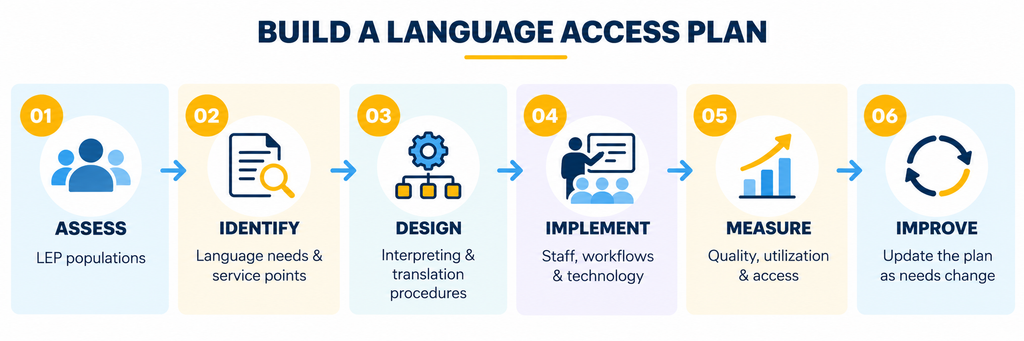
This guide explains how to build a Language Access Plan step by step—from assessing the populations you serve and identifying vital documents to establishing interpreting and translation workflows, selecting language-service providers, and monitoring the program.
Last updated: October 2026
What Is a Language Access Plan?
A Language Access Plan (LAP) is a practical framework an organization uses to identify and respond to the language needs of people with limited English proficiency (LEP) and, where applicable, other communication-access needs.
Rather than treating language assistance as an occasional response to a communication barrier, a Language Access Plan establishes how an organization will consistently provide appropriate language services across the programs, services, and interactions it supports.
A well-designed LAP helps an organization answer practical questions such as:
- Who are the LEP populations we serve?
- Which languages are most commonly needed?
- Where do language barriers occur in our services or programs?
- Which documents are important enough to require language assistance?
- When should staff arrange an interpreter?
- Which interpreting modality is appropriate?
- How will written materials be translated and reviewed?
- Who is responsible for managing language access?
- How will we measure whether the program is working?
Why Organizations Develop Language Access Plans
A LAP gives an organization a structured way to move from recognizing language needs to managing them consistently.
Without a defined plan, language access can become dependent on individual employees knowing whom to call, finding an available interpreter, deciding which documents should be translated, or determining how to respond when a language need arises.
A stronger approach establishes those processes in advance.
A Language Access Plan can help organizations:
- Identify language needs based on the populations they serve
- Establish consistent interpreting and translation procedures
- Help frontline staff understand their responsibilities
- Prioritize important and vital multilingual communications
- Coordinate scheduled and on-demand language services
- Establish quality and accountability measures
- Adapt language services as community and organizational needs change
A LAP Should Be an Operational Document
A Language Access Plan should not simply be a policy document that is written, approved, and placed on a shelf.
It should describe how language access actually works within the organization.
That means connecting the plan to the organization’s people, processes, services, technology, and accountability practices:
PEOPLE
Qualified interpreters, translators, staff, and program leaders
→ PROCESSES
Clear procedures for identifying, requesting, delivering, and managing language services
→ SERVICES
Interpreting, translation, multilingual content, and other appropriate language assistance
→ TECHNOLOGY
Tools that help coordinate, manage, document, and scale language-service activity
→ ACCOUNTABILITY
Quality monitoring, feedback, utilization, reporting, and ongoing improvement
The result is a language-access program that can function consistently across departments, locations, and service interactions.
The Goal of a Language Access Plan
The goal is not simply to create a document that demonstrates an organization has considered language access.
The goal is to create a repeatable system for providing meaningful, effective language assistance to the people the organization serves.
That distinction is important. A strong LAP becomes a working framework that guides everyday decisions—from identifying a patient’s or resident’s language need to arranging an interpreter, translating an important document, training staff, evaluating service quality, and updating the program as needs evolve.
The remainder of this guide walks through the major steps involved in building that framework.
Who Should Have a Language Access Plan?
A Language Access Plan can help any organization that regularly serves people with limited English proficiency (LEP) establish a more consistent approach to identifying language needs and providing appropriate language assistance.
However, not every organization has the same legal obligations. The need for a Language Access Plan—and the specific requirements it should address—can depend on the organization’s programs, funding, jurisdiction, population served, and applicable federal, state, local, or contractual requirements.
Organizations That May Benefit From a Language Access Plan
A LAP can be particularly valuable for organizations with frequent or significant interactions with LEP populations, including:
Government Agencies
Federal, state, county, municipal, and other public agencies that provide services, information, benefits, or programs to the public.
Healthcare Organizations
Hospitals, health systems, clinics, health departments, and other healthcare organizations serving patients with diverse language needs.
Courts & Legal Systems
Courts, administrative bodies, legal-service organizations, and other systems where language barriers can affect participation, access to information, or understanding of proceedings.
Schools & Educational Institutions
School districts, colleges, universities, and education-related programs serving students and families who use languages other than English.
Social-Service Organizations
Organizations providing public benefits, housing, employment services, community programs, family services, and other public-facing assistance.
Other Public-Facing Organizations
Organizations that regularly serve multilingual communities or operate programs where language access is important to participation and service delivery.
When Is a Language Access Plan Especially Important?
A formal LAP becomes particularly useful when an organization:
- Serves a substantial or recurring LEP population
- Provides services where misunderstanding can have significant consequences
- Operates across multiple locations or departments
- Receives federal financial assistance or operates a federally supported program
- Is subject to federal, state, or local language-access requirements
- Has recurring interpreting or translation needs
- Needs consistent procedures across frontline staff
- Works with multiple languages and service modalities
A Language Access Plan can also be useful even when an organization is not legally required to maintain one. It provides a practical framework for making language access consistent, measurable, and easier to manage.
Legal Requirements Can Vary
There is no single set of language-access obligations that applies identically to every organization.
Depending on the organization and the services it provides, requirements may arise from:
- Federal civil rights requirements
- Federal program or funding requirements
- State language-access laws or policies
- Local requirements
- Agency-specific regulations or policies
- Contractual or grant requirements
For example, organizations subject to applicable Title VI requirements may have obligations concerning meaningful access for individuals with LEP, while covered healthcare programs and activities may have additional requirements under Section 1557.
For that reason, a Language Access Plan should be developed around the organization’s actual legal, operational, and community context, rather than copied from a generic template.
Important: This guide is provided for general informational and educational purposes and is not legal advice. Section 1557 requirements may vary based on an organization’s programs, funding, activities, and applicable federal requirements. Healthcare organizations should consult current HHS guidance, applicable regulations, and qualified legal counsel regarding their specific obligations.
A LAP Should Match the Organization
A small municipal department may need a very different language-access framework from a national healthcare system or a large school district.
The underlying principles, however, remain similar:
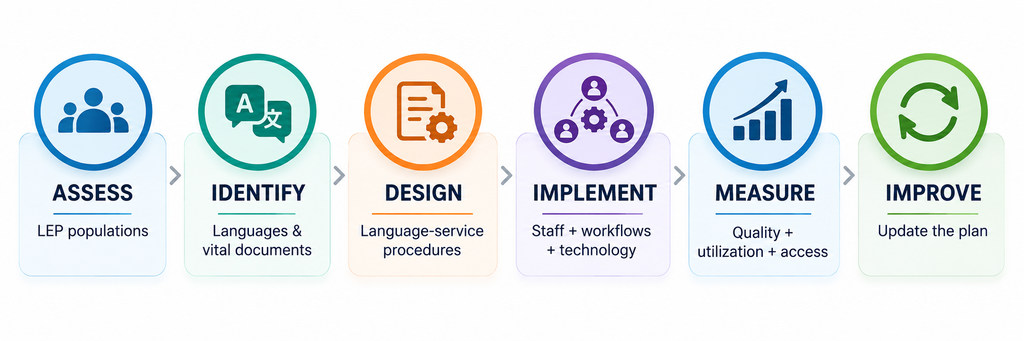
Understand who you serve → Identify language needs → Establish appropriate services → Train staff → Monitor performance → Improve the program
The goal is to create a plan that is specific enough to guide staff and flexible enough to evolve as language needs change.
Related EPIC Language Access Guides
For organizations evaluating their specific language-access responsibilities, EPIC’s other guides provide more focused information:
- Title VI Language Access Compliance Guide — for organizations evaluating language access under Title VI.
- Section 1557 Language Access Compliance Guide — for healthcare organizations and covered health programs addressing Section 1557 and LEP access.
- LEP Compliance Translation Services — Learn how EPIC supports organizations with translation and multilingual communication needs related to LEP language access.
These resources should complement—not replace—an organization’s review of the specific laws, regulations, guidance, funding conditions, and contractual requirements that apply to its programs.
Step 1 — Assess Your LEP Population
The foundation of an effective Language Access Plan is understanding who your organization serves and what language-access needs actually exist. Before establishing interpreting procedures, translating documents, or selecting language-service providers, an organization should develop a realistic picture of the languages used by the people who access its programs and services.
The goal is not simply to compile a list of languages. It is to understand where language needs occur, how frequently they arise, which populations are affected, and how those needs should influence the organization’s language-access operations.
Start With the Languages People Actually Use
Begin by asking:
Which languages are our patients, residents, students, customers, clients, or program participants actually using when they interact with us?
Depending on the organization, useful information may come from:
- Existing language-service requests
- Interpreter utilization records
- Translation project history
- Registration or intake information
- Customer or patient language preferences
- Program participation data
- Community and demographic data
- Census and other publicly available data
- Feedback from frontline employees
- Requests for languages that the organization currently cannot support
- Emerging patterns in service demand
No single source necessarily provides the complete picture. Comparing multiple sources can help identify both established and emerging language needs.
Look Beyond the Overall Population
Language needs can vary significantly across an organization’s geographic service area, facilities, departments, and programs.
For example, the languages most frequently requested at one healthcare facility may differ from those requested at another location. A school district may see different language needs among different schools. A county agency may encounter different language populations depending on the community it serves.
A useful assessment therefore considers:
Geography
Where are language needs concentrated?
Frequency
How often does each language need arise?
Program or Service
Which services generate the greatest demand?
Population
Which communities or groups are using the organization’s services?
Trend
Are particular language needs increasing, decreasing, or emerging?
This helps prevent the organization from designing its language-access program around a single overall language ranking that may not reflect actual service delivery.
Use Your Own Service Data
Existing language-service activity can be particularly valuable because it shows what is happening in practice.
Review available information such as:
- Number of interpreting requests by language
- On-site, VRI, and OPI utilization
- Translation requests by language
- Unfulfilled or delayed requests
- Recurring language needs
- Requests for languages outside the organization’s current coverage
- Departments or locations generating the greatest demand
This information can reveal gaps that demographic data alone may not show.
For example, a language may represent a relatively small percentage of the overall population but generate frequent requests within a particular program. Conversely, a language may appear prominently in demographic data but generate relatively little demand for a particular service.
The Language Access Plan should respond to the organization’s actual service environment, not simply to a population statistic.
Include Frontline Staff Observations
Employees who interact directly with patients, residents, students, customers, or program participants often have valuable information about language barriers.
Staff may know:
- Which languages they encounter most frequently
- Where communication difficulties occur
- Which services are hardest to access
- When interpreters are difficult to obtain
- Which documents generate questions
- Which populations may have emerging language needs
These observations should complement—not replace—available data.
Identify Emerging Needs
Language-access planning should not be based solely on historical demand.
Organizations should also consider whether changes in the communities they serve, new programs, demographic shifts, or changes in service utilization are likely to create new or increasing language needs.
A useful assessment therefore asks not only:
What language needs do we have today?
but also:
What language needs are we likely to encounter as our organization and the population we serve change?
Turn the Assessment Into an Operational Baseline
The purpose of this assessment is ultimately to inform the rest of the Language Access Plan.
The information gathered should help the organization determine:
Which languages should we prioritize?
→ Where are those languages needed?
→ How frequently are they needed?
→ Which services require interpreting?
→ Which communications require translation?
→ What staffing, workflow, and technology are needed to support them?
A strong language-needs assessment therefore becomes the evidence base for the rest of the plan.
The next step is to take that information and map where language access is needed throughout the organization’s services and interactions.
Step 2 — Identify Where Language Access Is Needed
Identifying the languages your organization serves is only the beginning. A strong Language Access Plan should also identify where language barriers can occur throughout the service journey.
Language access needs may arise before a person ever reaches a staff member, during a formal service interaction, or after the primary service has been delivered. Mapping these points helps an organization build language-access procedures around the way people actually interact with its programs and services.
Map the Entire Service Journey
A useful starting point is to map the major points of interaction:
Website → Phone → Intake → Appointment → Service → Documents → Follow-Up
At each stage, ask:
Could a person with limited English proficiency encounter a language barrier here?
If the answer is yes, the Language Access Plan should identify how that barrier will be addressed.
Common Points Where Language Access May Be Needed
Depending on the organization, language needs may arise during:
Front Desk & Reception
Initial questions, directions, check-in, and requests for assistance.
Call Centers & Telephone Communication
Scheduling, eligibility questions, customer support, and other phone-based interactions.
Online Forms & Digital Services
Websites, applications, portals, online forms, and other digital resources.
Registration & Intake
Collecting information, explaining procedures, and identifying language preferences.
Appointments & Meetings
Scheduled interactions where interpreting may need to be arranged in advance.
Hearings & Formal Proceedings
Court proceedings, administrative hearings, public meetings, or other settings where effective communication is essential.
Clinical Encounters
Healthcare consultations, treatment discussions, consent, discharge, and follow-up.
School & Education Meetings
Parent conferences, enrollment, special education meetings, student services, and other school interactions.
Case Management & Social Services
Eligibility determinations, benefits, counseling, referrals, and ongoing service coordination.
Written Notices & Documents
Applications, notices, instructions, forms, rights information, and other important communications.
Digital Communications
Web content, portals, email communications, multimedia, and other patient-, resident-, student-, or customer-facing content.
Think Beyond Interpreting
One of the most common weaknesses in language-access planning is treating the problem as simply:
“We need an interpreter when someone doesn’t speak English.”
Interpreting is important, but it represents only one part of the communication journey.
A person may encounter a language barrier when trying to:
- Find information on a website
- Complete an application
- Schedule an appointment
- Understand a notice
- Participate in a meeting
- Communicate by telephone
- Access a digital portal
- Understand instructions after receiving a service
A comprehensive Language Access Plan therefore considers spoken, written, digital, and other relevant forms of communication.
Connect Each Need to an Appropriate Solution
Once the organization has mapped its interaction points, it can determine what type of language assistance is appropriate at each stage.
| Interaction | Potential Language-Service Response |
|---|---|
| Website | Multilingual web content or localization |
| Telephone | OPI |
| Appointment | Scheduled interpreting |
| In-person service | On-site interpreting |
| Remote service | VRI |
| Forms and notices | Translation |
| Digital content | Translation/localization |
| Multimedia | Captioning, transcription, or multilingual media |
| Recurring services | Managed interpreting workflow |
The objective is not to use the same language service everywhere. It is to determine the appropriate solution for each communication point.
Build Language Access Into the Journey
A well-designed LAP should allow an individual to move through the organization’s services without repeatedly having to overcome the same language barrier.
For example:
DISCOVER
Find information about the organization
→ CONNECT
Contact the organization
→ ACCESS
Complete intake or registration
→ PARTICIPATE
Receive the service or participate in the program
→ UNDERSTAND
Receive important documents and instructions
→ CONTINUE
Access follow-up services
At each stage, the organization should know what language-access need may arise, who is responsible for addressing it, and what process or service should be used.
The Key Question
A Language Access Plan should ultimately answer:
“Where can language barriers prevent someone from accessing, understanding, participating in, or benefiting from our services—and what will we do at each point to address them?”
Once those interaction points have been mapped, the organization can move to the next step: identifying which documents and communications are important enough to prioritize for translation and other language assistance.
Step 3 — Identify Vital & Important Documents
Language access is not limited to spoken communication. People may also need to understand written information that affects their ability to access, participate in, or benefit from an organization’s programs and services.
A strong Language Access Plan should therefore establish a process for identifying which documents and communications should be prioritized for translation or other appropriate language assistance.
What Should Be Considered?
Depending on the organization and the services it provides, potentially important materials may include:
- Applications and enrollment materials
- Consent and authorization forms
- Notices and correspondence
- Eligibility information
- Rights and responsibilities
- Instructions and service information
- Emergency information
- Program materials
- Forms required to access services
- Other communications that are important to understanding or participating in a program
The objective is not necessarily to translate every document into every language. Instead, organizations should establish a consistent method for determining which written information is most important to the people they serve.
A Practical Prioritization Framework
When evaluating a document, consider four questions:
1. Importance of the Information
What does the document tell the person about accessing, receiving, or participating in the organization’s services?
2. Consequences of Misunderstanding
What could happen if the individual does not understand the information accurately?
3. Frequency of Use
How often is the document used or provided to the population served?
4. Population Served
Which LEP populations are likely to encounter or rely on the document?
Together, these factors can help an organization establish priorities rather than attempting to translate everything indiscriminately.
Prioritize Access-Critical Information
A useful way to think about document prioritization is:
Which written information does a person need to understand in order to access, participate in, or benefit from our services?
This can help distinguish between a document that is simply useful and one where a language barrier could materially interfere with access.
For example, an application, eligibility notice, consent form, or service instruction may warrant greater attention than a general informational publication that has little bearing on an individual’s ability to receive a service.
Consider More Than Translation
Translation is an important tool, but it should not automatically be assumed to be the answer for every document.
Depending on the communication and the population served, an organization may also consider:
- Interpretation to explain written information
- Multilingual digital content
- Accessible document formats
- Plain-language revisions
- Translated forms and notices
- Multilingual multimedia or educational content
The appropriate solution should reflect the importance of the information and how the person is expected to use it.
Build the Process Into the Language Access Plan
The LAP should establish who is responsible for:
- Identifying documents that require language assistance
- Prioritizing documents for translation
- Determining the languages needed
- Requesting translation
- Reviewing translated materials
- Maintaining current versions
- Updating translations when source content changes
This prevents document translation from becoming an ad hoc decision every time a new form or notice is created.
A Better Objective Than “Translate Everything”
An effective Language Access Plan does not need to begin with:
“How do we translate everything into every language?”
It should begin with:
“Which written information do people need to understand to effectively access and benefit from our services, and how should we make that information accessible?”
That shift—from volume of translated content to importance and access—helps organizations build a language-access program that is more practical, sustainable, and responsive to the people they serve.
The next step is to establish how staff will obtain qualified interpreting services when spoken language assistance is needed.
Step 4 — Establish Interpreting Procedures
A Language Access Plan should do more than state that interpreting is available. It should establish how staff recognize an interpreting need, request the appropriate service, connect with a qualified interpreter, and manage the interaction consistently.
The goal is to make language assistance a predictable part of the organization’s workflow rather than an improvised response when a communication barrier occurs.
Establish a Clear Interpreting Process
Staff should know what to do when an individual needs spoken language assistance.
A practical workflow is:
IDENTIFY
Recognize the language need
→ REQUEST
Request the appropriate interpreting service
→ MATCH
Connect with an appropriately qualified interpreter
→ DELIVER
Provide the interpreting service
→ DOCUMENT
Capture relevant information for future needs
The specific process can vary by organization, but it should be simple enough that frontline employees can follow it without having to determine the solution themselves.
Determine the Appropriate Interpreting Modality
A Language Access Plan should define when different interpreting modalities may be appropriate.
On-Site Interpreting
On-site interpreting provides a qualified interpreter who is physically present.
It may be appropriate when:
- The interaction is complex or sensitive
- Physical presence supports the communication
- Multiple participants are involved
- The encounter requires sustained interaction
- The organization determines that in-person interpreting is the most appropriate option
Video Remote Interpreting (VRI)
VRI connects participants with an interpreter through a video-enabled platform.
It can provide visual communication without requiring an interpreter to travel to the location and may be useful when:
- An on-site interpreter is unavailable
- The need is time-sensitive
- Physical presence is not necessary
- Visual communication is important
Organizations should ensure that the technology and interpreter are appropriate for the encounter and that audio and video quality support effective communication.
Over-the-Phone Interpreting (OPI)
OPI provides interpreting through a telephone connection.
It can be useful when:
- Rapid access is needed
- Video is unnecessary or unavailable
- The interaction is relatively straightforward
- A language is needed that may be difficult to source locally
OPI can be particularly valuable as part of an organization’s on-demand language-access capability.
Establish Scheduled and On-Demand Procedures
A comprehensive LAP should account for both predictable and unexpected interpreting needs.
Scheduled interpreting may be appropriate for appointments, hearings, meetings, consultations, recurring services, and other interactions where the language need is known in advance.
On-demand interpreting may be necessary when a language need arises unexpectedly or when immediate assistance is required.
The plan should identify:
- Who can request an interpreter
- How requests are submitted
- What information staff need to provide
- How far in advance scheduled services should be requested
- How urgent requests are handled
- What to do when the preferred modality is unavailable
- How recurring appointments are managed
- Who is responsible for resolving an unfilled request
Define Interpreter Qualification Expectations
The LAP should establish expectations for the language professionals used by the organization.
Depending on the setting and applicable requirements, organizations may consider:
- Language proficiency
- Interpreting skills
- Relevant subject-matter experience
- Healthcare, legal, education, or other specialized experience
- Appropriate credentials or certifications where applicable
- Confidentiality requirements
- Impartiality and professional conduct
The objective is not simply to find someone who speaks the required language. It is to connect the individual with a qualified language professional appropriate for the communication involved.
Do Not Leave Staff to Improvise
Frontline employees should know what to do without having to answer questions such as:
“Who should I call?”
“Can I ask a bilingual employee to interpret?”
“Should I schedule an interpreter or use VRI?”
“What do I do if nobody is available?”
The Language Access Plan should provide clear answers.
Training, written procedures, contact information, and technology-supported workflows can make the process easier to follow.
Plan for Recurring Language Needs
Language needs that occur repeatedly should not require staff to rebuild the process from the beginning each time.
Where appropriate, the organization should establish procedures for:
- Recurring appointments
- Frequently requested languages
- Regular meetings
- Ongoing case management
- Repeated program interactions
- Interpreter continuity where appropriate
This can improve efficiency while making language access more predictable for both staff and the people they serve.
The Goal: Reliable Access to Qualified Interpreters
A strong interpreting procedure ultimately connects four elements:
RIGHT LANGUAGE
→ RIGHT QUALIFICATION
→ RIGHT MODALITY
→ RIGHT TIME
The result should be a process that staff can activate easily and that gives individuals access to accurate, timely, and appropriate interpreting support.
Once interpreting procedures are established, the next step is to build a complementary process for written translation and multilingual content.
Step 5 — Establish Translation Procedures
A Language Access Plan should address written communication as deliberately as it addresses interpreting. Interpreting supports spoken communication; translation supports written communication. Both should be incorporated into the organization’s overall language-access workflow.
A well-defined translation procedure helps ensure that important documents are translated consistently, reviewed appropriately, maintained accurately, and available in the languages the organization has identified as priorities.
Establish a Clear Translation Request Process
Staff should know how to request translation and what information needs to accompany the request.
A practical process should identify:
- Who can submit a translation request
- Where requests are submitted
- Which languages are required
- The intended audience and use of the document
- The required deadline
- Whether the content is new or an update to an existing translation
- Whether formatting or desktop publishing is required
- Who is responsible for reviewing and approving the final content
This prevents translation requests from becoming informal, one-off transactions and creates a consistent process across departments.
Review the Source Document Before Translation
Before translation begins, the organization should confirm that the source document is complete, current, and ready for translation.
This is particularly important for forms, notices, policies, applications, and other materials that may change over time.
The source review should consider:
- Whether the content is final
- Whether there are unresolved edits or comments
- Whether tables, graphics, or forms require special handling
- Whether terminology needs to be defined
- Whether previous translations exist
- Whether the document will continue to be updated
Translating an unstable source document can create unnecessary rework and version-control problems.
Establish Terminology and Consistency
Organizations that regularly communicate in multiple languages should establish a consistent approach to important terminology.
This may include:
- Organization-specific terminology
- Program names
- Department names
- Legal or regulatory terminology
- Healthcare or technical terminology
- Frequently repeated phrases
- Names of services and programs
Terminology resources can help maintain consistency across documents and across translation projects, particularly when multiple linguists or departments are involved.
Determine the Appropriate Translation Workflow
Not every document requires the same translation approach.
Depending on the content, intended use, complexity, risk, volume, and quality requirements, an organization may use:
Human Translation
Professional linguists translate the content directly, with an appropriate review and quality-assurance process.
AI-Assisted Translation With Human Review
AI technology can support the initial translation workflow, followed by appropriate human linguistic review and correction.
The important consideration is not simply whether AI or human translation is used. It is whether the workflow is appropriate for the content and its intended use.
For important, sensitive, regulated, or high-risk communications, organizations should establish quality controls appropriate to the consequences of an inaccurate translation.
Build Quality Assurance Into the Process
Translation quality should not be treated as an afterthought.
Depending on the project, quality assurance may include:
- Linguistic review
- Terminology verification
- Accuracy checks
- Completeness checks
- Formatting review
- Comparison against the approved source
- Review of numbers, dates, names, and other critical information
- Client or subject-matter review where appropriate
A defined review process can help identify errors before translated materials are distributed.
Account for Formatting and DTP
Translation can change the length and structure of a document. Text expansion or contraction can affect:
- Forms
- Tables
- Headings
- Brochures
- Graphics
- Page breaks
- Web content
- Other design elements
For documents that need to preserve their original visual structure, multilingual desktop publishing (DTP) may be necessary after translation.
The goal is not simply to translate the words. The final document should remain usable, readable, and visually coherent in the target language.
Maintain Version Control
Organizations should know which translated version is current.
A translation workflow should establish procedures for:
- Identifying the source version
- Tracking translated versions
- Recording revision dates
- Reusing approved translations where appropriate
- Updating translated documents when the source changes
- Retiring outdated versions
This is particularly important when the same form, notice, policy, or instruction is used across multiple departments or locations.
Connect Translation to the Larger Language Access Program
Translation should not operate as a separate administrative function disconnected from the organization’s language-access assessment.
The process should connect:
IDENTIFY
Which documents require language assistance?
→ PRIORITIZE
Which languages and materials are most important?
→ TRANSLATE
Use the appropriate translation workflow
→ REVIEW
Verify accuracy, terminology, and usability
→ PUBLISH
Make the approved version available
→ UPDATE
Maintain it as the source content changes
This creates a repeatable translation process that can scale as the organization’s multilingual communication needs grow.
Human Expertise and Technology Can Work Together
Technology can make translation workflows more efficient, particularly when organizations manage large volumes of multilingual content. However, technology should be selected and applied based on the content, risk, intended audience, and required quality level.
EPIC supports organizations through Human Translation, Human-Reviewed AI Translation, and Multilingual DTP, allowing the translation workflow to be matched to the requirements of the content.
The objective is not to choose between technology and human expertise as a matter of principle. It is to establish the right translation workflow for the information being communicated.
With translation procedures established, the next step is ensuring that the people responsible for language access know how to use those procedures effectively.
Step 6 — Train Staff
A Language Access Plan is only effective when the people responsible for delivering services know how to use it. Frontline employees are often the first to recognize a language barrier, so they need clear instructions for identifying language needs, accessing language services, and responding appropriately.
The goal of staff training is not to make every employee a language-access expert. It is to ensure that employees understand their role in activating and supporting the organization’s language-access process.
Teach Staff How to Identify Language Needs
Employees should understand how to recognize when an individual may need language assistance and how to determine the appropriate language.
Training can cover:
- How to recognize a potential language barrier
- How to ask about language preferences appropriately
- How to document relevant language needs
- How to communicate that language assistance is available
- What to do when the individual has difficulty communicating in English
Staff should understand that a person may need language assistance even when they appear able to communicate at a basic conversational level. The relevant question is whether the individual can effectively understand and communicate the information involved in the interaction.
Show Staff How to Request an Interpreter
Employees should not have to figure out the interpreting process on their own.
Training should explain:
- Who can request an interpreter
- Where requests are submitted
- What information must be provided
- How to request scheduled interpreting
- How to access on-demand services
- What to do when the preferred modality is unavailable
- Who to contact when an interpreting request cannot be fulfilled
The process should be simple enough that a frontline employee can activate language assistance without unnecessary delay.
Train Staff on Interpreting Modalities
Employees should understand the organization’s available interpreting options and when each may be appropriate.
On-Site Interpreting
Staff should understand how to schedule an in-person interpreter and how to prepare for the assignment.
VRI
Staff should know how to access the video platform, connect with the interpreter, and address basic technical problems.
OPI
Staff should know how to initiate an over-the-phone interpreting session and how to use the service appropriately.
Training should focus on how staff activate the service, rather than expecting employees to independently determine complex interpreting qualifications or language-service policies.
Teach Staff How to Work With Interpreters
Using a professional interpreter effectively is itself a skill.
Staff should understand practices such as:
- Speak directly to the individual, not the interpreter
- Use clear, manageable statements
- Avoid unnecessary jargon where possible
- Allow sufficient time for interpretation
- Do not ask the interpreter to summarize or omit information
- Address questions or concerns directly with the individual
- Maintain appropriate confidentiality
The interpreter facilitates communication. The staff member remains responsible for the underlying service, clinical, legal, educational, or administrative interaction.
Explain What Staff Should Not Do
Training should also make clear what employees should avoid.
Depending on the organization’s policies and applicable requirements, staff should not routinely:
- Ask children to interpret
- Rely on family members or friends as the default interpreting solution
- Assume that a bilingual employee is automatically qualified to interpret
- Ask individuals to bring their own interpreter
- Use unapproved translation tools for sensitive or important communications
- Delay necessary language assistance because the process is inconvenient
Clear examples are often more useful than simply telling employees to “provide language access.”
Include Written Translation Procedures
Staff who create or distribute documents should understand the organization’s process for obtaining translated materials.
Training can explain:
- Which documents should be submitted for translation
- How to request translation
- How to identify the required language
- Where approved translations are stored
- How to determine whether a translation is current
- What to do when a source document changes
- Who approves translated materials
This helps prevent staff from independently creating inconsistent or unreviewed multilingual materials.
Address Confidentiality and Sensitive Information
Language services frequently involve confidential or sensitive information. Staff training should reinforce the organization’s applicable privacy, confidentiality, and information-handling requirements.
Employees should understand:
- How confidential information should be handled during interpreted encounters
- What information can be shared with language professionals
- How to use approved language-service channels
- What to do if a confidentiality concern arises
The exact requirements will depend on the organization’s industry, programs, and applicable laws and policies.
Establish Escalation Procedures
Not every language-access situation will proceed exactly as planned.
The LAP should identify what staff should do when:
- An interpreter cannot be obtained
- The requested language is difficult to source
- Technology is not functioning
- The individual indicates that communication is not effective
- A staff member is uncertain which service to use
- A language-access complaint is received
- An urgent situation requires immediate assistance
Employees should know who owns the problem when the normal workflow breaks down.
Make Training Ongoing
Language-access training should not necessarily be a one-time event.
Organizations can incorporate language-access procedures into:
- New employee orientation
- Refresher training
- Department-specific training
- Updates to policies and procedures
- Technology or workflow changes
- Quality-improvement initiatives
Training should also be updated when the organization’s language needs, services, technology, or applicable requirements change.
The Practical Principle
A Language Access Plan can contain excellent policies and procedures, but they have little value if frontline employees do not know how to activate them.
The best language-access policy is useless if staff do not know what to do when someone needs language assistance.
Effective training closes that gap by turning the written plan into consistent day-to-day practice.
Step 7 — Establish Technology & Workflow Infrastructure
Technology can make a Language Access Plan easier to implement, coordinate, monitor, and scale. But technology should support the language-access program—not become a substitute for qualified interpreters, translators, or trained staff.
The right technology infrastructure helps an organization move from individual language-service requests to a more consistent, visible workflow.
What Should Language-Access Technology Support?
Depending on the organization’s size and needs, technology can support several parts of the language-access lifecycle.
Request Management
Give staff a clear way to submit interpreting or translation requests and provide the information needed to fulfill them.
Interpreter Scheduling
Coordinate scheduled interpreting assignments and make language-service availability easier to manage.
Interpreter Matching
Help connect requests with appropriately qualified and available interpreters based on language, modality, timing, and assignment requirements.
Recurring Appointments
Manage recurring interpreting needs without requiring staff to recreate the same request repeatedly.
Translation Project Management
Track translation requests, source files, deadlines, review, approvals, and completed multilingual materials.
Reporting & Service Utilization
Provide visibility into language-service activity, including languages requested, service volume, modality, and recurring demand.
Department-Level Visibility
For larger organizations, help departments or locations understand their own language-service activity while maintaining appropriate organizational oversight.
Documentation
Maintain relevant information about language-service requests, assignments, projects, and completed services.
Workflow Automation
Reduce repetitive administrative work and create more consistent processes for requesting, assigning, delivering, and managing language services.
Technology Should Support the Language-Access Workflow
Technology is most useful when it is connected to the organization’s actual language-access procedures.
For example:
IDENTIFY
Staff identify a language need
→ REQUEST
Language service is requested through an established workflow
→ MATCH
The appropriate language professional is identified
→ DELIVER
Interpreting or translation is provided
→ DOCUMENT
Relevant activity is recorded
→ REPORT
The organization can evaluate utilization and recurring needs
This creates greater visibility and consistency without requiring frontline staff to manage every administrative detail manually.
EPIC’s Technology Ecosystem
EPIC has developed technology that supports different parts of the language-services lifecycle.
EPS — Language-Service & Project Management
EPS supports client and language-service workflows, helping organizations manage translation activity, projects, communication, and related language-service requirements.
SRH — Interpreting Operations & Staffing
SRH (Staffing Resources Hub) supports the operational side of interpreting, including interpreter availability, matching, scheduling, assignments, and session management across interpreting modalities.
This can be particularly valuable for organizations managing scheduled and on-demand interpreting across multiple languages and locations.
AITH — AI-Assisted Translation
AITH (AI Translation Hub) supports AI-assisted translation workflows. Depending on the content and quality requirements, these workflows can incorporate human linguistic review to provide an additional level of quality control.
The appropriate workflow should always be determined by the content, intended use, risk, and required quality—not simply by whether AI technology is available.
Technology + Qualified People
Technology should make language access easier to manage, not less human.
A strong language-access infrastructure combines:
Qualified Language Professionals
Interpreters and translators who provide the actual language service
Trained Staff
Employees who know when and how to activate language assistance
Defined Workflows
Processes that make language access consistent
Technology
Tools that help coordinate, manage, document, and scale those processes
The objective is not to automate the human component of language access. It is to remove unnecessary friction around it.
For organizations managing language services across multiple departments, locations, languages, or service modalities, this combination can provide the operational foundation needed to make a Language Access Plan work in practice.
Step 8 — Establish Quality & Accountability
A Language Access Plan should define not only what the organization intends to provide, but also how it will determine whether language access is working in practice.
Without measurement and accountability, an organization may not know whether language services are consistently available, whether staff are following established procedures, or where gaps are affecting the people it serves.
The goal is not to create unnecessary administrative reporting. It is to establish enough visibility to identify problems, understand demand, and continuously improve the program.
Monitor Language-Service Availability
An organization should know whether the language services identified in its LAP are actually available when needed.
Consider monitoring:
- Languages requested
- Languages successfully supported
- Unfilled or delayed requests
- Scheduled versus on-demand demand
- Availability by location or department
- Recurring periods of higher demand
A language may be listed in a plan, but that does not necessarily mean the organization can reliably provide assistance in that language when someone needs it.
Evaluate Interpreter Quality
Quality monitoring should consider whether interpreting services are meeting the organization’s expectations.
Depending on the setting, this may include:
- Interpreter qualifications
- Assignment appropriateness
- Staff or participant feedback
- Complaints or concerns
- Recurring quality issues
- Performance trends
The objective is to identify patterns that may require additional training, workflow changes, or adjustments to language-service coverage.
Monitor Translation Quality
Written language services should also be evaluated.
Organizations can monitor:
- Translation accuracy
- Terminology consistency
- Completeness
- Formatting and usability
- Review outcomes
- Corrections or revisions
- Feedback from staff or program stakeholders
This is particularly important for documents that are frequently used or contain information that is important to accessing or benefiting from services.
Measure Response Times
For organizations providing scheduled and on-demand language services, response time can be an important operational indicator.
Consider measuring:
Request → Response → Assignment → Delivery
This can help identify whether delays occur during the request process, interpreter matching, scheduling, or service delivery.
The goal is not simply to measure how quickly a request was answered. It is to determine whether language assistance was available when it was actually needed.
Track Language Coverage and Utilization
Service-utilization data can help an organization understand whether its language-access assumptions remain accurate.
Track information such as:
- Most frequently requested languages
- Service volume by language
- Service volume by modality
- Demand by department or location
- Recurring language needs
- Emerging language needs
- Languages that are difficult to fulfill
This information can feed directly back into the language-needs assessment described in Step 1.
Monitor Complaints and Feedback
Feedback can reveal problems that utilization data cannot.
Organizations should establish a process for receiving and reviewing:
- Patient, resident, student, customer, or participant feedback
- Staff feedback
- Interpreter feedback
- Translation concerns
- Complaints involving language access
- Reports of communication difficulties
The purpose should be improvement rather than blame. A recurring complaint may identify a weakness in the underlying workflow that needs to be addressed.
Identify Missed Language-Access Opportunities
Organizations should also look for situations in which language assistance was needed but was:
- Not requested
- Delayed
- Unavailable
- Provided through an inappropriate method
- Replaced by an informal interpreter
- Not continued through follow-up communication
These situations can be especially valuable because they reveal gaps between the organization’s written procedures and what actually happens in the field.
Evaluate Staff Compliance With the Workflow
A LAP should make responsibilities clear, but organizations should periodically determine whether staff understand and follow those procedures.
Questions might include:
- Do staff know how to request an interpreter?
- Are language preferences being identified consistently?
- Are approved interpreting channels being used?
- Do staff know where to find approved translated materials?
- Are language-access problems being escalated appropriately?
- Do departments follow the same core procedures?
If staff are consistently struggling with a particular step, the solution may be better training or a simpler workflow, rather than simply reminding employees to follow the policy.
Establish Practical KPIs
Organizations do not need dozens of metrics. A small set of meaningful indicators can provide useful visibility.
A practical framework is:
DEMAND
What language services are people requesting?
→ RESPONSE
How quickly are requests being addressed?
→ DELIVERY
Was the appropriate service actually provided?
→ QUALITY
Was the service accurate, effective, and appropriate?
→ IMPROVEMENT
What should change based on what we learned?
Potential measures may include:
| Area | Example Measures |
|---|---|
| Demand | Requests by language, modality, department, or location |
| Response | Response time, fulfillment time, delayed requests |
| Delivery | Fulfilled vs. unfulfilled requests |
| Quality | Feedback, complaints, corrections, quality issues |
| Coverage | Languages and modalities consistently available |
| Staff | Training completion and workflow adherence |
| Utilization | Interpreting and translation volume |
| Improvement | Recurring issues addressed and workflow changes implemented |
Turn Measurement Into Improvement
The purpose of measurement is not to produce a report and file it away.
The organization should use the information it collects to answer:
What is working, where are the gaps, and what should we change?
For example, increasing demand for a particular language may justify expanding interpreter coverage. Repeated delays in a particular department may indicate a workflow problem. Frequent translation corrections may signal a terminology or review issue.
This creates a continuous cycle:
Measure → Understand → Improve → Measure Again
A Language Access Plan becomes significantly more effective when quality and accountability are built into the program from the beginning rather than added after problems occur.
Step 9 — Monitor, Review & Update the Plan
A Language Access Plan should be treated as living infrastructure, not a document that is written once and then left unchanged.
The organization, the communities it serves, its programs, and the technology used to deliver services can all change over time. A plan that was effective several years ago may no longer reflect current language needs, service workflows, or operational capabilities.
Regular review helps ensure that the plan continues to reflect how the organization actually provides language access.
Review the Plan When Circumstances Change
An organization should consider reviewing its Language Access Plan when there are significant changes such as:
Population Changes
Demographic or community changes create new or increasing language needs.
New Services or Programs
New programs introduce new types of communication or new populations.
New Locations
Opening facilities or expanding into new geographic areas may change the languages and service needs the organization encounters.
Changes in Language Demand
Interpreting or translation utilization indicates that previously identified language priorities have changed.
Changes in Laws or Regulations
New or revised federal, state, local, program-specific, or contractual requirements may affect the organization’s language-access responsibilities.
New Technology
New platforms, portals, workflows, or language-service technology may change how language assistance is requested and delivered.
Service Problems
Repeated delays, unfilled requests, quality concerns, or other operational problems may indicate that the existing plan needs to be revised.
Feedback Identifies Gaps
Feedback from patients, residents, students, customers, staff, interpreters, or other stakeholders may reveal language-access barriers that were not previously identified.
Schedule Periodic Reviews
In addition to reviewing the plan when circumstances change, organizations should establish a regular review cycle.
The appropriate frequency will depend on the organization’s size, programs, language-service volume, and applicable requirements. A larger organization with significant language-service activity may need more frequent operational reviews than a smaller organization with limited demand.
A periodic review can examine:
- Current language needs
- Language-service utilization
- Interpreter and translation availability
- Staff training
- Service quality
- Complaints and feedback
- Technology and workflows
- Document-translation priorities
- Changes in applicable requirements
- Progress against language-access goals
Compare the Plan With What Actually Happens
One of the most valuable parts of a review is comparing the written plan with actual operational practice.
Ask:
Does our current Language Access Plan accurately describe what happens when someone needs language assistance?
For example:
- Can staff actually access the interpreting services described in the plan?
- Are the languages identified as priorities still the languages most frequently requested?
- Are translated documents still current?
- Do employees know where to find them?
- Are the technology workflows being used as intended?
- Are recurring service gaps being addressed?
- Are there new communication channels that the plan does not cover?
This can reveal the difference between a plan that looks complete on paper and one that works effectively in practice.
Document Changes and Maintain Version Control
The organization should maintain a clear record of when the plan was reviewed and what was changed.
Depending on the organization’s needs, this may include:
- Review date
- Version number
- Major changes
- Responsible department or owner
- Approval or sign-off
- Next scheduled review
The same principle applies to the multilingual materials and procedures that support the plan. When source content, workflows, or requirements change, related language-access resources may also need to be updated.
Treat Improvement as a Continuous Cycle
A mature language-access program does not follow a straight line. It operates as a continuous cycle:
ASSESS
Understand current language needs
→ PLAN
Establish appropriate services and procedures
→ IMPLEMENT
Put the plan into practice
→ MEASURE
Review utilization, quality, and access
→ IMPROVE
Address gaps and update the plan
→ REASSESS
Begin the cycle again as circumstances change
This approach allows the Language Access Plan to remain aligned with the organization rather than becoming outdated as its programs, communities, and operational environment evolve.
A Language Access Plan Should Evolve
The most effective LAP is not necessarily the longest or most detailed document.
It is the one that continues to reflect the organization’s actual language-access needs and provides clear direction when those needs change.
As populations evolve, services expand, technology changes, and new requirements emerge, the plan should evolve with them.
A Language Access Plan should be a living framework for managing language access—not a document that sits on a shelf.
A Practical Language Access Plan Framework
Common Language Access Plan Mistakes
Creating a Language Access Plan is an important first step, but the plan is only effective if it translates into consistent practice. Organizations can have well-written policies and still experience language-access gaps when procedures are unclear, staff are unprepared, or the plan is never evaluated.
The following are some of the most common mistakes to avoid.
1. Writing a Plan That Nobody Uses
A Language Access Plan should guide day-to-day operations, not simply satisfy a documentation requirement.
If frontline employees do not know where the plan is, what their responsibilities are, or how to activate language services, the organization may have a strong policy on paper but an inconsistent process in practice.
Better approach: Build the LAP around actual workflows and make the relevant procedures easy for staff to access and follow.
2. Focusing Only on Translation
Language access is broader than translating documents.
Organizations may focus heavily on multilingual forms and notices while overlooking spoken communication needs such as:
- On-site interpreting
- VRI
- OPI
- Meetings and appointments
- Telephone interactions
- Front-desk communication
- Follow-up conversations
Better approach: Address both spoken and written communication throughout the service journey.
3. Translating Everything Instead of Prioritizing
Trying to translate every document into every language can quickly become expensive, difficult to maintain, and operationally unrealistic.
The more useful question is:
Which written information is important for people to understand in order to access, participate in, or benefit from our services?
Better approach: Establish a consistent framework for prioritizing important and vital documents based on factors such as importance, consequences of misunderstanding, frequency of use, and the populations served.
4. Ignoring Frontline Staff
A Language Access Plan can fail at the point of service if employees do not know how to recognize a language need or obtain assistance.
Staff should know:
- How to identify language needs
- How to request an interpreter
- How to access OPI or VRI
- When on-site interpreting may be appropriate
- How to work effectively with interpreters
- Where to find approved translated materials
- What to do when the normal process does not work
Better approach: Incorporate language-access procedures into onboarding, training, and ongoing staff education.
5. Using Informal Interpreters
When a language barrier occurs unexpectedly, employees may be tempted to rely on whoever happens to be available—a family member, friend, child, or bilingual employee.
This can create concerns involving accuracy, confidentiality, impartiality, and the individual’s ability to participate effectively.
Better approach: Establish a clear process for accessing appropriate qualified language assistance and train staff to use that process.
6. Never Measuring the Program
A Language Access Plan should not be written once and then forgotten.
Without monitoring, an organization may not know:
- Which languages are actually being requested
- Whether services are consistently available
- Where delays or unfilled requests occur
- Whether staff are following established procedures
- Whether translated materials remain current
- What complaints or feedback are revealing
- Whether language needs have changed
Better approach: Establish practical measures for demand, response, delivery, quality, utilization, and access, and use the results to improve the program.
The Common Thread
These mistakes have something in common: they treat language access as a document or isolated service rather than as an operational program.
A stronger approach connects:
Policy → People → Processes → Language Services → Technology → Measurement
That is what turns a Language Access Plan from a document into a working framework for providing consistent language access.
Choosing a Language Services Partner
For many organizations, developing a Language Access Plan is only part of the challenge. The organization must also determine how language services will be delivered consistently once the plan is in place.
Choosing a language services partner should therefore involve more than comparing language counts or hourly rates. The right provider should be able to support the organization’s people, workflows, service requirements, quality expectations, and long-term operational needs.
1. Qualified Linguists and Interpreters
Ask how the provider recruits, screens, qualifies, and manages its language professionals.
Consider:
- Interpreter and translator qualifications
- Relevant subject-matter experience
- Language proficiency
- Specialized terminology experience
- Credentialing or certification where applicable
- Ongoing quality management
The important question is not simply whether a provider has someone who speaks a particular language. It is whether it can provide a qualified language professional appropriate for the assignment.
2. Relevant Industry and Public-Sector Experience
Language-access requirements and workflows can vary significantly by environment.
Consider whether the provider has experience supporting organizations such as:
- Government agencies
- Healthcare organizations
- Courts and legal systems
- School districts
- Higher education
- Social-service organizations
- Other public-facing programs
Relevant experience can help a provider understand the operational realities surrounding sensitive communications, confidentiality, documentation, scheduling, and compliance.
3. Language Coverage
Evaluate both the breadth and depth of language coverage.
Ask:
- How many languages are supported?
- Are less commonly requested languages available?
- Can the provider support emerging language needs?
- Is coverage available across different interpreting modalities?
- Can the provider support translation as well as interpreting?
A large language list is useful only if the provider can actually deliver the required language service when it is needed.
4. Multiple Interpreting Modalities
A strong partner should be able to support different situations with appropriate modalities, including:
- On-site interpreting
- Video Remote Interpreting (VRI)
- Over-the-Phone Interpreting (OPI)
Ask how the provider handles scheduled versus on-demand requests and how it responds when the preferred modality or interpreter is unavailable.
5. Translation Capabilities
If the organization needs translated documents, its language-services partner should be able to support the broader translation workflow—not simply provide translated text.
Consider whether the provider can support:
- Human translation
- AI-assisted translation with human review
- Terminology management
- Quality assurance
- Formatting and multilingual DTP
- Document and version management
- Digital and website content
- Multimedia and other multilingual communications
Having interpreting and translation capabilities under one language-services relationship can also simplify vendor management.
6. Availability and Urgent Support
Language needs do not always occur according to a predictable schedule.
Ask prospective providers:
- What hours are services available?
- How are urgent requests handled?
- Is on-demand interpreting available?
- How quickly can scheduled services be arranged?
- What happens when an interpreter cannot be assigned?
- Can recurring appointments be managed?
A provider should have a clearly defined process for both planned and unexpected language needs.
7. Quality Management
Ask the provider how it knows that the language services being delivered are meeting quality expectations.
Look for processes involving:
- Linguist qualification
- Assignment matching
- Linguistic review
- Client feedback
- Complaint resolution
- Performance monitoring
- Terminology consistency
- Corrective action
- Continuous improvement
Quality should be supported by a defined process, not simply a claim on a website.
8. Security and Confidentiality
Organizations should understand how a language services provider protects sensitive information.
Consider:
- Data-security practices
- Confidentiality requirements
- Information transmission and storage
- Access controls
- Interpreter and translator confidentiality
- Technology security
- Applicable privacy and regulatory requirements
The provider’s practices should align with the organization’s own security and confidentiality expectations.
9. Technology and Workflow
Technology should make language access easier to manage.
Consider whether the provider can support:
- Service requests
- Interpreter scheduling
- Interpreter matching
- Recurring appointments
- Translation project management
- Reporting
- Service utilization
- Department or location visibility
- Documentation
- Workflow automation
For organizations with significant language-service activity, these capabilities can make the difference between managing language access as a collection of individual requests and managing it as a coordinated program.
10. Reporting and Accountability
Ask what visibility the organization will have into its language-service activity.
Useful reporting may include:
- Requests by language
- Requests by modality
- Service utilization
- Department or location activity
- Fulfillment
- Response times
- Recurring demand
- Quality or feedback trends
Reporting should help the organization evaluate whether its Language Access Plan is working and where adjustments may be needed.
11. Scalability
Finally, consider whether the provider can grow with the organization.
Language-service needs may expand as an organization:
- Adds locations
- Introduces new programs
- Serves new populations
- Adds languages
- Increases interpreting volume
- Expands digital communications
- Requires additional translation
A provider should be capable of supporting that growth without forcing the organization to continually build new vendor relationships.
A Practical Vendor Evaluation
Before selecting a language services partner, ask:
Can this provider consistently deliver the right language professional, in the right modality, at the right time, through a secure and manageable workflow—and can it continue doing so as our needs evolve?
A strong partner should complement the organization’s Language Access Plan rather than operate separately from it.
The goal is not simply to find a company that can provide an interpreter or translate a document. It is to establish a reliable language-services infrastructure that supports the organization’s broader language-access program.
Why EPIC Translations
A Language Access Plan provides the framework. EPIC Translations provides the language professionals, services, workflows, and technology that can help put that framework into practice.
Qualified Language Professionals
EPIC provides access to 25,000+ linguists across 200+ languages, supporting organizations with a broad range of interpreting and translation requirements.
The goal is to connect each assignment with the appropriate language professional based on the language, service, modality, and requirements of the work.
Multiple Language-Service Modalities
EPIC can support organizations across multiple language-service needs, including:
- On-site interpreting
- Video Remote Interpreting (VRI)
- Over-the-Phone Interpreting (OPI)
- Translation
- ASL interpreting
- Multilingual digital and content services
This allows organizations to build a language-access program around their actual communication needs rather than relying on a single delivery model.
Technology That Supports the Program
EPIC combines language professionals with a technology ecosystem designed to support language-service operations:
EPS supports language-service and translation project management.
SRH supports interpreting operations, including interpreter availability, matching, scheduling, and assignments.
AITH supports AI-assisted translation workflows with human review when appropriate.
Together, these platforms help organizations manage language services with greater visibility, consistency, and scalability.
Scheduled and On-Demand Support
Language needs can be predictable or unexpected. EPIC supports both scheduled and on-demand language services, helping organizations address recurring requirements while maintaining access when language needs arise unexpectedly.
From Individual Requests to Program-Level Support
EPIC’s role can extend beyond fulfilling individual translation or interpreting requests.
For organizations with recurring multilingual needs, EPIC can help support the language-service infrastructure behind the Language Access Plan—bringing together qualified professionals, multiple service modalities, operational workflows, and technology.
The result is a more coordinated approach to language access:
People + Services + Workflows + Technology
That is the connection between a Language Access Plan on paper and a language-access program that can operate consistently in practice.
Language Access Plan FAQs
A Language Access Plan should be practical enough to guide day-to-day operations while remaining flexible enough to evolve as an organization’s programs, population, and language needs change. These FAQs address common questions organizations have when developing, implementing, and maintaining a language-access program.
What is a Language Access Plan?
A Language Access Plan (LAP) is a framework for identifying and responding to the language needs of people with limited English proficiency (LEP). It establishes how an organization will identify language needs, provide appropriate interpreting and translation, train staff, manage language-service workflows, monitor quality, and improve the program over time.
Who needs a Language Access Plan?
A LAP can be valuable for any organization that regularly serves people with LEP. This may include government agencies, healthcare organizations, courts, schools, social-service organizations, and other public-facing programs.
Specific legal requirements vary depending on the organization’s programs, funding, jurisdiction, and applicable federal, state, local, or contractual requirements.
What should a Language Access Plan include?
A comprehensive LAP should address the organization’s actual language-access operations. Common components include:
– Language-needs assessment
– Identification of important and vital documents
– Interpreting procedures
– Translation procedures
– Staff training
– Language-service technology and workflows
– Quality and accountability measures
– Procedures for monitoring and updating the plan
The plan should be specific enough to guide staff while remaining adaptable as language needs change.
How do you conduct a language-needs assessment?
Begin by identifying the languages used by the populations your organization serves and examining where and how frequently language needs arise.
Useful information can include language-service utilization, intake or registration information, community and demographic data, program participation, geographic differences, staff observations, and emerging language trends.
The goal is not simply to create a list of languages. It is to understand which languages are needed, where they are needed, how often they are needed, and which services generate that demand.
What are vital and important documents?
Vital or important documents are written materials that people may need to understand in order to access, participate in, or benefit from an organization’s programs or services.
Depending on the organization, these may include applications, consent forms, notices, eligibility information, rights and responsibilities, instructions, emergency information, and forms required to access services.
Organizations should establish a consistent process for prioritizing documents rather than assuming every document must be translated into every language.
Does a Language Access Plan need to include interpreting?
Yes. A comprehensive LAP should establish how the organization will provide appropriate spoken language assistance.
Depending on the organization’s needs, this may include:
– On-site interpreting
– Video Remote Interpreting (VRI)
– Over-the-Phone Interpreting (OPI)
The plan should explain how staff identify an interpreting need, request services, access the appropriate modality, and respond when an interpreter is unavailable.
Should a LAP address translation?
Yes. Translation should be addressed alongside interpreting because written communication is a major component of language access.
A LAP should establish procedures for identifying documents that require translation, prioritizing languages and content, requesting translation, reviewing translated materials, managing terminology, maintaining versions, and updating translations when source content changes.
How should staff be trained?
Staff should be trained on the parts of the Language Access Plan that affect their responsibilities.
Training may include:
– Recognizing language needs
– Asking about language preferences
– Requesting interpreting
– Accessing OPI and VRI
– Scheduling on-site interpreters
– Working effectively with interpreters
– Accessing approved translated materials
– Avoiding inappropriate reliance on family members, minors, or unqualified bilingual staff
– Protecting confidential information
– Escalating language-access problems
The objective is to make language access a usable operational process rather than a policy employees do not know how to activate.
How often should a Language Access Plan be updated?
There is no single review schedule that is appropriate for every organization. The plan should be reviewed periodically and whenever significant changes occur.
Reasons to revisit a LAP may include:
– Changes in the population served
– New or changing language demand
– New programs or locations
– Changes in applicable laws or requirements
– New technology or workflows
– Recurring service problems
– Complaints or stakeholder feedback
The plan should remain aligned with how the organization actually provides language access.
Should a Language Access Plan include ASL?
It can be appropriate to address ASL and other communication-access needs within the organization’s broader communication-access strategy. However, ASL access should not simply be treated as another LEP language under the Title VI framework.
Organizations should consider applicable disability and communication-access requirements separately and determine what services are appropriate for Deaf and hard-of-hearing individuals, which may include ASL interpreting and other communication-support services.
How should an organization choose a language-services provider?
Evaluate providers based on more than price or the number of languages advertised.
Important criteria include:
– Qualified interpreters and translators
– Relevant industry or public-sector experience
– Language coverage
– On-site, VRI, and OPI capabilities
– Translation services
– Scheduled and urgent support
– Quality management
– Security and confidentiality
– Technology and workflow capabilities
– Reporting
– Scalability
The key question is whether the provider can reliably support the organization’s language-access program as its needs evolve.
Can technology help manage a Language Access Plan?
Yes. Technology can support many operational components of a LAP, including language-service requests, interpreter scheduling and matching, recurring appointments, translation project management, reporting, utilization tracking, documentation, and workflow automation.
Technology should support—not replace—qualified language professionals and trained staff.
The strongest model combines people, processes, language services, technology, and accountability into one coordinated language-access program.
Build a More Effective Language Access Program
A Language Access Plan is only effective when it can be put into practice. That requires qualified language professionals, clear workflows, appropriate technology, and processes that help staff respond consistently to the people they serve.
EPIC Translations helps organizations turn language-access plans into operational programs through on-site interpreting, VRI, OPI, translation, ASL, multilingual content services, and technology-supported language-service workflows.
Whether you are developing a Language Access Plan, strengthening an existing program, or looking for a partner to manage recurring multilingual needs, EPIC can help you build a more consistent and scalable approach to language access.