Language Operations Platform
One Connected Ecosystem for Your Language Operations
Translation, localization and interpreting shouldn’t operate in separate silos.
EPIC connects multilingual projects, AI-assisted translation, professional linguists and interpreting services through a technology-enabled language operations ecosystem built for organizations managing language needs across departments, locations and programs.
EPS + AITH + SRH bring translation, localization, AI-assisted workflows and interpreting operations into a more connected environment.

Since 2005
20+ years of continuous operation

200+ Languages
Language support for global audiences
25,000+ Linguists
Qualified linguists

Nationwide
Coverage across the United States
Built for organizations where language access, accountability and operational control matter.
Language Services Become Harder to Manage as Organizations Grow
A translation request starts in one department. An interpreter is needed in another. A third team needs localized content. Another is experimenting with AI translation.
Without a coordinated approach, language operations can become fragmented across emails, spreadsheets, vendors, disconnected technologies and individual departments.
EPIC takes a different approach.
Our Language Operations Platform connects the technology, workflows and professional language resources needed to manage multilingual communication at scale.
CENTRALIZE
Bring Language Work Together
Create a more consistent way to request, manage and track translation, localization and interpreting services.
AUTOMATE
Reduce Administrative Work
Use structured workflows, intelligent routing and automation to reduce repetitive coordination and accelerate delivery.
CONTROL
Improve Visibility & Governance
Gain greater visibility into projects, service activity, language resources, workflows and organizational usage.
Three Platforms. One Language Operations Ecosystem.
EPIC’s technology environment is built around three specialized platforms, each designed for a different part of the language-services lifecycle.
EPS
Enterprise Project System
Translation & Localization Operations
EPS provides clients with a centralized environment for requesting and managing professional translation and localization projects.
Key capabilities: project requests, quoting, file exchange, project tracking, workflow management, delivery and project history.
AITH
AI Translation Hub
AI-Assisted Translation + Human Expertise
AITH supports scalable AI-assisted translation workflows while allowing professional linguists to review and refine content when quality, terminology and context require human expertise.
Key capabilities: AI-assisted translation, human review, multilingual workflows and scalable content processing.
SRH
Staffing Resources Hub
Interpreting & Language Access Operations
SRH connects organizations with interpreting resources while supporting the operational workflows behind OPI, VRI, ASL and on-site interpreting.
Key capabilities: interpreting requests, scheduling, interpreter matching, credential management, virtual access, reporting and service visibility.
From Language Request to Delivery—Through Connected Workflows
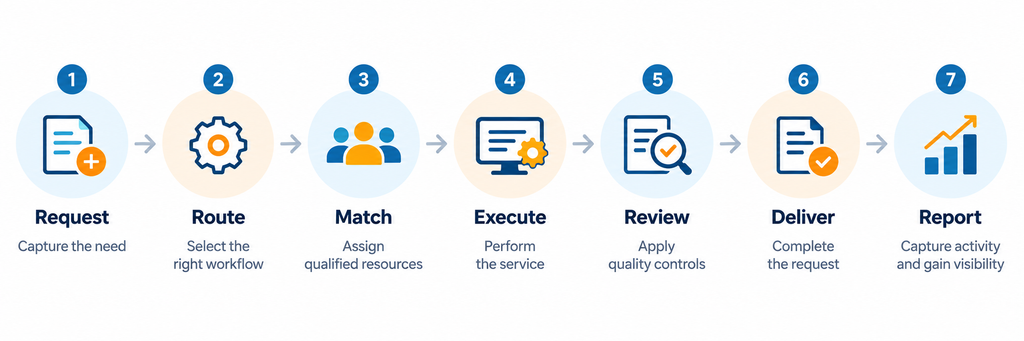
Whether an organization needs a translated document, localized software, an AI-assisted translation workflow or an interpreter for a live interaction, EPIC routes the work through the appropriate technology, workflow and professional resources.
The result is a more structured language operation without forcing every service into the same process.
Technology Built Around Real Language Operations
Connect the workflows, language resources and technology needed to manage multilingual operations across services, departments and programs.
Workflow Automation
Standardize repetitive processes and route work according to service type, language and workflow requirements.
Translation Memory & Terminology
Reuse approved translations and terminology to support consistency across recurring multilingual content.
Intelligent Resource Matching
Connect interpreting requirements with qualified language professionals based on relevant service and assignment criteria.
Organizational Visibility
Track language activity across projects, services, departments and programs.
Integrations & Enterprise Workflows
Support language operations within broader organizational processes rather than forcing teams to manage isolated workflows.
Reporting & Auditability
Maintain structured records that support operational oversight, reporting and accountability.
Control Without Sacrificing Flexibility
Large organizations need more than speed. They need language services that can operate within established requirements for security, access, accountability and organizational control.
EPIC’s technology-enabled approach is designed to support structured language operations across departments, locations and service types while maintaining the flexibility required for individual projects and programs.
Role-Based Access
Support appropriate access to projects and language-service workflows.
Credential Management
Maintain interpreter and linguist qualification information within operational workflows.
Audit Trails
Preserve activity and project records for greater accountability.
Secure Workflows
Support controlled handling of multilingual content and language-service activity.
Department & Program Visibility
Provide organizations with clearer insight into where and how language services are being used.
Built for Complex Organizations
Government & public sector
Coordinate language access across departments, programs and constituent-facing services while improving visibility and accountability.
Multinational Corporations
Manage multilingual content, localization and language services across products, teams and international markets.
Global Nonprofits & NGOs
Support multilingual programs, communications and communities through scalable translation and interpreting workflows.
Education & Institutional Organizations
Coordinate translation and interpreting requirements across students, families, staff, departments and programs.
Technology Orchestrates the Work. People Deliver the Expertise.
Language technology is most valuable when it helps the right people perform the right work efficiently.
EPIC combines workflow technology, automation and AI with professional translators, editors, interpreters, project managers and language specialists.
Technology helps coordinate the operation.
Human expertise remains where judgment, context, accuracy and communication matter.
More Than a Language Services Vendor
Traditional language-service relationships often focus on individual transactions: send a document, schedule an interpreter, receive the finished work.
EPIC can support something broader.
By combining professional language services with EPS, AITH and SRH, we help organizations establish a more connected operating model for translation, localization and interpreting.
Frequently Asked Questions About EPIC’s Language Operations Platform
Find answers to common questions about managing translation, localization and interpreting through EPIC’s connected technology ecosystem, including EPS, AITH and SRH.
What is a Language Operations Platform?
A Language Operations Platform helps organizations coordinate the people, technology and workflows involved in translation, localization and interpreting. EPIC’s approach connects specialized systems for professional translation projects, AI-assisted translation and interpreting operations.
Can EPIC manage both translation and interpreting?
Yes. EPIC supports professional translation and localization as well as OPI, VRI, ASL and on-site interpreting, with technology designed around the different operational requirements of each service.
Does EPIC use AI for translation?
EPIC supports AI-assisted translation through AITH, including workflows that incorporate professional human review when appropriate for the content, quality requirements and intended use.
Can different departments use the platform?
EPIC’s technology is designed to support organizations with language-service needs distributed across departments, programs and locations while providing more centralized operational visibility.
Can EPIC integrate with our existing workflows?
EPIC can structure language-service workflows around organizational requirements and evaluate integration options based on the systems, content and processes involved.
Is the Language Operations Platform only for large organizations?
No. The approach can support organizations with recurring or complex language needs, but it is particularly valuable when multiple departments, service types, languages or workflows need to be coordinated.