English to Spanish Translation: A Guide for Businesses and Organizations
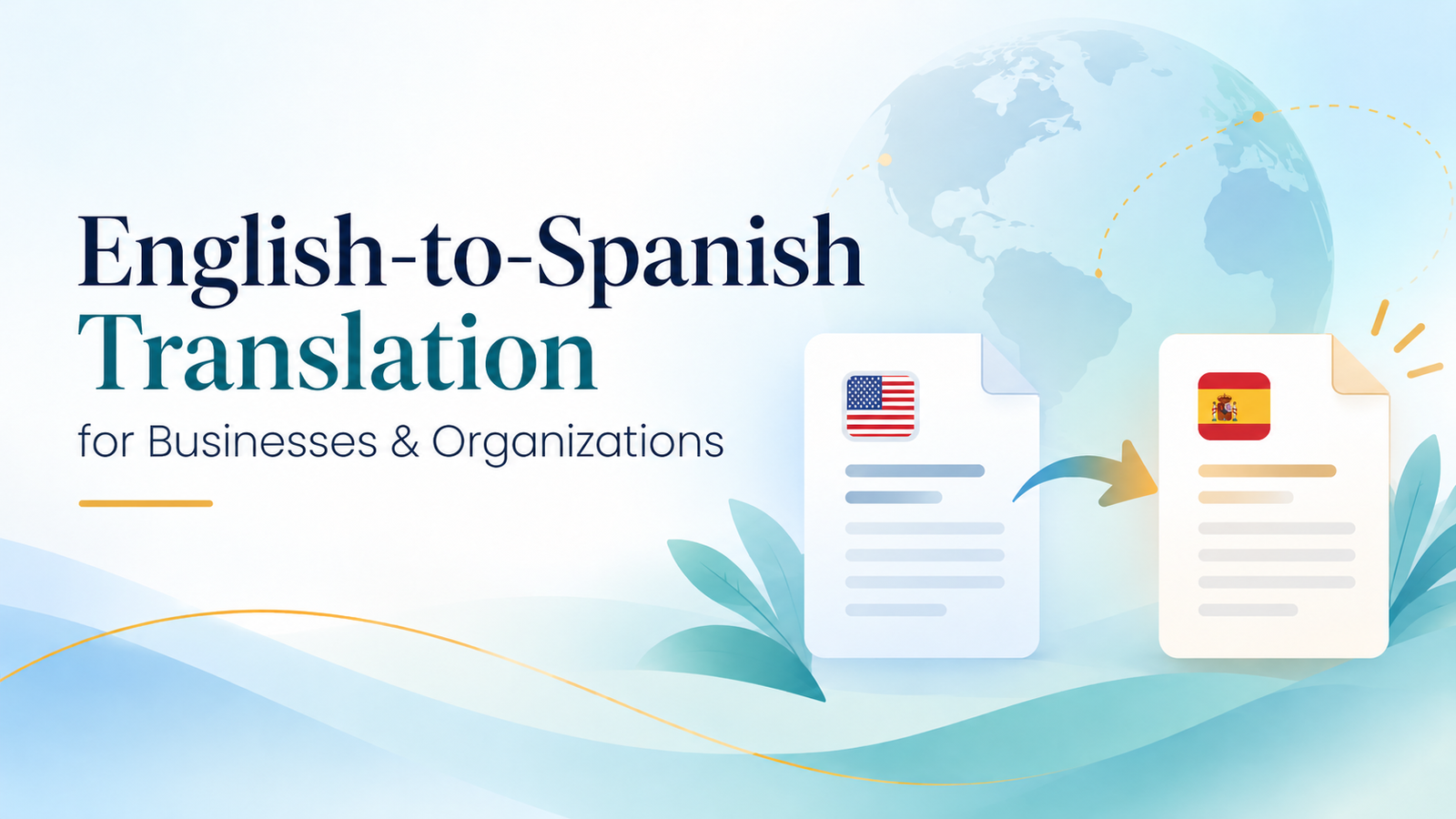
Why English-to-Spanish Translation Matters for Businesses and Organizations
English to Spanish translation plays an essential role in helping businesses and organizations communicate effectively with Spanish-speaking audiences. As one of the world’s most widely spoken languages, Spanish is important for organizations serving diverse communities, customers, employees, and international markets. In the United States, Spanish is the most commonly spoken language other than English. According to the U.S. Census Bureau, approximately 44.9 million U.S. residents aged five and older spoke Spanish at home in 2024, highlighting the importance of professional English-to-Spanish translation for organizations serving multilingual audiences.
For businesses, government agencies, healthcare providers, educational institutions, and other organizations, translating content into Spanish helps make important information more accessible and understandable.
However, effective English-to-Spanish translation involves more than converting words from one language into another. Differences in terminology, regional usage, cultural expectations, and document formatting can all influence how a message is understood.
Professional English to Spanish translation services help organizations communicate accurately while maintaining the meaning, purpose, and consistency of their original content.
Why Should Organizations Translate Their Content from English to Spanish?
Organizations increasingly need to communicate important information in both English and Spanish. Whether supporting patients, students, employees, customers, or members of the public, professional translation helps make information accessible to the people who need it.
English-to-Spanish translation is particularly valuable across several industries:
- Healthcare: Patient education materials, consent forms, medical instructions, and healthcare communications.
- Legal: Contracts, legal correspondence, case documentation, and other legal materials.
- Government: Public notices, agency communications, program information, and language access materials.
- Education: School communications, enrollment documents, parent notifications, and educational resources.
- Manufacturing: Technical manuals, safety instructions, product documentation, and employee training materials.
- Technology and Software: Websites, applications, software interfaces, user guides, and digital content.
- Retail and E-commerce: Product descriptions, customer communications, marketing materials, and online shopping experiences.
Translating content into Spanish can also support multilingual website visibility when the translated pages are properly localized, indexed, and optimized for relevant search queries.
The objective is not simply to reach a larger audience. It is to ensure Spanish-speaking readers receive clear, accurate, and culturally appropriate information that supports informed decisions and effective communication.
What Types of Documents and Content Can Be Translated from English to Spanish?
Professional English to Spanish translation services support a wide range of business, technical, educational, and public-sector documents.
Commonly translated materials include:
- Business Documents: Corporate communications, policies, reports, presentations, and employee materials.
- Technical Documentation: Product manuals, engineering specifications, installation instructions, and safety procedures.
- Healthcare Documents: Patient information, medical forms, healthcare instructions, and educational materials.
- Legal Documents: Contracts, agreements, legal correspondence, and supporting documentation.
- Educational Materials: School communications, student resources, enrollment documents, and parent notifications.
- Government Documents: Public notices, application forms, agency correspondence, and program materials.
- Website Content: Web pages, landing pages, product descriptions, and digital communications.
- Software and Applications: User interfaces, help documentation, mobile applications, and software-related content.
- Marketing Materials: Brochures, newsletters, campaigns, and customer communications.
Some projects also require multilingual desktop publishing (DTP) to preserve document layouts, tables, graphics, and formatting after translation.
EPIC Translations supports both 100% professional human translation and human-reviewed AI translation, helping organizations select an appropriate workflow based on content complexity, quality requirements, confidentiality considerations, timelines, and budget.
Learn more about our professional document translation services.
Why Regional Spanish Localization Matters
Spanish is spoken across numerous countries and regions, but vocabulary, expressions, cultural references, and communication preferences are not identical everywhere.
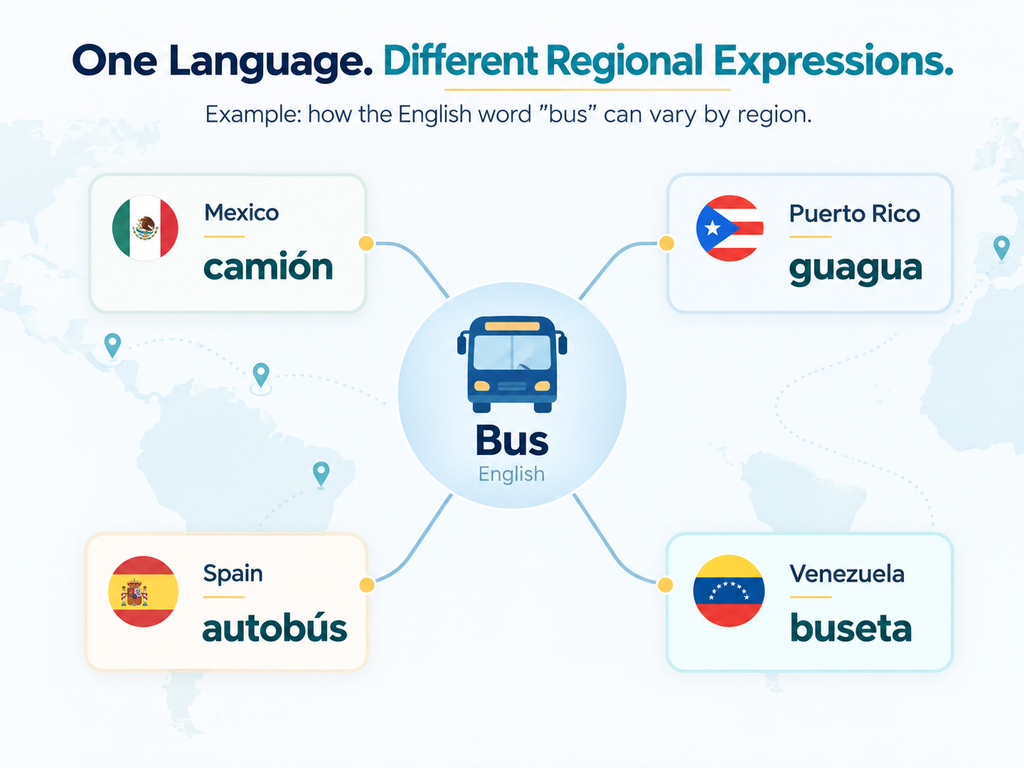
An English-to-Spanish translation intended for audiences in Mexico may require different terminology or stylistic choices than content intended for Spain, Argentina, Puerto Rico, or Spanish-speaking communities in the United States.
For example, the English word “bus” may be translated as autobús, camión, guagua, or another regional term depending on the intended audience and context.
These distinctions become particularly important in healthcare instructions, technical documentation, public-sector communications, marketing content, and software interfaces, where the wrong terminology can create confusion.
Organizations must also consider whether their content requires a country-specific Spanish translation or a more broadly understandable form of international Spanish.
Effective English to Spanish translation and localization involve selecting terminology, tone, formatting conventions, and cultural references appropriate for the intended audience while preserving the accuracy and purpose of the original content.
Formal vs. Informal Spanish: Choosing the Right Tone
Spanish translation requires careful consideration of tone, formality, and the relationship between an organization and its audience.
Unlike English, Spanish commonly distinguishes between formal and informal forms of address. For example, usted is frequently used in formal contexts, while tú is commonly used in informal communication. In some regions, vos is also widely used.
These distinctions can influence verb conjugation, word choice, and the overall tone of translated content.
Healthcare organizations, government agencies, and educational institutions often require clear, professional language appropriate for diverse audiences. Marketing content may use a more conversational style depending on the target market.
Establishing the intended tone and regional preferences before translation helps maintain consistency across documents, communications, and digital platforms.
Does Spanish Translation Require More Space Than English?
Spanish translations frequently require more space than their English source text because of differences in sentence structure, vocabulary, and grammatical conventions.
The amount of expansion varies depending on the content, but it can create challenges for documents and digital products with limited space.
This is particularly relevant for software interfaces, mobile applications, product packaging, technical manuals, brochures, presentations, and structured documents.
Effective English-to-Spanish translation requires consideration of both linguistic accuracy and the space available within the final document or interface.
Professional translators and localization specialists can work with designers and developers to address text expansion while maintaining clarity and usability.
For complex documents, multilingual desktop publishing (DTP) can help preserve the visual structure and professional appearance of translated materials.
How Do Spanish Accents and Punctuation Affect Translation?
Spanish uses the Latin alphabet with 27 letters, including ñ, which is recognized as a distinct letter.
Spanish also uses written accent marks on vowels (á, é, í, ó, ú) to indicate pronunciation, distinguish certain words, and support correct grammatical interpretation.
Punctuation conventions differ from English as well. For example, Spanish uses opening and closing question marks (¿ ?) and exclamation marks (¡ !).
These details are especially important in professional documents, user interfaces, educational materials, and marketing communications.
Accurate Spanish translation requires attention to spelling, accents, punctuation, and grammar to ensure the final content reads naturally and communicates the intended meaning.
How are Numbers, Dates, and Measurements Localized in Spanish?
Number formatting, dates, currencies, and measurements may differ across Spanish-speaking countries and regions.
For example, English-language documents commonly use a period as the decimal separator and a comma to group thousands. Many Spanish-speaking markets use different conventions, although the exact formatting varies by country and application.
Date formats may also differ. An English date written as 10/26/2026 might be presented as 26/10/2026 for audiences accustomed to a day-month-year format.
Other localization considerations include currency symbols and monetary values, units of measurement, decimal and thousands separators, telephone numbers, postal addresses, time and date formats, and technical specifications.
For financial, medical, engineering, and technical documents, accurate numerical formatting is particularly important because inconsistencies can create misunderstandings.
Professional localization ensures these conventions align with the requirements
Should Certain English Terms Remain Untranslated in Spanish?
Not every English term needs to be translated literally into Spanish.
In industries such as technology, engineering, manufacturing, and marketing, certain English terms are commonly recognized by Spanish-speaking professionals and consumers.
Product names, trademarks, technical terminology, and established industry expressions may also need to remain in English to maintain accuracy and consistency.
However, the decision to retain an English term should be based on the intended audience, regional language preferences, industry conventions, and the purpose of the content.
For organizations managing large volumes of multilingual materials, terminology glossaries and translation memory can help ensure consistent use of approved terms.
A professional translator can evaluate whether an English term should be retained, translated, or adapted to improve clarity for Spanish-speaking readers.
Choosing the Right English-to-Spanish Translation Service
Choosing the right English to Spanish translation provider involves more than comparing prices or turnaround times. Organizations should consider the type of content being translated, the intended audience, terminology requirements, confidentiality considerations, and the level of human review appropriate for the project.
Since 2005, EPIC Translations has supported organizations with professional translation and language services. With a network of more than 25,000 linguists across 200+ languages, EPIC provides language solutions for government agencies, educational institutions, healthcare organizations, and businesses.
For English-to-Spanish translation projects, EPIC offers two approaches:
100% Professional Human Translation
Translation performed by qualified professional linguists, with review and quality controls appropriate to the project. This approach is especially valuable for complex, sensitive, highly specialized, or public-facing content.
AI Translation with Professional Human Review
An AI-assisted translation workflow in which qualified linguists review and refine the translated content for accuracy, terminology, clarity, and contextual appropriateness. This approach may be suitable for certain document types and larger translation volumes where AI assistance offers operational efficiencies.
EPIC evaluates project requirements to help clients select an appropriate translation workflow while maintaining accountability for the final deliverable.
Explore EPIC’s document translation services to compare available translation approaches.
Need Professional English-to-Spanish Translation?
Whether you need to translate business documents, technical manuals, healthcare materials, educational resources, legal documents, or website content, EPIC Translations can help you communicate effectively with Spanish-speaking audiences.
Our team will review your documents, language requirements, intended audience, and timeline to recommend an appropriate translation solution.
Choose between 100% professional human translation and human-reviewed AI translation based on your project’s specific requirements.
Ready to get started? Submit your documents and receive a customized English to Spanish translation quote from EPIC Translations.
Ready to Translate Your Documents? Let’s Get Started.
Whether you need human translation or human-reviewed AI translation, EPIC can help you choose the right approach for your documents.