Section 1557 Language Access Compliance Guide
Understand Section 1557 of the Affordable Care Act and its implications for language access in healthcare. This practical guide explains meaningful access for individuals with limited English proficiency (LEP), qualified interpreter requirements, translation of vital documents, and practical considerations for building a more consistent healthcare language-access program.
Last updated: October 2026
Understanding Section 1557 and Language Access
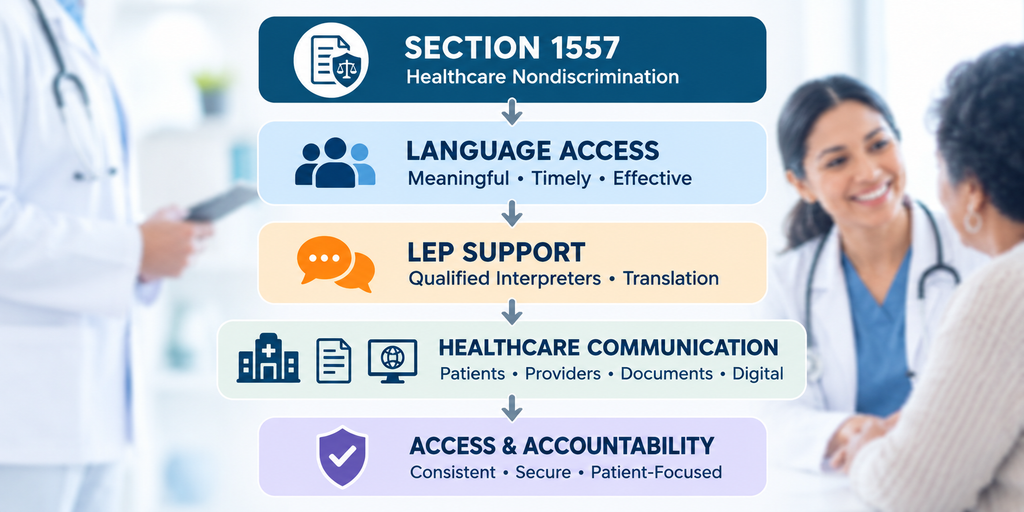
Section 1557 of the Affordable Care Act is a federal civil rights provision that prohibits discrimination in certain health programs and activities based on race, color, national origin, sex, age, or disability. For individuals with limited English proficiency (LEP), the national-origin protections include requirements related to meaningful access to health programs and services.
For healthcare organizations, language access is therefore more than a patient-service consideration. Effective communication can be an important part of providing equitable access to healthcare and meeting applicable civil rights obligations.
What Does Meaningful Access Mean?
For individuals with LEP, meaningful access generally means taking reasonable steps to provide language assistance when it is needed for effective participation in a health program or activity. Depending on the circumstances, language assistance may include oral interpretation or written translation.
The appropriate approach is not necessarily identical for every patient or every healthcare setting. HHS describes the standards as flexible and context-specific, taking into account factors such as the nature and importance of the healthcare program or communication involved and whether an effective language-access plan is in place.
In practice, healthcare organizations should be prepared to:
- Identify when a patient or participant needs language assistance
- Provide an appropriate form of language assistance
- Use qualified language professionals when interpretation or translation is required
- Make language assistance available in a timely manner
- Consider the importance and complexity of the communication
- Establish processes that allow language access to work consistently across the organization
HHS identifies oral language assistance and written translation as examples of language assistance services that may be appropriate for individuals with LEP.
Language Access Is an Operational Responsibility
A healthcare organization’s language-access program should not depend on individual employees figuring out what to do when a language barrier occurs. Instead, organizations should establish a repeatable process for identifying language needs, accessing appropriate interpreting or translation services, and maintaining quality.
HHS encourages covered entities to develop and implement a Language Access Plan to help ensure they are prepared to take reasonable steps to provide meaningful access to individuals with LEP.
The practical objective is straightforward: patients should not face avoidable communication barriers when accessing healthcare because they communicate primarily in a language other than English.
Who Is Covered by Section 1557?
Section 1557 applies to certain health programs and activities, rather than automatically applying to every healthcare organization simply because it provides healthcare. In general, the Section 1557 framework covers health programs or activities that receive federal financial assistance from HHS, programs or activities administered by HHS, and certain programs or activities established under Title I of the Affordable Care Act.
Examples of Organizations That May Be Covered
Depending on their funding, programs, and activities, covered entities can include:
- Hospitals and health systems
- Physicians’ practices and medical clinics
- Community health centers
- Nursing homes and other healthcare facilities
- Home health agencies
- State Medicaid agencies
- Health insurance issuers and certain health plans
- Health Insurance Marketplaces
- Other organizations operating covered health programs or activities
The key consideration is not simply the type of organization. Coverage depends on the health program or activity and the applicable federal funding or administrative relationship. HHS explains that Section 1557’s coverage can extend to health programs or activities receiving HHS financial assistance, HHS-administered programs, and certain Marketplace-related programs.
Why Coverage Matters for Language Access
For organizations subject to the applicable Section 1557 requirements, language access should be incorporated into the way healthcare services are delivered—not treated as an occasional accommodation that staff have to figure out when a communication barrier occurs.
HHS states that covered entities must take reasonable steps to provide meaningful access to individuals with limited English proficiency (LEP) who are eligible to be served or are likely to be encountered within their covered health programs and activities.
That means organizations should have practical processes for identifying language needs and accessing appropriate language assistance, including qualified interpreting and translation services where appropriate.
Coverage Can Extend Beyond the Clinical Encounter
Language access can affect much more than the conversation between a physician and patient. Healthcare organizations may need to consider language access across registration, scheduling, patient communications, consent and other documents, care coordination, billing-related communications, digital information, and other interactions within covered programs and activities.
The operational question is therefore broader than:
“Do we have an interpreter when a patient needs one?”
It is:
“Do we have a reliable system for providing meaningful language access throughout the patient’s interaction with our organization?”
That distinction is important for healthcare organizations building a sustainable language-access program.
Meaningful Language Access for Patients With LEP
For healthcare organizations subject to applicable Section 1557 requirements, meaningful language access means taking reasonable steps to provide effective communication for individuals with limited English proficiency (LEP) who are eligible to be served or are likely to be encountered within the organization’s covered health programs and activities. The appropriate approach can vary depending on the circumstances, including the nature and importance of the communication and the healthcare service involved.
What Meaningful Access Looks Like in Practice
Meaningful access is not simply a matter of having an interpreter available somewhere within the organization. Healthcare providers should have a practical process for identifying when language assistance is needed and determining what form of assistance is appropriate.
Depending on the situation, language assistance may include:
- Qualified oral interpretation for patient-provider and other healthcare interactions
- Written translation of important healthcare information
- Timely access to language assistance when communication is needed
- Appropriate interpreting modality, such as on-site, video remote, or telephone interpreting
- Language support across different points of the patient experience, rather than only during the clinical encounter
The appropriate service can depend on the importance, complexity, and context of the communication. A routine administrative interaction may require a different approach from a clinical discussion involving diagnosis, treatment, consent, or other significant healthcare decisions.
Language Access Should Be Built Into the Patient Experience
A healthcare organization’s language-access process should extend beyond the examination room. Patients may encounter language barriers during:
Scheduling → Registration → Intake → Clinical Care → Consent → Discharge → Follow-Up
Each point can create a communication need.
For that reason, healthcare organizations should establish procedures that allow staff to identify language needs early and access appropriate language assistance without unnecessary delay.
Qualified Language Assistance Matters
Healthcare communication can involve medical terminology, sensitive information, informed decision-making, and significant consequences if information is misunderstood. For these reasons, organizations should have a process for obtaining qualified interpreters and appropriate translation services rather than assuming that anyone who speaks another language can provide professional language assistance.
HHS specifically addresses the use of qualified interpreters and identifies concerns associated with relying on unqualified individuals to provide language assistance.
A Practical Standard
The objective is not to create a single language-access solution for every patient or every interaction. It is to establish a reliable system that allows the organization to recognize language needs, select the appropriate service, and provide effective communication when it matters.
That makes meaningful language access an operational capability—not simply a compliance statement.
For healthcare organizations, the practical question is therefore not only whether language services are available, but whether patients can access the right language support at the right time and in the right setting.
Qualified Interpreters in Healthcare
Healthcare communication can involve specialized terminology, sensitive personal information, informed consent, treatment decisions, and other interactions where accuracy matters. For organizations subject to applicable Section 1557 requirements, language access therefore requires more than finding someone who happens to speak the patient’s language.
A qualified interpreter should be able to interpret effectively, accurately, and impartially, including the specialized vocabulary and terminology relevant to the encounter. HHS specifically identifies the use of qualified language assistance and cautions covered entities against relying on unqualified staff or low-quality remote interpreting services.
Choosing the Right Interpreting Modality
The appropriate modality depends on the circumstances of the encounter, including its complexity, urgency, setting, and the communication needs of the patient.
On-Site Interpreting
Provides in-person interpreting for situations where physical presence is appropriate, including complex clinical encounters, sensitive discussions, and other interactions where direct communication is important.
Video Remote Interpreting (VRI)
Provides real-time visual access to an interpreter without requiring an interpreter to be physically present. VRI can be an effective option when implemented with reliable technology and qualified interpreters. HHS has specifically addressed the importance of high-quality VRI that provides effective communication.
Over-the-Phone Interpreting (OPI)
Provides rapid telephone access to interpreters when video or in-person interpreting is not necessary or practical.
The objective is not to use one modality for every encounter. It is to give healthcare staff a reliable way to obtain the appropriate qualified interpreter when communication assistance is needed.
Why Qualification Matters
Conversational fluency in another language does not automatically make someone qualified to interpret in a healthcare setting. A qualified interpreter must be able to convey information accurately and impartially while handling the terminology and communication demands of the encounter.
This becomes particularly important for:
- Diagnosis and treatment discussions
- Informed consent
- Medication and care instructions
- Discharge information
- Mental and behavioral healthcare
- Sensitive or confidential communications
- Communications involving complex medical terminology
Don’t Make the Patient Responsible for Finding the Interpreter
A reliable language-access program should not require an LEP patient to arrange their own interpreter. HHS materials explain that covered entities should provide appropriate language assistance when required, rather than placing the responsibility for obtaining competent language assistance on the individual.
Healthcare organizations should therefore have a straightforward process that allows staff to obtain qualified language assistance without unnecessarily delaying the patient’s care.
Build Interpreter Access Into the Healthcare Workflow
The strongest language-access programs make interpreter access part of normal operations:
IDENTIFY
Patient’s language need
→ REQUEST
Appropriate interpreting modality
→ CONNECT
Qualified interpreter
→ CONDUCT
Patient encounter
→ DOCUMENT
Relevant language-access needs
→ MANAGE
Recurring and future needs
This is where language services become an operational capability rather than an ad hoc response.
Technology That Supports Language Access
Effective language access depends on qualified people and well-defined processes, but technology can make those services easier to access, coordinate, manage, and scale across a healthcare organization.
For organizations managing language needs across multiple departments, locations, languages, and interpreting modalities, technology can help turn individual language-service requests into a more consistent operational workflow.
People + Process + Technology
Technology should support qualified linguists and interpreters—not replace them.
A strong language-access model brings together:
Qualified Language Professionals
Interpreters and translators with the appropriate skills, experience, and subject-matter knowledge.
Defined Workflows
Clear processes for identifying language needs, requesting services, assigning professionals, delivering services, and managing recurring requirements.
Technology Infrastructure
Tools that help organizations coordinate language services, manage activity, and support multilingual workflows at scale.
EPIC’s Technology Ecosystem
EPIC has developed technology designed to support different parts of the language-services lifecycle.
EPS — Language Services Management
EPIC’s client-facing platform supports the management of language-service activity, including translation workflows, communication, project coordination, and visibility into ongoing language-service needs.
SRH — Interpreting Operations
The Staffing Resources Hub supports the operational delivery of interpreting services, including interpreter availability, matching, scheduling, assignments, and session management across OPI, VRI, and on-site interpreting.
AITH — AI-Assisted Translation
EPIC’s AI Translation Hub supports AI-assisted translation workflows and can incorporate human linguistic review when the content, quality requirements, or intended use call for it.
Why This Matters for Healthcare Organizations
Healthcare organizations may have language-access needs across patient access, clinical care, administrative functions, documents, digital communications, and recurring appointments. Managing each request independently can make it difficult to maintain consistency and visibility.
A technology-supported workflow can help organizations:
- Coordinate scheduled and on-demand language services
- Connect requests with appropriate language professionals
- Manage recurring interpreting activity
- Maintain greater visibility into language-service operations
- Support translation workflows across different types of content
- Scale multilingual services as organizational needs change
The goal is not to make technology the center of the language-access program. The goal is to use technology to make qualified human language services easier to deliver consistently.
For healthcare organizations, that combination of qualified people, structured processes, and supporting technology can provide a more scalable foundation for managing language access over time.
Family Members, Minors & Other Informal Interpreting Risks
When a patient has limited English proficiency, family members or friends may sometimes offer to help with communication. Healthcare organizations, however, should not treat informal interpreters as a substitute for appropriate professional language assistance when qualified interpreting is needed.
The concerns are particularly important when the communication involves medical terminology, diagnosis, treatment, informed consent, sensitive information, or other significant healthcare decisions.
Why Informal Interpreting Can Create Problems
Family members and friends may not have the language skills, interpreting skills, or healthcare vocabulary needed to accurately communicate what a patient and provider are saying. They may also unintentionally summarize, omit, soften, or alter information rather than interpret it accurately.
Other concerns can include:
- Accuracy: Important medical information may be misunderstood or omitted.
- Impartiality: A family member may have personal interests or opinions that influence the communication.
- Confidentiality: Patients may be uncomfortable discussing sensitive information in front of relatives or friends.
- Patient autonomy: A patient should be able to communicate directly with healthcare professionals without another person controlling the conversation.
- Specialized terminology: Medical terminology can be difficult to interpret accurately without appropriate training and experience.
The Risks Are Greater When Minors Are Used
Using a child or teenager to interpret for a parent or another family member presents additional concerns. A minor may not have the vocabulary, maturity, or interpreting skills necessary to communicate complex healthcare information accurately.
Children may also be placed in the difficult position of communicating information involving diagnosis, treatment, mental health, reproductive health, or other sensitive subjects.
For these reasons, healthcare organizations should have clear procedures for obtaining appropriate professional language assistance rather than making a child responsible for facilitating an important healthcare conversation.
What Should Healthcare Organizations Do?
The practical solution is to make professional language assistance easy for staff to access.
A healthcare organization should establish a clear process for:
IDENTIFY
Recognize the patient’s language need
→ REQUEST
Obtain the appropriate language service
→ CONNECT
Provide access to a qualified interpreter
→ COMMUNICATE
Allow the patient and provider to communicate directly
This approach helps move language access from an informal, person-dependent practice to a consistent organizational process.
Professional Interpreting Protects the Quality of Communication
Professional interpreters are trained to facilitate communication accurately and impartially while maintaining appropriate confidentiality and handling the terminology required for the encounter.
The goal is not to prevent patients from communicating with family members. It is to ensure that family members, friends, or minors are not relied upon as the primary solution when qualified language assistance is appropriate.
For healthcare organizations building a Section 1557 language-access program, establishing a reliable process for obtaining qualified interpreters is an important part of creating consistent, patient-centered communication.
Translation of Vital & Important Healthcare Documents
Language access does not end when a patient leaves the examination room. Healthcare organizations also communicate with patients through written materials, including forms, notices, instructions, consent documents, patient education materials, and other information related to healthcare services.
For organizations subject to applicable Section 1557 requirements, written language assistance may be an important component of providing meaningful access to individuals with limited English proficiency. The appropriate approach depends on the nature and importance of the information and the circumstances in which it is provided.
Identify the Documents That Matter Most
Healthcare organizations should have a process for identifying written materials that are important to patients’ ability to understand and access healthcare services.
Depending on the organization and its programs, this may include:
- Patient registration and intake materials
- Consent and authorization forms
- Notices and patient rights information
- Appointment and follow-up instructions
- Medication and care instructions
- Discharge materials
- Patient education resources
- Program eligibility or enrollment information
- Other important communications provided to patients
The objective is not necessarily to translate every document into every language. It is to establish a consistent process for determining which materials require language assistance and how that assistance will be provided.
Translation Quality Matters
Healthcare documents can contain specialized terminology, instructions, legal language, and information that patients rely on to make important decisions. A translation that is technically understandable but inaccurate, inconsistent, or poorly formatted can undermine the purpose of the original communication.
A quality-focused translation workflow should consider:
Accuracy
The translated content should faithfully communicate the meaning of the source.
Terminology
Medical and organizational terminology should remain consistent across documents and departments.
Readability
The translated material should be understandable for its intended audience.
Formatting & Layout
Translated text may expand or contract, requiring adjustments so forms, tables, headings, and other design elements remain usable.
Review
Important or sensitive content may warrant human linguistic review and quality assurance.
Translation Is Part of a Larger Language-Access Program
Written translation should work alongside interpreting rather than being treated as a separate initiative.
For example:
Patient receives a translated appointment notice
↓
Patient arrives and receives qualified interpretation
↓
Patient receives translated instructions or discharge materials
↓
Follow-up communication remains accessible
This creates a more consistent experience across the patient’s interaction with the healthcare organization.
Translation Technology Can Support the Workflow
Technology can help healthcare organizations manage larger volumes of multilingual content, but the appropriate workflow depends on the content, intended use, risk, and quality requirements.
AI-assisted translation can be useful for certain workflows, particularly when combined with appropriate human review. For critical healthcare communications, organizations should establish quality controls appropriate to the importance of the information.
EPIC can support these workflows through human translation, AI-assisted translation with human review, multilingual DTP, and related language-service capabilities.
The goal is simple: patients should be able to understand important healthcare information in a language they can effectively use—not merely receive a document that has been translated.
Language Access Notices, Taglines & Patient Communication
Language access is most effective when patients know that language assistance is available and can understand how to access it. For healthcare organizations subject to applicable Section 1557 requirements, patient communication should therefore address language access as part of the broader process for providing meaningful access.
Make Language Assistance Visible
Patients should not have to guess whether an organization can provide language assistance or determine whom to contact when they need it.
Depending on the applicable requirements and the organization’s programs, language-access communication may include:
- Notices explaining the availability of language assistance
- Information about how patients can request an interpreter
- Translated or multilingual patient communications
- Appropriate language-assistance information accompanying important notices
- Information made available through patient-facing websites, portals, forms, and other digital channels
The objective is straightforward: patients should be able to recognize that language assistance is available and understand how to access it.
Notices Should Work Across the Patient Journey
Language-access information should not exist only in a compliance document that patients rarely see. Organizations should consider where patients interact with the healthcare system and where language needs are likely to arise.
For example:
Website & Digital Access
Patients can learn about available language assistance before an appointment.
→ Scheduling & Registration
Staff can identify language preferences and arrange appropriate assistance.
→ Clinical Encounter
The patient can access the appropriate interpreting service.
→ Written Communication
Important notices, instructions, and other materials can be provided in appropriate languages.
→ Follow-Up
Language-access needs can continue to be considered for future interactions.
This creates a more consistent experience rather than treating language assistance as something that begins only when a communication problem occurs.
Taglines and Multilingual Communication
Federal language-access requirements can include specific provisions concerning notices, translated information, and taglines indicating the availability of language assistance. The exact requirements can depend on the applicable Section 1557 framework, the type of communication, and the organization or program involved.
Because these requirements can change, healthcare organizations should rely on current HHS guidance and applicable regulations when determining which notices, languages, and communications are required.
This is particularly important when developing standardized materials for use across multiple locations or programs.
Language Access Should Be Part of the Communication Strategy
A strong healthcare language-access program connects notices and patient communications to the actual services available.
There is little value in telling patients that language assistance is available if staff do not have a reliable way to obtain a qualified interpreter when the patient needs one.
The communication process should therefore connect:
INFORM
Tell patients language assistance is available
→ IDENTIFY
Determine the patient’s language need
→ CONNECT
Provide appropriate language assistance
→ COMMUNICATE
Deliver information effectively
→ FOLLOW UP
Maintain accessibility for future interactions
The goal is not simply to satisfy a notice requirement. It is to make language assistance visible, understandable, and genuinely accessible throughout the patient’s experience.
For current Section 1557 requirements regarding notices, taglines, and language assistance, healthcare organizations should consult the applicable U.S. Department of Health and Human Services (HHS) guidance and regulations.
Building a Section 1557 Language Access Workflow
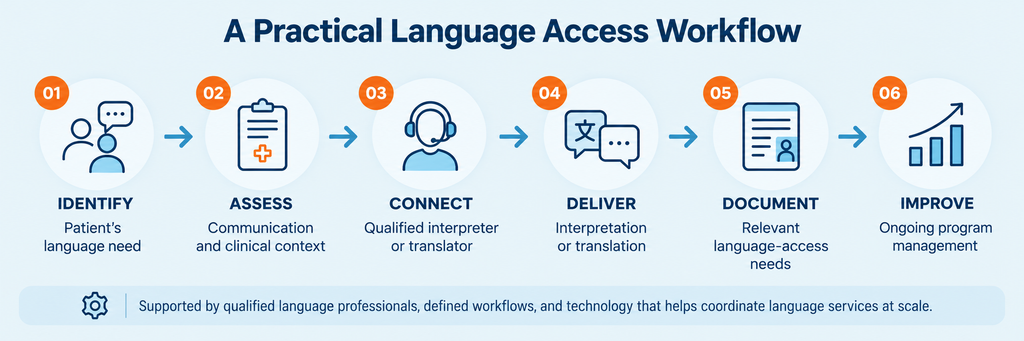
A strong language-access program turns regulatory expectations into repeatable operational practices. Rather than relying on individual staff members to determine what to do when a language barrier arises, healthcare organizations can establish a consistent workflow for identifying language needs, obtaining appropriate assistance, delivering the service, and managing recurring requirements.
A practical workflow can be organized into six steps:
1
IDENTIFY
Recognize the patient’s language or communication need
Determine whether the patient or participant needs language assistance and identify the appropriate language or communication support as early as possible.
2
ASSESS
Consider the communication and clinical context
Consider the nature and importance of the interaction, the complexity of the information being communicated, the setting, and the most appropriate language-service modality.
3
CONNECT
Access a qualified interpreter or translator
Use an established process to connect staff with an appropriately qualified language professional through on-site interpreting, VRI, OPI, or translation services, as appropriate.
4
DELIVER
Provide effective language assistance
Deliver the interpreting or translation service in a manner that supports accurate, impartial, timely communication while maintaining appropriate confidentiality.
5
DOCUMENT
Capture relevant language-access needs
Where appropriate, maintain the information needed to support recurring appointments, future interactions, language preferences, and ongoing service coordination.
6
IMPROVE
Manage and strengthen the program over time
Review language-service activity, recurring needs, operational challenges, and quality considerations. Use that information to improve workflows, staff procedures, language coverage, and service availability.
Important: This guide is provided for general informational and educational purposes and is not legal advice. Section 1557 requirements may vary based on an organization’s programs, funding, activities, and applicable federal requirements. Healthcare organizations should consult current HHS guidance, applicable regulations, and qualified legal counsel regarding their specific obligations.
Common Healthcare Language Access Mistakes
A strong language-access program is not defined only by whether an interpreter or translator is available. How language services are requested, delivered, and managed can determine whether patients actually receive meaningful access.
The following mistakes can create avoidable communication barriers and make an organization’s language-access program less consistent.
1. Relying on Unqualified Bilingual Staff
Speaking another language does not automatically qualify someone to interpret healthcare information. Clinical terminology, accuracy, impartiality, confidentiality, and the ability to convey the complete meaning of a communication all matter.
Healthcare organizations should have a clear process for determining when qualified interpreting services are needed rather than routinely assigning bilingual employees to interpret simply because they speak the patient’s language. HHS specifically identifies reliance on unqualified staff as a language-access concern.
2. Using Family Members or Minors as the Default Interpreter
Family members and friends may want to help, but they may lack the interpreting skills needed for complex healthcare communication. Confidentiality, impartiality, conflicts of interest, and patient autonomy can also become concerns.
The risks are even greater when a minor child is expected to interpret. HHS guidance states that covered entities cannot require an LEP individual to provide their own interpreter and specifically addresses restrictions around relying on minor children, with limited emergency circumstances.
A better approach is to make qualified language assistance readily available so patients are not placed in the position of having to find their own interpreter.
3. Treating VRI as Automatically Effective
Video remote interpreting can provide valuable access to qualified interpreters, but simply having a video connection does not guarantee effective communication.
Healthcare organizations should consider whether the technology, interpreter, audio/video quality, and environment are appropriate for the encounter. HHS specifically identifies low-quality VRI as a concern under its Section 1557 language-access materials.
The objective should be effective communication—not merely remote connection.
4. Waiting Until the Appointment to Address Language Needs
Language access works better when it is incorporated into the workflow before the patient encounter.
If language needs are identified during scheduling or registration, organizations can determine the appropriate modality and arrange services in advance when possible. For on-demand situations, staff should still have a straightforward process for quickly accessing appropriate language assistance.
Identify → Request → Connect → Deliver
A repeatable workflow reduces reliance on individual staff members improvising a solution.
5. Failing to Address Written Communication
An organization may have excellent interpreting coverage and still create language barriers through its written materials.
Important patient communications—including forms, consent materials, instructions, notices, and other healthcare information—may require appropriate language assistance depending on the circumstances.
Translation should therefore be considered alongside interpreting when developing a comprehensive language-access program. HHS identifies both oral language assistance and written translation as forms of language assistance that may be appropriate for individuals with LEP.
6. Treating Language Access as a One-Time Compliance Exercise
Language needs change. Organizations add locations, services, providers, digital platforms, patient populations, and new types of communication.
A language-access program should therefore be treated as an ongoing operational capability, with processes for monitoring service needs, managing recurring requests, reviewing quality, and improving workflows over time.
The Better Approach
The common thread behind these mistakes is the absence of a consistent system.
A stronger approach combines:
Qualified Professionals
→ Defined Workflows
→ Appropriate Technology
→ Consistent Quality Management
The goal is not simply to avoid mistakes. It is to create a language-access program that healthcare staff can use reliably and that patients can access when communication matters.
Choosing a Healthcare Language Services Partner
Selecting a language services partner is not simply a matter of comparing hourly rates or the number of languages a provider lists. For healthcare organizations, the more important question is whether the partner can provide qualified language professionals, reliable access, appropriate technology, quality controls, and a workflow that can support the organization’s needs over time.
A provider should be evaluated not only on what it can deliver today, but also on how well it can support language access as the organization grows.
1. Healthcare Experience
Look for a provider that understands the communication demands of healthcare environments, including medical terminology, patient confidentiality, sensitive encounters, and the importance of accurate communication.
Experience should extend beyond simply having healthcare listed as an industry on a website. Ask how the provider supports healthcare-specific assignments and workflows.
2. Qualified Interpreters and Translators
Ask how the provider recruits, screens, qualifies, and manages its language professionals.
Consider:
- Interpreter and translator qualifications
- Healthcare experience and subject-matter knowledge
- Language coverage
- Quality-assurance processes
- Ongoing performance management
- Ability to handle specialized terminology
The provider should be able to explain how it determines which language professional is appropriate for a particular assignment.
3. Multiple Interpreting Modalities
Healthcare organizations rarely have identical language-access needs for every encounter.
A capable partner should be able to support appropriate combinations of:
On-Site Interpreting
For encounters where physical presence is appropriate.
Video Remote Interpreting (VRI)
For real-time visual access to an interpreter without requiring physical presence.
Over-the-Phone Interpreting (OPI)
For situations where rapid telephone-based access is appropriate.
The important consideration is not simply whether a provider offers all three. It is whether the organization can access the appropriate modality when it is needed.
4. Availability and Response Time
Language access often involves both scheduled and unexpected needs.
Ask prospective providers:
- What languages are available?
- What hours are services available?
- How are urgent requests handled?
- Can services be scheduled in advance?
- How does on-demand interpreting work?
- What happens when an interpreter is unavailable?
- How are recurring appointments managed?
A provider’s stated language count means little if the required language professional cannot be accessed when the patient needs assistance.
5. Technology and Workflow
Technology should make language services easier to manage—not add unnecessary complexity.
Evaluate whether the provider can support:
- Request and scheduling workflows
- Interpreter matching
- Recurring appointments
- On-demand interpreting
- Translation project management
- Service visibility and reporting
- Communication between the organization and provider
- Scalable workflows across departments or locations
For larger healthcare organizations, technology can become particularly important when language services need to be coordinated across multiple facilities, departments, languages, and service modalities.
6. Security and Confidentiality
Healthcare organizations should understand how a language services provider handles sensitive information.
Questions may include:
- How is client and patient information protected?
- What security controls are in place?
- How is information transmitted and stored?
- Who has access to language-service data?
- What privacy and confidentiality procedures apply to interpreters and translators?
The answers should align with the organization’s own privacy, security, and compliance requirements.
7. Quality and Accountability
A strong provider should be able to explain how quality is managed after an interpreter or translator is assigned.
Look for processes involving:
- Linguist qualification and vetting
- Quality assurance
- Feedback and issue resolution
- Terminology consistency
- Performance monitoring
- Assignment documentation
- Continuous improvement
Quality should be treated as an ongoing process rather than a claim made during the sales process.
8. Scalability
Finally, consider whether the provider can support the organization as its needs change.
A healthcare organization may begin with a few scheduled interpreting requests and eventually require:
On-site + VRI + OPI + Translation + ASL + Digital Content + Recurring Language-Access Management
A partner should be able to accommodate that evolution without requiring the organization to build separate vendor relationships for every language-service need.
A Practical Evaluation Framework
Before selecting a healthcare language services partner, ask:
Can this provider give our organization qualified language professionals, appropriate modalities, reliable availability, secure workflows, measurable quality, and the technology needed to manage language access at scale?
The strongest partner is not necessarily the provider with the lowest price or the largest language list. It is the provider whose people, processes, technology, coverage, and accountability align with the organization’s actual language-access requirements.
Why EPIC Translations
Healthcare organizations need more than access to interpreters and translators. They need a language-services partner that can combine qualified professionals, reliable service delivery, appropriate technology, and scalable workflows.
EPIC Translations brings these capabilities together to support healthcare organizations with recurring and on-demand multilingual communication needs.
Qualified Language Professionals
EPIC’s network includes 25,000+ linguists supporting 200+ languages, providing access to professional language resources across a broad range of languages and communication needs.
Our approach is designed to match the requirements of the assignment with the appropriate language professional, modality, and workflow.
Multiple Language-Service Modalities
Healthcare organizations can access language services through multiple delivery models, including:
- On-site interpreting
- Video Remote Interpreting (VRI)
- Over-the-Phone Interpreting (OPI)
- Translation
- ASL interpreting
- Multilingual document and digital-content support
This allows organizations to use the modality that best fits the encounter, content, timing, and communication requirements.
Technology Built Around Language Services
EPIC combines professional language services with its technology ecosystem:
EPS supports language-service management and client workflows.
SRH supports interpreter availability, matching, scheduling, assignments, and interpreting operations.
AITH supports AI-assisted translation workflows with human review when appropriate.
Together, these platforms help connect people, processes, and technology so language services can be managed more consistently as needs grow.
Scheduled and On-Demand Support
Language needs do not always follow a predictable schedule. EPIC supports both planned language services and on-demand interpreting, helping healthcare organizations address recurring appointments as well as unexpected communication needs.
A Practical Partner for Healthcare Language Access
The goal is not simply to provide a translator or interpreter when a request arrives. EPIC helps healthcare organizations build a more consistent, scalable approach to multilingual communication—bringing together qualified language professionals, multiple service modalities, operational workflows, and technology.
For organizations evaluating language services in the context of Section 1557 and broader language-access responsibilities, EPIC provides a single partner capable of supporting both the individual language-service request and the larger program behind it.
Section 1557 Language Access FAQs
Understanding Section 1557 language-access requirements can raise practical questions for healthcare organizations, particularly when federal requirements need to be translated into day-to-day policies, interpreting workflows, and patient communications. The following FAQs address common questions about LEP, meaningful access, qualified interpreters, translation, and healthcare language-access programs.
What is Section 1557?
Section 1557 of the Affordable Care Act is a federal civil rights provision that prohibits discrimination in certain health programs and activities on specified grounds, including race, color, national origin, sex, age, and disability. Its protections for individuals with limited English proficiency are particularly relevant to healthcare organizations developing language-access programs.
Who is covered by Section 1557?
Section 1557 applies to certain health programs and activities, including programs or activities receiving federal financial assistance from HHS, programs administered by HHS, and certain programs or activities established under Title I of the Affordable Care Act. Coverage depends on the specific program or activity and applicable federal requirements.
What does Section 1557 require for patients with limited English proficiency?
Covered entities must take reasonable steps to provide meaningful access to individuals with limited English proficiency who are eligible to be served or are likely to be encountered within their covered health programs and activities. Depending on the circumstances, language assistance may include oral interpretation or written translation.
What is meaningful language access?
Meaningful access means providing language assistance in a manner that allows an individual with LEP to effectively participate in or benefit from a covered health program or activity. The appropriate approach can depend on factors such as the nature and importance of the communication, the healthcare setting, and the individual’s language needs.
Does Section 1557 require healthcare organizations to provide interpreters?
Where applicable Section 1557 requirements call for language assistance, covered entities should have appropriate processes for providing competent or qualified language assistance. Depending on the circumstances, this may include on-site interpreting, Video Remote Interpreting (VRI), or Over-the-Phone Interpreting (OPI). The appropriate modality depends on the communication, setting, urgency, and other circumstances.
What makes an interpreter qualified?
A qualified interpreter should be able to interpret effectively, accurately, and impartially, including the specialized vocabulary and terminology relevant to the encounter. Healthcare organizations should consider interpreter qualifications, healthcare experience, confidentiality, and the ability to communicate accurately without adding, omitting, or changing information.
Can family members interpret for LEP patients?
Family members or friends should not be treated as the default substitute for appropriate professional language assistance when qualified interpreting is needed. Informal interpretation can create concerns involving accuracy, confidentiality, impartiality, and patient autonomy.
Healthcare organizations should have a process for obtaining qualified language assistance rather than placing responsibility for interpreting on the patient or family.
Can minors interpret for their parents or other family members?
Healthcare organizations should not rely on minor children as the routine solution for providing language assistance. Children may lack the language skills, maturity, and specialized vocabulary required for healthcare interpretation, and they may be placed in situations involving sensitive or complex information.
Appropriate professional language assistance should be available when needed.
Can healthcare organizations use Video Remote Interpreting?
Yes, VRI can be an appropriate method of providing language assistance when it delivers effective communication. Organizations should consider the quality and reliability of the video and audio connection, the qualifications of the interpreter, the nature of the encounter, and whether the modality is appropriate for the patient’s circumstances.
What healthcare documents may need translation?
The need for written translation depends on the circumstances, the importance of the information, the populations served, and applicable requirements. Healthcare organizations may need to consider materials such as patient forms, consent documents, notices, instructions, patient rights information, discharge materials, and other important communications.
A strong language-access program should establish a consistent process for identifying which written materials require language assistance.
Does Section 1557 apply to ASL and Deaf or hard-of-hearing patients?
Section 1557 includes protections related to disability as well as national origin. Communication-access obligations for individuals who are Deaf or hard of hearing should therefore be considered separately from the LEP language-access framework.
Depending on the circumstances and applicable requirements, organizations may need services such as ASL interpreting, captioning, or other communication-access support.
Should healthcare organizations have a Language Access Plan?
A Language Access Plan can help an organization establish a consistent framework for identifying language needs, accessing appropriate language assistance, translating important materials, training staff, and managing language-access services over time.
A plan is particularly useful when language services must be coordinated across multiple departments, facilities, languages, or service modalities.
How should a healthcare organization choose a language services provider?
Organizations should evaluate providers based on factors such as healthcare experience, qualified linguists, language coverage, interpreting modalities, availability, security and confidentiality, quality management, technology, and scalability.
The lowest price or largest language list does not necessarily indicate the provider best suited to an organization’s operational requirements.
How can EPIC help with Section 1557 language access?
EPIC supports healthcare organizations with on-site interpreting, VRI, OPI, translation, ASL, multilingual content services, and technology-supported language-service workflows.
EPIC’s technology ecosystem—including EPS, SRH, and AITH—is designed to help coordinate and manage language services alongside the qualified professionals who deliver them.
The objective is to help healthcare organizations move from understanding language-access requirements to implementing a reliable, scalable language-access program.
Strengthen Your Healthcare Language Access Program
Section 1557 requirements are only the starting point. Effective language access depends on having the qualified professionals, appropriate interpreting and translation services, reliable workflows, and technology needed to support patients across the healthcare experience.
EPIC Translations helps healthcare organizations coordinate multilingual communication through on-site interpreting, VRI, OPI, translation, ASL, and technology-supported language-service workflows.
Whether you are developing a language-access program, strengthening existing processes, or looking for a more scalable language-services partner, EPIC can help.