Practical Title VI Language Access Compliance Guide
This practical guide explains Title VI language access compliance, meaningful access, Language Access Plans, interpreting and translation needs, common compliance challenges, and the operational practices government agencies can use to support effective multilingual communication.
Understanding Title VI Language Access Compliance Requirements
Title VI of the Civil Rights Act of 1964 prohibits discrimination based on national origin in programs and activities that receive federal financial assistance. For individuals with limited English proficiency (LEP), language barriers can prevent meaningful access to government services and information.
For government agencies, meaningful language access means taking reasonable steps to ensure that LEP individuals can:
- Understand important information
- Communicate effectively with agency staff
- Access services without unnecessary delay or disadvantage
In practice, this may require agencies to provide qualified interpreters for spoken communication, accurate translation of vital documents, and timely language support when services are delivered.
Language access should not be treated as a one-time compliance exercise. It needs to be incorporated into the agency’s day-to-day operations so that language support is available consistently across departments, programs, and public-facing services.
Why This Matters Operationally
A school district may need to communicate with a parent about an education plan. A city department may need to assist a resident at a public counter. A health agency may need to deliver urgent information, while a court or legal setting may need to ensure that individuals understand proceedings affecting their rights. These are everyday situations in which clear, timely, and accurate communication matters.
Title VI language access compliance should be viewed as part of service quality, risk management, and accountability—not simply as a regulatory requirement. For additional information on federal language-access obligations, see the U.S. Department of Justice’s Language Access Plan and related Title VI resources.
Why Title VI Language Access Matters in Practice
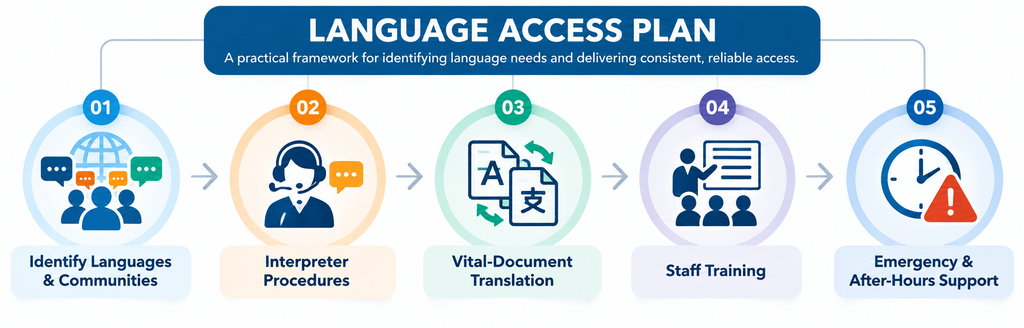
A Language Access Plan provides the operational framework agencies can use to support Title VI language access compliance across programs and services.
A well-developed Language Access Plan typically addresses:
- The languages most commonly spoken in the community
- Procedures for requesting and scheduling interpreters
- Guidelines for translating vital documents
- Staff training on how to access language services
- Protocols for emergencies and after-hours support
For government agencies, a Language Access Plan should function as more than a compliance document. It should serve as an operational blueprint for how language needs are identified, how services are requested, and how staff respond when individuals need communication support.
Without a clear plan, language services can become reactive, inconsistent, and difficult to manage across departments. A structured LAP helps agencies establish more consistent processes and deliver language support across public-facing interactions.
What Should a Language Access Plan Address?
A practical LAP should connect the agency’s language-access requirements to its day-to-day operations. That includes identifying the communities and languages the agency serves, establishing clear procedures for accessing interpreters and translation, preparing staff to use those services appropriately, and ensuring support remains available when needs arise.
The goal is straightforward: make language access a defined part of agency operations rather than something staff have to figure out each time a language barrier occurs.
That operational emphasis is important because the existing source material repeatedly frames language access as an ongoing responsibility rather than a one-time compliance exercise.
What Is a Language Access Plan (LAP)?
Title VI language access is not simply a regulatory consideration. For government agencies, it directly affects how effectively residents can understand information, access services, and communicate with public-facing staff.
Every agency operates in an environment where:
- Residents expect clear and equitable access to services
- Communication problems can lead to complaints and misunderstandings
- Public trust depends on transparency and accessibility
- Operational failures can quickly escalate into larger issues
For that reason, language access should be viewed as part of service quality, risk management, and accountability, not as a separate compliance activity.
Agencies that proactively establish structured language-access processes are better positioned to:
- Avoid disputes and misunderstandings
- Deliver services more efficiently
- Maintain consistent communication across departments
- Serve their communities more effectively
This matters across the public sector. School systems, municipalities, courts, healthcare organizations, and other public agencies regularly communicate with individuals who may need language assistance.
The practical objective is therefore not simply to have language services available somewhere within the organization. It is to establish a reliable, repeatable language-access process that staff can use when communication needs arise.
When language access is built into normal agency operations, departments are better equipped to respond consistently rather than improvising solutions each time a language barrier occurs. This supports clearer communication, more efficient service delivery, and greater confidence among the communities an agency serves.
What Happens When Language Access Fails?
Language access failures can affect more than an agency’s ability to communicate effectively. When individuals with limited English proficiency cannot understand important information or communicate effectively with an agency, the result can be delayed services, misunderstandings, additional administrative work, and difficulty accessing programs or benefits.
For government agencies, inadequate language access may contribute to:
- Complaints and compliance reviews
- Delays in service delivery
- Increased administrative burden
- Corrective actions following identified deficiencies
- Legal or reputational concerns
The consequences are not always immediate or dramatic. A communication breakdown may begin with something as straightforward as an individual misunderstanding a notice, being unable to communicate with agency staff, or not receiving information in a language they can effectively understand.
Over time, repeated communication problems can make it more difficult for an agency to deliver services consistently and can undermine confidence among the communities it serves.
Building a More Reliable Approach
The goal of a language access program should not be to react to problems after they occur. Agencies can reduce these challenges by establishing clear procedures, trained staff, reliable access to qualified interpreters, appropriate translation processes, and a structured Language Access Plan.
A proactive approach helps ensure that language support is available when it is needed and that staff know how to access the appropriate service without having to develop a solution from scratch each time.
Effective language access is therefore both a compliance consideration and an operational discipline. A well-structured program helps agencies communicate more consistently, respond to community needs, and reduce avoidable barriers to public services.
Language Access Across Government Services
Government agencies interact with residents across a wide range of programs and public-facing services. The specific language-access needs vary by agency, but the underlying requirement is consistent: people need to be able to understand important information and communicate effectively when accessing public services.
K–12 School Districts
School systems rely on language services to communicate with students and families about matters such as:
- IEP and special education meetings
- Parent-teacher conferences
- Enrollment and registration
- Disciplinary notices
- Transportation, health, and meal programs
Clear communication in these settings can directly affect student outcomes and family engagement.
Cities and Municipal Governments
Municipal agencies communicate with residents through many departments and channels. Language services may be needed for:
- Public meetings and community engagement
- Utility notices and billing
- Housing and neighborhood services
- Code enforcement
- Emergency alerts and public safety communications
Counties and Social Services
County agencies often provide essential services to vulnerable populations. Language access can be important for:
- Benefits enrollment and eligibility
- Case management and follow-up
- Housing and food assistance
- Family and child services
Courts and Legal Settings
In courts and other legal environments, accurate communication is particularly important because language barriers can affect an individual’s understanding of proceedings and rights. Language services may support:
- Hearings and legal proceedings
- Rights notifications
- Intake and case processing
- Victim and witness communication
Public Health and Healthcare
Government health agencies and healthcare programs also depend on clear communication. Language services may support:
- Patient intake and consultations
- Consent forms and instructions
- Discharge materials
- Public health announcements and outreach
Across these environments, the need is not simply to translate information or provide an interpreter when a problem arises. Agencies need language-access processes that can work consistently across the different departments, programs, and situations they serve.
That is why a structured Language Access Plan, supported by appropriate translation and interpreting workflows, is so important. It gives agencies a repeatable way to respond to language needs while maintaining consistency across public-facing services.
Core Language Services for Title VI Programs
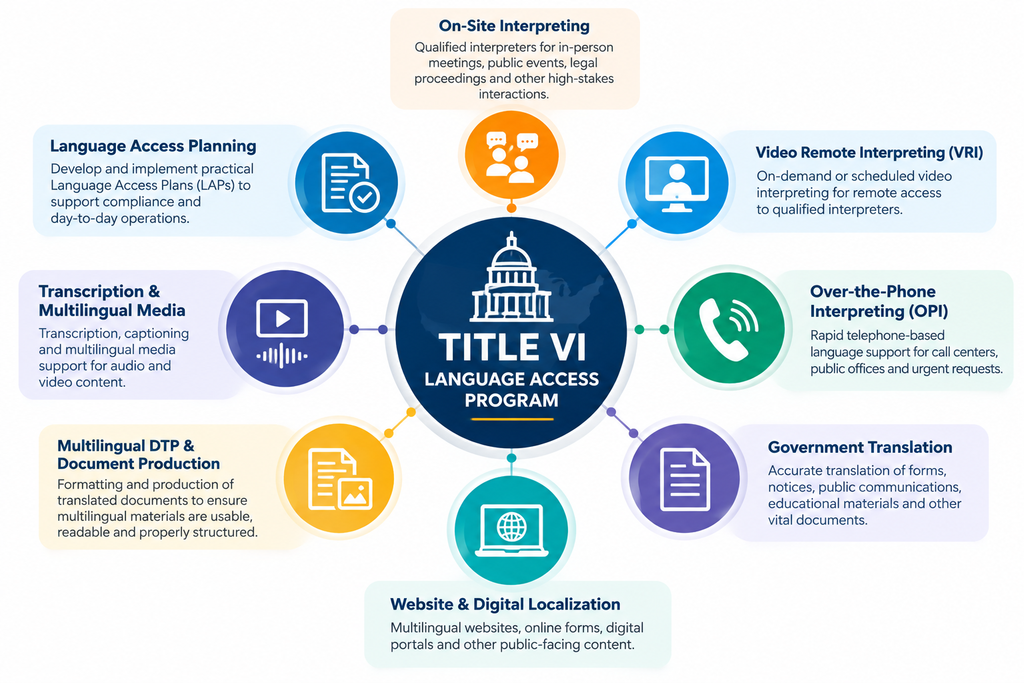
Title VI language access programs often require more than a single translation or interpreting solution. Government agencies may need a coordinated combination of interpreting, translation, digital accessibility, transcription, and language-access planning to support communication across departments and service environments.
On-Site Interpreting
For in-person interactions where accurate, real-time communication is essential, including legal proceedings, school meetings, medical consultations, public meetings, and other high-stakes settings.
Video Remote Interpreting (VRI)
Provides remote visual access to interpreters when an on-site interpreter is not practical or immediate access is needed.
Over-the-Phone Interpreting (OPI)
Provides rapid telephone-based language support for call centers, public offices, urgent requests, and other situations where immediate access is important. The source material groups VRI and OPI as scalable remote interpreting solutions.
Multilingual DTP & Document Production
Formatting and production of translated documents so multilingual materials remain usable, readable and properly structured. This is supported by the source article’s discussion of document formatting and multilingual content, though I would keep this card focused on production rather than make it a generic design service.
Government Translation
For applications, forms, rights notices, public communications, educational materials, and other written content where accuracy and consistency are critical.
Website & Digital Localization
Supports multilingual access to websites, online forms, digital portals, and other public-facing digital content.
Transcription & Multilingual Media
Supports transcription, captioning and subtitling for recorded communications, video content and other multilingual media.
Language Access Planning
Includes Language Access Plans, internal policies, and staff training to help agencies establish consistent language-access practices across departments.
The right combination depends on how an agency serves its communities. A comprehensive Title VI language-access program should align the appropriate language service with the communication setting, urgency, content, audience, and operational requirements.
Accessibility Beyond Spoken Languages
Language access can involve more than communication in spoken languages. Government agencies may also serve individuals who are Deaf or hard of hearing and may require American Sign Language (ASL) or other accessibility support to communicate effectively.
For agencies developing a comprehensive communication-access program, this means considering accessibility needs alongside spoken-language requirements. Depending on the setting, support may include:
- ASL interpreting for meetings, appointments, hearings, public events, and other interactions
- Remote ASL interpreting when an in-person interpreter is not practical
- Captioning and transcription for video, recorded communications, and digital content
- Accessible multilingual content for websites, documents, and public-facing information
Title VI and Broader Accessibility Requirements
It is important to distinguish between Title VI language-access obligations and other accessibility requirements. Title VI addresses discrimination based on national origin and language access for individuals with LEP. Accessibility requirements for individuals who are Deaf or hard of hearing may arise under other federal, state, or program-specific requirements, including the ADA.
For agencies, the practical takeaway is that these requirements should not be treated as interchangeable. Instead, organizations should understand the obligations that apply to their programs and establish appropriate processes for meeting each communication need.
A well-designed language and communication-access program accounts for the full range of populations an agency serves—while maintaining clear distinctions between the legal requirements that apply to each.
Building an Effective Language Access Workflow
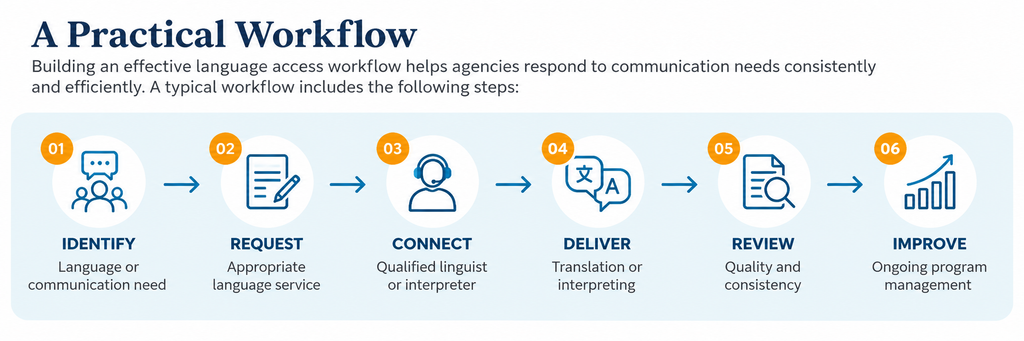
A strong Language Access Plan establishes the framework for language access, but agencies also need reliable processes for delivering language services in day-to-day operations. An effective workflow helps agencies turn Title VI language access compliance requirements into repeatable day-to-day practices.
Common Language Access Mistakes
Even when an agency recognizes the importance of language access, certain operational practices can create unnecessary barriers or reduce the effectiveness of its program. Avoiding these common mistakes can help agencies provide more consistent, reliable support to individuals with limited English proficiency.
Relying on Bilingual Staff Instead of Qualified Interpreters
Employees who speak another language can be valuable to an agency, but conversational bilingual ability does not necessarily mean an employee is qualified to interpret in a professional or high-stakes setting. Relying on staff without appropriate interpreting skills can create communication, accuracy, confidentiality, and consistency concerns.
Better approach: Establish clear procedures for accessing qualified interpreters when professional interpretation is needed.
Using Machine Translation Without Appropriate Review
Machine translation can be useful for certain applications, but relying on automated translation alone for important or sensitive communications can introduce errors in meaning, terminology, context, or tone.
Better approach: Match the translation workflow to the importance and intended use of the content, including human review when accuracy is critical.
Failing to Translate Vital Documents
Providing interpreting when someone visits an agency does not address every language-access need. Important written information may also need to be made accessible in appropriate languages, particularly when individuals need to understand forms, notices, instructions, or other vital information.
Better approach: Identify vital documents and establish a consistent process for determining when and how they should be translated.
Allowing Terminology to Become Inconsistent
When different departments, translators, or vendors use different terminology for the same program, service, or concept, multilingual communications can become confusing and inconsistent.
Better approach: Maintain terminology resources and review processes that help keep recurring translations consistent across departments and projects.
Delaying Access to Interpreters
If staff do not have a straightforward way to obtain interpreting support, individuals may experience unnecessary delays or staff may attempt to improvise another solution. The existing source material specifically identifies delayed interpreter access as a common operational problem.
Better approach: Establish clear procedures for both scheduled and on-demand interpreting so staff know how to obtain appropriate language support when it is needed.
The Larger Lesson
These mistakes have a common underlying problem: language access has not been fully integrated into the agency’s operational workflow.
A well-designed program gives staff clear guidance on when language assistance is needed, which service is appropriate, how to request it, and how quality is maintained. That turns language access from an ad hoc response into a repeatable organizational process.
Choosing a Language Services Partner
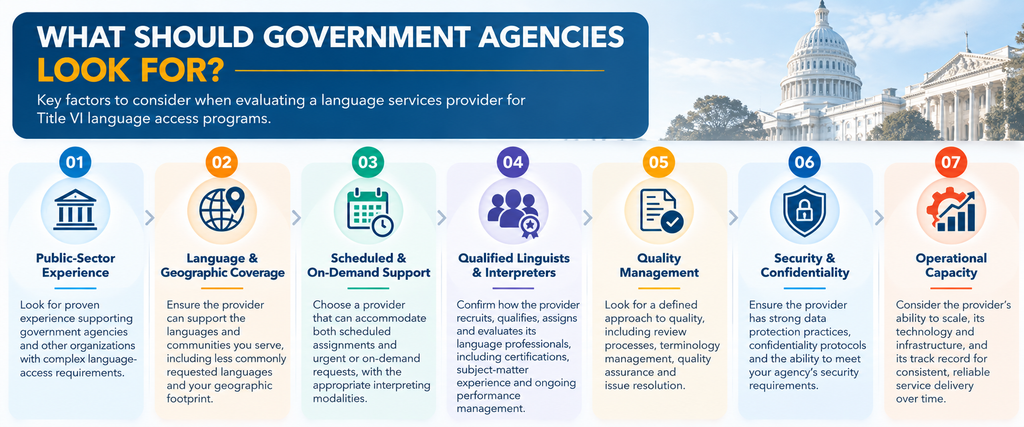
Selecting a language services partner is an important part of building a reliable Title VI language-access program. The right provider should be evaluated not only on price, but on its ability to support the agency’s language requirements, operational workflows, quality expectations, security needs, and service demands over time.
When evaluating a language services provider, consider the following:
1
Public-Sector Experience
Look for experience supporting government agencies and other organizations with complex language-access requirements. A provider should understand the importance of confidentiality, documentation, procurement requirements, accessibility, and consistent service delivery.
2
Language & Geographic Coverage
Evaluate whether the provider can support the languages and communities your agency serves, including less commonly requested languages. Consider both the breadth of language coverage and the provider’s ability to deliver services across your geographic footprint.
3
Scheduled & On-Demand Support
Language needs can arise both in advance and unexpectedly. Your provider should have processes for scheduled assignments as well as urgent or on-demand requests, with appropriate interpreting modalities available for different situations.
4
Qualified Linguists & Interpreters
Ask how the provider recruits, qualifies, assigns, and evaluates its language professionals. Depending on the service, this may include qualifications, certifications, subject-matter experience, background requirements, and ongoing performance management.
5
Quality Management
A provider should have a defined approach to quality rather than relying solely on individual linguists. Ask about review processes, terminology management, quality assurance, issue resolution, and procedures for maintaining consistency across recurring projects and services.
6
Security & Confidentiality
Government language services may involve sensitive personal, legal, healthcare, educational, or administrative information. Evaluate the provider’s security practices, confidentiality procedures, data handling, and controls for protecting information throughout the language-service workflow.
7
Availability & Operational Capacity
A provider may have extensive language coverage but still struggle to fulfill requests when demand increases. Consider its ability to support your agency during normal operations, high-demand periods, urgent situations, and recurring assignments.
A Practical Evaluation Framework
Before selecting a provider, ask:
Can they support our languages?
Can they respond when we need them?
Can they provide qualified professionals?
Can they maintain quality and consistency?
Can they protect sensitive information?
Can they scale as our needs change?
The best language services partner is not necessarily the provider with the lowest quoted rate. It is the provider that can reliably translate your language-access requirements into a sustainable operational program.
Why EPIC Translations
A strong language access program depends on more than access to individual interpreters or translators. Government agencies need a language services partner that can support multiple languages, service modalities, departments, and communication needs through a consistent operational framework.
EPIC Translations supports organizations across the public sector with translation and interpreting services designed for both scheduled and on-demand needs. Our network includes 25,000+ linguists supporting 200+ languages, with experience serving schools, courts, healthcare organizations, municipalities, and other public-sector environments.
Built to Support Government Language Access
EPIC can support a broad range of language-access requirements, including:
- On-site, video and telephone interpreting
- Document and vital-document translation
- ASL and accessibility-related language services
- Website and digital content localization
- Transcription and multilingual media support
- Language Access Plan and program support
The objective is not simply to provide individual language services. EPIC helps organizations establish a more coordinated approach to managing recurring translation and interpreting needs across their operations.
For agencies serving diverse communities, that means having access to the language professionals, service modalities, technology, and operational support needed to make language access more consistent and manageable.
A Partner for Ongoing Language Access
As language needs evolve, agencies may need to add languages, support new departments, introduce additional interpreting modalities, translate new types of content, or manage higher volumes of requests.
EPIC’s language-services model is designed to support that evolution while maintaining a consistent focus on quality, security, responsiveness, and operational accountability.
The result is a language-access program that can support today’s requirements while giving the agency a foundation for managing multilingual communication as its needs change.
Title VI Language Access FAQs
Understanding Title VI language-access requirements can raise practical questions for government agencies, particularly when requirements need to be translated into day-to-day policies and service procedures. The answers below address common questions about LEP, Language Access Plans, interpreting, translation, accessibility, and selecting a language services partner.
These FAQs are intended as a practical starting point for agencies developing, reviewing, or strengthening their language-access programs.
What is Title VI language access?
Title VI of the Civil Rights Act of 1964 prohibits discrimination based on national origin in programs and activities that receive federal financial assistance. For individuals with limited English proficiency (LEP), language access is an important part of providing meaningful access to federally assisted programs and services.
Who needs to provide language access under Title VI?
Organizations that receive federal financial assistance may have Title VI language-access obligations. The specific requirements and appropriate language services can vary based on the organization’s programs, services, populations served, and other applicable requirements.
What is a Language Access Plan?
A Language Access Plan (LAP) is a framework for how an organization provides language assistance to individuals with LEP. A practical LAP can address the languages commonly encountered, interpreter procedures, translation of vital documents, staff training, and emergency or after-hours language support.
Does Title VI require agencies to translate everything?
Not necessarily. Language-access planning should identify the information and documents that are important to the populations an agency serves, including vital documents, and establish an appropriate process for providing them in other languages. The need for translation should be evaluated as part of the agency’s overall language-access program.
Can government agencies use bilingual employees as interpreters?
Bilingual employees may be able to assist in some situations, but conversational fluency does not necessarily mean an employee is qualified to interpret in a professional or high-stakes setting. Agencies should establish procedures for obtaining qualified interpreters when professional interpretation is needed.
What types of interpreting services can support a Title VI language access program?
Depending on the situation, agencies may use on-site interpreting, Video Remote Interpreting (VRI), or Over-the-Phone Interpreting (OPI). The appropriate modality depends on factors such as the setting, urgency, complexity of the communication, and operational requirements.
Should agencies use machine translation for Title VI communications?
Machine translation can be useful for certain applications, but automated translation alone may not be appropriate for important or sensitive communications where accuracy is critical. Agencies should match the translation workflow to the content, intended use, and consequences of an error, including human review when appropriate.
How can an agency make language access more consistent?
A structured workflow can help agencies identify language needs, request the appropriate service, connect with qualified linguists or interpreters, deliver the service, review quality, and manage recurring needs. Integrating these processes into normal operations makes language access less dependent on ad hoc decisions by individual staff members.
How should an agency choose a language services provider?
Agencies should evaluate providers based on factors such as public-sector experience, language and geographic coverage, scheduled and on-demand capabilities, qualified linguists, quality management, security and confidentiality, and operational capacity. Price is only one part of evaluating whether a provider can reliably support an agency’s language-access requirements.
Does language access also include ASL?
Language access under Title VI and accessibility requirements for individuals who are Deaf or hard of hearing are related but distinct considerations. Agencies should understand the specific requirements that apply to their programs and establish appropriate processes for ASL interpreting, captioning, transcription, and other communication-access services where needed.
How can EPIC help with Title VI language access?
EPIC provides translation and interpreting services across public-sector environments, including on-site, video and telephone interpreting, document translation, ASL and accessibility-related services, website and digital localization, transcription, and language-access program support. EPIC’s network includes 25,000+ linguists supporting 200+ languages.
Build a More Effective Language Access Program
Title VI compliance is not just about understanding the requirements. It is about putting the right people, processes, and language services in place to provide consistent, meaningful access across your organization.
EPIC helps government agencies translate Title VI language access compliance requirements into practical translation, interpreting, accessibility, and program-management workflows.
Need help strengthening your language access program? Talk with EPIC about your organization’s languages, services, workflows, and communication requirements.