Mobile App Localization Services
Make Your App Ready for Every Language—and Every User
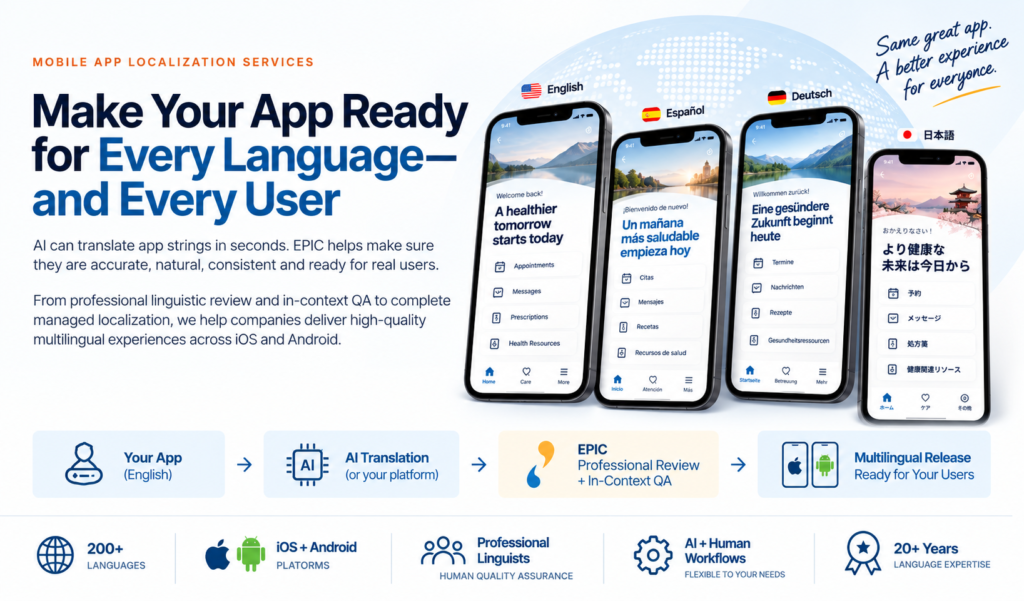
EPIC’s mobile app localization services help companies deliver accurate, natural and consistent multilingual experiences across iOS and Android—even when AI handles the first translation.
From professional linguistic review and in-context QA to complete managed localization, we help companies deliver high-quality multilingual experiences across iOS and Android.
Translating an App Has Never Been Easier. Getting Localization Right Still Matters.
Modern AI and development tools can generate translations quickly. But generating translated strings isn’t the same as delivering a localized product your customers can confidently use.
A translation can be technically correct and still be wrong in context, inconsistent with your terminology, awkward for the user, too long for the interface or inappropriate for the intended audience.
EPIC provides the professional language and quality layer between translation and release.
Accuracy in Context
Review language within the actual product experience—not just isolated strings.
Terminology Consistency
Keep product names, features, commands and industry terminology consistent across your app.
Multilingual UX
Identify language-related issues that affect clarity, navigation and the user experience.
Release Confidence
Add professional linguistic review and QA before localized content reaches your users.
Already Using AI to Localize Your App?
Keep using it. We’ll help make the output production-ready.
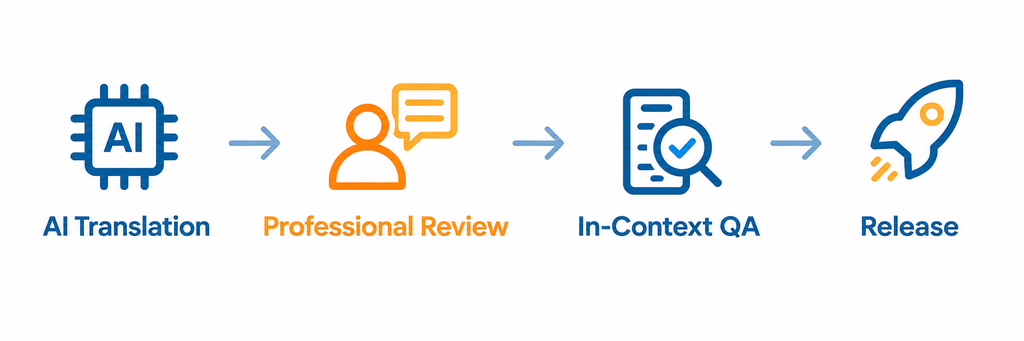
Whether your translations come from AI, your development environment, a localization platform or an existing internal workflow, EPIC can add professional human review without requiring you to start over.
Native-language professionals review localized content for meaning, terminology, tone, consistency and context—then help identify issues before they reach your customers.
THREE WAYS TO WORK WITH EPIC
1. Professional Localization QA
Your app is already translated. We validate it.
EPIC reviews existing localized content for linguistic accuracy, terminology, consistency, tone and contextual issues before release.
Ideal for: AI-translated apps, internally translated apps and companies seeking independent language QA.
2. AI + Human Localization
Combine automation with professional oversight.
Use AI where it creates efficiency while professional linguists review and refine customer-facing content for accuracy, context and natural language.
Ideal for: High-volume applications, multiple languages and frequent releases.
3. Managed App Localization
Let EPIC manage the multilingual workflow.
From initial localization and terminology setup through linguistic QA and ongoing releases, EPIC becomes an extension of your product team.
Ideal for: Organizations expanding into multiple languages or managing localization at scale.
WHAT WE LOCALIZE
More Than Buttons and Menus
Your users experience your entire product—not a translation file. EPIC can localize and review language across the mobile customer journey.
UI & Navigation
Menus, buttons, labels, settings, navigation and user-facing interface strings.
Onboarding & Instructions
Registration, tutorials, walkthroughs, help content and user guidance.
Alerts & Notifications
Push notifications, error messages, validation messages, confirmations and transactional content.
Dynamic Content
Variables, placeholders, plural forms and other language-dependent content.
App Store & Google Play Content
Descriptions, release notes and other localized store content.
Multimedia & Visual Assets
Text embedded in images, graphics, subtitles, audio and other customer-facing media.
Localization That Fits the Way Your Team Works
You shouldn’t have to copy thousands of app strings into spreadsheets just to work with a language partner.
EPIC can work with common localization resources and structured file formats used by modern iOS, Android and cross-platform development workflows.
ACommon Localization Formats We Support
XLIFF | .xcstrings | .strings | Android XML | JSON | ARB | YAML | CSV
Already have a localization workflow?
We can work within it.
Starting from scratch?
We’ll help establish a practical handoff process for your translatable content, terminology, context and future updates.
Your developers keep control of the application. EPIC manages the multilingual language workflow.
Correct Translation Doesn’t Always Mean a Correct User Experience
Text Expansion

English interface text can become substantially longer in other languages, creating truncation or layout problems.
Missing Context

Words such as “Home,” “Save,” “Order” or “Back” can require completely different translations depending on their function.
Plurals & Grammar

Languages follow different grammatical and pluralization rules. Dynamic content needs to behave naturally for each language.
Variables & Placeholders

User names, quantities, dates and other dynamic elements must remain functional while producing grammatically correct sentences.
Locale Conventions

Dates, times, numbers, currencies and other information may need to adapt to the user’s locale.
Right-to-Left Languages

Languages such as Arabic can introduce interface and layout considerations extending well beyond translated text.
Review the Translation Where It Actually Lives
A string can look perfect in a translation file and fail once it appears inside the app.
When the project requires it, EPIC can review localized content in context to identify issues such as:
Truncated text • Awkward line breaks • Incorrect terminology • Untranslated content • Context errors • Inconsistent language • UI-related linguistic issues
The result is localization evaluated as part of the user experience, not simply as translated text.
Your App Doesn’t Stop Changing. Neither Should Your Localization.
New features. New strings. Updated onboarding. Revised notifications. Product terminology changes.
You shouldn’t have to rebuild your localization process every time your app changes.
EPIC can maintain terminology, translation memory and approved language assets across releases so existing content can be reused and new or modified content moves efficiently through localization and review.
Some Apps Need More Than “Good Enough”
For applications used in healthcare, education, financial services, government, workforce management and other high-consequence environments, inaccurate or unclear language can create more than a poor customer experience.
EPIC brings more than 20 years of language-services experience to these environments, with professional linguists, terminology controls and quality-assurance workflows tailored to the content and audience.
Healthcare
Patient-facing applications, portals and health information.
Education & EdTech
Applications used by students, families, educators and multilingual communities.
Financial Services
Customer-facing financial applications and digital experiences.
Government
Public-facing applications and digital services serving multilingual communities.
Enterprise & SaaS
Complex products requiring consistent terminology across languages and releases.
Workforce & HR
Employee applications used across multilingual and distributed workforces.
Trusted in Complex, High-Accountability Environments
State of Wisconsin · State of Michigan · Virginia Department of Transportation · University of Michigan
EPIC supports public agencies, educational institutions and organizations where accuracy, accessibility and dependable language services matter.
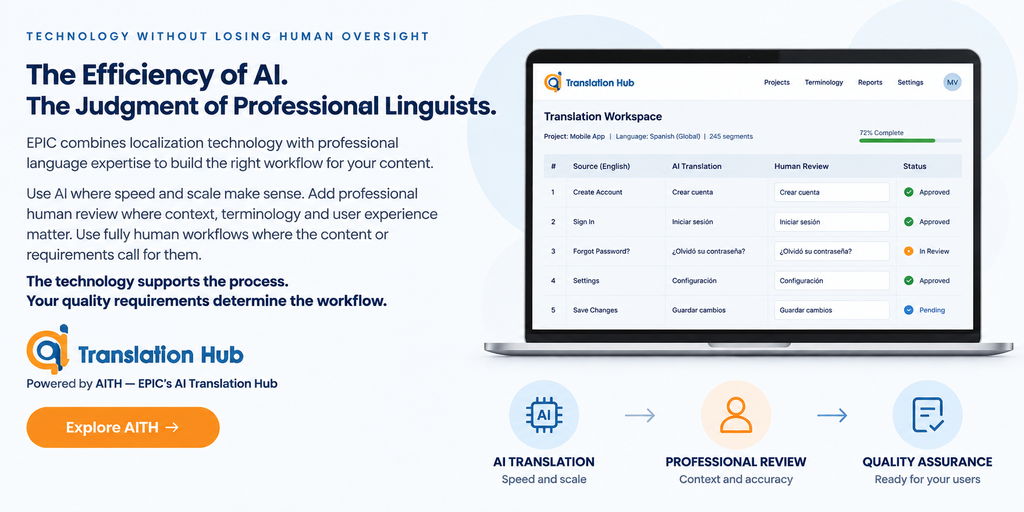
The Efficiency of AI. The Judgment of Professional Linguists.
EPIC combines localization technology with professional language expertise to build the right workflow for your content.
Use AI where speed and scale make sense. Add professional human review where context, terminology and user experience matter. Use fully human workflows where the content or requirements call for them.
The technology supports the process. Your quality requirements determine the workflow.
One Language Partner Across Your Product Experience
Your app doesn’t exist in isolation. EPIC can help maintain consistent language and terminology wherever customers interact with your organization.
Mobile App Localization →
One terminology strategy. One localization partner. A consistent multilingual experience.
Frequently Asked Questions About Mobile App Localization
What is mobile app localization?
Mobile app localization adapts an application for users in different languages and locales. It can include interface text, onboarding, notifications, help content, multimedia, store listings and locale-sensitive elements, along with linguistic and in-context quality assurance.
Can EPIC review an app we’ve already translated with AI?
Yes. You don’t need to discard existing translations to work with EPIC. We can professionally review AI-generated or previously translated content for accuracy, terminology, tone, consistency and contextual issues.
Can EPIC localize both iOS and Android apps?
Yes. EPIC supports localization workflows for iOS and Android applications as well as common cross-platform localization resources.
Do you need access to our source code?
Not necessarily. Many localization workflows allow development teams to provide the required localization resources without sharing the application’s complete source code.
Can you work with our existing localization platform or process?
Yes. If you already have an established localization workflow, EPIC can work within it rather than requiring you to replace it.
Can EPIC support app updates after the initial localization?
Yes. EPIC can establish an ongoing localization workflow for new and modified strings so supported languages remain aligned with future releases.
Do you use AI for mobile app localization?
When appropriate. EPIC can support AI-assisted, hybrid and fully human workflows. The appropriate approach depends on the content, risk, quality requirements, languages and release schedule.
How do you quality-check a localized app?
Depending on scope, QA can include professional linguistic review, terminology verification and in-context review for issues such as mistranslations, truncation, untranslated content, inconsistent terminology and other language-related user-experience problems.