Transcription Services
PROFESSIONAL TRANSCRIPTION
EPIC transforms recorded audio and video into accurate, professionally reviewed text for research, legal, government, education, business and other specialized needs.
Audio & Video | Research | Legal | Government | Education | Business
Accurate Transcription Requires More Than Speech-to-Text
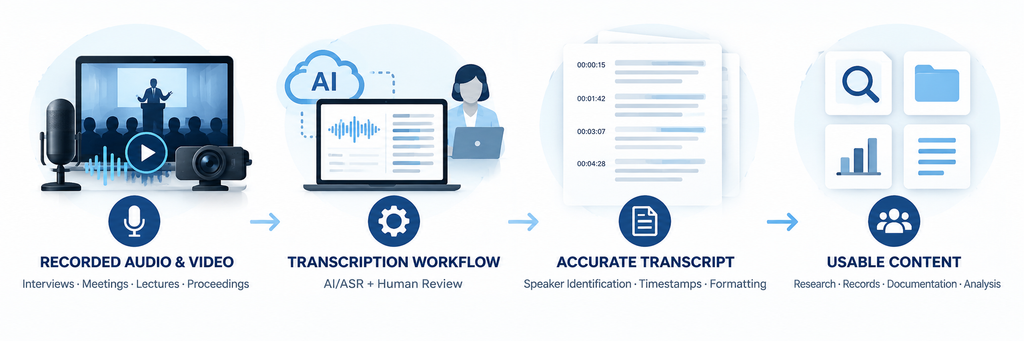
Turning recorded audio or video into useful text requires more than generating words from a recording. Professional transcription may require accurate speaker identification, timestamps, terminology, formatting and human review to produce a transcript that meets the needs of the organization using it.
Human Review & Quality Control
AI-assisted transcription can accelerate the initial conversion of speech to text, while human review helps identify errors, clarify context and improve the accuracy of the final transcript.
Speaker Identification
For interviews, meetings, focus groups and other multi-speaker recordings, clear speaker identification helps readers understand who said what and makes the transcript easier to use.
Timestamps & Synchronization
Timestamps can help users locate specific portions of a recording quickly and, when required, align transcript content with the corresponding audio or video.
Specialized Formatting
Transcripts may require specific formatting, terminology, structure or documentation standards depending on the purpose and setting of the assignment.
Transcription Across Programs, Organizations & Content Types
EPIC provides transcription for recorded audio and video across a range of professional, educational, government and research environments. Workflows can be tailored to the content, speakers, terminology, formatting requirements and intended use of the transcript.
Government & Public Sector
Transcribe meetings, interviews, hearings, public programs, trainings and other recorded government communications.
Higher Education & Research
Support research interviews, focus groups, lectures, academic discussions and other recorded content used for research, instruction or documentation.
Legal & Administrative
Transcribe appropriate proceedings, interviews, meetings, statements and other recorded material where accurate documentation is required.
Healthcare & Community Services
Support transcription of appropriate meetings, interviews, educational sessions and other recorded communications, subject to the requirements of the assignment.
Business & Professional
Transcribe meetings, interviews, presentations, training sessions, discussions and other business recordings.
Media, Events & Presentations
Convert recorded conferences, panels, webinars, presentations and other event content into searchable, usable text.
Connecting Transcription With Translation, Captioning & Language Services
Transcription is often the first step in a broader content workflow. EPIC can coordinate transcription with translation and other language services when recorded content needs to be converted, translated, reviewed or prepared for another use.
Transcription & Translation
Transcribe recorded audio or video first when an accurate source transcript is needed before translating the content into another language.
Transcription & Captioning
A transcript can serve as the source for captions when recorded video needs accessible, time-aligned text.
Transcription & CART
Transcription and CART serve different purposes. Transcription works from recorded content, while CART provides real-time text during live communication. Understanding the distinction helps organizations select the appropriate service.
Transcription & Multilingual Content
Recorded interviews, research materials, presentations and other content may require transcription followed by translation, localization or multilingual production.
Transcription & AI-Assisted Workflows
AI/ASR can support the initial conversion of speech to text, with human review incorporated when accuracy, terminology, speaker identification or formatting requirements call for it.
Transcription & Specialized Workflows
Projects may require diarization, timestamps, synchronized audio-text, verbatim or edited transcripts, specialized formatting or other assignment-specific requirements.
One Language Program. Three Purpose-Built Platforms.
LANGUAGE & CONTENT OPERATIONS
Transcription projects can be part of a broader content workflow involving translation, review, interpreting or multilingual production. EPIC’s technology ecosystem provides purpose-built platforms for managing different aspects of language and content operations.
EPS
Enterprise Project System
Manage translation projects, documents, workflows and delivery through EPIC’s translation management environment.
Best for: Translation project intake, document workflows and project management.
AITH
AI Translation Hub
Support appropriate AI-assisted translation workflows with human review when quality, terminology and context require professional oversight.
Best for: High-volume translation and workflows that combine AI-assisted processing with human review.
SRH
Staffing Resources Hub
Coordinate OPI, VRI, ASL and on-site interpreting through a centralized platform for requests, scheduling, interpreter matching, credentials and reporting.
Best for: Interpreting and communication-service coordination.
Together, EPS, AITH and SRH provide EPIC with a connected technology foundation for managing translation, interpreting and multilingual language-service operations.
Built for the Operational Demands of Transcription
TRANSCRIPTION OPERATIONS
Transcription projects can vary significantly in length, complexity, number of speakers, terminology and formatting requirements. EPIC structures each workflow around the characteristics of the recording and the intended use of the final transcript.
Handle Different Recording Types
Support interviews, meetings, lectures, focus groups, presentations, webinars and other recorded audio or video content.
Manage Multiple Speakers
Incorporate speaker identification and diarization when recordings involve multiple participants and clear attribution is important.
Apply Project-Specific Requirements
Workflows can account for terminology, formatting, timestamps, verbatim requirements and other specifications established for the assignment.
Support AI-Assisted Workflows
Where appropriate, AI/ASR can accelerate initial transcription, with human review used to improve accuracy and address context, terminology and formatting requirements.
Support Complex or Specialized Content
EPIC can structure transcription workflows around specialized subject matter, recording quality, technical terminology and intended use.
Deliver Usable Transcripts
Produce transcripts in formats and structures suited to the organization’s downstream needs, whether for research, documentation, analysis, records or further language services.
THE SCALE BEHIND EPIC’S LANGUAGE SERVICES

Since 2005
20+ years of continuous language-service operations

200+ Languages
Language support for diverse communities and programs

25,000+ Linguists
Global network of language professionals

Technology-Supported
Technology-enabled language and content workflows
Quality, Security & Accountability for Transcription Services
QUALITY, SECURITY & TRANSCRIPTION WORKFLOWS
Transcription projects may involve sensitive recordings, multiple speakers, specialized terminology and detailed formatting requirements. EPIC structures transcription workflows around the content, intended use and requirements of each assignment.
Human Review & Quality Control
Where AI/ASR is used to support the initial transcription, human review can help identify errors, clarify context, verify terminology and improve the accuracy of the final transcript.
Speaker Identification & Diarization
For recordings with multiple speakers, workflows can incorporate speaker identification or diarization to help distinguish and attribute individual contributions.
Terminology & Context
Specialized recordings may contain industry-specific terminology, names, acronyms or other language that requires attention during review. EPIC can incorporate project-specific terminology and reference materials where provided.
Formatting & Timestamps
Transcripts can be structured according to assignment requirements, including timestamps, speaker labels, formatting specifications and other requested conventions.
Security & Confidentiality
Recorded content may contain confidential business information, research data, legal information, government communications or other sensitive material. EPIC’s language-service workflows incorporate appropriate security and confidentiality practices.
Accountability & Documentation
Structured workflows help organizations maintain visibility into project requirements, processing, review and delivery, particularly for recurring or specialized transcription programs.
Transcription Services for Audio & Video Content
EPIC provides transcription for recorded audio and video across professional, educational, government, research and other specialized environments. Transcription workflows can be tailored to the recording, speakers, terminology, formatting requirements and intended use of the final transcript.
Interviews & Research
Transcribe research interviews, qualitative studies, focus groups and other recorded conversations for analysis, documentation and research workflows.
Meetings & Discussions
Convert recorded meetings, discussions and organizational conversations into searchable, usable text.
Lectures & Educational Content
Transcribe lectures, seminars, presentations and other recorded instructional content for documentation, research or downstream use.
Government & Public Programs
Transcribe recorded meetings, hearings, trainings, interviews and other government or public-sector communications.
Legal & Administrative Recordings
Support transcription of appropriate interviews, proceedings, statements, meetings and other recorded administrative content.
Conferences, Webinars & Presentations
Convert recorded conferences, webinars, panels, presentations and similar content into organized, usable transcripts.
A Practical Partner for Transcription Services
TRANSCRIPTION WORKFLOW
Effective transcription starts with understanding how the recording will be used. EPIC can structure the workflow around the source material, speakers, terminology, formatting requirements, turnaround needs and any downstream translation or content requirements.
Transcription Services FAQs
Have questions about transcription, AI-assisted workflows, human review, formatting or how EPIC handles different types of recorded content? Here are answers to common questions about EPIC’s transcription services.
What types of audio and video can EPIC transcribe?
EPIC can support transcription of interviews, meetings, lectures, focus groups, presentations, webinars, research recordings, government communications and other recorded audio or video.
Is every transcription reviewed by a human?
Not necessarily. The appropriate workflow depends on the project requirements, intended use, content and quality expectations. Where human review is required or appropriate, EPIC can incorporate professional review into the workflow.
Can you identify different speakers?
Yes. Transcription workflows can incorporate speaker identification or diarization for recordings involving multiple speakers, helping distinguish and attribute individual contributions.
Can transcripts include timestamps?
Yes. Timestamps can be incorporated when required, helping users locate specific portions of the recording and, where applicable, align transcript content with the corresponding audio or video.
What is the difference between verbatim and edited transcription?
A verbatim transcript captures the spoken content more literally, including elements such as repetitions or verbal fillers when required. An edited transcript may remove certain speech patterns while preserving the meaning and substance of the communication. The appropriate format can be established based on the intended use.
Can EPIC handle specialized terminology?
Yes. Projects can incorporate terminology, reference materials, glossaries and other information provided by the client to help support consistent treatment of specialized names, terms, acronyms and subject matter.
Can transcription be combined with translation?
Yes. A recorded file can be transcribed first to establish a source transcript and then translated into another language when that workflow is appropriate. This can be useful for multilingual research, interviews, presentations and other recorded content.
What formats can transcripts be delivered in?
Delivery format depends on the requirements of the assignment. EPIC can structure transcripts according to requested formatting, speaker-labeling, timestamp and documentation requirements.
How do I request transcription services?
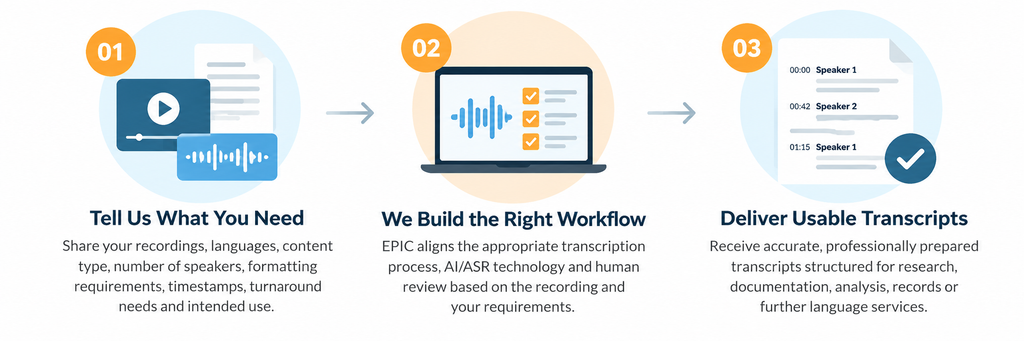
Provide the recording or relevant project information along with the languages, content type, number of speakers, formatting requirements, timestamps, turnaround needs and intended use. EPIC can then determine an appropriate transcription workflow.