Website Localization Services
Make Your Website Work Across Languages, Markets and Audiences
Translating the words on a website is only the beginning. Effective website localization adapts digital content for the language, terminology, user experience and expectations of the people you need to reach.
EPIC helps government agencies, educational institutions, healthcare organizations and businesses localize websites for multilingual audiences—combining professional linguists, structured translation workflows and multilingual quality assurance.
From individual webpages to large multilingual websites and ongoing content updates, EPIC provides a scalable approach to website localization across 200+ languages.
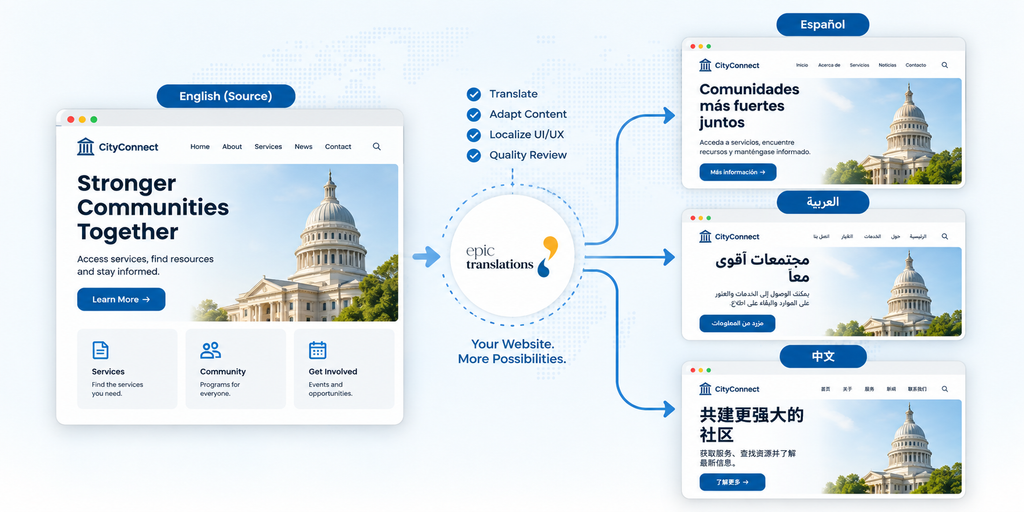
What Website Localization Means at EPIC
Website localization goes beyond translating webpage copy. EPIC adapts website content for multilingual audiences while accounting for terminology, navigation, interface text, calls to action, formatting, language-specific requirements and the context in which content appears.
Depending on the project, localization may include public-facing webpages, landing pages, forms, menus, buttons, resource libraries, downloadable content, metadata and other translatable website elements.
The objective is not simply to create translated text. It is to help organizations deliver a multilingual website experience that is clear, consistent and appropriate for the intended audience.

Since 2005
20+ years of continuous operation

200+ Languages
Language support for global audiences

25,000+
Qualified linguists

Nationwide
Coverage across the United States
More Than Website Translation
Professional Linguistic Localization
Qualified linguists adapt website content for meaning, terminology, tone, context and the intended audience—not simply word-for-word translation.
Multilingual Website Consistency
Navigation, calls to action, recurring terminology and related content can be managed consistently across webpages and language versions.
Structured Quality Review
Localized content is reviewed for linguistic quality, consistency, completeness and appropriate presentation before delivery.
Website Localization for Organizations With Complex Content
Government & public Agencies
Public information, program pages, service information, forms and digital resources for multilingual communities.
Education
District, university, admissions, program and resource content for multilingual students and families.
Healthcare & Benefits
Patient information, benefits content, service pages, instructions and other digital communications.
Corporate & Global Organizations
Company, product, service, support and marketing websites for customers, employees and global audiences.
From Source Website to Localized Experience
1. Identify Content
Review website scope, target languages, content and project requirements.
2. Translate & Adapt
Qualified linguists localize content for language, context, terminology and audience.
3. Linguistic QA
Review localized content for accuracy, consistency, completeness and language-specific issues.
4. Prepare for Implementation
Deliver approved localized content in the agreed format for website implementation.
What Can Be Localized?
Website localization can extend across the entire digital experience—not only the paragraphs visitors read.
Webpages & Landing Pages
Service pages, program pages, informational content and campaign landing pages.
Navigation & Interface Content
Menus, buttons, labels, calls to action and other user-facing interface text.
Forms & User Instructions
Form labels, instructions, supporting text and related user communications.
Graphics & Embedded Text
Text contained within banners, graphics and other visual website elements.
Downloadable Resources
PDFs, brochures, guides, forms and other resources linked from the website.
Metadata & Search Content
Page titles, descriptions and other agreed translatable metadata.
Localization Designed for Ongoing Website Content
Websites are not static. New pages are published, programs change, services are updated and organizations continually add new content.
EPIC can support both initial website localization projects and ongoing multilingual content updates, helping organizations maintain consistency as their websites evolve.
Initial Website Localization
Localize an existing website or defined group of webpages into one or multiple target languages.
New Content & Updates
Submit new or revised website content for localization as pages, programs and information change.
Terminology Continuity
Maintain approved terminology and language conventions across recurring website localization projects.
When to Choose Website Localization
Website localization is appropriate when:
- Your organization serves audiences who use multiple languages.
- Your website contains important public, customer, student, patient or constituent information.
- Translated website content needs to remain consistent across many pages.
- You are launching website content for new languages or markets.
- Your organization regularly publishes website updates that require translation.
- Navigation, forms, calls to action, graphics or other website elements also require multilingual adaptation.
- You need more than raw machine translation for public-facing digital content.
If you only need a standalone document translated, EPIC’s document translation services may be more appropriate. If the content is part of a broader website experience, website localization provides a more comprehensive approach.
Website Localization Within a Managed Translation Workflow
EPS — Translation Project Management
EPIC Project System (EPS) provides a centralized environment for managing translation projects, files, status and deliverables.
Translation Production
Website content can follow the translation production approach appropriate to the project, including 100% Human Translation or Human-Reviewed AI Translation.
Multilingual Production
When localized website resources include formatted documents, graphics or other production requirements, EPIC can coordinate related multilingual production services within the broader project.
Why Organizations Choose EPIC for Website Localization
Qualified Linguists
Website content is handled by professional linguists according to language, subject matter, audience and project requirements.
200+ Languages
Support multilingual website initiatives across widely used languages as well as less commonly requested language needs.
Terminology Consistency
Approved terminology and organizational language can be maintained across pages, files, updates and language versions.
Structured Quality Assurance
Localized content is reviewed for linguistic quality, completeness, consistency and project-specific requirements.
Ongoing Support
EPIC can support both initial localization projects and recurring website content as your multilingual presence evolves.
Frequently Asked Questions About Website Localization Services
Find answers to common questions about website translation, localization workflows, multilingual content, languages, file formats and ongoing website updates.
What is website localization?
Website localization is the process of adapting website content for a particular language or audience. It can include translation as well as terminology, navigation, interface text, calls to action, metadata, graphics and other language-specific content requirements.
What is the difference between website translation and website localization?
Website translation focuses primarily on converting written content from one language into another. Website localization takes a broader approach by considering how translated content functions within the website experience, including terminology, navigation, interface elements, formatting and audience context.
What parts of a website can EPIC localize?
EPIC can localize webpages, landing pages, navigation text, buttons, calls to action, forms, instructions, graphics containing text, downloadable resources, metadata and other agreed website content.
How many languages does EPIC support?
EPIC supports translation and localization across 200+ languages, allowing organizations to manage multilingual website initiatives through one language-services partner.
Can EPIC localize an entire website?
Yes. Projects can range from individual webpages or defined sections to large multilingual website initiatives. Scope, languages, content volume, technical requirements and delivery approach are evaluated for each project.
Can EPIC handle ongoing website updates?
Yes. EPIC can support recurring localization as organizations add or revise website content, helping maintain terminology and linguistic consistency across updates.
Does EPIC work directly in our CMS?
The appropriate workflow depends on the client’s website environment and project requirements. EPIC can review the available content format, CMS workflow and implementation requirements to determine the appropriate localization process.
Can EPIC localize website graphics and downloadable documents?
Yes. Website localization projects can include translatable text within graphics as well as downloadable materials such as PDFs, forms, brochures and guides. Additional multilingual desktop publishing may be appropriate for formatted documents.
Does EPIC use AI for website localization?
EPIC offers different translation production approaches depending on project requirements, including 100% Human Translation and Human-Reviewed AI Translation. The appropriate workflow can be selected according to content, organizational requirements, risk considerations and client preferences.
How do we get started?
Send EPIC your website URL, target languages and the content or sections you want localized. Our team can review the scope and recommend an appropriate localization workflow and project approach.